
BuddhistCatholicContemplativeEvangelicalGeneral ChristianHinduJewishLatter-day SaintMuslimNew VisionsProgressive Christian
Beliefs
- Buddhist
- Catholic
- Contemplative
- Evangelical
- General Christian
- Hindu
- Jewish
- Latter-day Saint
- More Voices
- Muslim
- New Visions
- Pagan
- Progressive Christian
Topics
- Religion News
- Food and Religion
- Sports and Religion
- Religious Art
- Religious Music and Entertainment
- Religious Events
- History and Religion
- Style and Religion
- Politics and Religion
- Women in Religion
- Recreation Outdoors and Religion
- Business Finance and Religion
- Careers Workplace and Religion
- Education and Religion
- Family Parenting and Religion
- Health Fitness and Religion
- Home and Religion
- Relationships and Religion
- Technology and Religion
- Travel and Religion
Columnists
- Buddhist Columnists
- Business Finance and Religion Columnists
- Careers Workplace and Religion Columnists
- Catholic Columnists
- Contemplative Columnists
- Education and Religion Columnists
- Evangelists Columnists
- Family Parenting and Religion Columnists
- General Christian Columnists
- Health Fitness and Religion Columnists
- Hindu Columnists
- History and Religion Columnists
- Home and Religion Columnists
- Jewish Columnists
- More Voices Columnists
- Latter Day Columnists
- Muslim Columnists
- New Visions Columnists
- Nonreligious Columnists
- Pagan Columnists
- Politics and Religion Columnists
- Progressive Columnists
- Recreation Outdoors and Religion Columnists
- Relationships and Religion Columnists
- Religion News Columnists
- Religious Art Columnists
- Religious Events Columnists
- Religious Music and Entertainment Columnists
- Sports and Religion Columnists
- Style and Religion Columnists
- Technology and Religion Columnists
- Travel and Religion Columnists
- Women in Religion Columnists
Resource Library
- 2026 Calendar
- Library of World Religions
- The 100 Most Holy Places on Earth
- Patheos Answers
- Podcasts
- Videos
- Faith Leaders Database
- Anglican Episcopalian
- Bahai
- Baptist
- Buddhism
- Christianity
- Confucianism
- Eastern Orthodoxy
- Hinduism
- Holiness and Pentecostal
- ISKCON
- Islam
- Judaism
- Lutheran
- Methodist
- The Church of Jesus Christ of Latter-day Saints
- New Age
- Paganism
- Presbytarian and Reformed
- Protestantism
- Religion Behind the Scenes
- Roman Catholic
- Scientology
- Shia Islam
- Sikhism
- Sufism
- Sunni Islam
- Taoism
- Zen
- See all religions
Research Tools
 Ad-Free & Subscriber Log-In Subscription Support
Ad-Free & Subscriber Log-In Subscription Support
Follow Patheos 

- Trending:
- Forgiveness
- |
- Marriage
- |
- Consciousness
- |
- Death Penalty
- |
- Election
- |
- Halloween

- Home
- Progressive Christian
- The various endings of the Gospel of Mark (part 2)
The various endings of the Gospel of Mark (part 2)
Last updated on: October 14, 2015 at 6:24 pm by Fred Clark
The various endings of the Gospel of Mark (part 2) 2015-10-14T18:24:25-04:00 Fred Clark
Patheos Explore the world's faith through different perspectives on religion and spirituality! Patheos has the views of the prevalent religions and spiritualities of the world.
The Bibles we read are the product of countless acts of transcription and translation. This was human labor and, like everything we humans do, it involved plenty of missteps and mistakes.
You may have heard of some of the more famous, or infamous, examples of that, such as the so-called “Wicked Bible” of 1631, which accidentally omitted a key word in the seventh of Moses’ ten commandments, so that Exodus 20:14 wound up reading “Thou shalt commit adultery.” That reversal of the verse’s meaning was a simple, obvious, and easily corrected mistake — unlike the deliberate mistranslation that completely reverses the meaning of a passage in the following chapter of Exodus because of partisan American politics.
Wikipedia offers a long and amusing list of “Biblical errata” — misprints, mistranslations, scribal errors, typos and printing errors that resulted in all sorts of bungled Bibles. There’s the “Blasphemous comma” — a missing comma in several King James editions that puts Jesus on a cross between “two other malefactors” instead of between “two others, malefactors.” And the 1718 edition of the KJV that renders the “sin no more” of Jeremiah 31:34 as “sin on more.” And the earlier 1562 Geneva Bible that garbled a Beatitude into “Blessed are the placemakers.”
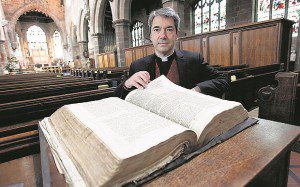
The Rev. Jason Bray recently found this first-edition of the 1611 King James Bible in a cupboard at St. Giles Church, Wexham. (Click pic for link to article.)
Our friends who insist that the Bible is “inerrant” are aware of things like this, and they try to account for it in two ways. First, they clarify that this claim of “biblical inerrancy” doesn’t apply to every copy or edition ever printed, but “only to the autographic text of Scripture” (that’s from the “Chicago Statement on Biblical Inerrancy,” which established this ancient inerrantist tradition in CE 1978).
By the “autographic text” they mean the original documents on which the original texts were first written. That makes sense. This is, after all, how we go about validating the legitimacy of most texts or quotations. We want to know what was originally said. We consider the original thing authentic and legitimate and any variation from it to be inauthentic and illegitimate.
“Because I could not stop for Death — / He kindly stopped for me.” That’s Emily Dickinson. If a printer’s error misrenders that “Because I could stop for Death …” then we would say it’s no longer really Emily Dickinson, but something else. Likewise, our inerrantist friends say, reasonably, the commandment to commit adultery in the misprinted “Wicked Bible” isn’t really the Bible, but something else. The real Bible is the original that preceded any such errors of transcription and translation.
The tricky bit here, though, is that the books of the Bible are far, far older than Emily Dickinson’s poems and so we don’t actually have any of the original manuscripts. Our earliest biblical manuscripts come from long after most of the “autographic texts” were written. Those originals are long lost and what we have is a copy of a copy of a copy, and a translation of a translation of a translation.
It seems a bit slippery, then, to put so much emphasis on the perfection and inerrancy of original “autographic texts” that no living person has ever seen and that none of us is able to consult.
Our inerrantist friends recognize this, too, which is why they assert this emphatic denial*:
We deny that any essential element of the Christian faith is affected by the absence of the autographs. We further deny that this absence renders the assertion of Biblical inerrancy invalid or irrelevant.
It’s perfectly fine that these inerrant original “autographs” no longer exist, they say, because of the second part of their accounting for the problem of transcription and translation errors. The claim of perfection and inerrancy, they say, “applies only to the autographic text of Scripture, which in the providence of God can be ascertained from available manuscripts with great accuracy.”
The heavy lifting there is done by the subtle enormity of this appeal to “the providence of God.” Nevermind all the many examples of scribal errors, transcription mistakes, mistranslations in or out of Hebrew, Greek, Latin, German or English. God has been intervening, providentially ensuring that our copies of copies of copies and our translations of translations of translations still allow us access to the original perfection of those long-lost inerrant autographs.
This is the logic that gives us the kooky American phenomenon of “KJV-only” fundamentalism. If you’re reading this somewhere in America, then somewhere not far from where you’re sitting there’s a small nondenominational church of “Bible-believing” fundamentalist white Christians who believe that the King James Version (1611 authorized edition) is the only true and legitimate Word of God. They think the much-larger white evangelical church on the other side of town is full of heresy and apostasy because those heathens over there read from the NIV. (The New International Version and all other such more contemporary translations might as well be the Book of Mormon as far as the KJV-only folks are concerned.)
KJV-only folks aren’t really all that different from the rest of the “biblical inerrancy” crowd — they just follow the logic of the idea a bit farther down the road. And they don’t realize they’re not supposed to say the quiet parts loud. They take the logic of the active “providence of God” in preserving the Bible’s purported inerrancy as the centerpiece of their faith. They believe God acts and intervenes to ensure that the English-language Bibles in their pews and in their hands have been shielded from human frailty and from the wiles of the devil and his servants.
Thus, they believe, God has ensured that we have precisely the form of the Bible that we have. And in doing so God has intervened to protect us from being led astray by any other possible form of the Bible.
Which brings us back to the Gospel of Mark and its many various endings. The King James Version doesn’t include all of those endings, nor does it even acknowledge their existence. It includes the longer ending of Mark — continuing past verse 8, where our oldest and most-reliable manuscripts stop, to include what it offers as verses 9 through 20, an interpolation composed and appended many years after the original “autograph” was first written.
What’s perversely fun here is how this idea of divine providence and divine protection relates to the possibility of an original, “lost” ending to Mark’s Gospel.** If, indeed, the original ending of Mark was lost and much later replaced with the addendum we have in verses 9-20 of the King James Version, and if, indeed, this version is the product of God’s providence and protection, then we must conclude that the original ending originally written by the evangelist Mark must have been something God needed to get rid of — something that God had to step in to protect us from reading.
What horrors or heresies or errors do you suppose Mark might have originally written? It must have been something spectacularly awful to require Almighty God to providentially intervene to prevent us from being led astray by it.
As I said in part 1, this is where “biblical inerrancy” overlaps with Da Vinci Code conspiracy theories. The possibility of a “lost” ending to Mark’s Gospel has long led to fevered speculation that it might actually be a suppressed ending — that Mark continued on after what we have as verse 8 to write something They didn’t want us to read. (Who are “They”? Take your pick — the Knights Templar, the Illuminati, the Jesus Seminar …)
This makes for a fun exercise in storytelling, or in joke-writing. If the lost ending of Mark was, indeed, something that God’s providence needed to protect us from reading, then what did that original, too-dangerous-to-be-allowed-to-endure ending say?
We can only speculate. So let’s do that.
I’ll start. Here are some possible lost endings to Mark’s Gospel gleaned from other more recent sources and manuscripts:
• Jesus meets two disciples on the road to Emmaus but they do not recognize him. They arrive at an inn and sit down to break bread together. Journey’s “Don’t Stop Believing” starts to play, then abruptly stops as the screen goes black for seven minutes.
• Tom Sawyer arrives and hijinks ensue, mostly at Jim’s expense, which seems like a violation of everything we’d previously read.
• The first 13 chapters of Mark are presented out of order, after which the rest of the Gospel is abruptly canceled by the Fox network.
• A terse message informs readers that the Kickstarter campaign for a crowd-sourced 17th chapter failed to meet its goal.
• After Jesus’ crucifixion and burial, Mark introduces two new disciples, played by Robert Patrick and Annabeth Gish.
• “… e dure questo pistolenza fino a …“
• Mary Magdalene awakens and hears the shower running in the other room. It’s Jesus. She realizes the past three years were all a dream.
• Instead of continuing the story of Jesus and his followers, Mark waits 20 years, then presents a trilogy of disappointing prequels focusing on the childhood and adolescence of Judas Iscariot.
• “How’s Annie? How’s Annie?”
– – – – – – – – – – – –
* As we discussed here last month, if you want to understand “biblical inerrantists,” you should read all the “We Deny” statements in this Chicago Statement replacing “We deny …” with “We fear …” or “We Have a Terrifying, Gnawing Suspicion that …” Hence the denial above would read:
We fear that essential elements of the Christian faith may be affected by the absence of the autographs. We further have a terrifying, gnawing suspicion that this absence renders the assertion of Biblical inerrancy invalid or irrelevant.
** It’s entirely possible that there is no such “lost” ending. The original version of Mark’s Gospel may have simply stopped abruptly at Mark 16:8. “And they said nothing to anyone, for they were afraid.” The End. Many very smart biblical scholars argue that this is the likeliest explanation — even though it would’ve been a very strange choice for the author. That theory leads to another realm of speculation: Why would Mark choose such a strange and abrupt ending? Was there some intervening circumstance (his death or arrest, perhaps) that forced him to stop so abruptly?
That’s not as much fun as speculating about the possible content of a possible lost ending, but it’s still grounds for more intriguing speculation than the sadly pedestrian theory toward which I lean — which is that Mark’s original ending was likely copied and adapted in either Matthew or Luke, so we probably already have it elsewhere in the New Testament.
Previous Post

October 13, 2015
Wait, you mean 'Blindspot' isn't a time-travel story?
Next Post
October 15, 2015 Smart people saying smart things (10.15)
Browse Our Archives
Select a Category class warfare evangelicals Iraq Left Behind Mammon music Uncategorized
Select a Month October 2026 September 2026 August 2026 July 2026 June 2026 May 2026 April 2026 March 2026 January 2026 December 2025 November 2025 October 2025 September 2025 August 2025 July 2025 June 2025 May 2025 April 2025 March 2025 February 2025 January 2025 December 2024 November 2024 October 2024 September 2024 August 2024 July 2024 June 2024 May 2024 April 2024 March 2024 February 2024 January 2024 December 2023 November 2023 October 2023 September 2023 August 2023 July 2023 June 2023 May 2023 April 2023 March 2023 February 2023 January 2023 December 2022 November 2022 October 2022 September 2022 August 2022 July 2022 June 2022 May 2022 April 2022 March 2022 February 2022 January 2022 December 2021 November 2021 October 2021 September 2021 August 2021 July 2021 June 2021 May 2021 April 2021 March 2021 February 2021 January 2021 December 2020 November 2020 October 2020 September 2020 August 2020 July 2020 June 2020 May 2020 April 2020 March 2020 February 2020 January 2020 December 2019 November 2019 October 2019 September 2019 August 2019 July 2019 June 2019 May 2019 April 2019 March 2019 February 2019 January 2019 December 2018 November 2018 October 2018 September 2018 August 2018 July 2018 June 2018 May 2018 April 2018 March 2018 February 2018 January 2018 December 2017 November 2017 October 2017 September 2017 August 2017 July 2017 June 2017 May 2017 April 2017 March 2017 February 2017 January 2017 December 2016 November 2016 October 2016 September 2016 August 2016 July 2016 June 2016 May 2016 April 2016 March 2016 February 2016 January 2016 December 2015 November 2015 October 2015 September 2015 August 2015 July 2015 June 2015 May 2015 April 2015 March 2015 February 2015 January 2015 December 2014 November 2014 October 2014 September 2014 August 2014 July 2014 June 2014 May 2014 April 2014 March 2014 February 2014 January 2014 December 2013 November 2013 October 2013 September 2013 August 2013 July 2013 June 2013 May 2013 April 2013 March 2013 February 2013 January 2013 December 2012 November 2012 October 2012 September 2012 August 2012 July 2012 June 2012 May 2012 April 2012 March 2012 February 2012 January 2012 December 2011 November 2011 October 2011 September 2011 August 2011 July 2011 June 2011 May 2011 April 2011 March 2011 February 2011 January 2011 December 2010 November 2010 October 2010 September 2010 August 2010 July 2010 June 2010 May 2010 April 2010 March 2010 February 2010 January 2010 December 2009 November 2009 October 2009 September 2009 August 2009 July 2009 June 2009 May 2009 April 2009 March 2009 February 2009 January 2009 December 2008 November 2008 October 2008 September 2008 August 2008 July 2008 June 2008 May 2008 April 2008 March 2008 February 2008 January 2008 December 2007 November 2007 October 2007 September 2007 August 2007 July 2007 June 2007 May 2007 April 2007 March 2007 February 2007 January 2007 December 2006 November 2006 October 2006 September 2006 August 2006 July 2006 June 2006 May 2006 April 2006 March 2006 February 2006 January 2006 December 2005 November 2005 October 2005 September 2005 August 2005 July 2005 June 2005 May 2005 April 2005 March 2005 February 2005 January 2005 December 2004 November 2004 October 2004 September 2004 August 2004 July 2004 June 2004 May 2004 April 2004 March 2004 February 2004 January 2004 December 2003 November 2003 October 2003 September 2003
Follow Us!
TAKE THE
Religious Wisdom Quiz
Who was David’s best friend?
Select your answer to see how you score.
Samuel Saul Jonathan Joseph
Related posts from slacktivist

It's not 'pick and choose.' It's pick a...

Is this the right room for an argument?

Team Everybody sliding into our DMs

TRENDING AT PATHEOS Progressive Christian

The Real AI Story Is Adoption Without Trust
Artificial intelligence has crossed a political threshold. It is no longer a...

A new article, written by Jeff Lindsay and Gale L. Pooley,...

Swimfan: Forgotten Aughts Pleasures
This is a recovery effort. In 2002, My Big Fat Greek Wedding...

Top Three Anti-Catholic Lies About Catholicism
This is my initial transcript for the video, "THE 3 WORST...

Pope Leo Celebrates Mass for Nurses & Docs...
I don't have any idea how he did it, but Pope Leo...

The Sermon on the Mount, Part I: Matthew...
The Sermon on the Mount, Part I (Matthew 4:12-5:12) St. Matthew moves...
view all Progressive Christian blogs
Ad-Free & Subscriber Log-In Subscription Support
- About Us
- 2026 Calendar
- Videos
- Podcasts
- Library of World Religions
- Faith In Media Tracker
- Advertise With Us
- Write for Us
- Privacy Policy
- Terms of Service
- Do Not Sell My Data
- Contact Us
- Radiant Digital
- Manage Newsletter Subscriptions
- Unsubscribe From Notifications
- Sitemap
Copyright 2008-2026, Patheos. All rights reserved.
Subscription Support Ad-Free & Subscriber Log-In
Follow Patheos