
BuddhistCatholicContemplativeEvangelicalGeneral ChristianHinduJewishLatter-day SaintMuslimNew VisionsProgressive Christian
Beliefs
- Buddhist
- Catholic
- Contemplative
- Evangelical
- General Christian
- Hindu
- Jewish
- Latter-day Saint
- More Voices
- Muslim
- New Visions
- Pagan
- Progressive Christian
Topics
- Religion News
- Food and Religion
- Sports and Religion
- Religious Art
- Religious Music and Entertainment
- Religious Events
- History and Religion
- Style and Religion
- Politics and Religion
- Women in Religion
- Recreation Outdoors and Religion
- Business Finance and Religion
- Careers Workplace and Religion
- Education and Religion
- Family Parenting and Religion
- Health Fitness and Religion
- Home and Religion
- Relationships and Religion
- Technology and Religion
- Travel and Religion
Columnists
- Buddhist Columnists
- Business Finance and Religion Columnists
- Careers Workplace and Religion Columnists
- Catholic Columnists
- Contemplative Columnists
- Education and Religion Columnists
- Evangelists Columnists
- Family Parenting and Religion Columnists
- General Christian Columnists
- Health Fitness and Religion Columnists
- Hindu Columnists
- History and Religion Columnists
- Home and Religion Columnists
- Jewish Columnists
- More Voices Columnists
- Latter Day Columnists
- Muslim Columnists
- New Visions Columnists
- Nonreligious Columnists
- Pagan Columnists
- Politics and Religion Columnists
- Progressive Columnists
- Recreation Outdoors and Religion Columnists
- Relationships and Religion Columnists
- Religion News Columnists
- Religious Art Columnists
- Religious Events Columnists
- Religious Music and Entertainment Columnists
- Sports and Religion Columnists
- Style and Religion Columnists
- Technology and Religion Columnists
- Travel and Religion Columnists
- Women in Religion Columnists
Resource Library
- 2026 Calendar
- Library of World Religions
- The 100 Most Holy Places on Earth
- Patheos Answers
- Podcasts
- Videos
- Faith Leaders Database
- Anglican Episcopalian
- Bahai
- Baptist
- Buddhism
- Christianity
- Confucianism
- Eastern Orthodoxy
- Hinduism
- Holiness and Pentecostal
- ISKCON
- Islam
- Judaism
- Lutheran
- Methodist
- The Church of Jesus Christ of Latter-day Saints
- New Age
- Paganism
- Presbytarian and Reformed
- Protestantism
- Religion Behind the Scenes
- Roman Catholic
- Scientology
- Shia Islam
- Sikhism
- Sufism
- Sunni Islam
- Taoism
- Zen
- See all religions
Research Tools
 Ad-Free & Subscriber Log-In Subscription Support
Ad-Free & Subscriber Log-In Subscription Support
Follow Patheos 

- Trending:
- Forgiveness
- |
- Marriage
- |
- Consciousness
- |
- Death Penalty
- |
- Election
- |
- Halloween

- Home
- Progressive Christian
- Holy places
Holy places
Last updated on: September 19, 2015 at 5:09 pm by Fred Clark
Holy places 2015-09-19T17:09:38-04:00 Fred Clark
Patheos Explore the world's faith through different perspectives on religion and spirituality! Patheos has the views of the prevalent religions and spiritualities of the world.
Our tour leader was a short, wry, charming Armenian man named Tony. He was a history scholar and an irreverent cynic — both qualities that suited him well for the task of guiding a group of American college students all over Israel and the West Bank for several weeks in January, 1990.
As we prepared to visit each of the many sites on our formal itinerary, Tony would briefly summarize the prevailing scholarly understanding of its history, often highlighting the contrast between that view and the more popular legends surrounding many places. And, if you prodded him a very little, he’d also sometimes share his own opinion — which was sometimes persuasive, sometimes outrageous, and sometimes both.
Before we visited the Temple Mount, Tony offered his nutshell opinion of the site’s history. Before David, he said, the holiest site in Judaism was Hebron, regarded as the location of the Cave of the Patriarchs, where Abraham and Isaac were said to be buried.* But after David, Tony said, Jerusalem became the holy city and the most revered site. Tony thought this was largely a military development.
Hebron, he said, was indefensible and a lousy place for a king and general to build his capital city. Jerusalem, though, was perfect — high ground, water, just about everything you’d want for a Bronze Age walled city. The only thing it was lacking was some claim to holiness or sacredness that could trump the bones of the patriarchs in Hebron. So, Tony says, David and Joab probably cooked up the idea that the vaguely located “Mount Moriah” from the story of the binding of Isaac in Genesis was the same place as Jerusalem. David purchased land there and built a shrine, literally enshrining the place, and presto — he had a capital city worthy of a warrior-king.
We were there during the First Intifada (which, of course, wasn’t yet called the “first” Intifada) and things were a bit tense in and around Jerusalem. More than a bit, really. Our formal college tour, led by Tony, was unable to take us to several sites because of the uprising or because the IDF had shut them down in suppressing it. We still went to Bethlehem — for Christmas (their Christmas, our Epiphany) — a visit that included multiple military checkpoints and lines of tanks. But Hebron was locked down and our scheduled trip there was cancelled.
But that unrest was, in 1990, kept removed from the Temple Mount. That site was off-limits, held in too great reverence by everyone in the region — Jews, Muslims, Christians, secular scholars — for it to become part of the field of play for the roiling political struggle unfolding throughout the rest of the region. Everyone we spoke to, across the broad array of political and religious perspectives we encountered, said the same thing. It was, at that time, unthinkable to carry that political struggle into the tangled complex of holy places that Moishe Dayan, in 1967, called “all that Vatican.”
This shared sense of keeping that site off limits wasn’t entirely due to religious reverence. It was also a matter of prudence — of a healthy respect for the fact that the Temple Mount is the focus of intense passions and apocalyptic visions for three major religions and, therefore, a powder keg it would be wise to keep safe from sparks. (And I’m sure Tony’s cynical follow-the-money perspective was also a factor. No one wants to scare away the tourists and pilgrims, he said. Everybody needs their money.)
All of that is why it is so frightening to have watched, over the past 25 years, as political violence has seeped into, and then concentrated on, this sacred ground. Hanan Ashrawi — a distinguished scholar, Palestinian legislator, and Anglican — is frightened by this too. “By imposing its own version of its concept of the Temple Mount on the third most holiest Islamic site, Israel is not only provoking the Palestinians, but the entire Muslim world,” she said, warning that politicizing the status of that site seems intended to provoke “a global holy war.”
Ashrawi is a Palestinian partisan, of course, and you’re free to disagree with her passionately partisan framing of the current conflict centered on the Temple Mount. But she’s not wrong about the stakes of that conflict.
The same sense of reverence that insulated that holiest part of the Holy Land from early struggles is driving the current struggle, which is about access to and control of that site. These fireworks in a powder keg are not due to concerns that the inviolable is being violated, or that the Others are desecrating the sacred, but rather about who is permitted and who is denied access to this invaluable holy place — and who gets to decide that.
When I visited the Temple Mount, in 1990, access to the site was shared and negotiated through an arrangement literally named the Status Quo. Nobody seemed completely happy or satisfied with that arrangement, but everyone was able to live with it — and therefore to live with each other. That Status Quo arrangement seems in jeopardy now and, because this holy site is immeasurably important to all sides, that threatens to destabilize far more than just who is able to visit these holy places. So this is one time when I think defending the status quo is both necessary and good.
But again, back in 1990, those extreme stakes were not yet on the table. The Temple Mount was off limits to the struggles of that time and the perpetual occupation, the Intifada, and the crackdown against it, did not in any way interfere with our visit to the site. And thus I was able to take this photograph of the Dome of the Rock:
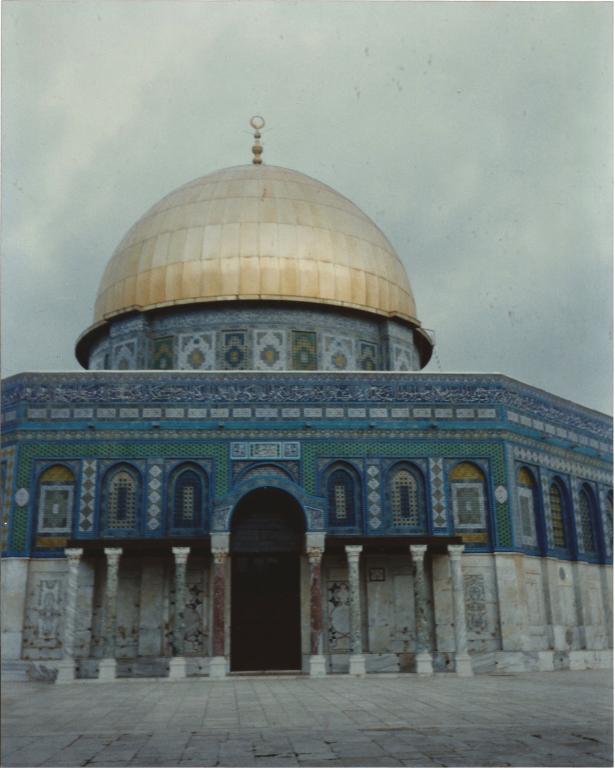
It was a dim, drizzly day and I am a lousy photographer and that photo doesn’t begin to do the building justice. It is dazzling, overwhelming. The inside is awe-inspiring. It took me a moment to close my mouth and remember to breathe. We were instructed to take off our shoes as we entered. I might have done so anyway simply due to the knee-buckling beauty and majesty of the place.
This was not, for me, a religious awe — nothing like the sense I had on the shore of Galilee or among the ancient olive trees of Gethsemane. But I was awestruck nonetheless — by its sheer beauty, by the recognition that I was standing in a place centuries older than my own language, and by a recognition of what that place means and has meant to so many other people. That last one is difficult to describe, but its a tangible, pervasive sense of something like vicarious sacredness — a site that gives meaning to so many for so long is, in turn, given meaning by them, and we can experience a bit of that regardless of whether we share anything like their understanding of the place.
I somewhat glibly referred to this place the other day, expressing my frustration with the way the boilerplate, at this point cliché, description of the al-Aqsa site as “the third-holiest site in Islam,” has morphed from a fact into a factoid. The fact is fuzzily accurate. The factoid is misleading.
Yes, this Islamic holy site is “outranked” by two other sites — sites a non-Muslim like myself would not be allowed to visit, but reciting this kind of ranking amidst a host of other things ranked and rated and quantified sequentially can mislead us into thinking of “third-holiest” as something akin to finishing third in the weekend box office. Like it’s a bronze medal in holiness, or the Ron Paul-in-Iowa of holiness. And that’s not what it means. Not at all. The fact that its “holiness” is exceeded by those two other sites doesn’t in any way diminish its standing as a holy place. Being “third-holiest” does not, as the factoidizing repetition of that designation seems to suggest, mean that Muslims regard the site as anything less than wholly holy.
Consider ∞. Infinity means a number “greater than any assignable quantity or countable number.” But here comes a mathematician telling us about ∞+1. That’s a real thing, but its existence does not thereby make infinity less than infinite. It exceeds infinity, but it does not thereby diminish it.
Part of the problem here is that the word “holy” is nebulous — it can describe both a quality and a category. When we use it to describe a quality, then something can be comparably or relatively “holy” — holy, holier, holiest. And a quality that allows for something to be regarded as “holiest” also seems to allow for something to be regarded as holy*-ish* — as maybe a little bit holy, but not really. When we use the word “holy” to describe a category it tends to be more binary — either “holy” or not.
Further mucking things up is the confusing way that religions like to use it to mean both things at the same time — the holy of holies, the high holy days, the “third-holiest site,” etc. Thus, for example, it is accurate to say that Yom Kippur is a holier holy day than your average Sabbath. But if you flip that the other way to suggest that the Sabbath is in any way anything less that entirely and utterly holy — that it does not completely belong to the category of holy — then you’re going to run into problems. The “third-holiest” factoid invites similar problems.
But there’s also a real danger in the way this factoid is sometimes employed. In the “Bible prophecy” writings of some white American Christians, al-Aqsa’s status as the third-holiest site in Islam is often contrasted with the Temple Mount’s status as the first-holiest site in Judaism. The implicit — and sometimes explicit — idea there is that Jewish regard for the site therefore outranks its importance in Islam. It seems unfair to have one group’s first-holiest site interfered with by another group’s merely second-runner-up to holiest. And so they ignore the meaning of the fact and recite it as a factoid, twisting a statement that’s actually about the place’s immeasurable value to billions of people into a statement diminishing and dismissing its value to them.
And when I describe that as a real danger I mean exactly that. Tossing lit matches at the powder keg of the Temple Mount is a hobby for “Bible prophecy”-obsessed American Christians. They’re hoping for an explosion. They’re praying for it. They want to see the islamic holy site razed so that the Jewish holy site can be rebuilt so that the Antichrist they long for can come along to desecrate it. And then, they believe, RoboJesus can at last come back, kill the infidels, destroy the whole thing, and replace it with a holy site for them. At which point they win, I guess.
I said earlier that the fact behind this factoid was fuzzily accurate. “Al-Aqsa is the third holiest site in Islam” is an accurate statement, but it contains terms that are defined and understood in different ways by different audiences. Here’s how Gershom Gorenberg addresses this in his excellent, dismayingly insightful book, The End of Days: Fundamentalism and the Struggle for the Temple Mount:
Al-Haram al-Sharif, the Noble Sanctuary, is the third-holiest site in Islam. Near its center stands the Dome of the Rock — a gilded half-sphere rising from an octagonal base. The protuberance of bedrock inside the shrine traditionally marks the spot where Muhammad ascended to heaven on his nighttime journey from Mecca nearly 1,400 years ago. It probably also marks — a shimmering uncertainty is part of the landscape — the location of the Holy of Holies, the sacred core of the Jewish Temple. At the southern end of the esplanade is Al-Aqsa Mosque. To confuse matters, the name has a double meaning: Today any Muslim, at least in Jerusalem and the West Bank and Israel, will insist that the entirety of the Haram is Al-Aqsa, including the open squares between the shrines and the olive grove north of the Dome, all sacred ground.
(The cover of Gorenberg’s book features a splendid photograph of the Dome of the Rock, artfully framed in full sun by David H. Wells. Wells’ photo does a far, far better job than mine in capturing the beauty of the site, but I posted my photo here instead because I stood there and took it myself.)
– – – – – – – – – – – –
* In the book of Acts, Luke has Stephen saying the Cave of the Patriarchs was in Shechem (now Nablus), which is a long way in the other direction from Hebron. Shechem is also near where Tony thought Mount Moriah really was — by which he meant that was the location of the actual mountain referenced in the story, not that he thought the story actually happened.
Previous Post

September 18, 2015
How to Lose Friends and Influence People
Next Post
September 19, 2015 You can see them getting smaller as they pull away
Browse Our Archives
Select a Category class warfare evangelicals Iraq Left Behind Mammon music Uncategorized
Select a Month October 2026 September 2026 August 2026 July 2026 June 2026 May 2026 April 2026 March 2026 January 2026 December 2025 November 2025 October 2025 September 2025 August 2025 July 2025 June 2025 May 2025 April 2025 March 2025 February 2025 January 2025 December 2024 November 2024 October 2024 September 2024 August 2024 July 2024 June 2024 May 2024 April 2024 March 2024 February 2024 January 2024 December 2023 November 2023 October 2023 September 2023 August 2023 July 2023 June 2023 May 2023 April 2023 March 2023 February 2023 January 2023 December 2022 November 2022 October 2022 September 2022 August 2022 July 2022 June 2022 May 2022 April 2022 March 2022 February 2022 January 2022 December 2021 November 2021 October 2021 September 2021 August 2021 July 2021 June 2021 May 2021 April 2021 March 2021 February 2021 January 2021 December 2020 November 2020 October 2020 September 2020 August 2020 July 2020 June 2020 May 2020 April 2020 March 2020 February 2020 January 2020 December 2019 November 2019 October 2019 September 2019 August 2019 July 2019 June 2019 May 2019 April 2019 March 2019 February 2019 January 2019 December 2018 November 2018 October 2018 September 2018 August 2018 July 2018 June 2018 May 2018 April 2018 March 2018 February 2018 January 2018 December 2017 November 2017 October 2017 September 2017 August 2017 July 2017 June 2017 May 2017 April 2017 March 2017 February 2017 January 2017 December 2016 November 2016 October 2016 September 2016 August 2016 July 2016 June 2016 May 2016 April 2016 March 2016 February 2016 January 2016 December 2015 November 2015 October 2015 September 2015 August 2015 July 2015 June 2015 May 2015 April 2015 March 2015 February 2015 January 2015 December 2014 November 2014 October 2014 September 2014 August 2014 July 2014 June 2014 May 2014 April 2014 March 2014 February 2014 January 2014 December 2013 November 2013 October 2013 September 2013 August 2013 July 2013 June 2013 May 2013 April 2013 March 2013 February 2013 January 2013 December 2012 November 2012 October 2012 September 2012 August 2012 July 2012 June 2012 May 2012 April 2012 March 2012 February 2012 January 2012 December 2011 November 2011 October 2011 September 2011 August 2011 July 2011 June 2011 May 2011 April 2011 March 2011 February 2011 January 2011 December 2010 November 2010 October 2010 September 2010 August 2010 July 2010 June 2010 May 2010 April 2010 March 2010 February 2010 January 2010 December 2009 November 2009 October 2009 September 2009 August 2009 July 2009 June 2009 May 2009 April 2009 March 2009 February 2009 January 2009 December 2008 November 2008 October 2008 September 2008 August 2008 July 2008 June 2008 May 2008 April 2008 March 2008 February 2008 January 2008 December 2007 November 2007 October 2007 September 2007 August 2007 July 2007 June 2007 May 2007 April 2007 March 2007 February 2007 January 2007 December 2006 November 2006 October 2006 September 2006 August 2006 July 2006 June 2006 May 2006 April 2006 March 2006 February 2006 January 2006 December 2005 November 2005 October 2005 September 2005 August 2005 July 2005 June 2005 May 2005 April 2005 March 2005 February 2005 January 2005 December 2004 November 2004 October 2004 September 2004 August 2004 July 2004 June 2004 May 2004 April 2004 March 2004 February 2004 January 2004 December 2003 November 2003 October 2003 September 2003
Follow Us!
TAKE THE
Religious Wisdom Quiz
Which book comes immediately before Psalms in the Bible?
Select your answer to see how you score.
Job Song of Songs Ecclesiastes Proverbs
Related posts from slacktivist

The purpose-driven labor priest

'A hermeneutical Pandora’s box'

No, most white evangelicals are not 'egalitarian'

TRENDING AT PATHEOS Progressive Christian

Catholic Evangelization: Sharing Your Faith Every Day
Welcome back to the Graceful Awakening mini-series called, “From Faith to Mission.” ...

The Pillar of the Boatmen: the Ancient Monument...
The Pillar of the Boatmen is a Romano-Gaulish sculpture that dates from...

In one sense walking into Westminster Abbey is like walking down the...

'Super Scam Me' Exposes AI Jon Bon Jovi...
Leslie Pickett believed she was in a relationship with Jon Bon Jovi....

The Brazilian Remake of Kendricks' 'Flywheel' Opens in...
“Flywheel,” the story that launched the Kendrick Brothers’ filmmaking career is getting...

The Dangers of Gradual Accommodation (Winking at Sin)
Recently, the “law of gradualness” resurfaced during the opening of a weeklong,...
view all Progressive Christian blogs
Ad-Free & Subscriber Log-In Subscription Support
- About Us
- 2026 Calendar
- Videos
- Podcasts
- Library of World Religions
- Faith In Media Tracker
- Advertise With Us
- Write for Us
- Privacy Policy
- Terms of Service
- Do Not Sell My Data
- Contact Us
- Radiant Digital
- Manage Newsletter Subscriptions
- Unsubscribe From Notifications
- Sitemap
Copyright 2008-2026, Patheos. All rights reserved.
Subscription Support Ad-Free & Subscriber Log-In
Follow Patheos