
BuddhistCatholicContemplativeEvangelicalGeneral ChristianHinduJewishLatter-day SaintMuslimNew VisionsProgressive Christian
Beliefs
- Buddhist
- Catholic
- Contemplative
- Evangelical
- General Christian
- Hindu
- Jewish
- Latter-day Saint
- More Voices
- Muslim
- New Visions
- Pagan
- Progressive Christian
Topics
- Religion News
- Food and Religion
- Sports and Religion
- Religious Art
- Religious Music and Entertainment
- Religious Events
- History and Religion
- Style and Religion
- Politics and Religion
- Women in Religion
- Recreation Outdoors and Religion
- Business Finance and Religion
- Careers Workplace and Religion
- Education and Religion
- Family Parenting and Religion
- Health Fitness and Religion
- Home and Religion
- Relationships and Religion
- Technology and Religion
- Travel and Religion
Columnists
- Buddhist Columnists
- Business Finance and Religion Columnists
- Careers Workplace and Religion Columnists
- Catholic Columnists
- Contemplative Columnists
- Education and Religion Columnists
- Evangelists Columnists
- Family Parenting and Religion Columnists
- General Christian Columnists
- Health Fitness and Religion Columnists
- Hindu Columnists
- History and Religion Columnists
- Home and Religion Columnists
- Jewish Columnists
- More Voices Columnists
- Latter Day Columnists
- Muslim Columnists
- New Visions Columnists
- Nonreligious Columnists
- Pagan Columnists
- Politics and Religion Columnists
- Progressive Columnists
- Recreation Outdoors and Religion Columnists
- Relationships and Religion Columnists
- Religion News Columnists
- Religious Art Columnists
- Religious Events Columnists
- Religious Music and Entertainment Columnists
- Sports and Religion Columnists
- Style and Religion Columnists
- Technology and Religion Columnists
- Travel and Religion Columnists
- Women in Religion Columnists
Resource Library
- 2026 Calendar
- Library of World Religions
- The 100 Most Holy Places on Earth
- Patheos Answers
- Podcasts
- Videos
- Faith Leaders Database
- Anglican Episcopalian
- Bahai
- Baptist
- Buddhism
- Christianity
- Confucianism
- Eastern Orthodoxy
- Hinduism
- Holiness and Pentecostal
- ISKCON
- Islam
- Judaism
- Lutheran
- Methodist
- The Church of Jesus Christ of Latter-day Saints
- New Age
- Paganism
- Presbytarian and Reformed
- Protestantism
- Religion Behind the Scenes
- Roman Catholic
- Scientology
- Shia Islam
- Sikhism
- Sufism
- Sunni Islam
- Taoism
- Zen
- See all religions
Research Tools
 Ad-Free & Subscriber Log-In Subscription Support
Ad-Free & Subscriber Log-In Subscription Support
Follow Patheos 

- Trending:
- Forgiveness
- |
- Marriage
- |
- Consciousness
- |
- Death Penalty
- |
- Election
- |
- Halloween

- Home
- Progressive Christian
- Bad faith in witch hunts and moral panics
Bad faith in witch hunts and moral panics
Last updated on: September 15, 2015 at 7:01 pm by Fred Clark
Bad faith in witch hunts and moral panics 2015-09-15T19:01:30-04:00 Fred Clark
Patheos Explore the world's faith through different perspectives on religion and spirituality! Patheos has the views of the prevalent religions and spiritualities of the world.
The good news is that, unlike back in 17th-century Salem, no one was literally hanged as a witch during the late-20th-century American witch trials of the Satanic Panic. But many people were wrongly imprisoned — some still are — and many lives were destroyed.
Dan Shewan revisits the Satanic Panic, and examines its enduring effects, in a mostly terrific piece called “Conviction of Things Not Seen: The Uniquely American Myth of Satanic Cults.” This may cover a lot of familiar territory for those who have read about all this before (perhaps on a blog that may seem to be thuddingly repetitious in its obsession with this topic), but Shewan’s piece includes some valuable new material, including interviews with Lucien Greaves of the wickedly satiric Satanic Temple, and with Kenneth Lanning, the FBI Special Agent whose 1992 report helped to debunk claims of a Satanic conspiracy of ritual abuse:
“My role in the FBI Behavioral Science Unit was as a case consultant,” Lanning says. “Eventually I consulted on hundreds of cases, including some from outside the United States — far more cases than I could ever have personally investigated,” he says. “In my FBI position, I also became a kind of informal clearinghouse for most of the cases from their beginnings in the early 1980s until the growing skepticism took hold in the early 1990s. Before most professionals had seen their first case, I had consulted on and analyzed dozens of them.”
Lanning’s report critically examined the often-fluid definitions of Satanism that were used interchangeably by many law enforcement agencies, as well as debunking supposed indicators of Satanic crime highlighted during police training seminars such as symbolism in heavy metal music and fantasy role-playing games such as Dungeons & Dragons. Lanning also offered several alternative explanations for similarities among the disparate eyewitness accounts, including pathological distortions commonly observed in cases of Munchausen syndrome. It was the first time anyone had objectively challenged the commonalities in cases of ritual abuse that police forces across the country were taking as irrefutable evidence of Satanic cult activity.
“Generally, the response [to the report] was positive,” Lanning says. “Several law enforcement supervisors thanked me for bringing objectivity to the issue. Of course, nothing I wrote would reach or convince everyone of my point of view. I received several letters from some questioning aspects of what I had written or said. One officer wanted me investigated by Congress. Perhaps most upset were those law enforcement officers who were making money and getting status as experts in this area.”
Ah, yes, the money. “Follow the money” is always useful advice, and “the money” did play a role in the spread of this moral hysteria. People like Michelle Smith, Lawrence Pazder, Laurel Rose Willson, and Mike Warnke raked in a tidy sum peddling their fabricated stories of outlandish Satanic threats. And then there was the cottage industry Lanning refers to of law enforcement and former-law-enforcement officers holding themselves up as experts and consultants — people like Dale W. Griffis — and raking it in by conducting “seminars” or consulting as “expert witnesses.”
But it’s not the people who made money who interest me. I’m intrigued by the vastly greater number of people who spent money — not the “Satan Sellers,” but the Satan buyers. They weren’t in this for the money.
The transparent grifters are easily understandable. Their audience is more of a puzzle.
Lanning came to this same view of the whole phenomenon:
In addition to questioning the criminal significance of occult symbolism, Lanning’s report also warned of the danger of reducing the complex issue of child abuse into a pat, simplistic narrative — a tendency that marred many cases of Satanic ritual abuse and raised the important question of why so many people accepted wild allegations about Satanic cults in the absence of any hard evidence.
“Although I did not realize it at first, I came to learn that the last of my key questions was actually the most significant. If something wasn’t happening, why do so many intelligent, well-educated professionals believe it is?” Lanning says. “Regardless of intelligence and education, and often despite common sense and evidence to the contrary, adults tend to believe what they want or need to believe; the greater the need, the greater the tendency. There was a need to believe.”
What could motivate such a perverse “need to believe”?
Keep in mind that the belief we’re talking about here is something vast and horrible. We’re talking about the need — or desire — to believe that something Very Bad is true, even when there is no evidence to suggest it is, and even when it requires ignoring a great deal of evidence that proves it is not.
“Faith is the assurance of things hoped for,” Hebrews 11:1 says. That, I think, is more relevant to Shewan’s topic than the latter half of that verse, quoted in the title to his piece. The witch-hunters of the 1690s and the 1980s acted with apparent conviction based on “things not seen,” and they eagerly convicted others of things not seen, but the most perplexing thing about witch-hunters is their “assurance of things hoped for.”
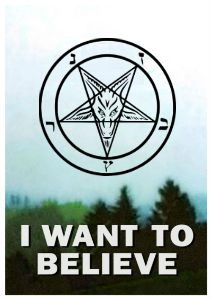 The things they hope for are monstrous. What is the worst thing you can imagine? They hope it is true. They assure themselves, and reassure themselves, with the idea that it is. That’s what this “need to believe” entails.
This need to believe in a conspiracy of evil witches is more understandable, I think, in cases like that of the West Memphis Three — three young men wrongly convicted and imprisoned for the alleged Satanic ritual murder of three young boys in Arkansas. The crime did not, in fact, involve any kind of Satanic cultic rituals, and the three young men convicted of that crime were not guilty of it. But there was a crime. Someone killed those three young boys whose bound, lifeless bodies were found in a West Memphis creek. Someone did that evil thing to them.
That case, in other words, involved outlandish attempts to explain actual evils and an actual crime. But most of the Satanic Panic did not involve cases like that. More often, there was no evidence of any crime having occurred at all. It wasn’t a matter of struggling to imagine what kind of evil people might have done such horrifically evil things, but rather a matter of imagining horrifically evil things and then behaving as though they had occurred. In West Memphis, fabricated evidence was used to convict innocent people of a crime. In those other cases, crimes were fabricated.
The supposed evidence for these invented crimes was the testimony of very young children. Lanning notes that the “need to believe” the testimony of these young victims is understandable — laudable even. But this doesn’t solve the puzzle about this need to believe, it only kicks the can one step farther down the road, because, as Shewan writes, it turns out this testimony did not originate with these very young witnesses: “subsequent review of these cases revealed that much of this testimony was obtained through coercion and suggestive interviewing techniques.”
These children affirmed what they were asked to affirm or repeated back the accusations they were encouraged to repeat. Shewan blames this form of manipulative fabrication on “overzealous social workers,” but police, clergy, and — most of all — parents, also played a large role in manufacturing and securing such false accusations.
That word “overzealous” also begs the question and, thereby, misidentifies the problem. An overabundance of zeal to protect children from abuse was not the problem here. The problem, rather, was the idea that there existed a particular form of abuse from which children require protection: witches. And the zeal these manipulative questioners displayed had far less to do with protecting children from witches than it did with confirming the existence of witches.
That last sentence, to be clear, is an imputation of bad faith. It suggest that the witch-hunters of this moral panic were not trustworthy, that they were duplicitous and disingenuous — claiming to seek one thing (protecting children) while primarily seeking another (proving the existence of witches).
We’re often told that we must never suggest such a thing. We must never impugn the motives of others — never assume bad faith, always attribute the best-possible motive, always give the benefit of the doubt. Those are good rules. Like the principle of “innocent until proven guilty,” those rules ensure a measure of procedural fairness and justice.
But the presumption of innocence does not require a conclusion of innocence — that rule does not rule out the possibility of a guilty verdict. And the benefit of the doubt is not an eternal, inexhaustible resource. We should never presume bad faith, but we should also never preclude the possibility of it when following the evidence leads us that way.
I did not start with the presumption that witch-hunters are acting in bad faith. But that is the conclusion at which I have arrived because I have not yet found any other explanation that can credibly explain their behavior.
I remain open to suggestions though. I invite them, and I’ve collected a few possibilities worth discussing later. Anyone have any more?
Previous Post

September 15, 2015
As one by one the lights go out
Next Post
September 16, 2015 More richer than my tongue
Browse Our Archives
Select a Category class warfare evangelicals Iraq Left Behind Mammon music Uncategorized
Select a Month October 2026 September 2026 August 2026 July 2026 June 2026 May 2026 April 2026 March 2026 January 2026 December 2025 November 2025 October 2025 September 2025 August 2025 July 2025 June 2025 May 2025 April 2025 March 2025 February 2025 January 2025 December 2024 November 2024 October 2024 September 2024 August 2024 July 2024 June 2024 May 2024 April 2024 March 2024 February 2024 January 2024 December 2023 November 2023 October 2023 September 2023 August 2023 July 2023 June 2023 May 2023 April 2023 March 2023 February 2023 January 2023 December 2022 November 2022 October 2022 September 2022 August 2022 July 2022 June 2022 May 2022 April 2022 March 2022 February 2022 January 2022 December 2021 November 2021 October 2021 September 2021 August 2021 July 2021 June 2021 May 2021 April 2021 March 2021 February 2021 January 2021 December 2020 November 2020 October 2020 September 2020 August 2020 July 2020 June 2020 May 2020 April 2020 March 2020 February 2020 January 2020 December 2019 November 2019 October 2019 September 2019 August 2019 July 2019 June 2019 May 2019 April 2019 March 2019 February 2019 January 2019 December 2018 November 2018 October 2018 September 2018 August 2018 July 2018 June 2018 May 2018 April 2018 March 2018 February 2018 January 2018 December 2017 November 2017 October 2017 September 2017 August 2017 July 2017 June 2017 May 2017 April 2017 March 2017 February 2017 January 2017 December 2016 November 2016 October 2016 September 2016 August 2016 July 2016 June 2016 May 2016 April 2016 March 2016 February 2016 January 2016 December 2015 November 2015 October 2015 September 2015 August 2015 July 2015 June 2015 May 2015 April 2015 March 2015 February 2015 January 2015 December 2014 November 2014 October 2014 September 2014 August 2014 July 2014 June 2014 May 2014 April 2014 March 2014 February 2014 January 2014 December 2013 November 2013 October 2013 September 2013 August 2013 July 2013 June 2013 May 2013 April 2013 March 2013 February 2013 January 2013 December 2012 November 2012 October 2012 September 2012 August 2012 July 2012 June 2012 May 2012 April 2012 March 2012 February 2012 January 2012 December 2011 November 2011 October 2011 September 2011 August 2011 July 2011 June 2011 May 2011 April 2011 March 2011 February 2011 January 2011 December 2010 November 2010 October 2010 September 2010 August 2010 July 2010 June 2010 May 2010 April 2010 March 2010 February 2010 January 2010 December 2009 November 2009 October 2009 September 2009 August 2009 July 2009 June 2009 May 2009 April 2009 March 2009 February 2009 January 2009 December 2008 November 2008 October 2008 September 2008 August 2008 July 2008 June 2008 May 2008 April 2008 March 2008 February 2008 January 2008 December 2007 November 2007 October 2007 September 2007 August 2007 July 2007 June 2007 May 2007 April 2007 March 2007 February 2007 January 2007 December 2006 November 2006 October 2006 September 2006 August 2006 July 2006 June 2006 May 2006 April 2006 March 2006 February 2006 January 2006 December 2005 November 2005 October 2005 September 2005 August 2005 July 2005 June 2005 May 2005 April 2005 March 2005 February 2005 January 2005 December 2004 November 2004 October 2004 September 2004 August 2004 July 2004 June 2004 May 2004 April 2004 March 2004 February 2004 January 2004 December 2003 November 2003 October 2003 September 2003
Follow Us!
TAKE THE
Religious Wisdom Quiz
Which New Testament city was known for worshipping Artemis?
Select your answer to see how you score.
Rome Corinth Athens Ephesus
Related posts from slacktivist

Innocence, identity, and blood libel (cont'd.)
Innocence, identity, and blood libel (part 2)
Innocence, identity, and blood libel (part 1)

Pro-lifers keep killing women and their children
TRENDING AT PATHEOS Progressive Christian

The Pillar of the Boatmen: the Ancient Monument...
The Pillar of the Boatmen is a Romano-Gaulish sculpture that dates from...

In one sense walking into Westminster Abbey is like walking down the...

'Super Scam Me' Exposes AI Jon Bon Jovi...
Leslie Pickett believed she was in a relationship with Jon Bon Jovi....

The Brazilian Remake of Kendricks' 'Flywheel' Opens in...
“Flywheel,” the story that launched the Kendrick Brothers’ filmmaking career is getting...

The Dangers of Gradual Accommodation (Winking at Sin)
Recently, the “law of gradualness” resurfaced during the opening of a weeklong,...

The Iron Gates and the Lion of the...
Yesterday, I didn't finish my report about, well, yesterday. So I'll...
view all Progressive Christian blogs
Ad-Free & Subscriber Log-In Subscription Support
- About Us
- 2026 Calendar
- Videos
- Podcasts
- Library of World Religions
- Faith In Media Tracker
- Advertise With Us
- Write for Us
- Privacy Policy
- Terms of Service
- Do Not Sell My Data
- Contact Us
- Radiant Digital
- Manage Newsletter Subscriptions
- Unsubscribe From Notifications
- Sitemap
Copyright 2008-2026, Patheos. All rights reserved.
Subscription Support Ad-Free & Subscriber Log-In
Follow Patheos