
BuddhistCatholicContemplativeEvangelicalGeneral ChristianHinduJewishLatter-day SaintMuslimNew VisionsProgressive Christian
Beliefs
- Buddhist
- Catholic
- Contemplative
- Evangelical
- General Christian
- Hindu
- Jewish
- Latter-day Saint
- More Voices
- Muslim
- New Visions
- Pagan
- Progressive Christian
Topics
- Religion News
- Food and Religion
- Sports and Religion
- Religious Art
- Religious Music and Entertainment
- Religious Events
- History and Religion
- Style and Religion
- Politics and Religion
- Women in Religion
- Recreation Outdoors and Religion
- Business Finance and Religion
- Careers Workplace and Religion
- Education and Religion
- Family Parenting and Religion
- Health Fitness and Religion
- Home and Religion
- Relationships and Religion
- Technology and Religion
- Travel and Religion
Columnists
- Buddhist Columnists
- Business Finance and Religion Columnists
- Careers Workplace and Religion Columnists
- Catholic Columnists
- Contemplative Columnists
- Education and Religion Columnists
- Evangelists Columnists
- Family Parenting and Religion Columnists
- General Christian Columnists
- Health Fitness and Religion Columnists
- Hindu Columnists
- History and Religion Columnists
- Home and Religion Columnists
- Jewish Columnists
- More Voices Columnists
- Latter Day Columnists
- Muslim Columnists
- New Visions Columnists
- Nonreligious Columnists
- Pagan Columnists
- Politics and Religion Columnists
- Progressive Columnists
- Recreation Outdoors and Religion Columnists
- Relationships and Religion Columnists
- Religion News Columnists
- Religious Art Columnists
- Religious Events Columnists
- Religious Music and Entertainment Columnists
- Sports and Religion Columnists
- Style and Religion Columnists
- Technology and Religion Columnists
- Travel and Religion Columnists
- Women in Religion Columnists
Resource Library
- 2026 Calendar
- Library of World Religions
- The 100 Most Holy Places on Earth
- Patheos Answers
- Podcasts
- Videos
- Faith Leaders Database
- Anglican Episcopalian
- Bahai
- Baptist
- Buddhism
- Christianity
- Confucianism
- Eastern Orthodoxy
- Hinduism
- Holiness and Pentecostal
- ISKCON
- Islam
- Judaism
- Lutheran
- Methodist
- The Church of Jesus Christ of Latter-day Saints
- New Age
- Paganism
- Presbytarian and Reformed
- Protestantism
- Religion Behind the Scenes
- Roman Catholic
- Scientology
- Shia Islam
- Sikhism
- Sufism
- Sunni Islam
- Taoism
- Zen
- See all religions
Research Tools
 Ad-Free & Subscriber Log-In Subscription Support
Ad-Free & Subscriber Log-In Subscription Support
Follow Patheos 

- Trending:
- Forgiveness
- |
- Marriage
- |
- Consciousness
- |
- Death Penalty
- |
- Election
- |
- Halloween

- Home
- Progressive Christian
- The ‘Rocky’ road of John’s geography
The ‘Rocky’ road of John’s geography
Last updated on: August 18, 2015 at 7:15 pm by Fred Clark
The ‘Rocky’ road of John’s geography 2015-08-18T19:15:35-04:00 Fred Clark
Patheos Explore the world's faith through different perspectives on religion and spirituality! Patheos has the views of the prevalent religions and spiritualities of the world.
I liked Gregory Hoblit’s delightfully creepy movie Fallen, with Denzel Washington and John Goodman. But it’s otherwise seamless atmosphere of haunting doom occasionally falters for audiences around here. We’re taken out of the story not by the writing or the performances or the direction, but by the movie’s geography.
The movie was filmed here, in Philadelphia and the region, and the familiar locations can make the story more vivid for audiences who regularly walk those same streets. But that familiarity also creates occasional problems for Philly audiences. (And I don’t just mean the film’s most audacious geographic innovation — spoilerish hint alert — relocating Sunset Boulevard in the South Jersey Pine Barrens.)
In one scene, for example, we see Denzel encounter the villain in Center City. He gives chase, on foot, rounding the corner to … Manayunk. He turns a corner and winds up, suddenly, seven miles away. That was a bit jarring.
I’ve seen countless examples of similar nit-picking complaints from movie audiences in New York or L.A. or the Bay Area, criticizing the Escher-esque movie geography of many stories filmed in their cities. San Franciscans have been attempting to map out the classic car chase in Bullitt for decades — a task as impossible as trying to figure out how many gears Steve McQueen’s Mustang actually has. But those of us here in the Philly area don’t get to play this game as often.*
We do have one classic, iconic example though: Rocky Balboa’s training montage run through Philadelphia in Rocky II.
Dan McQuade of Philadelphia magazine offered the definitive retracing of the Italian Stallion’s steps a couple years ago — “How Far Did Rocky Go in His Training Run in Rocky II?” — identifying all the locations in the montage and using USA Track and Field’s distance-measuring tool and Google to map out Rocky’s route. Total distance: 30.61 miles.
And that doesn’t even account for the three miles it will take him to get home from the Art Museum.
Here’s McQuade’s map of that absurdly long training run, which has now become the route for an unofficial annual 50K race:
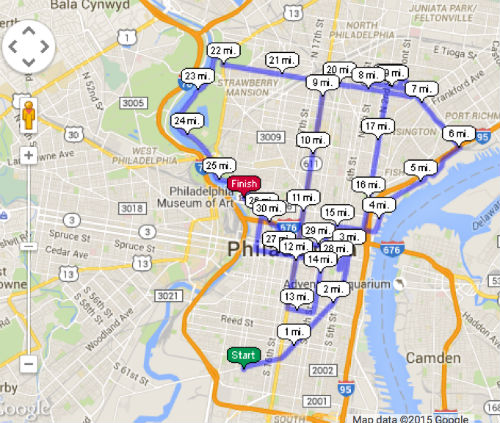
Dan McQuade’s definite map of the training run from “Rocky II.”
The route, you may notice, makes little sense. Rocky cuts through the Italian Market on his way up to Kensington, then comes all the way back to South Philly before turning around to make his way back up to Kelly Drive, near the Art Museum. At this point he’s run nearly the distance of a complete marathon — but he’s not done yet, so he passes by the museum steps, racing back to Center City and Independence Hall before turning back to sprint all the way up the Parkway back to the museum.
The screenshots accompanying McQuade’s article allow us to nitpick further. Rocky sets out in the early morning, and the sun is still in the east as he races along Kelly Drive more than 25 miles later. But he must have slowed down a lot in his final jaunt back to Center City, because the sun is low in the west as he celebrates atop the museum steps with his battalion of incredibly fit schoolchildren.
McQuade’s geographical dissection of this scene in Rocky II is, in many ways, similar to the kind of thing that biblical scholars often do when they study the ancient texts of the Christian Bible. Like McQuade, they’re taking a closer look than the casual movie-goer or devotional Bible-reader who just wants to get swept up in the familiar story. (And, like McQuade, they tend to do this because of their enthusiasm — their love — for the thing they’re examining.)
We saw this recently in discussing the story of “The Day the Sun Stood Still” from the book of Joshua. Paul Davidson approaches that story in precisely the same way that McQuade approaches the beloved Rocky run. He maps out its geography on a map of the real world, finding a route that doubles back on itself inexplicably and covers staggering distances in an implausible time frame. Even Rocky Balboa and the Olympic-class ultramarathon schoolchildren of Philadelphia couldn’t have raced the hundreds of miles that the story tells us Joshua traveled in a single day.
And that brings us to Davidson’s newest post, wherein he gives the Rocky/Joshua treatment to the book of John and “The Strange Geography and Chronology of the Fourth Gospel.”
“If you pay close attention,” Davidson writes, “the geography of Jesus’ travels is often confusing, if not downright contradictory.”
That may be an understatement. The geography of John’s Gospel is so mixed up that scholars have suggested a host of possible ways the text itself must have been mixed up. Literally mixed up — as in the suggestion that “an early manuscript [was] dropped and the pages put back in the wrong order.” Retracing the text’s “strange geography and chronology” led the theologian Rudolph Bultmann to “propose that ch. 7 originally followed ch. 5, in which Jesus is is in Judea; and that both followed chs. 4 and 6, in which Jesus is in Galilee.”
There are at least three things about that which will make conservative white evangelicals howl in protest. First is the admission that there are problems in the text of the Gospel; second is the suggestion that it might be possible to reorder the text to make better sense of it; and third is the mention of Bultmann — a name that is, to conservatives, synonymous with infamous, scandalous, liberalism.
But Bultmann’s suggestion — right or wrong — shouldn’t be any more scandalous or radical than McQuade’s discussion of Rocky’s training run. Watch that montage again:
https://www.youtube.com/watch?v=NubH5BDOaD8
That final, canonical version of the scene was written, directed, and performed by Sylvester Stallone. It’s not outlandish to suggest that Stallone and his film crew didn’t actually trace the entire 30-mile route McQuade maps out. They didn’t set up all their equipment in South Philly, schlep it all up to Kensington, and then drive back down to shoot the scene in the Italian Market. We don’t have to be film scholars or professional movie-makers to understand that its far likelier that the sequence of the final film is the product of the editing process.
That editing process might be less visible to viewers who aren’t familiar with the real-world geography of Philadelphia, but for someone like Dan McQuade –someone who recognizes all those locations and their relationship to one another — the work of those editors is an obvious and unavoidable fact suggested by the film, the text, itself.
Similarly, one doesn’t need to be an expert on the geography of the Holy Land to see some editorial hand at work in the Gospel of John. All you really need to know is that Jerusalem and Galilee are not across the street from one another.
Film editing is a form of the art of storytelling. Movie editors thus make their choices based on what will best serve the story they are telling.
In a sense, then, nitpicking criticism of movie geography is unfair and beside the point. The training montage in Rocky II wasn’t filmed to be a road atlas of Philadelphia. It was filmed to tell a story. And the meaning and effect of that story isn’t necessarily dependent on or diminished by the real-world accuracy of the geography it portrays. McQuade’s geographical dissection, in a way, tempts us to misread the story — to misrepresent it to ourselves and thereby to misunderstand it.
The same is true for that classic chase scene from Bullitt. If you treat it like a geography lesson or a road atlas, you’ll come away with the sense that it’s nothing more than an inept geography lesson and an inaccurate road atlas. And you will thereby miss the point — the most important thing about the scene, which is that it’s a thrilling, remarkable piece of cinematic storytelling.
The first time I watched Fallen I saw Denzel turn that seven-mile corner into Manayunk and was momentarily jarred out of the story by its impossible geography. A few months later, though, I went to see some friends playing at Grape Street and wound up having to park somewhere right around where that scene was filmed. I was alone and it was dark there under the bridge at night, and if someone had stepped out of the shadows singing “Tie-ie-ie-ime Is on My Side” I would have collapsed and soiled myself.
Despite its fictional movie-geography,the story worked. It worked partly because of its impossible geography. The story needed, above all else, for Denzel to round the corner and find himself on a shadowy, creepy street, and locating the ideal such location — the best possible shadowy, creepy street for the purpose of the story — was more important to the storytellers than settling for a location that was more geographically realistic.
In other words, sometimes impossible movie-geography may result from a mistake, and sometimes it may result from an artistic choice. And sometimes it may be both of those at the same time.
We should keep that in mind when we consider things like the mixed up geography and chronology of John’s Gospel. Are we seeing a storytelling choice made to advance the story? Or are we seeing the result of someone dropping the pages of the manuscript and then putting them back together out of order? Or both?
We haven’t yet touched on the biggest difference between Rocky’s ridiculous run and Jesus’ implausible hopscotching about the Holy Land in John’s Gospel. One is a movie. The other is biblical canon. Neither Rocky II nor the Gospel of John purports to be suitable replacement for Google Maps or a GPS, but the latter does purport to be a true story and not a work of fiction. Imaginatively implausible geography in service of a fiction story seems less troublesome than the same sort of imaginatively implausible geography in a story that asks to be considered a true and reliable account.
Here, I think, it’s vitally important to remember another huge difference between these two stories. Rocky II was released in 1979.** John’s Gospel was written in the first century — in another language, in another world.
The 1970s may seem like a long time ago now, but really that’s the blink of an eye. Heck, Rocky’s Philadelphia is coming back to our movie screens in November. The past of 1979 looks different, but it’s not incomprehensible to us. Go back further, though, a generation earlier to the 1927 boxing movie The Ring. That’s an artifact from the silent movie era — cinema that employed a very different style of performance and writing than the realism of the 1970s. The stylized approach of silent-movie actors seems alien and strange to those of us engaging such storytelling today.
But silent movies, while strange, are still recognizably part of our modern world and culture. The Ring is Hitchcock, after all — the work of a familiar artist from the fairly recent past. Go back further. Read Hawthorne or Dickens and you’ll encounter more that is strange — storytelling conventions that seem a bit less familiar to the conventions of our time. Go back further and dip into Gibbon’s Decline and Fall. That’s a work of history — of non-fiction — but works of history from two centuries ago employed methods and conventions that were wholly different from those employed today.
Go back further, to Shakespeare, and further, to Chaucer. Chaucer didn’t write in English as we know it because English as we know it didn’t yet exist. He didn’t write novels or short stories because novels and short stories didn’t yet exist. He was writing in a language now long gone and in a genre now long gone.
We tend to remember this when we approach The Canterbury Tales. We tend to forget this when we approach the Gospel of John — which is vastly older, stranger, and less immediately accessible to us.
That doesn’t mean we should ignore the geographical and chronological confusion in the Gospel of John, or the many ways it is incompatible with the accounts we find in the Synoptic Gospels. But it is an important thing to keep in mind — a caution against assuming we can easily assess or evaluate what we’re encountering in a text that was two times older to Chaucer than Chaucer is to us.
– – – – – – – – – – – –
* Many of the best movies set in Philadelphia — Blow Out, The Sixth Sense, Trading Places — offer a fairly faithful rendition of the city’s geography. (So do Mannequin, National Treasure and Transformers: Revenge of the Fallen, but we try not to speak of those.) So we’re stuck with nitpicking about the geography on TV shows like It’s Always Sunny or Cold Case.
Let me note, though, that Steve McQueen’s first leading role was filmed right here in Chester County.
** The first Rocky movie came out in 1976, winning the Academy Award for Best Picture. It also won for best director and best film editing, and collected seven other Oscar nominations — including two for Stallone for acting and screenwriting.
The fact that Rocky was chosen over Network, Taxi Driver and All the President’s Men has produced a lot of critical resentment over the years, but that’s mainly a reflection, I think, of the way that all of the Rocky sequels wound up diminishing the reputation of the original. Ignore those sequels and that first movie, by itself, really does deserve to be listed alongside those others as a classic of 1970s American cinema.
In fact, if you want a simple case study for the difference between that classic period of American movies and the decline that followed in the 1980s, just watch Rocky and then, say, Rocky IV.
But my point here in this little tangent isn’t simply to defend the quality of the original Rocky. We often talk about these distinct epochs or eras of American cinema — the auteur-driven 1970s vs. the blockbuster-driven 1980s. We have no trouble recognizing that time passed and time changed. It seems logical to us that the expectation of audiences and the approach of storytellers could have changed, significantly, over the course of a decade — ten whole years. We don’t approach movies from the 1970s with the same set of expectations we bring to movies from the 1980s. And yet we approach the Bible — a collection of texts more than two millennia old — as though it shouldn’t be any different from something written last week.
Previous Post

August 17, 2015
It's funny how I never knew
Next Post
August 19, 2015 And the dog bites down a little harder
Browse Our Archives
Select a Category class warfare evangelicals Iraq Left Behind Mammon music Uncategorized
Select a Month October 2026 September 2026 August 2026 July 2026 June 2026 May 2026 April 2026 March 2026 January 2026 December 2025 November 2025 October 2025 September 2025 August 2025 July 2025 June 2025 May 2025 April 2025 March 2025 February 2025 January 2025 December 2024 November 2024 October 2024 September 2024 August 2024 July 2024 June 2024 May 2024 April 2024 March 2024 February 2024 January 2024 December 2023 November 2023 October 2023 September 2023 August 2023 July 2023 June 2023 May 2023 April 2023 March 2023 February 2023 January 2023 December 2022 November 2022 October 2022 September 2022 August 2022 July 2022 June 2022 May 2022 April 2022 March 2022 February 2022 January 2022 December 2021 November 2021 October 2021 September 2021 August 2021 July 2021 June 2021 May 2021 April 2021 March 2021 February 2021 January 2021 December 2020 November 2020 October 2020 September 2020 August 2020 July 2020 June 2020 May 2020 April 2020 March 2020 February 2020 January 2020 December 2019 November 2019 October 2019 September 2019 August 2019 July 2019 June 2019 May 2019 April 2019 March 2019 February 2019 January 2019 December 2018 November 2018 October 2018 September 2018 August 2018 July 2018 June 2018 May 2018 April 2018 March 2018 February 2018 January 2018 December 2017 November 2017 October 2017 September 2017 August 2017 July 2017 June 2017 May 2017 April 2017 March 2017 February 2017 January 2017 December 2016 November 2016 October 2016 September 2016 August 2016 July 2016 June 2016 May 2016 April 2016 March 2016 February 2016 January 2016 December 2015 November 2015 October 2015 September 2015 August 2015 July 2015 June 2015 May 2015 April 2015 March 2015 February 2015 January 2015 December 2014 November 2014 October 2014 September 2014 August 2014 July 2014 June 2014 May 2014 April 2014 March 2014 February 2014 January 2014 December 2013 November 2013 October 2013 September 2013 August 2013 July 2013 June 2013 May 2013 April 2013 March 2013 February 2013 January 2013 December 2012 November 2012 October 2012 September 2012 August 2012 July 2012 June 2012 May 2012 April 2012 March 2012 February 2012 January 2012 December 2011 November 2011 October 2011 September 2011 August 2011 July 2011 June 2011 May 2011 April 2011 March 2011 February 2011 January 2011 December 2010 November 2010 October 2010 September 2010 August 2010 July 2010 June 2010 May 2010 April 2010 March 2010 February 2010 January 2010 December 2009 November 2009 October 2009 September 2009 August 2009 July 2009 June 2009 May 2009 April 2009 March 2009 February 2009 January 2009 December 2008 November 2008 October 2008 September 2008 August 2008 July 2008 June 2008 May 2008 April 2008 March 2008 February 2008 January 2008 December 2007 November 2007 October 2007 September 2007 August 2007 July 2007 June 2007 May 2007 April 2007 March 2007 February 2007 January 2007 December 2006 November 2006 October 2006 September 2006 August 2006 July 2006 June 2006 May 2006 April 2006 March 2006 February 2006 January 2006 December 2005 November 2005 October 2005 September 2005 August 2005 July 2005 June 2005 May 2005 April 2005 March 2005 February 2005 January 2005 December 2004 November 2004 October 2004 September 2004 August 2004 July 2004 June 2004 May 2004 April 2004 March 2004 February 2004 January 2004 December 2003 November 2003 October 2003 September 2003
Follow Us!
TAKE THE
Religious Wisdom Quiz
What natural disaster did God use to destroy the earth in Noah’s time?
Select your answer to see how you score.
Famine Flood Fire Earthquake
Related posts from slacktivist

It's not 'pick and choose.' It's pick a...

Team Everybody sliding into our DMs

The phantom menace of biblical chronology
TRENDING AT PATHEOS Progressive Christian

Emotion in Early Christianity by Andrew Crislip
Andrew Crislip’s Emotion in Early Christianity examines an often overlooked dimension of...

16 Spiritual Touchstones for a More Grounded Life
After decades of spiritual study, here are 16 principles I try...

Catholic Evangelization: Sharing Your Faith Every Day
Welcome back to the Graceful Awakening mini-series called, “From Faith to Mission.” ...

The Pillar of the Boatmen: the Ancient Monument...
The Pillar of the Boatmen is a Romano-Gaulish sculpture that dates from...

In one sense walking into Westminster Abbey is like walking down the...

'Super Scam Me' Exposes AI Jon Bon Jovi...
Leslie Pickett believed she was in a relationship with Jon Bon Jovi....
view all Progressive Christian blogs
Ad-Free & Subscriber Log-In Subscription Support
- About Us
- 2026 Calendar
- Videos
- Podcasts
- Library of World Religions
- Faith In Media Tracker
- Advertise With Us
- Write for Us
- Privacy Policy
- Terms of Service
- Do Not Sell My Data
- Contact Us
- Radiant Digital
- Manage Newsletter Subscriptions
- Unsubscribe From Notifications
- Sitemap
Copyright 2008-2026, Patheos. All rights reserved.
Subscription Support Ad-Free & Subscriber Log-In
Follow Patheos