
BuddhistCatholicContemplativeEvangelicalGeneral ChristianHinduJewishLatter-day SaintMuslimNew VisionsProgressive Christian
Beliefs
- Buddhist
- Catholic
- Contemplative
- Evangelical
- General Christian
- Hindu
- Jewish
- Latter-day Saint
- More Voices
- Muslim
- New Visions
- Pagan
- Progressive Christian
Topics
- Religion News
- Food and Religion
- Sports and Religion
- Religious Art
- Religious Music and Entertainment
- Religious Events
- History and Religion
- Style and Religion
- Politics and Religion
- Women in Religion
- Recreation Outdoors and Religion
- Business Finance and Religion
- Careers Workplace and Religion
- Education and Religion
- Family Parenting and Religion
- Health Fitness and Religion
- Home and Religion
- Relationships and Religion
- Technology and Religion
- Travel and Religion
Columnists
- Buddhist Columnists
- Business Finance and Religion Columnists
- Careers Workplace and Religion Columnists
- Catholic Columnists
- Contemplative Columnists
- Education and Religion Columnists
- Evangelists Columnists
- Family Parenting and Religion Columnists
- General Christian Columnists
- Health Fitness and Religion Columnists
- Hindu Columnists
- History and Religion Columnists
- Home and Religion Columnists
- Jewish Columnists
- More Voices Columnists
- Latter Day Columnists
- Muslim Columnists
- New Visions Columnists
- Nonreligious Columnists
- Pagan Columnists
- Politics and Religion Columnists
- Progressive Columnists
- Recreation Outdoors and Religion Columnists
- Relationships and Religion Columnists
- Religion News Columnists
- Religious Art Columnists
- Religious Events Columnists
- Religious Music and Entertainment Columnists
- Sports and Religion Columnists
- Style and Religion Columnists
- Technology and Religion Columnists
- Travel and Religion Columnists
- Women in Religion Columnists
Resource Library
- 2026 Calendar
- Library of World Religions
- The 100 Most Holy Places on Earth
- Patheos Answers
- Podcasts
- Videos
- Faith Leaders Database
- Anglican Episcopalian
- Bahai
- Baptist
- Buddhism
- Christianity
- Confucianism
- Eastern Orthodoxy
- Hinduism
- Holiness and Pentecostal
- ISKCON
- Islam
- Judaism
- Lutheran
- Methodist
- The Church of Jesus Christ of Latter-day Saints
- New Age
- Paganism
- Presbytarian and Reformed
- Protestantism
- Religion Behind the Scenes
- Roman Catholic
- Scientology
- Shia Islam
- Sikhism
- Sufism
- Sunni Islam
- Taoism
- Zen
- See all religions
Research Tools
 Ad-Free & Subscriber Log-In Subscription Support
Ad-Free & Subscriber Log-In Subscription Support
Follow Patheos 

- Trending:
- Forgiveness
- |
- Marriage
- |
- Consciousness
- |
- Death Penalty
- |
- Election
- |
- Halloween

- Home
- Progressive Christian
- Who do you say that I am?: Putting the ‘post-‘ in ‘post-evangelical’ (part 1)
Who do you say that I am?: Putting the ‘post-‘ in ‘post-evangelical’ (part 1)
Last updated on: September 23, 2014 at 1:28 am by Fred Clark
Who do you say that I am?: Putting the ‘post-‘ in ‘post-evangelical’ (part 1) 2014-09-23T01:28:01-04:00 Fred Clark
Patheos Explore the world's faith through different perspectives on religion and spirituality! Patheos has the views of the prevalent religions and spiritualities of the world.
As the fall semester begins, I am again enjoying the “virtual office hours” videos regularly posted by history professor/blogger John Fea, who teaches at Messiah College. This year, Dr. Fea is teaching a seminar class on the history of evangelical Christianity in America — they’re reading some terrific books, and the discussions in Fea’s brief, large-man-at-a-small-desk videos are informative and fun.
His second episode for the class — “What is an evangelical?” — gives a good five-minute summary of the various ways people who study religion have tried to define this elusive, slippery category. Fea surveys the religious temperaments of the famous “Bebbington quadrilateral,” and discusses the boundary-defining cultural aspects that came to shape evangelicalism in the 20th century.
The really helpful bit just now, for me, was this important reminder:
Evangelicalism has a certain trans-denominational quality. You can find an evangelical in just about every Protestant denomination. … So an evangelical is not necessarily associated with a denomination, like a Methodist or an Episcopalian or a Baptist, but throughout 18th-, 19th-, 20th-, 21st-century America, evangelicals who embrace the quadrilateral can be found just about anywhere.
This “trans-denominational quality” is why attempts to define or describe evangelicalism have to resort to things like the religious temperaments or emphases of Bebbington. A theological or doctrinal definition won’t work — it would either be so vague as to be meaningless, or else it would inevitably exclude some group or groups that it shouldn’t be excluding.
This is why the tribal gatekeepers of white evangelicalism in America cannot and do not concern themselves with doctrine. They like to employ the rhetoric of doctrinal purity and of heresy hunters, going on about “orthodoxy” or “traditional Christianity” or what is or is not “biblical,” but the substance of their gatekeeping can never be theology or doctrine.
A generation ago, tribal gatekeepers tended to focus more on certain behaviors — drinking, dancing, playing cards, going to movies, etc. You can still find all those tribal indicators listed in old student handbooks from evangelical schools, but apart from the hard-core fundies, no one really takes them seriously anymore. They’re dancing at Wheaton. Professors at Moody can drink.
But those old tribal markers have been replaced by political tribal identifiers — all distinctly partisan. Over the past generation, all those student handbooks and statements of faith have been rewritten to reflect this. Gatekeepers no longer care about drinking and dancing. What they care about now is abortion, abortion, abortion and same-sex marriage.
 That is, again, a New Thing. It was a change in the criteria used by tribal gatekeepers and thus it became a change in core tribal identity — a change in how the tribe identifies itself to itself.
That’s enormously important. American evangelicals changed the way they answer the question “Who do we say that we are?” And that means, inevitably, that they have also — consciously or not — changed the way they answer the question “Who do you say that I am?”
For Christians, that’s a rather important question. Changing our answer to that bedrock question shouldn’t be something that happens without serious, conscious consideration. And yet that’s what happened.
How did that happen? Where did that change come from?
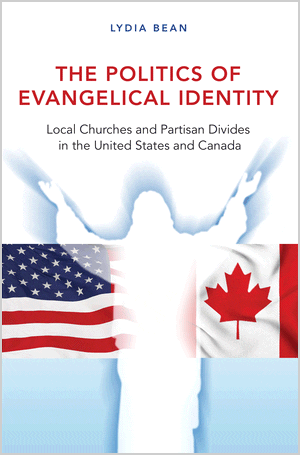
Dr. Lydia Bean suggests one answer in her book The Politics of Evangelical Identity: Local Churches and Partisan Divides in the United States and Canada. Bean, formerly a sociology professor at Baylor, studied local congregations in Buffalo, N.Y., and in Hamilton, Ontario to understand “Why Canadian Evangelicals Are Different.”
And they are different. They are, shockingly to some here in the U.S., not Republicans. Canada, it turns out, doesn’t have Republicans. And yet they still have white evangelicals. How can this be?
Canada’s white evangelicals, like their American counterparts, tend to be more conservative, but not nearly as partisan. Their identity — their sense of self, of who they are — is not defined by partisan politics the way it is here in America.
(I should note that the discussion of Bean’s book I’m linking to here involves a bit of transparent nepotism. But we shouldn’t fault the author for her father’s enthusiastic recommendation. What makes this awkward here is that I’ll be quoting from Alan Bean as he summarizes the argument of Lydia Bean.)
Alan Bean writes:
American evangelicals have engineered a highly partisan and politicized religion rooted in narratives of Christian nationalism and visions of national revival that results in an almost Manichean drama pitting good against evil. Economic and political forms of conservatism have taken on a sacred quality by being associated with the intimate “identity-work” of congregational life. …
Religious identity has become “so closely intertwined with partisanship,” [Lydia] Bean says, that it has become “socially impossible for evangelicals to identify with the Democratic Party.”
The key here is this notion of identification. Identity is the thing that tribal gatekeepers are in the business of protecting, defining and defending. To identify as anything other than Republican is to be identified as an outsider — as no longer a part of the tribe. To fail to identify as a Republican means your identity will be redefined as no longer evangelical.
Hence the current popularity of the term “post-evangelical.” I’m an evangelical Christian and also a Democrat, I say. No you’re not, say the tribal gatekeepers. If you’re a Democrat then you are, henceforth, a post-evangelical.
This is not a doctrinal or theological category. Nor does it have anything at all to do with the temperaments of the Bebbington quadrilateral. “Post-evangelical” is a partisan political category. It is, roughly, a synonym for born-again white Protestants who vote for Democrats.
And just as “Who do we say that we are?” has been redefined and re-answered according to partisan political criteria, those same Republican criteria have redefined and re-answered that more essential question of “Who do you say that I am?”
Flesh and blood hath not revealed this new answer unto American evangelicalism, but neither did it come from Heaven.
Alan Bean writes:
Beginning in the 1940s, [Lydia] Bean argues, religious and political elites worked out a form of Christian nationalism that created a fearsome symmetry between conservative theology, small-government politics and laissez-faire economics.
In other words, “evangelicalism became bundled with small-government conservatism through a historical process of partisan coalition-building.” “The Christian Right,” [Lydia] Bean argues, “has not just ‘represented’ the values and policy priorities of evangelicals; it has served as an internal movement to shape what these values and policy priorities should be.”
Ding. Yes. The religious right — anti-integrationism transmuted into a surrogate anti-abortionism — did not arise as a political manifestation of the agenda favored by a “moral majority” of evangelicals, it reshaped evangelical identity to circumscribe everything and anything other than support for its political agenda.
American evangelicals, [Lydia] Bean discovered, didn’t reason from religious principles to conservative political and economic views; they imbibed their partisan religious views from the environment that engulfed them on all sides.
The species of religion [Lydia] Bean encountered in the American evangelical churches she studied was a marriage of convenience that had been cobbled together by conservative think tanks and para-church ministries. This movement was heavily reliant upon culture war captains, congregational opinion leaders who imbibed this new nationalistic religion outside the cloistered world of established evangelical life and carried it back to their congregations.
But regardless of whether culture war captains picked up their new partisan world view from the anti-abortion movement or a Focus on the Family conference, they were immersed in all the symbols, songs and therapeutic messaging they grew up with in their churches.
… This constant interplay between prayer for person issues and prayer for the nation lent a sacred aspect to the fight against abortion. This explains the central place of anti-abortion rhetoric within the Christian Right. According to [Lydia] Bean,
Abortion has become sacred for rank-and-file evangelicals because it strengthens a sense of cultural tension with their environment. Understood as a spiritual drama between good and evil, the pro-life cause helps Christians to define their moral and social boundaries against the world.
“The world,” in this case, being the evil side of that “spiritual drama between good and evil.” You know, the Satanic baby-killers.
Alan Bean summarizes one implication of his daughter’s research:
Until we can create new forms of religious community in which solidarity with the poor, creation care and racial reconciliation become sacred through integration into the everyday community life of real congregations, we can’t compete with the Christian Right.
He worries that this seems “unrealistic,” but I’m more hopeful. I think those new forms of religious community are already here, and they’re growing — maybe not in “real congregations,” but certainly in virtual ones. And because those communities recognize the sacredness of care for others and for justice, they can offer a better, truer, more compelling answer to that bedrock question of “Who do you say that I am?”
Previous Post

September 22, 2014
Religion and justice: Two corruptions
Next Post
September 23, 2014 'Around the Web'
Browse Our Archives
Select a Category class warfare evangelicals Iraq Left Behind Mammon music Uncategorized
Select a Month October 2026 September 2026 August 2026 July 2026 June 2026 May 2026 April 2026 March 2026 January 2026 December 2025 November 2025 October 2025 September 2025 August 2025 July 2025 June 2025 May 2025 April 2025 March 2025 February 2025 January 2025 December 2024 November 2024 October 2024 September 2024 August 2024 July 2024 June 2024 May 2024 April 2024 March 2024 February 2024 January 2024 December 2023 November 2023 October 2023 September 2023 August 2023 July 2023 June 2023 May 2023 April 2023 March 2023 February 2023 January 2023 December 2022 November 2022 October 2022 September 2022 August 2022 July 2022 June 2022 May 2022 April 2022 March 2022 February 2022 January 2022 December 2021 November 2021 October 2021 September 2021 August 2021 July 2021 June 2021 May 2021 April 2021 March 2021 February 2021 January 2021 December 2020 November 2020 October 2020 September 2020 August 2020 July 2020 June 2020 May 2020 April 2020 March 2020 February 2020 January 2020 December 2019 November 2019 October 2019 September 2019 August 2019 July 2019 June 2019 May 2019 April 2019 March 2019 February 2019 January 2019 December 2018 November 2018 October 2018 September 2018 August 2018 July 2018 June 2018 May 2018 April 2018 March 2018 February 2018 January 2018 December 2017 November 2017 October 2017 September 2017 August 2017 July 2017 June 2017 May 2017 April 2017 March 2017 February 2017 January 2017 December 2016 November 2016 October 2016 September 2016 August 2016 July 2016 June 2016 May 2016 April 2016 March 2016 February 2016 January 2016 December 2015 November 2015 October 2015 September 2015 August 2015 July 2015 June 2015 May 2015 April 2015 March 2015 February 2015 January 2015 December 2014 November 2014 October 2014 September 2014 August 2014 July 2014 June 2014 May 2014 April 2014 March 2014 February 2014 January 2014 December 2013 November 2013 October 2013 September 2013 August 2013 July 2013 June 2013 May 2013 April 2013 March 2013 February 2013 January 2013 December 2012 November 2012 October 2012 September 2012 August 2012 July 2012 June 2012 May 2012 April 2012 March 2012 February 2012 January 2012 December 2011 November 2011 October 2011 September 2011 August 2011 July 2011 June 2011 May 2011 April 2011 March 2011 February 2011 January 2011 December 2010 November 2010 October 2010 September 2010 August 2010 July 2010 June 2010 May 2010 April 2010 March 2010 February 2010 January 2010 December 2009 November 2009 October 2009 September 2009 August 2009 July 2009 June 2009 May 2009 April 2009 March 2009 February 2009 January 2009 December 2008 November 2008 October 2008 September 2008 August 2008 July 2008 June 2008 May 2008 April 2008 March 2008 February 2008 January 2008 December 2007 November 2007 October 2007 September 2007 August 2007 July 2007 June 2007 May 2007 April 2007 March 2007 February 2007 January 2007 December 2006 November 2006 October 2006 September 2006 August 2006 July 2006 June 2006 May 2006 April 2006 March 2006 February 2006 January 2006 December 2005 November 2005 October 2005 September 2005 August 2005 July 2005 June 2005 May 2005 April 2005 March 2005 February 2005 January 2005 December 2004 November 2004 October 2004 September 2004 August 2004 July 2004 June 2004 May 2004 April 2004 March 2004 February 2004 January 2004 December 2003 November 2003 October 2003 September 2003
Follow Us!
TAKE THE
Religious Wisdom Quiz
Who predicted the fall of Jerusalem?
Select your answer to see how you score.
Daniel Isaiah Jesus Jeremiah
Related posts from slacktivist

Is this the right room for an argument?

The Amish are not 'Evangelicals.' They're Amish.

The lumpers, the splitters, and me

'Is it right on red or left on...
TRENDING AT PATHEOS Progressive Christian

Emotion in Early Christianity by Andrew Crislip
Andrew Crislip’s Emotion in Early Christianity examines an often overlooked dimension of...

16 Spiritual Touchstones for a More Grounded Life
After decades of spiritual study, here are 16 principles I try...

Catholic Evangelization: Sharing Your Faith Every Day
Welcome back to the Graceful Awakening mini-series called, “From Faith to Mission.” ...

The Pillar of the Boatmen: the Ancient Monument...
The Pillar of the Boatmen is a Romano-Gaulish sculpture that dates from...

In one sense walking into Westminster Abbey is like walking down the...

'Super Scam Me' Exposes AI Jon Bon Jovi...
Leslie Pickett believed she was in a relationship with Jon Bon Jovi....
view all Progressive Christian blogs
Ad-Free & Subscriber Log-In Subscription Support
- About Us
- 2026 Calendar
- Videos
- Podcasts
- Library of World Religions
- Faith In Media Tracker
- Advertise With Us
- Write for Us
- Privacy Policy
- Terms of Service
- Do Not Sell My Data
- Contact Us
- Radiant Digital
- Manage Newsletter Subscriptions
- Unsubscribe From Notifications
- Sitemap
Copyright 2008-2026, Patheos. All rights reserved.
Subscription Support Ad-Free & Subscriber Log-In
Follow Patheos