
BuddhistCatholicContemplativeEvangelicalGeneral ChristianHinduJewishLatter-day SaintMuslimNew VisionsProgressive Christian
Beliefs
- Buddhist
- Catholic
- Contemplative
- Evangelical
- General Christian
- Hindu
- Jewish
- Latter-day Saint
- More Voices
- Muslim
- New Visions
- Pagan
- Progressive Christian
Topics
- Religion News
- Food and Religion
- Sports and Religion
- Religious Art
- Religious Music and Entertainment
- Religious Events
- History and Religion
- Style and Religion
- Politics and Religion
- Women in Religion
- Recreation Outdoors and Religion
- Business Finance and Religion
- Careers Workplace and Religion
- Education and Religion
- Family Parenting and Religion
- Health Fitness and Religion
- Home and Religion
- Relationships and Religion
- Technology and Religion
- Travel and Religion
Columnists
- Buddhist Columnists
- Business Finance and Religion Columnists
- Careers Workplace and Religion Columnists
- Catholic Columnists
- Contemplative Columnists
- Education and Religion Columnists
- Evangelists Columnists
- Family Parenting and Religion Columnists
- General Christian Columnists
- Health Fitness and Religion Columnists
- Hindu Columnists
- History and Religion Columnists
- Home and Religion Columnists
- Jewish Columnists
- More Voices Columnists
- Latter Day Columnists
- Muslim Columnists
- New Visions Columnists
- Nonreligious Columnists
- Pagan Columnists
- Politics and Religion Columnists
- Progressive Columnists
- Recreation Outdoors and Religion Columnists
- Relationships and Religion Columnists
- Religion News Columnists
- Religious Art Columnists
- Religious Events Columnists
- Religious Music and Entertainment Columnists
- Sports and Religion Columnists
- Style and Religion Columnists
- Technology and Religion Columnists
- Travel and Religion Columnists
- Women in Religion Columnists
Resource Library
- 2026 Calendar
- Library of World Religions
- The 100 Most Holy Places on Earth
- Patheos Answers
- Podcasts
- Videos
- Faith Leaders Database
- Anglican Episcopalian
- Bahai
- Baptist
- Buddhism
- Christianity
- Confucianism
- Eastern Orthodoxy
- Hinduism
- Holiness and Pentecostal
- ISKCON
- Islam
- Judaism
- Lutheran
- Methodist
- The Church of Jesus Christ of Latter-day Saints
- New Age
- Paganism
- Presbytarian and Reformed
- Protestantism
- Religion Behind the Scenes
- Roman Catholic
- Scientology
- Shia Islam
- Sikhism
- Sufism
- Sunni Islam
- Taoism
- Zen
- See all religions
Research Tools
 Ad-Free & Subscriber Log-In Subscription Support
Ad-Free & Subscriber Log-In Subscription Support
Follow Patheos 

- Trending:
- Forgiveness
- |
- Marriage
- |
- Consciousness
- |
- Death Penalty
- |
- Election
- |
- Halloween

- Home
- Progressive Christian
- ‘Ambiguity proposes, preference disposes’: We have to choose
‘Ambiguity proposes, preference disposes’: We have to choose
Last updated on: June 17, 2014 at 4:17 pm by Fred Clark
‘Ambiguity proposes, preference disposes’: We have to choose 2014-06-17T16:17:52-04:00 Fred Clark
Patheos Explore the world's faith through different perspectives on religion and spirituality! Patheos has the views of the prevalent religions and spiritualities of the world.
“It’s simple,” my friend says. “I believe the whole Bible, just as it is.”
But if he thinks that’s simple, then I suspect he’s never read the whole Bible, just as it is.
To read the Bible is to interpret the Bible, which is to say it requires us to choose between possible meanings. This choosing is constant and unavoidable. There is no such thing as reading the Bible without making such choices. Those, like my friend, who imagine that they are reading the Bible without choosing are simply choosing subconsciously, or unconsciously. Or blindly accepting the choices made by others.
We have to choose. We cannot read the Bible without choosing.
Start at the beginning. Start at “In the beginning …” in Genesis 1:1. The first 34 verses of the Bible give us a creation story in which God creates the universe in six days. First the light, then the dry land, then plants, fish and so on, until finally, on the sixth day, God creates a bunch of humans. That’s the first story.
But that first story is immediately followed by a second story, beginning in Genesis 2:4. That second story is very different. It all takes place on a single day, with God first creating a single man, and then after that creating animals and plants and all the rest.
These two stories share many similar themes, but their sequence and chronology cannot be reconciled. Those like my friend, who insist that the Bible’s self-evident meaning requires no interpretation, have developed elaborate schemes to “harmonize” these two very different stories. Regardless of whether or not such schemes can actually be made to work,* the undeniable fact is that these “harmonizations” are not, themselves, a part of the text. They are external mechanisms brought to the text from outside of the text, which is to say that they are interpretations — choices.
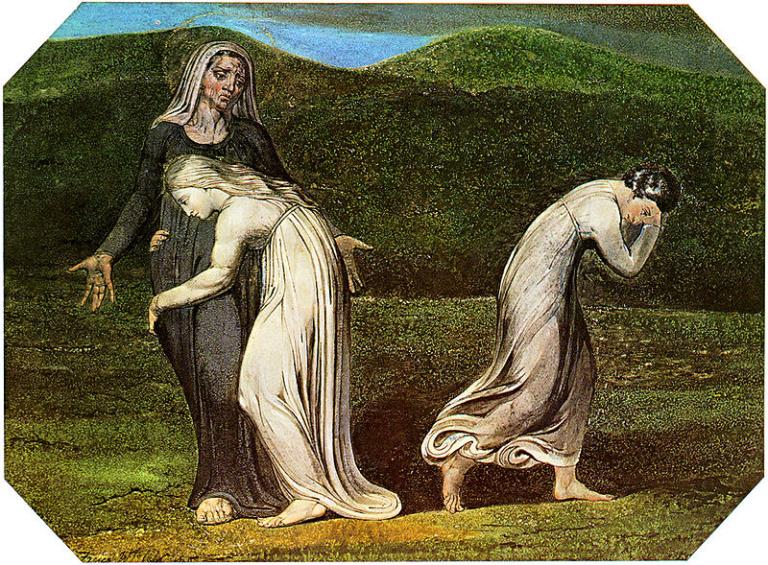
“It was found written that no Moabite should ever enter the assembly of God” — Nehemiah 13:1. (“Naomi entreating Ruth and Orpah to return to the land of Moab,” William Blake, 1795)
The Bible always forces us to choose because the Bible is ambiguous, and ambiguity requires us to make a choice.
The ambiguity introduced right from the beginning starts even sooner than my discussion of Genesis 1 and 2 suggests, because Genesis 1:1 doesn’t actually say “In the beginning.” What it says, rather, is בְּרֵאשִׁית. The Bible wasn’t written in English, but in Hebrew. Does the process of translating that Hebrew text into an English text introduce further unavoidable ambiguity? Does a bereshit in the woods? To translate is to interpret. To translate is to choose.
Skip ahead to the beginning of the New Testament. Here again we are given multiple versions of a story — all similar, but not all reconcilable. Matthew, Mark and Luke repeat many of the same stories, but not in the same order and they alter the details. Again, those who like to pretend their interpretation involves no interpretation have devised complex systems attempting to “harmonize” the Gospels. And again, regardless of whether or not such schemes can actually be made to work,* these harmonizations are, themselves, undeniably not a part of the original texts. They are a separate construct imposed on the text by those who have chosen to employ such a construct. They are a choice — one of many possible choices in response to the ambiguity of the text itself, which always requires that we choose.
Systematic theology tends to be more thoughtful and more careful than those clumsy attempts to “harmonize” the Gospels, but even the most sophisticated systematic theology runs into the same need to interpret and to choose between possible meanings. Consider the matter of christology in the Gospels. Luke’s christology is not the same as Mark’s christology, and John’s christology is very different from both of those. A good systematic theologian will synthesize an overall christology that attempts to honor and include all of these Gospel perspectives (along with the various other New Testament christologies found in Paul or in Revelation). Such a synthesis can provide us with a single “biblical” christology, but that end result gives us a “biblical” christology that is not the same as Luke’s christology or John’s christology. That seems to put us in the awkward position of saying that we have a biblical theology, while the original evangelists who wrote the Gospels did not.
Again, I’m not concerned with whether such syntheses and systematic theologies are right or wrong. My point here is that they are interpretations that we must choose to accept or to reject.
This isn’t a new phenomenon. The Bible has always required its readers to choose between ambiguous meanings.
Let’s look again at one of my favorite examples of this, a story from the Bible in which people read from the Bible.
Acts 15 tells us about an argument among the leaders of the early church over the status of Gentile believers. James gets up and speaks in favor of including these unclean outsiders in the community of believers. He quotes the Bible in support of this position:
“This agrees with the words of the prophets, as it is written, ‘After this I will return, and I will rebuild the dwelling of David, which has fallen; from its ruins I will rebuild it, and I will set it up, so that all other peoples may seek the Lord.'”
He’s quoting there from the book of Amos — Amos 9:11-12. But here’s the odd thing: according to the book of Amos in our Bible, he’s quoting it wrong.
Keep one finger there in Acts 15 and turn to that passage in Amos in the same Bible you’re holding there in your hands. You won’t find what James says there in Amos. Instead, you’ll read something like this:
On that day I will raise up the booth of David that is fallen, and repair its breaches, and raise up its ruins, and rebuild it as in the days of old; in order that they may possess the remnant of Edom.
That’s not the same at all. That says the opposite of what James says it said.
James is there in Acts 15, claiming that Amos 9:11-12 tells us that the dwelling of David will be built up “so that all other peoples may seek the Lord,” but when we turn there ourselves we find Amos saying, instead, that the dwelling of David will be built up so that David’s people “may possess the remnant of Edom.”
One choice offers a radically inclusive view in which Israel was chosen so that salvation could come to every last person on earth. The other choice offers a radically exclusive view in which Israel was chosen so that it could utterly vanquish every last remnant of its enemies.
And they’re both right there in the same Bible. You’ve got one finger stuck in a passage defending one choice and another finger stuck in a passage defending its opposite. And these conflicting meanings don’t even come from two different passages — they come from the exact same two verses. What gives?
This particular ambiguity has to do, in part, with the difficulty of translation — and in particular the difficulty of translation involving a language without written vowels. Plug one set of vowels into those verses in Amos — as the translators of the text we get our “Old Testament” from did — and you wind up with “that they may possess the remnant of Edom.” Plug in a different set of vowels — as James did at the Council of Jersualem — and you wind up with “that all other peoples may seek the Lord.”
But this quirk in translation is only possible because of the larger, pre-existing ambiguity between those exclusive and inclusive viewpoints. Ambiguity proposes, preference disposes. That ambiguity — that perennial argument — between exclusion and inclusion pervades the entirety of scripture. And preference predisposes which side of that argument we choose to endorse.
“I cleansed them from everything foreign,” Nehemiah boasts, after striking a blow for Team Exclusion by overseeing a mass divorce and expelling all foreigners from Jerusalem. In response, the author of Jonah writes for Team Inclusion. “And should I not be concerned about Nineveh, that great city?”
Nehemiah seemed certain that his expulsion of foreigners was based on a simple reading of the Bible, just as it is. “On that day they read from the book of Moses in the hearing of the people; and in it was found written that no Ammonite or Moabite should ever enter the assembly of God.” So what then are we to make of the book of Ruth — the story of King David’s Moabite great-grandmother? We have to choose. We can choose Nehemiah’s ruthless exclusion, or Jonah’s radical inclusion. Or we can try to choose some convoluted scheme to harmonize or synthesize the two. But that’s still a choice, regardless of whether or not such schemes can actually be made to work.*
We always have to choose.
– – – – – – – – – – – – –
* Such schemes cannot actually be made to work.
Previous Post

June 17, 2014
This is not good news. This is not salvation.
Next Post
June 18, 2014 Avoid any book with 'leadership' in the title
Browse Our Archives
Select a Category class warfare evangelicals Iraq Left Behind Mammon music Uncategorized
Select a Month October 2026 September 2026 August 2026 July 2026 June 2026 May 2026 April 2026 March 2026 January 2026 December 2025 November 2025 October 2025 September 2025 August 2025 July 2025 June 2025 May 2025 April 2025 March 2025 February 2025 January 2025 December 2024 November 2024 October 2024 September 2024 August 2024 July 2024 June 2024 May 2024 April 2024 March 2024 February 2024 January 2024 December 2023 November 2023 October 2023 September 2023 August 2023 July 2023 June 2023 May 2023 April 2023 March 2023 February 2023 January 2023 December 2022 November 2022 October 2022 September 2022 August 2022 July 2022 June 2022 May 2022 April 2022 March 2022 February 2022 January 2022 December 2021 November 2021 October 2021 September 2021 August 2021 July 2021 June 2021 May 2021 April 2021 March 2021 February 2021 January 2021 December 2020 November 2020 October 2020 September 2020 August 2020 July 2020 June 2020 May 2020 April 2020 March 2020 February 2020 January 2020 December 2019 November 2019 October 2019 September 2019 August 2019 July 2019 June 2019 May 2019 April 2019 March 2019 February 2019 January 2019 December 2018 November 2018 October 2018 September 2018 August 2018 July 2018 June 2018 May 2018 April 2018 March 2018 February 2018 January 2018 December 2017 November 2017 October 2017 September 2017 August 2017 July 2017 June 2017 May 2017 April 2017 March 2017 February 2017 January 2017 December 2016 November 2016 October 2016 September 2016 August 2016 July 2016 June 2016 May 2016 April 2016 March 2016 February 2016 January 2016 December 2015 November 2015 October 2015 September 2015 August 2015 July 2015 June 2015 May 2015 April 2015 March 2015 February 2015 January 2015 December 2014 November 2014 October 2014 September 2014 August 2014 July 2014 June 2014 May 2014 April 2014 March 2014 February 2014 January 2014 December 2013 November 2013 October 2013 September 2013 August 2013 July 2013 June 2013 May 2013 April 2013 March 2013 February 2013 January 2013 December 2012 November 2012 October 2012 September 2012 August 2012 July 2012 June 2012 May 2012 April 2012 March 2012 February 2012 January 2012 December 2011 November 2011 October 2011 September 2011 August 2011 July 2011 June 2011 May 2011 April 2011 March 2011 February 2011 January 2011 December 2010 November 2010 October 2010 September 2010 August 2010 July 2010 June 2010 May 2010 April 2010 March 2010 February 2010 January 2010 December 2009 November 2009 October 2009 September 2009 August 2009 July 2009 June 2009 May 2009 April 2009 March 2009 February 2009 January 2009 December 2008 November 2008 October 2008 September 2008 August 2008 July 2008 June 2008 May 2008 April 2008 March 2008 February 2008 January 2008 December 2007 November 2007 October 2007 September 2007 August 2007 July 2007 June 2007 May 2007 April 2007 March 2007 February 2007 January 2007 December 2006 November 2006 October 2006 September 2006 August 2006 July 2006 June 2006 May 2006 April 2006 March 2006 February 2006 January 2006 December 2005 November 2005 October 2005 September 2005 August 2005 July 2005 June 2005 May 2005 April 2005 March 2005 February 2005 January 2005 December 2004 November 2004 October 2004 September 2004 August 2004 July 2004 June 2004 May 2004 April 2004 March 2004 February 2004 January 2004 December 2003 November 2003 October 2003 September 2003
Follow Us!
TAKE THE
Religious Wisdom Quiz
Who said, "I can do all things through Christ who strengthens me"?
Select your answer to see how you score.
James John Peter Paul
Related posts from slacktivist

It's not 'pick and choose.' It's pick a...

Is this the right room for an argument?

Team Everybody sliding into our DMs

TRENDING AT PATHEOS Progressive Christian

The Iron Gates and the Lion of the...
Yesterday, I didn't finish my report about, well, yesterday. So I'll...

Dolly Parton’s Last Song Wins Dove Award with...
Bluegrass band The Grascals, speaking on the red carpet at the 57th...

The Image: On the Horror of Capitalism and...
The Image Then went the Pharisees, and took counsel how they might...

We are approaching the date of our new American national holiday: October...

Letters on Living the Faith by C.S. Lewis
Most of us met C.S. Lewis as a public intellectual. Mere Christianity....

When Halloween Unmasks Married Hearts
Written by Dr. David K. Ewen from Eternal Truth Bible College Behind...
view all Progressive Christian blogs
Ad-Free & Subscriber Log-In Subscription Support
- About Us
- 2026 Calendar
- Videos
- Podcasts
- Library of World Religions
- Faith In Media Tracker
- Advertise With Us
- Write for Us
- Privacy Policy
- Terms of Service
- Do Not Sell My Data
- Contact Us
- Radiant Digital
- Manage Newsletter Subscriptions
- Unsubscribe From Notifications
- Sitemap
Copyright 2008-2026, Patheos. All rights reserved.
Subscription Support Ad-Free & Subscriber Log-In
Follow Patheos