
BuddhistCatholicContemplativeEvangelicalGeneral ChristianHinduJewishLatter-day SaintMuslimNew VisionsProgressive Christian
Beliefs
- Buddhist
- Catholic
- Contemplative
- Evangelical
- General Christian
- Hindu
- Jewish
- Latter-day Saint
- More Voices
- Muslim
- New Visions
- Pagan
- Progressive Christian
Topics
- Religion News
- Food and Religion
- Sports and Religion
- Religious Art
- Religious Music and Entertainment
- Religious Events
- History and Religion
- Style and Religion
- Politics and Religion
- Women in Religion
- Recreation Outdoors and Religion
- Business Finance and Religion
- Careers Workplace and Religion
- Education and Religion
- Family Parenting and Religion
- Health Fitness and Religion
- Home and Religion
- Relationships and Religion
- Technology and Religion
- Travel and Religion
Columnists
- Buddhist Columnists
- Business Finance and Religion Columnists
- Careers Workplace and Religion Columnists
- Catholic Columnists
- Contemplative Columnists
- Education and Religion Columnists
- Evangelists Columnists
- Family Parenting and Religion Columnists
- General Christian Columnists
- Health Fitness and Religion Columnists
- Hindu Columnists
- History and Religion Columnists
- Home and Religion Columnists
- Jewish Columnists
- More Voices Columnists
- Latter Day Columnists
- Muslim Columnists
- New Visions Columnists
- Nonreligious Columnists
- Pagan Columnists
- Politics and Religion Columnists
- Progressive Columnists
- Recreation Outdoors and Religion Columnists
- Relationships and Religion Columnists
- Religion News Columnists
- Religious Art Columnists
- Religious Events Columnists
- Religious Music and Entertainment Columnists
- Sports and Religion Columnists
- Style and Religion Columnists
- Technology and Religion Columnists
- Travel and Religion Columnists
- Women in Religion Columnists
Resource Library
- 2026 Calendar
- Library of World Religions
- The 100 Most Holy Places on Earth
- Patheos Answers
- Podcasts
- Videos
- Faith Leaders Database
- Anglican Episcopalian
- Bahai
- Baptist
- Buddhism
- Christianity
- Confucianism
- Eastern Orthodoxy
- Hinduism
- Holiness and Pentecostal
- ISKCON
- Islam
- Judaism
- Lutheran
- Methodist
- The Church of Jesus Christ of Latter-day Saints
- New Age
- Paganism
- Presbytarian and Reformed
- Protestantism
- Religion Behind the Scenes
- Roman Catholic
- Scientology
- Shia Islam
- Sikhism
- Sufism
- Sunni Islam
- Taoism
- Zen
- See all religions
Research Tools
 Ad-Free & Subscriber Log-In Subscription Support
Ad-Free & Subscriber Log-In Subscription Support
Follow Patheos 

- Trending:
- Forgiveness
- |
- Marriage
- |
- Consciousness
- |
- Death Penalty
- |
- Election
- |
- Halloween

- Home
- Progressive Christian
- Dulce et decorum est pro patria mori
Dulce et decorum est pro patria mori
Last updated on: May 27, 2014 at 1:42 am by Fred Clark
Dulce et decorum est pro patria mori 2014-05-27T01:42:22-04:00 Fred Clark
Patheos Explore the world's faith through different perspectives on religion and spirituality! Patheos has the views of the prevalent religions and spiritualities of the world.
Memorial Day is one time during the year when American civil religion imitates one of my least favorite aspects of the white evangelical Christianity that I was raised in. It takes the kernel of an idea of something right and honorable and spins it into a defensive, sanctimonious, performative ritual — one which makes sincerity and truth-telling almost impossible.
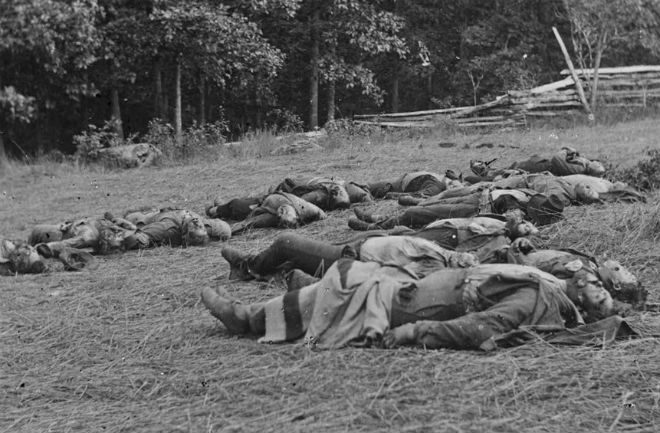
Confederate soldiers slain during their attack on the United States. These men did not fight and die for freedom.
It is a time, in other words, when we say that which we are expected to say, even if — and perhaps especially if — we know it is not true. We say what we are expected and directed and required to say because we are being watched and monitored and evaluated for our willingness to say it. The point is not about saying what we believe to be true, but rather about affirming our membership in the tribe of people who recite such affirmations. This recitation is not optional. Those who fail to make it with the appropriate simulacrum of sincerity will be sanctioned.
“Can we tell the truth on Memorial Day?” Craig M. Watts asks at Red Letter Christians. And the answer, I think, is No — not if we know what’s good for us.
“I have told the whole truth in that,” Mark Twain said, “and only dead men can tell the truth in this world. It can be published after I am dead.” He was speaking of “The War Prayer” — a harshly satiric fable in which Twain wrote some of the truth that American civil religion forbids us to acknowledge on Memorial Day.
Watts is more hopeful than Twain. He believes that truth-telling is possible, if difficult. “While some truth is given voice on this solemn occasion, there are other important truths that are distorted in the telling or pushed from memory altogether,” Watts writes:
Too often on Memorial Day, rather than remembering individuals who tragically died in battle, an idealized version of the war dead is presented. The dead are indiscriminately described as “heroes.” Sweeping claims are made about the reason for their deaths: they died to “protect our freedom.” And in particular in churches we are told they died for the freedom of religion, the freedom to worship.
We are told soldiers “sacrificed themselves,” though they were actually sacrificed by politicians who sent them to war. And in churches scriptures are quoted to leave the impression they died as martyrs for their faith: “those who lose their life for my sake will find it” (Matthew 16:25).
Watts proposes three questions for Memorial Day, all of which are good questions. Here, though, let’s just focus on the first one:
(1) Can we remember without attributing reasons for war that aren’t in fact the real reasons? To celebrate Memorial Day by claiming soldiers died that we might be free is misleading. The real causes behind most wars have had little to do with protecting freedom of speech or assembly or worship. … Can we remember in a way that doesn’t falsify the causes of war, justify national self-righteousness, or turn Memorial Day into a recruiting tool to entice the young to enter the armed forces?
I understand that this ritual assertion of a falsehood — the war dead “died that we might be free” — is intended in part to ascribe the greatest possible honor to those who gave the last full measure of devotion. But if we owe them our gratitude, then we also owe them our honesty. The pretense that all wars, or even most wars, are fought to defend our freedom does not so much honor our war dead as it does guarantee that we’ll keep making more of them.
As Watts notes, the honor and gratitude at the heart of Memorial Day are appropriate. “Those Americans who suffered and died in war ought to be remembered,” he writes. We have a duty and an obligation to remember them and to honor their memory:
The grave difficulties endured by of those who faced armed conflict and lost their lives should be recognized. The soldiers’ best intentions in allowing themselves to be put in harm’s way – regardless of the actual reasons for war — deserve to be honored. But in the process, war itself should not be honored, the reasons for war whitewashed, nor should the suffering and the deaths of others be ignored.
And the whitewashing of the reasons for war starts, I think, with this ritual incantation of the false claim that war is perpetually necessary if we are to remain free.
That is not true in the particulars nor is it true in the abstract and in general. Richard III did not say, “First, kill all the soldiers.” No tyrant has ever said such a thing. Tyrants like Richard need soldiers. They need someone to carry out that order, “First, kill all the lawyers” Or all the journalists, the prophets, the educators, the demonstrators. Nowadays, many tyrants and would-be tyrants seem to be saying “First, kill all the school girls.”
The cultic ritual glorification of war is not necessary to defend freedom. It may well be necessary, though, for getting rid of it. It is, at least, immensely useful for that purpose.
Here in America, Memorial Day began after the Civil War as a way of remembering and honoring those who died in that conflict. It was, and still is, a pale shadow of the true memorial that honors those more than 600,000 dead — the 13th Amendment, 14th Amendment and 15th Amendment. America has been at war for most of my lifetime and most of those wars have done more to undermine those laws than they have to defend them.
I’ll tell you what Memorial Day is all about, Charlie Brown. Lights please:
No state shall make or enforce any law which shall abridge the privileges or immunities of citizens of the United States; nor shall any state deprive any person of life, liberty, or property, without due process of law; nor deny to any person within its jurisdiction the equal protection of the laws.
Previous Post

May 25, 2014
Smart people saying smart things (5.25)
Next Post
May 27, 2014 Remember, remember from where you came
Browse Our Archives
Select a Category class warfare evangelicals Iraq Left Behind Mammon music Uncategorized
Select a Month October 2026 September 2026 August 2026 July 2026 June 2026 May 2026 April 2026 March 2026 January 2026 December 2025 November 2025 October 2025 September 2025 August 2025 July 2025 June 2025 May 2025 April 2025 March 2025 February 2025 January 2025 December 2024 November 2024 October 2024 September 2024 August 2024 July 2024 June 2024 May 2024 April 2024 March 2024 February 2024 January 2024 December 2023 November 2023 October 2023 September 2023 August 2023 July 2023 June 2023 May 2023 April 2023 March 2023 February 2023 January 2023 December 2022 November 2022 October 2022 September 2022 August 2022 July 2022 June 2022 May 2022 April 2022 March 2022 February 2022 January 2022 December 2021 November 2021 October 2021 September 2021 August 2021 July 2021 June 2021 May 2021 April 2021 March 2021 February 2021 January 2021 December 2020 November 2020 October 2020 September 2020 August 2020 July 2020 June 2020 May 2020 April 2020 March 2020 February 2020 January 2020 December 2019 November 2019 October 2019 September 2019 August 2019 July 2019 June 2019 May 2019 April 2019 March 2019 February 2019 January 2019 December 2018 November 2018 October 2018 September 2018 August 2018 July 2018 June 2018 May 2018 April 2018 March 2018 February 2018 January 2018 December 2017 November 2017 October 2017 September 2017 August 2017 July 2017 June 2017 May 2017 April 2017 March 2017 February 2017 January 2017 December 2016 November 2016 October 2016 September 2016 August 2016 July 2016 June 2016 May 2016 April 2016 March 2016 February 2016 January 2016 December 2015 November 2015 October 2015 September 2015 August 2015 July 2015 June 2015 May 2015 April 2015 March 2015 February 2015 January 2015 December 2014 November 2014 October 2014 September 2014 August 2014 July 2014 June 2014 May 2014 April 2014 March 2014 February 2014 January 2014 December 2013 November 2013 October 2013 September 2013 August 2013 July 2013 June 2013 May 2013 April 2013 March 2013 February 2013 January 2013 December 2012 November 2012 October 2012 September 2012 August 2012 July 2012 June 2012 May 2012 April 2012 March 2012 February 2012 January 2012 December 2011 November 2011 October 2011 September 2011 August 2011 July 2011 June 2011 May 2011 April 2011 March 2011 February 2011 January 2011 December 2010 November 2010 October 2010 September 2010 August 2010 July 2010 June 2010 May 2010 April 2010 March 2010 February 2010 January 2010 December 2009 November 2009 October 2009 September 2009 August 2009 July 2009 June 2009 May 2009 April 2009 March 2009 February 2009 January 2009 December 2008 November 2008 October 2008 September 2008 August 2008 July 2008 June 2008 May 2008 April 2008 March 2008 February 2008 January 2008 December 2007 November 2007 October 2007 September 2007 August 2007 July 2007 June 2007 May 2007 April 2007 March 2007 February 2007 January 2007 December 2006 November 2006 October 2006 September 2006 August 2006 July 2006 June 2006 May 2006 April 2006 March 2006 February 2006 January 2006 December 2005 November 2005 October 2005 September 2005 August 2005 July 2005 June 2005 May 2005 April 2005 March 2005 February 2005 January 2005 December 2004 November 2004 October 2004 September 2004 August 2004 July 2004 June 2004 May 2004 April 2004 March 2004 February 2004 January 2004 December 2003 November 2003 October 2003 September 2003
Follow Us!
TAKE THE
Religious Wisdom Quiz
In what parable does a father run to greet his lost son?
Select your answer to see how you score.
The Prodigal Son The Lost Sheep The Two Sons The Rich Man and Lazarus
Related posts from slacktivist

A pickpocket snatches watches ...
Postcards from the class & culture wars (12.4.19)
Postcards from the class & culture wars (11.6.19)
TRENDING AT PATHEOS Progressive Christian

Nearly every morning, I make the drive to Detroit with my high-school-age...

The Real AI Story Is Adoption Without Trust
Artificial intelligence has crossed a political threshold. It is no longer a...

A new article, written by Jeff Lindsay and Gale L. Pooley,...

Swimfan: Forgotten Aughts Pleasures
This is a recovery effort. In 2002, My Big Fat Greek Wedding...

Top Three Anti-Catholic Lies About Catholicism
This is my initial transcript for the video, "THE 3 WORST...

Pope Leo Celebrates Mass for Nurses & Docs...
I don't have any idea how he did it, but Pope Leo...
view all Progressive Christian blogs
Ad-Free & Subscriber Log-In Subscription Support
- About Us
- 2026 Calendar
- Videos
- Podcasts
- Library of World Religions
- Faith In Media Tracker
- Advertise With Us
- Write for Us
- Privacy Policy
- Terms of Service
- Do Not Sell My Data
- Contact Us
- Radiant Digital
- Manage Newsletter Subscriptions
- Unsubscribe From Notifications
- Sitemap
Copyright 2008-2026, Patheos. All rights reserved.
Subscription Support Ad-Free & Subscriber Log-In
Follow Patheos