
BuddhistCatholicContemplativeEvangelicalGeneral ChristianHinduJewishLatter-day SaintMuslimNew VisionsProgressive Christian
Beliefs
- Buddhist
- Catholic
- Contemplative
- Evangelical
- General Christian
- Hindu
- Jewish
- Latter-day Saint
- More Voices
- Muslim
- New Visions
- Pagan
- Progressive Christian
Topics
- Religion News
- Food and Religion
- Sports and Religion
- Religious Art
- Religious Music and Entertainment
- Religious Events
- History and Religion
- Style and Religion
- Politics and Religion
- Women in Religion
- Recreation Outdoors and Religion
- Business Finance and Religion
- Careers Workplace and Religion
- Education and Religion
- Family Parenting and Religion
- Health Fitness and Religion
- Home and Religion
- Relationships and Religion
- Technology and Religion
- Travel and Religion
Columnists
- Buddhist Columnists
- Business Finance and Religion Columnists
- Careers Workplace and Religion Columnists
- Catholic Columnists
- Contemplative Columnists
- Education and Religion Columnists
- Evangelists Columnists
- Family Parenting and Religion Columnists
- General Christian Columnists
- Health Fitness and Religion Columnists
- Hindu Columnists
- History and Religion Columnists
- Home and Religion Columnists
- Jewish Columnists
- More Voices Columnists
- Latter Day Columnists
- Muslim Columnists
- New Visions Columnists
- Nonreligious Columnists
- Pagan Columnists
- Politics and Religion Columnists
- Progressive Columnists
- Recreation Outdoors and Religion Columnists
- Relationships and Religion Columnists
- Religion News Columnists
- Religious Art Columnists
- Religious Events Columnists
- Religious Music and Entertainment Columnists
- Sports and Religion Columnists
- Style and Religion Columnists
- Technology and Religion Columnists
- Travel and Religion Columnists
- Women in Religion Columnists
Resource Library
- 2026 Calendar
- Library of World Religions
- The 100 Most Holy Places on Earth
- Patheos Answers
- Podcasts
- Videos
- Faith Leaders Database
- Anglican Episcopalian
- Bahai
- Baptist
- Buddhism
- Christianity
- Confucianism
- Eastern Orthodoxy
- Hinduism
- Holiness and Pentecostal
- ISKCON
- Islam
- Judaism
- Lutheran
- Methodist
- The Church of Jesus Christ of Latter-day Saints
- New Age
- Paganism
- Presbytarian and Reformed
- Protestantism
- Religion Behind the Scenes
- Roman Catholic
- Scientology
- Shia Islam
- Sikhism
- Sufism
- Sunni Islam
- Taoism
- Zen
- See all religions
Research Tools
 Ad-Free & Subscriber Log-In Subscription Support
Follow Patheos 

- Trending:
- Advent
- |
- Forgiveness
- |
- Thanksgiving
- |
- Election
- |
- Seasonal Holidays
- |
- Marriage

- Home
- Progressive Christian
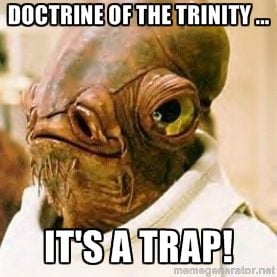
- The doctrine of the Trinity … it’s a trap!
The doctrine of the Trinity … it’s a trap!
Last updated on: June 23, 2013 at 6:20 pm by Fred Clark
The doctrine of the Trinity … it’s a trap! 2013-06-23T18:20:23-04:00 Fred Clark
Patheos Explore the world's faith through different perspectives on religion and spirituality! Patheos has the views of the prevalent religions and spiritualities of the world.
I wasn’t joking on Friday when I wrote that I’m probably guilty of the old Christian “heresy” of Patripassianism.
The Wikipedia entry on that heresy notes that, “This view is opposed to the classical theological doctrine of divine apathy.” And, well, me too — even if that contradicts 1 John 4:8, where it says “Whoever is not apathetic does not know God, for God is apathy.”
 Patripassianism, roughly, is the idea that God the Father suffered in the passion of God the Son. Because, apparently, the idea that a loving Father would suffer from the suffering of a beloved son is heretical. Someone here seems deeply confused about the meaning of the words “father” and “beloved.” The early church authorities say it’s me who is confused. This makes me wonder if the early church authorities had any kids of their own. And it makes me suspect that their own dads must’ve been colossal pricks.
Patripassianism, by the way, is apparently related to Modalistic Monarchianism. Theologian Scot McKnight offers a description of Modalistic Monarchianism here. And here, in a post three days earler, theologian Scot McKnight seems to get his Patripassianism on in a big way. And I say good for him. His post about the various gradations of trinitarian heresies is arcane, confusing, and not obviously helpful when it comes to, say, loving my neighbor. But his post chiding the theology of miserable comforters and commending Bonhoeffer’s appeal to “the suffering God” is a helpful discussion of a necessary subject — even if it could easily be criticized for straying too near the forbidden zone of all those arcane heresies.
This is why the smartest thing I’ve read recently about the doctrine of the Trinity is this post from Reverend Ref back on Trinity Sunday in May:
Today is Trinity Sunday. The day when all regular preachers try to find or draft a seminarian or deacon or guest preacher to fill the pulpit. Because, really, once you get past “Three in One and One in Three,” or, “I am He and He is Me and We are All Together,” one generally begins to wander off into heresy-land — The more you talk, the more trouble you get into.
He’s right. It’s a trap. See also “St. Patrick’s Bad Analogies,” from Lutheran Satire:
As the Irish twins with the Scottish accents in that video illustrate, one is “allowed” to recite the lawyerly formulations of the Athanasian Creed, but if you stray at all from that narrow path or attempt to say anything more — any positive statements, clarifications, analogies, applications — you’re screwed. And as that video shows, this doctrine creates so many different ways in which you can be screwed that it’s hard not to suspect this was the intention — a doctrine more useful for generating and then condemning heresies than for avoiding error.
Don’t get me wrong, I believe in the Trinity, in one God in three persons. This is a historically Christian way of talking and thinking about God. It’s a helpful and insightful metaphor. And it’s a metaphor that can be supported by several passages in the Bible. But it’s not actually a biblical metaphor. It’s something that Christians have, for many centuries, laid on top of the scriptures, but it was never something we found there in any explicit form.
Set aside all the whole Monster Manual of traditional heresies and heretical -isms, where theology often starts to get into trouble is when we elevate our metaphors about God and begin worshiping and serving those metaphors rather than worshiping and serving God.
That word — “metaphor” — tends to infuriate the defenders of doctrinal purity, but it’s a necessary word. Anything else leads to laughable overreach, to the claim that we can define or confine the infinite.
I believe in God. And I believe that God, being God, is more than I can comprehend, more than I can pin down, define, contain, master or bind into a formula.
And that’s OK. Because I also believe that everything I need to know about God has been revealed in the person of Jesus Christ. And that is not a metaphor.
As for my Patripassianist tendencies, if I go for a very long walk and think about it very hard, then I can almost imagine some way in which it might be marginally useful to clarify precise ways in which God did and did not suffer in the passion of Jesus Christ. Almost. Just as I can almost conceive of some way that something called “the classical theological doctrine of divine apathy” might be something other than slanderous blasphemy. But all of that still strikes me mainly as an elaborate exercise in evading some other, far more urgent business.
All of which is to say that if anyone is looking to catechize me on the particulars of the doctrine of the Trinity, let me save you some time. I will fail that test. I’m afraid that may delegitimize everything else I have to say among those who regard that test as essential and paramount, but then this illegitimacy was already a given since I don’t have much interest in joining those who regard that test as essential and paramount. (Does that make me some kind of defiant heretic? Well, duh. What part of the words “Baptist” and “evangelical” didn’t you understand?)
If you are ever called on to parse or to try to explain the doctrine of the Trinity, remember this: It’s a trap.
Your safest response may be something like what a theology student of Ben Myers’ turned in for a class on the Trinity. Myers read the paper’s delirious conclusion and called the student aside, to say: “As your teacher, I have to tell you that this is completely unacceptable, and you must never do this again in an academic essay. As a human being, I loved it – can I post it on my blog?” (This is a response every student should aspire to inspire — but probably only once.)
Previous Post

June 23, 2013
Sunday favorites
Next Post
June 24, 2013 9 years ago: Congressional box scores
Browse Our Archives
Select a Category class warfare evangelicals Iraq Left Behind Mammon music Uncategorized
Select a Month November 2026 October 2026 September 2026 August 2026 July 2026 June 2026 May 2026 April 2026 March 2026 January 2026 December 2025 November 2025 October 2025 September 2025 August 2025 July 2025 June 2025 May 2025 April 2025 March 2025 February 2025 January 2025 December 2024 November 2024 October 2024 September 2024 August 2024 July 2024 June 2024 May 2024 April 2024 March 2024 February 2024 January 2024 December 2023 November 2023 October 2023 September 2023 August 2023 July 2023 June 2023 May 2023 April 2023 March 2023 February 2023 January 2023 December 2022 November 2022 October 2022 September 2022 August 2022 July 2022 June 2022 May 2022 April 2022 March 2022 February 2022 January 2022 December 2021 November 2021 October 2021 September 2021 August 2021 July 2021 June 2021 May 2021 April 2021 March 2021 February 2021 January 2021 December 2020 November 2020 October 2020 September 2020 August 2020 July 2020 June 2020 May 2020 April 2020 March 2020 February 2020 January 2020 December 2019 November 2019 October 2019 September 2019 August 2019 July 2019 June 2019 May 2019 April 2019 March 2019 February 2019 January 2019 December 2018 November 2018 October 2018 September 2018 August 2018 July 2018 June 2018 May 2018 April 2018 March 2018 February 2018 January 2018 December 2017 November 2017 October 2017 September 2017 August 2017 July 2017 June 2017 May 2017 April 2017 March 2017 February 2017 January 2017 December 2016 November 2016 October 2016 September 2016 August 2016 July 2016 June 2016 May 2016 April 2016 March 2016 February 2016 January 2016 December 2015 November 2015 October 2015 September 2015 August 2015 July 2015 June 2015 May 2015 April 2015 March 2015 February 2015 January 2015 December 2014 November 2014 October 2014 September 2014 August 2014 July 2014 June 2014 May 2014 April 2014 March 2014 February 2014 January 2014 December 2013 November 2013 October 2013 September 2013 August 2013 July 2013 June 2013 May 2013 April 2013 March 2013 February 2013 January 2013 December 2012 November 2012 October 2012 September 2012 August 2012 July 2012 June 2012 May 2012 April 2012 March 2012 February 2012 January 2012 December 2011 November 2011 October 2011 September 2011 August 2011 July 2011 June 2011 May 2011 April 2011 March 2011 February 2011 January 2011 December 2010 November 2010 October 2010 September 2010 August 2010 July 2010 June 2010 May 2010 April 2010 March 2010 February 2010 January 2010 December 2009 November 2009 October 2009 September 2009 August 2009 July 2009 June 2009 May 2009 April 2009 March 2009 February 2009 January 2009 December 2008 November 2008 October 2008 September 2008 August 2008 July 2008 June 2008 May 2008 April 2008 March 2008 February 2008 January 2008 December 2007 November 2007 October 2007 September 2007 August 2007 July 2007 June 2007 May 2007 April 2007 March 2007 February 2007 January 2007 December 2006 November 2006 October 2006 September 2006 August 2006 July 2006 June 2006 May 2006 April 2006 March 2006 February 2006 January 2006 December 2005 November 2005 October 2005 September 2005 August 2005 July 2005 June 2005 May 2005 April 2005 March 2005 February 2005 January 2005 December 2004 November 2004 October 2004 September 2004 August 2004 July 2004 June 2004 May 2004 April 2004 March 2004 February 2004 January 2004 December 2003 November 2003 October 2003 September 2003
Follow Us!
TAKE THE
Religious Wisdom Quiz
Who said, "Silver and gold have I none, but what I have I give to you"?
Select your answer to see how you score.
Paul John James Peter
Related posts from slacktivist
Christian nationalism vs. the children's catechism

We're born again, there's new grass on the...

Ravi and Joss and John Howard Yoder

TRENDING AT PATHEOS Progressive Christian

Happy Thanksgiving! I published this Thanksgiving column back in 2017 in...

More Than a Meal: A Messianic Thanksgiving
A Messianic Thanksgiving What if Thanksgiving became more than a meal to...

The Darkening of the Sun, Moon, and Stars
The darkening of the sun and moon and the falling of stars...

Gratitude as the Parent of All Virtues
Giving thanks stems from gratitude. Cicero said that gratitude is the parent...

Make Thanksgiving Bring Family Closer
Written by Dr. David K. Ewen from Eternal Truth Bible College Start...

Ghosts, Spirits, and Wizards in Post-Puritan New England
As it is Thanksgiving, I have a seasonal post concerned with New...
view all Progressive Christian blogs
Ad-Free & Subscriber Log-In Subscription Support
- About Us
- 2026 Calendar
- Videos
- Podcasts
- Library of World Religions
- Faith In Media Tracker
- Advertise With Us
- Write for Us
- Privacy Policy
- Terms of Service
- Do Not Sell My Data
- Contact Us
- Radiant Digital
- Manage Newsletter Subscriptions
- Unsubscribe From Notifications
- Sitemap
Copyright 2008-2026, Patheos, part of the Radiant Digital network of media brands. All rights reserved.
Subscription Support Ad-Free & Subscriber Log-In
Follow Patheos