
BuddhistCatholicContemplativeEvangelicalGeneral ChristianHinduJewishLatter-day SaintMuslimNew VisionsProgressive Christian
Beliefs
- Buddhist
- Catholic
- Contemplative
- Evangelical
- General Christian
- Hindu
- Jewish
- Latter-day Saint
- More Voices
- Muslim
- New Visions
- Pagan
- Progressive Christian
Topics
- Religion News
- Food and Religion
- Sports and Religion
- Religious Art
- Religious Music and Entertainment
- Religious Events
- History and Religion
- Style and Religion
- Politics and Religion
- Women in Religion
- Recreation Outdoors and Religion
- Business Finance and Religion
- Careers Workplace and Religion
- Education and Religion
- Family Parenting and Religion
- Health Fitness and Religion
- Home and Religion
- Relationships and Religion
- Technology and Religion
- Travel and Religion
Columnists
- Buddhist Columnists
- Business Finance and Religion Columnists
- Careers Workplace and Religion Columnists
- Catholic Columnists
- Contemplative Columnists
- Education and Religion Columnists
- Evangelists Columnists
- Family Parenting and Religion Columnists
- General Christian Columnists
- Health Fitness and Religion Columnists
- Hindu Columnists
- History and Religion Columnists
- Home and Religion Columnists
- Jewish Columnists
- More Voices Columnists
- Latter Day Columnists
- Muslim Columnists
- New Visions Columnists
- Nonreligious Columnists
- Pagan Columnists
- Politics and Religion Columnists
- Progressive Columnists
- Recreation Outdoors and Religion Columnists
- Relationships and Religion Columnists
- Religion News Columnists
- Religious Art Columnists
- Religious Events Columnists
- Religious Music and Entertainment Columnists
- Sports and Religion Columnists
- Style and Religion Columnists
- Technology and Religion Columnists
- Travel and Religion Columnists
- Women in Religion Columnists
Resource Library
- 2026 Calendar
- Library of World Religions
- The 100 Most Holy Places on Earth
- Patheos Answers
- Podcasts
- Videos
- Faith Leaders Database
- Anglican Episcopalian
- Bahai
- Baptist
- Buddhism
- Christianity
- Confucianism
- Eastern Orthodoxy
- Hinduism
- Holiness and Pentecostal
- ISKCON
- Islam
- Judaism
- Lutheran
- Methodist
- The Church of Jesus Christ of Latter-day Saints
- New Age
- Paganism
- Presbytarian and Reformed
- Protestantism
- Religion Behind the Scenes
- Roman Catholic
- Scientology
- Shia Islam
- Sikhism
- Sufism
- Sunni Islam
- Taoism
- Zen
- See all religions
Research Tools
 Ad-Free & Subscriber Log-In Subscription Support
Follow Patheos 

- Trending:
- Advent
- |
- Forgiveness
- |
- Thanksgiving
- |
- Election
- |
- Seasonal Holidays
- |
- Marriage

- Home
- Progressive Christian
- When conscience and ‘obedience’ pull in opposite directions
When conscience and ‘obedience’ pull in opposite directions
Last updated on: June 17, 2013 at 9:08 am by Fred Clark
When conscience and ‘obedience’ pull in opposite directions 2013-06-17T09:08:49-04:00 Fred Clark
Patheos Explore the world's faith through different perspectives on religion and spirituality! Patheos has the views of the prevalent religions and spiritualities of the world.
A couple weeks ago we looked at a helpful short post from Danny Coleman in which he discussed the anxious conflict gnawing at many Christians who are reluctantly convinced that obedience to God’s Law requires them to be unkind, unjust and unloving to LGBT people. Coleman pithily describes those Christians’ dilemma:
They do not hate or fear LBGT people. They fear God. They carry a perception of the wrathful Old Testament God who will destroy cities or nations if “sin” is found in the camp. … Attempts to reconcile this ancient God of wrath with the God of love and inclusion that Jesus represented tend to create a sort of cognitive and spiritual dissonance. And so, most Christians don’t hate and fear gays — they really want to love them. What they fear is God’s wrath and what they hate is the idea of the destruction God will bring down if LGBT people are accepted — if “sin” is allowed.
The problem is that even for Christians bound by such a stunted view of sin, conscience says something else. Conscience tells them that even if they don’t feel fear or hatred, behaving as if they fear or hate others is still wrong. So they feel trapped — torn between the conflicting demands of conscience and “obedience.” If they avoid the guilt of sinful disobedience by allowing “sinful” others in the camp, they incur the guilt of mistreating those others. Conscience pulls them toward love of the other; “obedience” pulls them in the other direction.
You can see the enormous strain of this being-pulled-apart in a recent guest-post by Peter Wehner at Tim Dalrymple’s blog on Patheos’ evangelical channel. The post, titled “An Evangelical Christian Looks at Homosexuality,”* reveals Wehner’s struggle to reconcile the tug of conscience with what he perceives as the demands of obedience. He begins by stating that “I’d associate myself with the views of Timothy J. Keller, senior pastor of Redeemer Presbyterian Church in New York City,” linking to a recent discussion in which Keller inadvertently restated, endorsed and underlined the point Danny Coleman made above. Keller said:
If you say to everybody, “Anyone who thinks homosexuality is a sin is a bigot,” [Jonathan Rauch] says, “You are going to have to ask them to completely disassemble the way in which they read the Bible.” Completely disassemble their whole approach to authority. You are basically going to have to ask them to completely kick their entire faith out the door.
That, in a nutshell, is the fear Coleman describes. And it is the fear that pervades Wehner’s argument.
 But Wehner is also more honest than Keller. Keller pretends as though the accusation of bigotry arises solely from the belief that “homosexuality is a sin.” Wehner recognizes that, in reality, the accusation of bigotry arises from Christian support for legally enforced bigotry. He seems to recognize that the problem is not so much that Christians like himself believe “homosexuality is a sin,” but rather that this belief has led many such Christians to deny full legal equality to LGBT people. I am an enthusiastic, almost obsessive, coffee-drinker. I don’t think Mormons are bigots because they regard drinking coffee as a kind of sin. But if the Saints suddenly lost their minds and began lobbying for laws denying coffee-drinkers like myself the right to marry, or insisting that it should be legal for employers to fire coffee-drinkers, then, yes, that would be bigotry.
Wehner doesn’t explicitly call out Keller for the self-serving disingenuousness of his “Anyone who thinks homosexuality is a sin” straw-man nonsense, but I give Wehner credit for acknowledging the legitimate substance of the complaints about anti-gay bigotry. The main thrust of his argument is to challenge that substance without challenging the belief he shares with Keller, that homosexuality is a sin.
Wehner’s conclusion isn’t wholly conclusive. He seems extremely cautious not to be perceived as advocating “disobedience” lest he incur the wrath of God or of the tribal gatekeepers of evangelicalism. But he’s clearly pointing toward a solution that I think can work for conservative evangelicals like Wehner or Keller or Dalrymple. They don’t need to change their theology or their hermeneutics in order to stop denying other people full legal equality and civil rights:
I think it’s reasonable to say that even for orthodox Christians,** how the Scriptural injunctions against homosexual behavior should manifest themselves in modern American law and society are not self-evident. For example, you might believe homosexual conduct is not what God intended but (like idolatry) that view should not be written in law.
I’d be quite pleased if more anti-gay Christians would settle on that view. (Keller calls this a “Neo-Anabaptist” position, but really it’s just plain Baptist — more Roger Williams than John Howard Yoder.)
My main point here, though, is not the conclusion of Wehner’s argument or the logic he uses in getting there. What strikes me more is the impulse compelling him to make this anguished argument — which, again, is the strain of being pulled in opposite directions by the demands of conscience and the demands of “obedience.” For Wehner, as for many white evangelicals, “their whole approach to authority” compels them to believe that God demands a “firm stance” opposing homosexuality. Yet Wehner’s conscience is pulling him the other way — he seems to genuinely regret the harm that is being done to LGBT people by Christians who advocate laws denying their civil rights.
The pangs of conscience are clearest toward the end of Wehner’s post, when he recalls a conversation with former InterVarsity president Steve Hayner:
“I doubt whether God will have much to say about our political convictions in the end,” Steve said to me, “but I’m quite sure that he will have something to say about how we loved the least, the marginalized, the outcasts, the lonely, the abused — even when some think that they have it all. Political convictions that lead toward redemption and reconciliation are most likely headed in the right direction.”
Hayner describes a trajectory leading “toward redemption and reconciliation” and emphasizing the powerless, “the outcasts, the lonely, the abused.” And Wehner says, “It seems to me there is great wisdom in his words.”
It seems that way to me, too. But I should warn Wehner that the gatekeepers of the white evangelical tribe don’t look kindly on anyone who allows this wisdom to shape their hermeneutic. That, they say, would be disobedient. It would “ask them to completely disassemble the way in which they read the Bible. Completely disassemble their whole approach to authority.” You’d be asking them to kick their faith out the door and they’d prefer, instead, to kick you out of the tribe.
Just ask Steve Chalke. Chalke’s evangelical credentials were beyond question — even more than Keller’s or Wehner’s or Dalrymple’s. But he was judged to have headed too far “in the right direction” of reconciliation and love for the outcast, and he was banished from the evangelical tribe — cast into the outer darkness with the mainliners, the “progressives” and the Episcopalians.
But here’s the joyous thing that Steve Chalke discovered. He’s not anguished. He’s not torn between conscience and obedience. For Chalke, obedience to God and conscience are pulling in the same direction. That unity of direction is at the root of the meaning of the word “integrity,” which is why Chalke’s farewell letter to the tribal gatekeepers — his manifesto in support of marriage equality — was titled, “A Matter of Integrity: The Church, sexuality, inclusion and an open conversation.”
When conscience and obedience are integrated — when they are pulling in the same direction — then faith becomes something that perpetually challenges us to become better people. It calls us to constantly expand our love and our capacity for love and to move ever onward, ever outward and ever Christward.
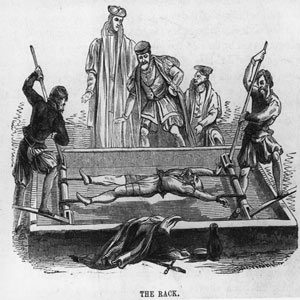
Peter Wehner is clearly aware of the discomfort and anxiety that comes from the kind of faith Danny Coleman described and Tim Keller endorsed — a form of faith in which conscience and obedience are at odds, pulling in opposite directions. It’s like being stretched on a rack. And, one way or the other, such faith will always entail being racked with guilt.
Maybe Steve Chalke is right. Maybe God is a better person than you think. Maybe obedience to what God wants doesn’t have to produce a queasy, uneasy conscience and the nagging sense that treating others unkindly and unfairly is still wrong, even when it’s done out of a sincere attempt to be obedient.
I’ve experience both forms of faith — the fearful kind Coleman describes and the fearless sort Steve Chalke advocates. The latter is a lot more joyful.
– – – – – – – – – – – –
* I had a hard time getting past that title, which seems like the archetypal headline for any in-group discussion of out-group people. You could fill a bookshelf with the unspoken assumptions packed into and conveyed by those six words: An Evangelical Christian Looks at Homosexuality.
Here are some potential alternate versions of that title:
• “A Member of the Tribe Observes Outsiders.”
• “I am a legitimate person. You are an issue and an abstraction.”
• “The Myopia of Privilege.”
• “Jonah looks at the Ninevites.”
• “Blessed are you, Lord our God, Ruler of the Universe, who has not made me a homosexual.”
• “Even the dogs eat the crumbs that fall from their masters’ table. And you’re welcome.”
That actual title — “An Evangelical Christian Looks at Homosexuality” — includes something of all of those, and more. And that’s before we even consider the false assumption that “an evangelical Christian” must, by definition, be looking at homosexuality from the outside — that no evangelicals are LGBT and no LGBT persons are evangelicals. (Here are links to more than a dozen blogs written by people who are both.)
While there’s something of that attitude pervading the whole post, the general spirit of Wehner’s piece is better than that title.
In general, though, I’m way beyond tired of articles and blog posts titled “An Evangelical Christian Looks at …” It’s long past time for a new wave of articles titled, instead, “An Evangelical Christian Listens to …”
** The colloquial use of “begs the question” to mean “raises the question” leaves us without a term for what Wehner is doing here. “Orthodox Christians,” he says, are those who believe the Bible declares homosexuality to be a sin. And we know that the Bible says so because this is what “orthodox Christians” say the Bible says. He’s assuming the initial point. Or presuming it, actually.
Previous Post

June 16, 2013
The execution of Achan, son of Carmi, rescuer of children
Next Post
June 17, 2013 More on conscience vs. 'obedience' -- with music
Browse Our Archives
Select a Category class warfare evangelicals Iraq Left Behind Mammon music Uncategorized
Select a Month November 2026 October 2026 September 2026 August 2026 July 2026 June 2026 May 2026 April 2026 March 2026 January 2026 December 2025 November 2025 October 2025 September 2025 August 2025 July 2025 June 2025 May 2025 April 2025 March 2025 February 2025 January 2025 December 2024 November 2024 October 2024 September 2024 August 2024 July 2024 June 2024 May 2024 April 2024 March 2024 February 2024 January 2024 December 2023 November 2023 October 2023 September 2023 August 2023 July 2023 June 2023 May 2023 April 2023 March 2023 February 2023 January 2023 December 2022 November 2022 October 2022 September 2022 August 2022 July 2022 June 2022 May 2022 April 2022 March 2022 February 2022 January 2022 December 2021 November 2021 October 2021 September 2021 August 2021 July 2021 June 2021 May 2021 April 2021 March 2021 February 2021 January 2021 December 2020 November 2020 October 2020 September 2020 August 2020 July 2020 June 2020 May 2020 April 2020 March 2020 February 2020 January 2020 December 2019 November 2019 October 2019 September 2019 August 2019 July 2019 June 2019 May 2019 April 2019 March 2019 February 2019 January 2019 December 2018 November 2018 October 2018 September 2018 August 2018 July 2018 June 2018 May 2018 April 2018 March 2018 February 2018 January 2018 December 2017 November 2017 October 2017 September 2017 August 2017 July 2017 June 2017 May 2017 April 2017 March 2017 February 2017 January 2017 December 2016 November 2016 October 2016 September 2016 August 2016 July 2016 June 2016 May 2016 April 2016 March 2016 February 2016 January 2016 December 2015 November 2015 October 2015 September 2015 August 2015 July 2015 June 2015 May 2015 April 2015 March 2015 February 2015 January 2015 December 2014 November 2014 October 2014 September 2014 August 2014 July 2014 June 2014 May 2014 April 2014 March 2014 February 2014 January 2014 December 2013 November 2013 October 2013 September 2013 August 2013 July 2013 June 2013 May 2013 April 2013 March 2013 February 2013 January 2013 December 2012 November 2012 October 2012 September 2012 August 2012 July 2012 June 2012 May 2012 April 2012 March 2012 February 2012 January 2012 December 2011 November 2011 October 2011 September 2011 August 2011 July 2011 June 2011 May 2011 April 2011 March 2011 February 2011 January 2011 December 2010 November 2010 October 2010 September 2010 August 2010 July 2010 June 2010 May 2010 April 2010 March 2010 February 2010 January 2010 December 2009 November 2009 October 2009 September 2009 August 2009 July 2009 June 2009 May 2009 April 2009 March 2009 February 2009 January 2009 December 2008 November 2008 October 2008 September 2008 August 2008 July 2008 June 2008 May 2008 April 2008 March 2008 February 2008 January 2008 December 2007 November 2007 October 2007 September 2007 August 2007 July 2007 June 2007 May 2007 April 2007 March 2007 February 2007 January 2007 December 2006 November 2006 October 2006 September 2006 August 2006 July 2006 June 2006 May 2006 April 2006 March 2006 February 2006 January 2006 December 2005 November 2005 October 2005 September 2005 August 2005 July 2005 June 2005 May 2005 April 2005 March 2005 February 2005 January 2005 December 2004 November 2004 October 2004 September 2004 August 2004 July 2004 June 2004 May 2004 April 2004 March 2004 February 2004 January 2004 December 2003 November 2003 October 2003 September 2003
Follow Us!
TAKE THE
Religious Wisdom Quiz
What is the meaning of "amen" as Jesus often used it?
Select your answer to see how you score.
Glory Truly or verily Let it happen Hurry
Related posts from slacktivist

Is this the right room for an argument?

The Amish are not 'Evangelicals.' They're Amish.

The lumpers, the splitters, and me

'Is it right on red or left on...
TRENDING AT PATHEOS Progressive Christian

The Late Francis Frangipane & the Failure Too...
I learned today that another one of my heroes has gone to...

Thomas Paine, the Smiths, the apostles in England,...
I'm pleased to announce that the Becoming Brigham Black Friday Sale,...

CatholicTV Series: Six Black Catholics on Path to...
WATERTOWN, Mass., November 9, 2026 – In recognition of Black Catholic History...

New Advent Journal Invites Catholics to Be Pilgrims
Florissant, MO, November 16, 2026— What if Advent were more than a...

INNER CIRCLE: John's Quantum Gospel
INTRODUCTION In this next Inner Circle series, which I anticipate will...

"Three B's" of My Apologetics Ministry (+ VIDEO)
In early December 2026 (less than a week from the time...
view all Progressive Christian blogs
Ad-Free & Subscriber Log-In Subscription Support
- About Us
- 2026 Calendar
- Videos
- Podcasts
- Library of World Religions
- Faith In Media Tracker
- Advertise With Us
- Write for Us
- Privacy Policy
- Terms of Service
- Do Not Sell My Data
- Contact Us
- Radiant Digital
- Manage Newsletter Subscriptions
- Unsubscribe From Notifications
- Sitemap
Copyright 2008-2026, Patheos, part of the Radiant Digital network of media brands. All rights reserved.
Subscription Support Ad-Free & Subscriber Log-In
Follow Patheos