
BuddhistCatholicContemplativeEvangelicalGeneral ChristianHinduJewishLatter-day SaintMuslimNew VisionsProgressive Christian
Beliefs
- Buddhist
- Catholic
- Contemplative
- Evangelical
- General Christian
- Hindu
- Jewish
- Latter-day Saint
- More Voices
- Muslim
- New Visions
- Pagan
- Progressive Christian
Topics
- Religion News
- Food and Religion
- Sports and Religion
- Religious Art
- Religious Music and Entertainment
- Religious Events
- History and Religion
- Style and Religion
- Politics and Religion
- Women in Religion
- Recreation Outdoors and Religion
- Business Finance and Religion
- Careers Workplace and Religion
- Education and Religion
- Family Parenting and Religion
- Health Fitness and Religion
- Home and Religion
- Relationships and Religion
- Technology and Religion
- Travel and Religion
Columnists
- Buddhist Columnists
- Business Finance and Religion Columnists
- Careers Workplace and Religion Columnists
- Catholic Columnists
- Contemplative Columnists
- Education and Religion Columnists
- Evangelists Columnists
- Family Parenting and Religion Columnists
- General Christian Columnists
- Health Fitness and Religion Columnists
- Hindu Columnists
- History and Religion Columnists
- Home and Religion Columnists
- Jewish Columnists
- More Voices Columnists
- Latter Day Columnists
- Muslim Columnists
- New Visions Columnists
- Nonreligious Columnists
- Pagan Columnists
- Politics and Religion Columnists
- Progressive Columnists
- Recreation Outdoors and Religion Columnists
- Relationships and Religion Columnists
- Religion News Columnists
- Religious Art Columnists
- Religious Events Columnists
- Religious Music and Entertainment Columnists
- Sports and Religion Columnists
- Style and Religion Columnists
- Technology and Religion Columnists
- Travel and Religion Columnists
- Women in Religion Columnists
Resource Library
- 2026 Calendar
- Library of World Religions
- The 100 Most Holy Places on Earth
- Patheos Answers
- Podcasts
- Videos
- Faith Leaders Database
- Anglican Episcopalian
- Bahai
- Baptist
- Buddhism
- Christianity
- Confucianism
- Eastern Orthodoxy
- Hinduism
- Holiness and Pentecostal
- ISKCON
- Islam
- Judaism
- Lutheran
- Methodist
- The Church of Jesus Christ of Latter-day Saints
- New Age
- Paganism
- Presbytarian and Reformed
- Protestantism
- Religion Behind the Scenes
- Roman Catholic
- Scientology
- Shia Islam
- Sikhism
- Sufism
- Sunni Islam
- Taoism
- Zen
- See all religions
Research Tools
 Ad-Free & Subscriber Log-In Subscription Support
Ad-Free & Subscriber Log-In Subscription Support
Follow Patheos 

- Trending:
- Forgiveness
- |
- Marriage
- |
- Consciousness
- |
- Death Penalty
- |
- Election
- |
- Halloween

- Home
- Progressive Christian
- Church and state and erecting convenient boundaries
Church and state and erecting convenient boundaries
Last updated on: February 12, 2013 at 11:38 am by Fred Clark
Church and state and erecting convenient boundaries 2013-02-12T11:38:28-05:00 Fred Clark
Patheos Explore the world's faith through different perspectives on religion and spirituality! Patheos has the views of the prevalent religions and spiritualities of the world.
As an evangelical Christian, I can appreciate the legal pretense of an Orthodox Jewish eruv.
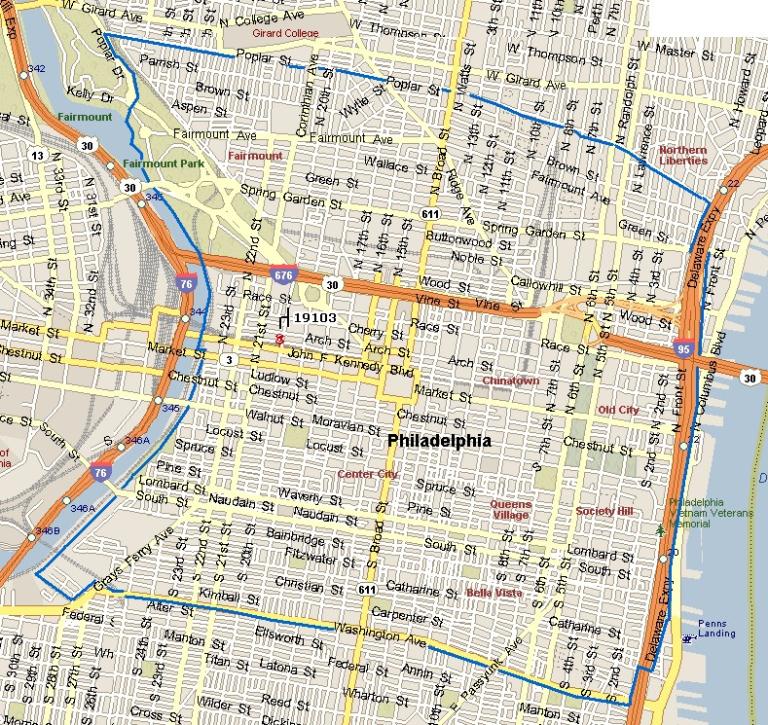
I had never heard of such a thing until reading Michael Chabon’s brilliant alternate-history detective novel The Yiddish Policemen’s Union. Yet it turns out that I’d spent most of the 1990s living within the sprawling Lower Merion eruv, and much of the next decade commuting into and out of and through the huge eruvin of Center City and University City. (The blue line on the map in this post denotes Philly’s Center City eruv.)
Here’s a helpful description of an eruv from the Jewish Press last month:
Jewish law prohibits carrying an object from a private domain to a public domain (or vice versa) or within a public domain on the Sabbath. … The creation of an eruv establishes, where possible, an extended private domain in which such carrying is permissible.
The rules regarding “carrying” between “domains” on the Sabbath are complicated, but deadly serious. Those rules are so extensive that it would be easy to violate them unwittingly or unintentionally. They also forbid some things that would seem necessary for anyone traveling to or from services on the Sabbath. Say you have severe asthma or extreme allergies and need to carry an inhaler or an EpiPen with you at all times. The law forbids you to carry such things from one domain (your home) to another (the street leading to your local synagogue) on the Sabbath. An eruv technically encompasses the entire area within a single domain, turning whole neigborhoods or cities into one “courtyard,” thus permitting carrying within the eruv without violating the law.
 The idea shows an enormous, immersive respect for biblical law while simultaneously showing an enthusiastic willingness to elude that same law through ingeniously creative means. In a sense, the elaborate nature of the law-evading construct becomes an expression of reverence for the very law it evades. Technically, the law forbids you from carrying from point A to point B. The eruv creates a legal fiction whereby technically you can. The lawyerliness of the latter technicality pays tribute to the deep sincerity of the former.
In Chabon’s novel, the community’s dependence on the eruv and its keepers enables crafty, crooked men to wield power over others by making them the arbiters of who is or is not within the bounds of the law. They become the gatekeepers of others’ righteousness.
Like I said, this all seems terribly familiar to those of us who have lived within the subculture of white evangelicalism. So much so that it’s tempting to abandon the original point of this post and just go galloping off into exploring the eruv as a metaphor for white evangelicalism in America.
But here’s the key thing: The boundaries of an eruv have to be physical, tangible and real. They’re nearly invisible, even if you know where to look and you know what you’re looking for. Walk along Poplar Street in Philadelphia and look very carefully and you may spot the boundaries of the blue line on the map here — a length of wire, a bit of thin pipe affixed to a utility pole. The lines these boundaries draw enclose a fictive space, but the lines themselves must be real.
There are, of course, many, many rules about the rules that allow one to abide by the rules. (Familiar, all too familiar.)
Ari Kohen draws our attention to a battle over a proposed eruv in Westhampton Village, New York:
The eruv would consist of about 60 10-to-15-foot-long, five-eighths-of-an-inch-wide PVC strips affixed to utility poles, and painted to blend in with them. They would be difficult to see, and would be shorter than the poles themselves.
That’s how these things work. If you don’t know it’s there, you’d never know it was there. You can’t see it, and unless you’re an Orthodox Jew it doesn’t affect your life at all in any way.
And yet many of the residents of Westhampton Village — including the mayor — want to prevent the Orthodox community from constructing its eruv. They offer two reasons for this. The first is an attempt at a principled-sounding argument. The second is an accidental admission of simple discrimination (which is why Kohen’s post is titled, “Oops, You Said the Quiet Part Out Loud“).
Let’s address the supposedly principled argument first. Out in the Hamptons, they’re arguing that an eruv somehow constitutes an establishment of religion in violation of the First Amendment:
In 2012, the Quogue board of trustees ruled that constructing an eruv “would very likely constitute a violation of the establishment clause” of the Constitution, and denied the application. Southhampton and Westhampton Village have not made a formal ruling, but Mr. Teller, the mayor, said he agreed with that reasoning.
“It’s about the separation of church and state,” he said.
That’s ridiculous. It ignores the existence of eruvin in communities all over the United States, none of which have been challenged, let alone ruled against, as any sort of religious establishment. Because they are not any sort of religious establishment — the state is not involved, and they do not affect anyone except the members of the Orthodox community. They are not noticed by anyone except the members of the Orthodox community.
If the city were being asked to fund the construction of the eruv, that would be a violation of the Establishment Clause. If the existence of the eruv meant that suddenly every resident had to begin abiding by the Orthodox Jewish restrictions against carrying on the Sabbath, then that would clearly be unconstitutional. But the town is not being asked to pay for any of this, only to allow its existence. And none of the non-Orthodox residents of the town will be asked or required even to acknowledge its presence.
So what’s really behind the opposition to the Westhampton Village eruv? The ugly truth seems to be that because it would make life easier for Orthodox Jewish residents, it might attract Orthodox Jewish residents, and the people of Westhampton Village don’t want those kind of people around. The law might not allow Westhampton to prohibit Orthodox Jews from building a synagogue, but perhaps the law can be manipulated to prevent them from being able to get to that synagogue. And if so maybe they’ll all just go away.
It’s discrimination, plain and simple. It’s no different from the anti-Islamic bigotry opposing the “Ground-Zero mosque” (which was neither a mosque, nor very near Ground Zero) or opposing the mosque in Murfreesboro, Tenn.
That would be a harsh accusation to level against Mayor Teller and his constituents, but they’ve already confessed to it. As Kohen said, they unintentionally “said the quiet part out loud”:
Estelle Lubliner, another Jewish member of the anti-eruv group, said she feared that the eruv “will make more Orthodox people come in, and it’s not right to the history of these towns.”
“Why are they forcing the community to change?” she added.
… [M]any in Westhampton Village — a diverse mix of Catholics, Protestants and Jews — say they fear the prospect of more Orthodox Jews moving in if the eruv is constructed. The mayor, Conrad Teller, estimated that perhaps 90 to 95 percent of Westhampton Village is now against it. “It’s divisive,” he said. “I believe they think somebody’s trying to push something down their throats.”
Storekeepers on Main Street have voiced practical concerns, because Orthodox Jews traditionally don’t spend money on the Sabbath. “Retail is hard enough as it is,” said Anick Darbellay, sitting in her dress shop on Friday. “I don’t want to have to shut down on Saturdays. Have you been to the Five Towns?” she asked, referring to an Orthodox Jewish enclave in Nassau County. “That’s what happened there.”
That’s just straight-up We Don’t Want You Here. It’s explicit bigotry, explicitly stated.
Kohen comments:
It’s absolutely bizarre — and very sad — that, rather than attempting to learn something about those whose beliefs are different, the majority population immediately acted like there was some sort of terrible threat to their country and their way of life.
Yep, the majority population perceives that a minority constitutes “some sort of terrible threat to their country and their way of life,” and so they impose legal restrictions against that minority, all the while trumping up disingenuous arguments that such restrictions against the freedom of the minority are necessary to protect the “religious liberty” of the majority. The very existence of the minority, the majority says, is “divisive.”
The eruv is a legal fiction that allows Orthodox Jews to carry on the Sabbath. The “religious liberty” argument of the privileged majority is a legal fiction that allows them to impose their will on others while pretending they’re making a principled stand for freedom.
The former is benign and unobtrusive. The latter is not.
Previous Post

February 12, 2013
Smart people saying smart things
Next Post
February 12, 2013 Blue Valentines, back roads and building your book
Browse Our Archives
Select a Category class warfare evangelicals Iraq Left Behind Mammon music Uncategorized
Select a Month October 2026 September 2026 August 2026 July 2026 June 2026 May 2026 April 2026 March 2026 January 2026 December 2025 November 2025 October 2025 September 2025 August 2025 July 2025 June 2025 May 2025 April 2025 March 2025 February 2025 January 2025 December 2024 November 2024 October 2024 September 2024 August 2024 July 2024 June 2024 May 2024 April 2024 March 2024 February 2024 January 2024 December 2023 November 2023 October 2023 September 2023 August 2023 July 2023 June 2023 May 2023 April 2023 March 2023 February 2023 January 2023 December 2022 November 2022 October 2022 September 2022 August 2022 July 2022 June 2022 May 2022 April 2022 March 2022 February 2022 January 2022 December 2021 November 2021 October 2021 September 2021 August 2021 July 2021 June 2021 May 2021 April 2021 March 2021 February 2021 January 2021 December 2020 November 2020 October 2020 September 2020 August 2020 July 2020 June 2020 May 2020 April 2020 March 2020 February 2020 January 2020 December 2019 November 2019 October 2019 September 2019 August 2019 July 2019 June 2019 May 2019 April 2019 March 2019 February 2019 January 2019 December 2018 November 2018 October 2018 September 2018 August 2018 July 2018 June 2018 May 2018 April 2018 March 2018 February 2018 January 2018 December 2017 November 2017 October 2017 September 2017 August 2017 July 2017 June 2017 May 2017 April 2017 March 2017 February 2017 January 2017 December 2016 November 2016 October 2016 September 2016 August 2016 July 2016 June 2016 May 2016 April 2016 March 2016 February 2016 January 2016 December 2015 November 2015 October 2015 September 2015 August 2015 July 2015 June 2015 May 2015 April 2015 March 2015 February 2015 January 2015 December 2014 November 2014 October 2014 September 2014 August 2014 July 2014 June 2014 May 2014 April 2014 March 2014 February 2014 January 2014 December 2013 November 2013 October 2013 September 2013 August 2013 July 2013 June 2013 May 2013 April 2013 March 2013 February 2013 January 2013 December 2012 November 2012 October 2012 September 2012 August 2012 July 2012 June 2012 May 2012 April 2012 March 2012 February 2012 January 2012 December 2011 November 2011 October 2011 September 2011 August 2011 July 2011 June 2011 May 2011 April 2011 March 2011 February 2011 January 2011 December 2010 November 2010 October 2010 September 2010 August 2010 July 2010 June 2010 May 2010 April 2010 March 2010 February 2010 January 2010 December 2009 November 2009 October 2009 September 2009 August 2009 July 2009 June 2009 May 2009 April 2009 March 2009 February 2009 January 2009 December 2008 November 2008 October 2008 September 2008 August 2008 July 2008 June 2008 May 2008 April 2008 March 2008 February 2008 January 2008 December 2007 November 2007 October 2007 September 2007 August 2007 July 2007 June 2007 May 2007 April 2007 March 2007 February 2007 January 2007 December 2006 November 2006 October 2006 September 2006 August 2006 July 2006 June 2006 May 2006 April 2006 March 2006 February 2006 January 2006 December 2005 November 2005 October 2005 September 2005 August 2005 July 2005 June 2005 May 2005 April 2005 March 2005 February 2005 January 2005 December 2004 November 2004 October 2004 September 2004 August 2004 July 2004 June 2004 May 2004 April 2004 March 2004 February 2004 January 2004 December 2003 November 2003 October 2003 September 2003
Follow Us!
TAKE THE
Religious Wisdom Quiz
What language was the New Testament originally written in?
Select your answer to see how you score.
Aramaic Latin Greek Hebrew
Related posts from slacktivist

Jesus loves me, this I know, for Pete...

Is this the right room for an argument?

The Amish are not 'Evangelicals.' They're Amish.

The lumpers, the splitters, and me
TRENDING AT PATHEOS Progressive Christian

When Halloween Unmasks Married Hearts
Written by Dr. David K. Ewen from Eternal Truth Bible College Behind...

Aristotle. He’s been called the father of logic, the father of the...

Methodist Central Hall and Westminster Abbey
Situated on the same square is Methodist Central Hall and Westminster Abbey. ...

57th Dove Awards Honor Dolly Parton, Crown New...
On gospel music’s biggest night, the 57th annual GMA Dove Awards honored...

The First Eucharistic Controversy: Christ’s Real Presence
For Catholics, the Eucharist is the source and summit of the Christian...

What a Stop Sign Can Teach Us About...
How to Make a Decision When You Can't Hear God Main point:...
view all Progressive Christian blogs
Ad-Free & Subscriber Log-In Subscription Support
- About Us
- 2026 Calendar
- Videos
- Podcasts
- Library of World Religions
- Faith In Media Tracker
- Advertise With Us
- Write for Us
- Privacy Policy
- Terms of Service
- Do Not Sell My Data
- Contact Us
- Radiant Digital
- Manage Newsletter Subscriptions
- Unsubscribe From Notifications
- Sitemap
Copyright 2008-2026, Patheos. All rights reserved.
Subscription Support Ad-Free & Subscriber Log-In
Follow Patheos