
BuddhistCatholicContemplativeEvangelicalGeneral ChristianHinduJewishLatter-day SaintMuslimNew VisionsProgressive Christian
Beliefs
- Buddhist
- Catholic
- Contemplative
- Evangelical
- General Christian
- Hindu
- Jewish
- Latter-day Saint
- More Voices
- Muslim
- New Visions
- Pagan
- Progressive Christian
Topics
- Religion News
- Food and Religion
- Sports and Religion
- Religious Art
- Religious Music and Entertainment
- Religious Events
- History and Religion
- Style and Religion
- Politics and Religion
- Women in Religion
- Recreation Outdoors and Religion
- Business Finance and Religion
- Careers Workplace and Religion
- Education and Religion
- Family Parenting and Religion
- Health Fitness and Religion
- Home and Religion
- Relationships and Religion
- Technology and Religion
- Travel and Religion
Columnists
- Buddhist Columnists
- Business Finance and Religion Columnists
- Careers Workplace and Religion Columnists
- Catholic Columnists
- Contemplative Columnists
- Education and Religion Columnists
- Evangelists Columnists
- Family Parenting and Religion Columnists
- General Christian Columnists
- Health Fitness and Religion Columnists
- Hindu Columnists
- History and Religion Columnists
- Home and Religion Columnists
- Jewish Columnists
- More Voices Columnists
- Latter Day Columnists
- Muslim Columnists
- New Visions Columnists
- Nonreligious Columnists
- Pagan Columnists
- Politics and Religion Columnists
- Progressive Columnists
- Recreation Outdoors and Religion Columnists
- Relationships and Religion Columnists
- Religion News Columnists
- Religious Art Columnists
- Religious Events Columnists
- Religious Music and Entertainment Columnists
- Sports and Religion Columnists
- Style and Religion Columnists
- Technology and Religion Columnists
- Travel and Religion Columnists
- Women in Religion Columnists
Resource Library
- 2026 Calendar
- Library of World Religions
- The 100 Most Holy Places on Earth
- Patheos Answers
- Podcasts
- Videos
- Faith Leaders Database
- Anglican Episcopalian
- Bahai
- Baptist
- Buddhism
- Christianity
- Confucianism
- Eastern Orthodoxy
- Hinduism
- Holiness and Pentecostal
- ISKCON
- Islam
- Judaism
- Lutheran
- Methodist
- The Church of Jesus Christ of Latter-day Saints
- New Age
- Paganism
- Presbytarian and Reformed
- Protestantism
- Religion Behind the Scenes
- Roman Catholic
- Scientology
- Shia Islam
- Sikhism
- Sufism
- Sunni Islam
- Taoism
- Zen
- See all religions
Research Tools
 Ad-Free & Subscriber Log-In Subscription Support
Ad-Free & Subscriber Log-In Subscription Support
Follow Patheos 

- Trending:
- Forgiveness
- |
- Marriage
- |
- Consciousness
- |
- Death Penalty
- |
- Election
- |
- Halloween

- Home
- Progressive Christian
- Does the Universe Have a Purpose? Your vote counts
Does the Universe Have a Purpose? Your vote counts
Last updated on: December 9, 2012 at 1:59 pm by Fred Clark
Does the Universe Have a Purpose? Your vote counts 2012-12-09T13:59:50-05:00 Fred Clark
Patheos Explore the world's faith through different perspectives on religion and spirituality! Patheos has the views of the prevalent religions and spiritualities of the world.
Joe Hanson shared this quote from Michio Kaku: “Physicists are made of atoms. A physicist is an attempt by an atom to understand itself.”
And vorjack shared this from Phil Hellenes:
It’s like the universe screams in your face, “Do you know what I am? How grand I am? What are you, compared to me?”
And when you know enough science, you can just smile up at the universe and reply, “Dude, I AM you.”
Vorjack says, “I like the sentiment, but we’re only a tiny part of the universe.” And thus it’s a stretch to “[equate] ourselves with the universe because ‘we are all star dust’ or something similar.”
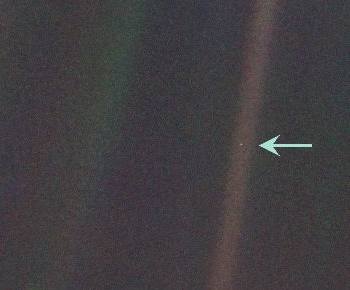
You are here.
I agree. Each of us is only a tiny part of the universe. A tiny, tiny part.
But undeniably a part of it nonetheless.
And that, it seems to me, has to be an essential consideration for considering the “Big Question” recently posed by the John Templeton Foundation: “Does the Universe Have a Purpose?”
Neal deGrasse Tyson’s response to this question — “I’m not sure” — seems to have gone viral. That’s deservedly so, since it’s his usual Sagan-esque mix of science and near-poetry (and has already been transformed into another terrific NdGT-narrated YouTube video).
Tyson emphasizes how very, very tiny we are against the incomprehensible vastness of space and time. This is science, but it reads like one of the monologues spoken by the character God in the book of Job:
If you are religious, you might declare that the purpose of life is to serve God. But if you’re one of the 100 billion bacteria living and working in a single centimeter of our lower intestine (rivaling, by the way, the total number of humans who have ever been born) you would give an entirely different answer. You might instead say that the purpose of human life is to provide you with a dark, but idyllic, anaerobic habitat of fecal matter.
Tyson concludes:
So in the absence of human hubris, and after we filter out the delusional assessments it promotes within us, the universe looks more and more random. Whenever events that are purported to occur in our best interest are as numerous as other events that would just as soon kill us, then intent is hard, if not impossible, to assert. So while I cannot claim to know for sure whether or not the universe has a purpose, the case against it is strong, and visible to anyone who sees the universe as it is rather than as they wish it to be.
The problem there, as Kaku and Helles remind us above, is that our wishes for how the universe ought to be are part of the universe. A tiny, tiny part of it, perhaps, but a part of it nonetheless.
We have a say in this.
We cannot consider the question “Does the Universe Have a Purpose?” without considering the sub-question “Do I Have a Purpose?” or even the sub-question to that, “Do I Want to Have a Purpose?”
Answering “Yes” to that third question means answering “Yes” to the second. And that means — even if only in a very tiny, tiny way — answering “Yes” to the first.
Consider Jane Goodall’s response to Templeton’s question. Maybe all that talk of wonder and beauty and spirit is just her wishful thinking. But even so, as she argues there, the wishful thinking of Jane Goodall is also a part of the universe and thus must also be at least a part of what we consider when we ask if the universe has a purpose.
I’m not really disagreeing with Tyson here, just trying to approach the question differently than his essentially Thomistic take. He echoes scholastic arguments when he says:
To assert that the universe has a purpose implies the universe has intent. And intent implies a desired outcome. But who would do the desiring?
Many theologians have posed that question in just that way, of course answering, “God — God does the desiring, and God supplies the intent.” I believe that’s true, but I can’t supply any more evidence that it is than the God-character supplied to Job.
As Nancey Murphy said in her response to Templeton’s question: “Nothing can be known of any plan for the future perfection of the world or the human condition.”
So let’s try another answer to this question from Aquinas and Tyson: “Who would do the desiring?”
How about us? You and me — we can do the desiring.
That’s actually a terrific word for what we are capable of doing as incomprehensibly tiny parts of the universe. We can’t ensure any outcome, or impose our intent on the universe. But we can desire a purposeful outcome.
“The arc of the moral universe is long,” Dr. King said, “but it bends toward justice.” That’s a statement of faith, not of science. It’s a statement about the universe as we wish it to be rather than as it is — “random,” with “events that are purported to occur in our best interest … as numerous as other events that would just as soon kill us all.”
But our desiring, our wishing it to be, is also part of what is. A tiny, tiny part, perhaps, but there it is.
That’s why as much as I like the responses from Tyson, Goodall and Murphy, my favorite of all the responses from Templeton’s conversation comes from Elie Wiesel. Does the universe have a purpose?
“I hope so,” Wiesel said. “And if it doesn’t, it’s up to us to give it one.”
Does the universe have a purpose? Do you have a purpose? Do you want to have a purpose?
Three forms of the same question. And my answer is the same as those of Goodall, Tyson and Wiesel: Certainly, I’m not sure, I hope so.
Previous Post

December 9, 2012
Sunday favorites
Next Post
December 9, 2012 'And what is this play about?'
Browse Our Archives
Select a Category class warfare evangelicals Iraq Left Behind Mammon music Uncategorized
Select a Month October 2026 September 2026 August 2026 July 2026 June 2026 May 2026 April 2026 March 2026 January 2026 December 2025 November 2025 October 2025 September 2025 August 2025 July 2025 June 2025 May 2025 April 2025 March 2025 February 2025 January 2025 December 2024 November 2024 October 2024 September 2024 August 2024 July 2024 June 2024 May 2024 April 2024 March 2024 February 2024 January 2024 December 2023 November 2023 October 2023 September 2023 August 2023 July 2023 June 2023 May 2023 April 2023 March 2023 February 2023 January 2023 December 2022 November 2022 October 2022 September 2022 August 2022 July 2022 June 2022 May 2022 April 2022 March 2022 February 2022 January 2022 December 2021 November 2021 October 2021 September 2021 August 2021 July 2021 June 2021 May 2021 April 2021 March 2021 February 2021 January 2021 December 2020 November 2020 October 2020 September 2020 August 2020 July 2020 June 2020 May 2020 April 2020 March 2020 February 2020 January 2020 December 2019 November 2019 October 2019 September 2019 August 2019 July 2019 June 2019 May 2019 April 2019 March 2019 February 2019 January 2019 December 2018 November 2018 October 2018 September 2018 August 2018 July 2018 June 2018 May 2018 April 2018 March 2018 February 2018 January 2018 December 2017 November 2017 October 2017 September 2017 August 2017 July 2017 June 2017 May 2017 April 2017 March 2017 February 2017 January 2017 December 2016 November 2016 October 2016 September 2016 August 2016 July 2016 June 2016 May 2016 April 2016 March 2016 February 2016 January 2016 December 2015 November 2015 October 2015 September 2015 August 2015 July 2015 June 2015 May 2015 April 2015 March 2015 February 2015 January 2015 December 2014 November 2014 October 2014 September 2014 August 2014 July 2014 June 2014 May 2014 April 2014 March 2014 February 2014 January 2014 December 2013 November 2013 October 2013 September 2013 August 2013 July 2013 June 2013 May 2013 April 2013 March 2013 February 2013 January 2013 December 2012 November 2012 October 2012 September 2012 August 2012 July 2012 June 2012 May 2012 April 2012 March 2012 February 2012 January 2012 December 2011 November 2011 October 2011 September 2011 August 2011 July 2011 June 2011 May 2011 April 2011 March 2011 February 2011 January 2011 December 2010 November 2010 October 2010 September 2010 August 2010 July 2010 June 2010 May 2010 April 2010 March 2010 February 2010 January 2010 December 2009 November 2009 October 2009 September 2009 August 2009 July 2009 June 2009 May 2009 April 2009 March 2009 February 2009 January 2009 December 2008 November 2008 October 2008 September 2008 August 2008 July 2008 June 2008 May 2008 April 2008 March 2008 February 2008 January 2008 December 2007 November 2007 October 2007 September 2007 August 2007 July 2007 June 2007 May 2007 April 2007 March 2007 February 2007 January 2007 December 2006 November 2006 October 2006 September 2006 August 2006 July 2006 June 2006 May 2006 April 2006 March 2006 February 2006 January 2006 December 2005 November 2005 October 2005 September 2005 August 2005 July 2005 June 2005 May 2005 April 2005 March 2005 February 2005 January 2005 December 2004 November 2004 October 2004 September 2004 August 2004 July 2004 June 2004 May 2004 April 2004 March 2004 February 2004 January 2004 December 2003 November 2003 October 2003 September 2003
Follow Us!
TAKE THE
Religious Wisdom Quiz
What is taught about promises or oaths?
Select your answer to see how you score.
Never promise Swear on everything Change your answer Let your yes be yes
Related posts from slacktivist
Christian nationalism vs. the children's catechism

We're born again, there's new grass on the...
Ravi and Joss and John Howard Yoder
TRENDING AT PATHEOS Progressive Christian

The Brazilian Remake of Kendricks' 'Flywheel' Opens in...
“Flywheel,” the story that launched the Kendrick Brothers’ filmmaking career is getting...

The Dangers of Gradual Accommodation (Winking at Sin)
Recently, the “law of gradualness” resurfaced during the opening of a weeklong,...

The Iron Gates and the Lion of the...
Yesterday, I didn't finish my report about, well, yesterday. So I'll...

Dolly Parton’s Last Song Wins Dove Award with...
Bluegrass band The Grascals, speaking on the red carpet at the 57th...

The Image: On the Horror of Capitalism and...
The Image Then went the Pharisees, and took counsel how they might...

We are approaching the date of our new American national holiday: October...
view all Progressive Christian blogs
Ad-Free & Subscriber Log-In Subscription Support
- About Us
- 2026 Calendar
- Videos
- Podcasts
- Library of World Religions
- Faith In Media Tracker
- Advertise With Us
- Write for Us
- Privacy Policy
- Terms of Service
- Do Not Sell My Data
- Contact Us
- Radiant Digital
- Manage Newsletter Subscriptions
- Unsubscribe From Notifications
- Sitemap
Copyright 2008-2026, Patheos. All rights reserved.
Subscription Support Ad-Free & Subscriber Log-In
Follow Patheos