
BuddhistCatholicContemplativeEvangelicalGeneral ChristianHinduJewishLatter-day SaintMuslimNew VisionsProgressive Christian
Beliefs
- Buddhist
- Catholic
- Contemplative
- Evangelical
- General Christian
- Hindu
- Jewish
- Latter-day Saint
- More Voices
- Muslim
- New Visions
- Pagan
- Progressive Christian
Topics
- Religion News
- Food and Religion
- Sports and Religion
- Religious Art
- Religious Music and Entertainment
- Religious Events
- History and Religion
- Style and Religion
- Politics and Religion
- Women in Religion
- Recreation Outdoors and Religion
- Business Finance and Religion
- Careers Workplace and Religion
- Education and Religion
- Family Parenting and Religion
- Health Fitness and Religion
- Home and Religion
- Relationships and Religion
- Technology and Religion
- Travel and Religion
Columnists
- Buddhist Columnists
- Business Finance and Religion Columnists
- Careers Workplace and Religion Columnists
- Catholic Columnists
- Contemplative Columnists
- Education and Religion Columnists
- Evangelists Columnists
- Family Parenting and Religion Columnists
- General Christian Columnists
- Health Fitness and Religion Columnists
- Hindu Columnists
- History and Religion Columnists
- Home and Religion Columnists
- Jewish Columnists
- More Voices Columnists
- Latter Day Columnists
- Muslim Columnists
- New Visions Columnists
- Nonreligious Columnists
- Pagan Columnists
- Politics and Religion Columnists
- Progressive Columnists
- Recreation Outdoors and Religion Columnists
- Relationships and Religion Columnists
- Religion News Columnists
- Religious Art Columnists
- Religious Events Columnists
- Religious Music and Entertainment Columnists
- Sports and Religion Columnists
- Style and Religion Columnists
- Technology and Religion Columnists
- Travel and Religion Columnists
- Women in Religion Columnists
Resource Library
- 2026 Calendar
- Library of World Religions
- The 100 Most Holy Places on Earth
- Patheos Answers
- Podcasts
- Videos
- Faith Leaders Database
- Anglican Episcopalian
- Bahai
- Baptist
- Buddhism
- Christianity
- Confucianism
- Eastern Orthodoxy
- Hinduism
- Holiness and Pentecostal
- ISKCON
- Islam
- Judaism
- Lutheran
- Methodist
- The Church of Jesus Christ of Latter-day Saints
- New Age
- Paganism
- Presbytarian and Reformed
- Protestantism
- Religion Behind the Scenes
- Roman Catholic
- Scientology
- Shia Islam
- Sikhism
- Sufism
- Sunni Islam
- Taoism
- Zen
- See all religions
Research Tools
 Ad-Free & Subscriber Log-In Subscription Support
Ad-Free & Subscriber Log-In Subscription Support
Follow Patheos 

- Trending:
- Forgiveness
- |
- Marriage
- |
- Consciousness
- |
- Death Penalty
- |
- Election
- |
- Halloween

- Home
- Progressive Christian
- L.B.: Ars poetica
L.B.: Ars poetica
Last updated on: April 8, 2005 at 5:33 pm by Fred Clark
L.B.: Ars poetica 2005-04-08T17:33:58-04:00 Fred Clark
Patheos Explore the world's faith through different perspectives on religion and spirituality! Patheos has the views of the prevalent religions and spiritualities of the world.
Left Behind, pp. 66-68, 73-76
This is the most human-seeming and almost successful passage in the book so far.
Jenkins, for once, eases off the expository gas and lets the reader look around as Rayford Steele explores the home he dreads he will find empty. The result is a little set piece where, for the first time, Rayford almost seems human.
Jenkins seems to realize that the key to this scene is the selection and presentation of details — the unattended and overcooked coffee pot, the still-sounding alarm clock, the pictures in the hallway that remain as the only presence amid absence. Not all these details are aptly chosen or aptly conveyed — this ain't "For all the history of grief / An empty doorway and a maple leaf." And some of the details convey something other than what LaHaye and Jenkins intend. Consider, for example, this description of the Steeles' bedroom:
At the end of the hall he paused before the French doors that led to the master suite. What a beautiful, frilly place Irene had made it, decorated with needlepoint and country knickknacks. Had he ever told her he appreciated it? …
"Country knickknacks"? Ugh. I suppose we're meant to take this as evidence that Irene Steele was a loving and devoted homemaker, but I read that as further confirmation that the frilly, preachy Irene was not someone you might enjoy knowing.
Still, the overall approach here is right. In the movie version, about which we'll have more to say later, the scene works better than it does on the page. That's partly because Brad Johnson, who plays Rayford, is a better actor than Jenkins is a writer. But it's also because a movie — a motion picture — is forced by nature of the medium to show more than it tells. This particular scene is one of the few that didn't have to be re-envisioned in order to work in the movie.
There's much here that is maudlin, or cliched, or both, but a few choice details stand out as well-chosen, as when Rayford looks into the garage because he can't yet summon the courage to examine the empty upstairs rooms:
If only one of the cars was missing. And one was! Maybe she had gone somewhere! But as soon as he thought of it, Rayford slumped onto the step inside the garage. It was his own BMW that was gone. The one he had driven to O'Hare the day before. …
Or this, after discovering his son's empty pajamas:
He … noticed a picture of himself on the bed table. He stood smiling inside the terminal, his cap tucked under his arm, a 747 outside the window in the background. The picture was signed, "To Raymie with love, Dad." Under that he had written, "Rayford Steele, Captain, Pan-Continental Airlines, O'Hare." He shook his head. What kind of dad autographs a picture for his own son?
He hits the note a little hard, and that last rhetorical question is probably overkill, but that's a revealing little glimpse of Rayford's character. Such moments are rare in these books, so let's be charitable and celebrate this one without getting too picky about it.
It is interesting, though, that the few aptly drawn bits of characterization in the book tend to be of Rayford Steele as a stern father figure. Such moments may reveal less about Rayford's character than they do about that of our co-authors and their relationship. I've noted that the two main heroes of our story — Rayford and Buck Williams — seem to be Mary Sue surrogates for Tim LaHaye and Jerry Jenkins, respectively. It's Jenkins who does the actual writing/typing of these books, and it's Jenkins who provides these very occasional insights into Rayford's odd character (and never provides similar insights into Buck's character). It may be, therefore, that the implied answer to the rhetorical question above — "What kind of dad autographs a picture for his own son?" — is "Tim LaHaye, that's who. This guy's a piece of work."
The mysterious disappearance of Irene and Raymie Steele is not, of course, at all mysterious to Rayford, who seems to have realized very early on that he was stuck inside a premillennial dispensationalist fantasy novel and that Darby's Rapture has come to pass. Just in case the reader is slower on the uptake than Rayford, though, Jenkins takes pains to remind us of this every few pages. Thus, when Rayford first enters the empty house, we get this:
Was it possible she had gone somewhere? Visited someone? Left him a message? But if she had and he did find her, what would that say about her own faith? Would that prove this was not the Rapture she believed in? Or would it mean she was lost, just like he was? For her sake, if this was the Rapture, he hoped she was gone.
Yet the passage that follows this betrays that odd notion. There is no message — Rayford's wife and son are gone. They are among the disappeared and Rayford, for once, responds like a human being. He breaks down weeping and cries himself to sleep.
That sorrow is the main reason this section of the book sort of works. Rayford here seems to stumble across an insight that eludes Jenkins and LaHaye. He realizes that this "Rapture" idea doesn't make any difference. Irene and Raymie are gone, and it doesn't make a bit of difference — to him, or to them — whether it's due to a Rapture or to an aneurysm.
Any pretend distinction between "raptured" and just plain "dead" is irrelevant.
This is the most pitiable aspect of Rapture mania. It is, at its core, driven by denial and fear of death, and so it desperately imagines a shortcut to the after life. One need only to consider that phrase — "the after life" — to realize that no such shortcut is possible.
Rayford's wife and son are dead. He seems to realize this, even if LaHaye and Jenkins do not.
Previous Post

April 6, 2005
Pope-pourri
Next Post
April 11, 2005 Illiteracy
Recent Comments
Browse Our Archives
Select a Category class warfare evangelicals Iraq Left Behind Mammon music Uncategorized
Select a Month October 2026 September 2026 August 2026 July 2026 June 2026 May 2026 April 2026 March 2026 January 2026 December 2025 November 2025 October 2025 September 2025 August 2025 July 2025 June 2025 May 2025 April 2025 March 2025 February 2025 January 2025 December 2024 November 2024 October 2024 September 2024 August 2024 July 2024 June 2024 May 2024 April 2024 March 2024 February 2024 January 2024 December 2023 November 2023 October 2023 September 2023 August 2023 July 2023 June 2023 May 2023 April 2023 March 2023 February 2023 January 2023 December 2022 November 2022 October 2022 September 2022 August 2022 July 2022 June 2022 May 2022 April 2022 March 2022 February 2022 January 2022 December 2021 November 2021 October 2021 September 2021 August 2021 July 2021 June 2021 May 2021 April 2021 March 2021 February 2021 January 2021 December 2020 November 2020 October 2020 September 2020 August 2020 July 2020 June 2020 May 2020 April 2020 March 2020 February 2020 January 2020 December 2019 November 2019 October 2019 September 2019 August 2019 July 2019 June 2019 May 2019 April 2019 March 2019 February 2019 January 2019 December 2018 November 2018 October 2018 September 2018 August 2018 July 2018 June 2018 May 2018 April 2018 March 2018 February 2018 January 2018 December 2017 November 2017 October 2017 September 2017 August 2017 July 2017 June 2017 May 2017 April 2017 March 2017 February 2017 January 2017 December 2016 November 2016 October 2016 September 2016 August 2016 July 2016 June 2016 May 2016 April 2016 March 2016 February 2016 January 2016 December 2015 November 2015 October 2015 September 2015 August 2015 July 2015 June 2015 May 2015 April 2015 March 2015 February 2015 January 2015 December 2014 November 2014 October 2014 September 2014 August 2014 July 2014 June 2014 May 2014 April 2014 March 2014 February 2014 January 2014 December 2013 November 2013 October 2013 September 2013 August 2013 July 2013 June 2013 May 2013 April 2013 March 2013 February 2013 January 2013 December 2012 November 2012 October 2012 September 2012 August 2012 July 2012 June 2012 May 2012 April 2012 March 2012 February 2012 January 2012 December 2011 November 2011 October 2011 September 2011 August 2011 July 2011 June 2011 May 2011 April 2011 March 2011 February 2011 January 2011 December 2010 November 2010 October 2010 September 2010 August 2010 July 2010 June 2010 May 2010 April 2010 March 2010 February 2010 January 2010 December 2009 November 2009 October 2009 September 2009 August 2009 July 2009 June 2009 May 2009 April 2009 March 2009 February 2009 January 2009 December 2008 November 2008 October 2008 September 2008 August 2008 July 2008 June 2008 May 2008 April 2008 March 2008 February 2008 January 2008 December 2007 November 2007 October 2007 September 2007 August 2007 July 2007 June 2007 May 2007 April 2007 March 2007 February 2007 January 2007 December 2006 November 2006 October 2006 September 2006 August 2006 July 2006 June 2006 May 2006 April 2006 March 2006 February 2006 January 2006 December 2005 November 2005 October 2005 September 2005 August 2005 July 2005 June 2005 May 2005 April 2005 March 2005 February 2005 January 2005 December 2004 November 2004 October 2004 September 2004 August 2004 July 2004 June 2004 May 2004 April 2004 March 2004 February 2004 January 2004 December 2003 November 2003 October 2003 September 2003
Follow Us!
TAKE THE
Religious Wisdom Quiz
In the New Testament what is the last book?
Select your answer to see how you score.
Matthew Revelation Luke Titus
Related posts from slacktivist

Hal Lindsey is gone (the Late, Great Planet...
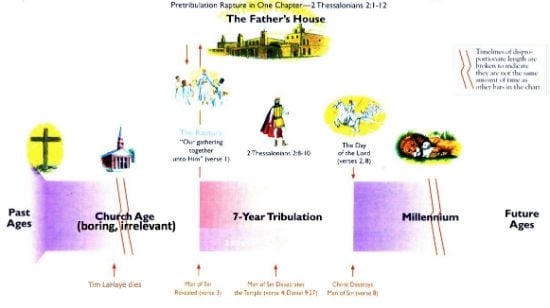
'One will be taken, and one will be...

NRA: How not to evangelize, Step 1
The Left Behind franchise is coming for your...
TRENDING AT PATHEOS Progressive Christian

Looking at the Largest Orthodox Cathedral on Earth
There is often a considerable amount of anger and, shall we...

The Problem with False Prophets
Miller’s Station UMC| 10/18/26| Anchor Verse: Jeremiah 23: 1, 9-23 I...

Emotion in Early Christianity by Andrew Crislip
Andrew Crislip’s Emotion in Early Christianity examines an often overlooked dimension of...

16 Spiritual Touchstones for a More Grounded Life
After decades of spiritual study, here are 16 principles I try...

Catholic Evangelization: Sharing Your Faith Every Day
Welcome back to the Graceful Awakening mini-series called, “From Faith to Mission.” ...

The Pillar of the Boatmen: the Ancient Monument...
The Pillar of the Boatmen is a Romano-Gaulish sculpture that dates from...
view all Progressive Christian blogs
What Are Your Thoughts?leave a comment
Comments are closed.
Ad-Free & Subscriber Log-In Subscription Support
- About Us
- 2026 Calendar
- Videos
- Podcasts
- Library of World Religions
- Faith In Media Tracker
- Advertise With Us
- Write for Us
- Privacy Policy
- Terms of Service
- Do Not Sell My Data
- Contact Us
- Radiant Digital
- Manage Newsletter Subscriptions
- Unsubscribe From Notifications
- Sitemap
Copyright 2008-2026, Patheos. All rights reserved.
Subscription Support Ad-Free & Subscriber Log-In
Follow Patheos