
BuddhistCatholicContemplativeEvangelicalGeneral ChristianHinduJewishLatter-day SaintMuslimNew VisionsProgressive Christian
Beliefs
- Buddhist
- Catholic
- Contemplative
- Evangelical
- General Christian
- Hindu
- Jewish
- Latter-day Saint
- More Voices
- Muslim
- New Visions
- Pagan
- Progressive Christian
Topics
- Religion News
- Food and Religion
- Sports and Religion
- Religious Art
- Religious Music and Entertainment
- Religious Events
- History and Religion
- Style and Religion
- Politics and Religion
- Women in Religion
- Recreation Outdoors and Religion
- Business Finance and Religion
- Careers Workplace and Religion
- Education and Religion
- Family Parenting and Religion
- Health Fitness and Religion
- Home and Religion
- Relationships and Religion
- Technology and Religion
- Travel and Religion
Columnists
- Buddhist Columnists
- Business Finance and Religion Columnists
- Careers Workplace and Religion Columnists
- Catholic Columnists
- Contemplative Columnists
- Education and Religion Columnists
- Evangelists Columnists
- Family Parenting and Religion Columnists
- General Christian Columnists
- Health Fitness and Religion Columnists
- Hindu Columnists
- History and Religion Columnists
- Home and Religion Columnists
- Jewish Columnists
- More Voices Columnists
- Latter Day Columnists
- Muslim Columnists
- New Visions Columnists
- Nonreligious Columnists
- Pagan Columnists
- Politics and Religion Columnists
- Progressive Columnists
- Recreation Outdoors and Religion Columnists
- Relationships and Religion Columnists
- Religion News Columnists
- Religious Art Columnists
- Religious Events Columnists
- Religious Music and Entertainment Columnists
- Sports and Religion Columnists
- Style and Religion Columnists
- Technology and Religion Columnists
- Travel and Religion Columnists
- Women in Religion Columnists
Resource Library
- 2026 Calendar
- Library of World Religions
- The 100 Most Holy Places on Earth
- Patheos Answers
- Podcasts
- Videos
- Faith Leaders Database
- Anglican Episcopalian
- Bahai
- Baptist
- Buddhism
- Christianity
- Confucianism
- Eastern Orthodoxy
- Hinduism
- Holiness and Pentecostal
- ISKCON
- Islam
- Judaism
- Lutheran
- Methodist
- The Church of Jesus Christ of Latter-day Saints
- New Age
- Paganism
- Presbytarian and Reformed
- Protestantism
- Religion Behind the Scenes
- Roman Catholic
- Scientology
- Shia Islam
- Sikhism
- Sufism
- Sunni Islam
- Taoism
- Zen
- See all religions
Research Tools
 Ad-Free & Subscriber Log-In Subscription Support
Ad-Free & Subscriber Log-In Subscription Support
Follow Patheos 

- Trending:
- Forgiveness
- |
- Marriage
- |
- Consciousness
- |
- Death Penalty
- |
- Election
- |
- Halloween
 The Skeptical Catholic
- Home
- Catholic
- Why Skeptical? (Part 2)
Why Skeptical? (Part 2)
Last updated on: January 31, 2016 at 11:49 pm by Matthew Miller
Why Skeptical? (Part 2) 2016-01-31T23:49:55-08:00 Matthew Miller
Patheos Explore the world's faith through different perspectives on religion and spirituality! Patheos has the views of the prevalent religions and spiritualities of the world.
My last draft gave a brief introduction to ancient skepticism, particularly in the Pyrrhonian variety that interests me most. In part 2 I want briefly to touch on how skepticism came to play a role in Catholic thought, particularly during the Reformation and Counter-Reformation, and especially in the Essays of Michel de Montaigne. In part 3, the final part of this series of posts, I will touch on how I came to be interested in philosophical skepticism, the role it plays in my life, what form or degree of skepticism is compatible with Catholicism, what it has to offer as a Catholic way of life, and how it will inform what I want to do with this blog.
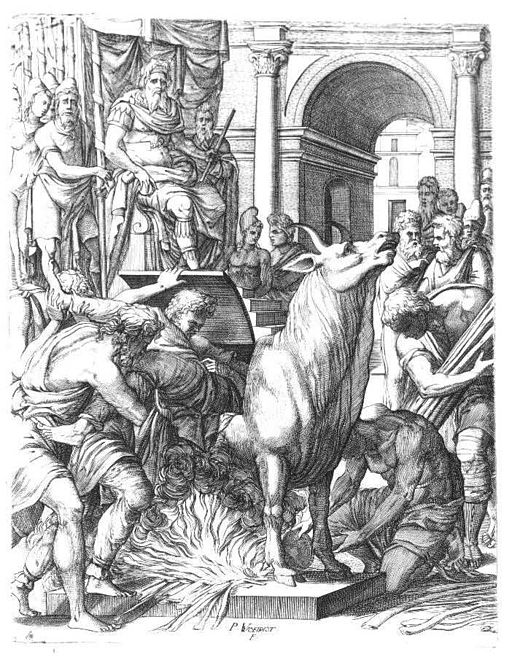
The Brazen Bull; Pierre Woeiriot [Public domain], via Wikimedia Commons
Before the crucifix was the great symbol of torture and pain in the Roman world, the Greeks had their own method of execution which was considered a kind of summum malum, the greatest evil or misfortune that a person could undergo: the Brazen Bull of Phalaris. As the story goes the bull was invented by an Athenian named Perillos, who offered it to the psychopathic Sicilian tyrant Phalaris as a method of execution. Phalaris thanked Perillos by having the latter demonstrate its effectiveness himself by being its first victim (Raytheon and Lockheed Martin executives take note!). I will leave it to you all to inquire if you wish into the gory details of how the Brazen Bull worked. Or you can watch Hollywood’s take on it in the 2011 film Immortals, if you’re into that sort of thing. Anyway, it was pretty horrific. It apparently used to be a topic of discussion amongst the representatives of the Hellenistic schools, when debating about their respective philosophies, whether the Stoic or Epicurean sage, for instance, could be considered happy even while being roasted alive in the Bull of Phalaris. Those two schools in particular staked a claim to a way of life that allowed for happiness regardless what horrors Fortune might send your way. Others, like the Peripatetics, admitted that for certain very unlucky individuals, such evil might overtake them that no amount of virtue could save their life from being considered a ruin. It is easy to see the appeal of the Stoic and Epicurean philosophies here and why, by the time of the Gospels, they were the dominant philosophies of the Mediterranean world. Even Cicero, a proponent of Academic skepticism, in this Tusculan Disputations, defends the Stoic position, saying the sage can be considered happy even in the midst of torture because the Good for him is identified with virtue, which cannot be touched by fire or spear. In the rapidly changing and sometimes brutal world of the Hellenistic and Imperial Roman eras, what people wanted above all was to know that their life was safe from the vagaries of fate. It is no wonder then that Christianity spread so quickly in such an intellectual milieu. Where the philosopher’s discussed in abstract whether a wise man or woman could be happy even in the Brazen Bull, Christians were dying in horrific ways while confessing their faith and pardoning their torturers. While the Aristotelians were doubting that a person of extreme misfortune could be considered happy, St. Paul was was boasting of his misfortunes, shipwrecks, imprisonments and tortures, saying, “That is why, for Christ’s sake, I delight in weaknesses, in insults, in hardships, in persecutions, in difficulties. For when I am weak, then I am strong.” Christians showed by their actions, and not merely their words (though the philosophical schools were not without their own martyrs, just not as impressive or plentiful), that not only could blessedness survive torture, it could be most perfectly manifest in such torture. The sufferings of this small religious sect must have had a tremendous impact on the world around them. Even the Stoic emperor, Marcus Aurelius, took notice, enjoining himself in his Meditations not to throw away his life heedlessly as the Christians did.
I believe, other political and social factors aside, that the witness of the martyrs to a society anxious for a philosophy tough enough to withstand terrible misfortune must be one reason for the rapid spread of Christianity. As late antiquity passed over into the early middle ages, the great schools of Hellenistic philosophy, with their focus on tranquility, faded from the scene. The Skeptics and Epicureans faded first while the Stoic philosophy and Neoplatonism were gradually absorbed, mutatis mutandis by Christianity. Though skeptical issues would continue to exert some influence on philosophy in the Middle Ages, it would not be until the Renaissance that the skeptics would come roaring back.
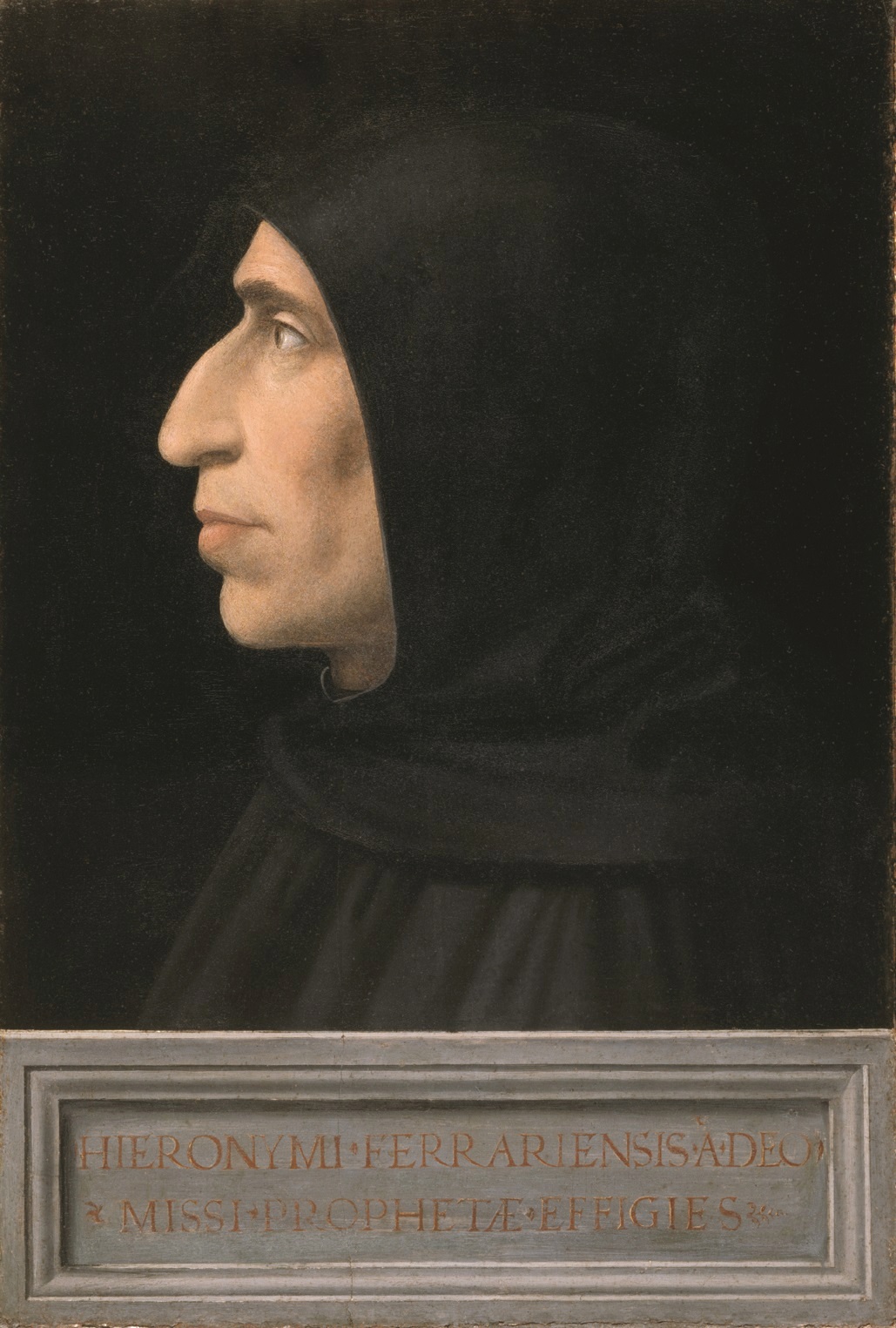
Girolamo Savonarola, This image was orginally posted to Wikipedia Commons,https://commons.wikimedia.org/wiki/Category:Girolamo_Savonarola#/media/File:Savonarola.jpg
The story of skepticism’s resurgence in the Renaissance has been told best in Richard Popkin’s History of Skepticism from Savonarola to Bayle. As Popkin’s title suggests, the story begins with the famous Dominican Florentine friar. Though he probably did not read the Greek text of Sextus Empiricus that was available to him in the Convent of San Marco, he was familiar enough with Sextus’ arguments through his scholarly acquaintances that he ordered a translation of his works into Latin, hoping that they could be used to attack the religious authority of the papacy. Such at least is the testimony of Gianfrancesco Pico, one of Savonarola’s devoted followers. Though he would not live to see the work translated, the stage was set for Sextus’ central importance in the religious debates of the Reformation and Counter-Reformation, with Protestant and Catholic authors alternately employing Pyrrhonian argumentation against the criterion of truth of their opponents and also accusing their opponents of open or latent Pyrrhonism. These debates live on in current arguments in popular apologetics between Catholics defending the papacy and Reformed Christians defending sola scriptura as their respective criterions of true faith. However, Sextus’ growing popularity was not limited to his usefulness in religious polemics. In the midst of murderous hostility between Protestants and Catholics a humane, liberal, and peace-loving variant of skepticism began to emerge in the 16th century. This humane skepticism was best exemplified in the person of Michel Eyquem de Montaigne. The best place to acquaint oneself with Montaigne is to pick up his Essays and allow him introduce himself. The Essays are intensely personal and rambling meditations on just about everything. Were he a saint (he was not and he would be the first to tell you so) he would be the patron of bloggers. After withdrawing from public life at 37(he was mayor of Bordeaux) he retired to his very impressive personal library to study and write. While Montaigne, through his study of classical authors like Plutarch, Cicero, and Seneca, was influenced by all of the Hellenistic schools, his writing is especially shot through with the spirit of Pyrrhonian skepticism. Pyrrhonian skepticism encourages an enquirer to contemplate innumerable points of view in order to dissolve dogmatic belief: the views of non-human animals, the views of human beings with altered senses, the views of people from radically different cultures, the views of future persons with advanced knowledge, etc. Montaigne was intensely curious and well situated to take such alternate views. He travelled widely through Europe and paid special attention to cultural difference. He even had a chance to talk to a couple Tupi indians from Brazil. He was also very knowledgable of the customs of ancient peoples through his classical studies. Pierre Hadot has called the Essays a breviary of the classical world. This ability to consider multiple points of view gave him a great capacity for sympathy and tolerance. Though a Catholic he was opposed to the religious violence of the Holy Catholic League (think Catholic Taliban) who in violent mobs would hack Huguenots to pieces in the streets of Paris. He allied himself with the Politiques who favored the extension of tolerance to religious dissent. There is much more to say about the man and his very appealing brand of skepticism, but I defer to his own Essays as well as to a good recent biography of him by Sarah Bakewell that I will include among the books at the end of this post. It is through the extreme popularity of Montaigne’s works that the influence of skepticism began to spread around Europe and the world. Shakespeare was apparently a fan, as parts of his plays paraphrase sections of the Essays. He was also a favorite author of Blaise Pascal, who would alternately embrace and be repelled by Montaigne’s skepticism. His influence was felt in more ways than I can relate in this post, but more on that can be found elsewhere as well as in Bakewell’s biography.
For more reading see:
A nice edition of Montaigne’s complete Essays as well as his travel journals.
A fascinating look at how skepticism helped form the modern mind.
A very readable biography/introduction to the thought of Montaigne.
Previous Post

January 23, 2016
Why Skeptical? (Part 1)
Next Post

January 31, 2016 Sunday Samba.
Browse Our Archives
Select a Category Uncategorized
Select a Month April 2016 March 2016 February 2016 January 2016
Follow Us!
TAKE THE
Religious Wisdom Quiz
Who helped Jesus carry His cross?
Select your answer to see how you score.
John Simon of Cyrene Judas Peter
Related posts from The Skeptical Catholic

A plea for a measure of incoherence


Sunday Samba #4, Martinho da Vila.

TRENDING AT PATHEOS Catholic

Creation, Preservation, and Teleology in Catholic Theology
As I write this, it is very early Monday morning. Like millions...

The Parable Of The Sower And The Word...
One of Christ’s most famous parables is that of the sower who...

Rejecting Doom: Christian Hope And Human Action
Christianity is a religion of hope. We are to have hope and...

Why I Choose the Eucharist Over the Sermon
Choose the Eucharist, Not the Sermon What are we supposed to get...

5 Design Elements Found in Spiritually Rooted Homes
Putting Spirituality Into Home Decor Our homes are more than our living...

Credo: A Story of God Told with the...
About 10 years ago, I began to imagine a personal "Credo" that...
view all Catholic blogs
Ad-Free & Subscriber Log-In Subscription Support
- About Us
- 2026 Calendar
- Videos
- Podcasts
- Library of World Religions
- Faith In Media Tracker
- Advertise With Us
- Write for Us
- Privacy Policy
- Terms of Service
- Do Not Sell My Data
- Contact Us
- Radiant Digital
- Manage Newsletter Subscriptions
- Unsubscribe From Notifications
- Sitemap
Copyright 2008-2026, Patheos. All rights reserved.
Subscription Support Ad-Free & Subscriber Log-In
Follow Patheos