
BuddhistCatholicContemplativeEvangelicalGeneral ChristianHinduJewishLatter-day SaintMuslimNew VisionsProgressive Christian
Beliefs
- Buddhist
- Catholic
- Contemplative
- Evangelical
- General Christian
- Hindu
- Jewish
- Latter-day Saint
- More Voices
- Muslim
- New Visions
- Pagan
- Progressive Christian
Topics
- Religion News
- Food and Religion
- Sports and Religion
- Religious Art
- Religious Music and Entertainment
- Religious Events
- History and Religion
- Style and Religion
- Politics and Religion
- Women in Religion
- Recreation Outdoors and Religion
- Business Finance and Religion
- Careers Workplace and Religion
- Education and Religion
- Family Parenting and Religion
- Health Fitness and Religion
- Home and Religion
- Relationships and Religion
- Technology and Religion
- Travel and Religion
Columnists
- Buddhist Columnists
- Business Finance and Religion Columnists
- Careers Workplace and Religion Columnists
- Catholic Columnists
- Contemplative Columnists
- Education and Religion Columnists
- Evangelists Columnists
- Family Parenting and Religion Columnists
- General Christian Columnists
- Health Fitness and Religion Columnists
- Hindu Columnists
- History and Religion Columnists
- Home and Religion Columnists
- Jewish Columnists
- More Voices Columnists
- Latter Day Columnists
- Muslim Columnists
- New Visions Columnists
- Nonreligious Columnists
- Pagan Columnists
- Politics and Religion Columnists
- Progressive Columnists
- Recreation Outdoors and Religion Columnists
- Relationships and Religion Columnists
- Religion News Columnists
- Religious Art Columnists
- Religious Events Columnists
- Religious Music and Entertainment Columnists
- Sports and Religion Columnists
- Style and Religion Columnists
- Technology and Religion Columnists
- Travel and Religion Columnists
- Women in Religion Columnists
Resource Library
- 2026 Calendar
- Library of World Religions
- The 100 Most Holy Places on Earth
- Patheos Answers
- Podcasts
- Videos
- Faith Leaders Database
- Anglican Episcopalian
- Bahai
- Baptist
- Buddhism
- Christianity
- Confucianism
- Eastern Orthodoxy
- Hinduism
- Holiness and Pentecostal
- ISKCON
- Islam
- Judaism
- Lutheran
- Methodist
- The Church of Jesus Christ of Latter-day Saints
- New Age
- Paganism
- Presbytarian and Reformed
- Protestantism
- Religion Behind the Scenes
- Roman Catholic
- Scientology
- Shia Islam
- Sikhism
- Sufism
- Sunni Islam
- Taoism
- Zen
- See all religions
Research Tools
 Ad-Free & Subscriber Log-In Subscription Support
Ad-Free & Subscriber Log-In Subscription Support
Follow Patheos 

- Trending:
- Forgiveness
- |
- Marriage
- |
- Consciousness
- |
- Death Penalty
- |
- Election
- |
- Halloween

- Home
- Bibliography for Sr. Rose Pacatte
- Using film to contemplate Religious Life
- Archives
- FREE NEWSLETTER
- Home
- Religious Music and Entertainment
- Neither faith nor magic saves ‘Little Boy’ from its muddled message
Neither faith nor magic saves ‘Little Boy’ from its muddled message
Last updated on: April 16, 2015 at 2:44 pm by Sister Rose
Neither faith nor magic saves ‘Little Boy’ from its muddled message 2015-04-16T14:44:19-06:00 Sister Rose
Patheos Explore the world's faith through different perspectives on religion and spirituality! Patheos has the views of the prevalent religions and spiritualities of the world.
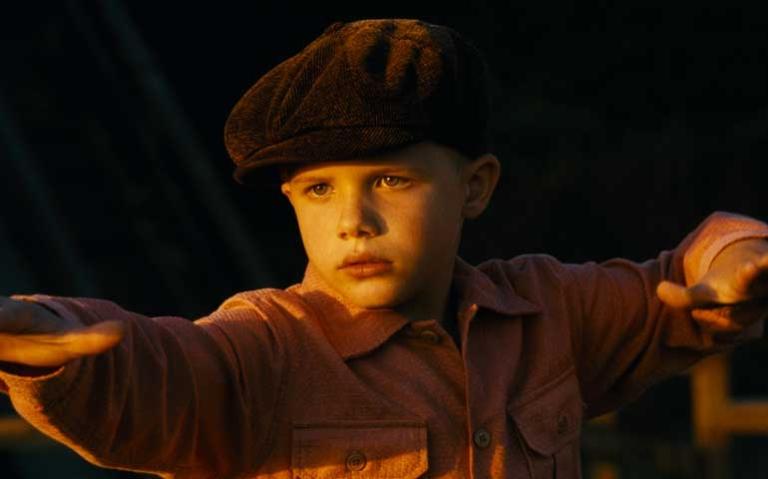
Jakob Salvati as the title character in “Little Boy” (©Metanoia Films)
I imagine that the writers of “Little Boy,” Pepe Portillo and Alejandro Monteverde, who also directs, wanted to make a sweet film about faith and the love between a father and his son. They surely wanted audiences to see life through a Catholic lens when they crafted this highly structured, ambitious, well-cast, and beautiful-looking movie, which opens in theaters April 24. Unfortunately, while it may make you shed a tear at the end, it’s for all the wrong reasons.
As “Little Boy” opens, we hear the voice-over narration of the main character in old age telling us that the U.S. is fully engaged in World War II in 1944. In a fictional, almost idyllic, California coastal town, James Busbee (Michael Rapaport) is a mechanic who runs his garage with his sullen older son, London (David Henrie), and a homeless man, Teacup (Abraham Benrubi). But James is closest to his 7-year-old son, Pepper (Jakob Salvati), whom everyone calls “Little Boy” because he is small for his age. With wife and mother Emma (Emily Watson) running the house, the Busbee home is a happy one.
When the amazing magician Ben Eagle (Ben Chaplin) comes to town to perform at the theater, he challenges Little Boy that if he believes, he can make a bottle move across a table — and it does, with a little sleight of hand from the magician, of course.
London is turned down for military service due to his flat feet, and James must go in his place. The family is heartbroken when James leaves home and the war becomes more real for them. At Sunday Mass, the associate pastor at the church, Fr. Crispin (Eduardo Verástegui), preaches about faith: If you have faith like a mustard seed, you can move mountains.
What follows is a story in parallel structure. Important human themes are juxtaposed neatly, as if a writing teacher were in charge: the love between father and son; racism and violence; understanding and forgiveness; the corporal works of mercy vis-à-vis acts of hatred; the tension between magic and faith. These are experienced through the eyes of a child and the kids and adults in his world, including a bully and a Japanese-American, Hashimoto (Cary-Hiroyuki Tagawa), just released from an internment camp. The bigger conflict is, of course, between the United States and its archenemy, Japan.
The pastor, Fr. Oliver (Tom Wilkinson) gives a list of the seven corporal works of mercy to Little Boy, telling him that to carry out these actions is a much better way to live one’s faith than by magic or actions that hurt others.
Framing the central part of the film with showing love for one’s neighbor through the corporal works of mercy is the most creative and original aspect, although it is not enough to save the story’s overall meaning from, at the very least, gross ambiguity.
Little Boy wants his dad to come home so much that one day he decides to prove that he has faith. He extends his arms, like Ben the magician does to perform magic, toward the mountain overlooking the town. Instead of moving it, an earthquake occurs, making people think that Little Boy is on to something.
Faith through good works, or through magic, becomes the focus of all of Little Boy’s efforts. Hashimoto shows him where Japan is out across the water toward the setting sun, and Little Boy once again extends his arms, commanding the war to end.
Then one morning, as he rides through town on his bike, all the people start yelling at him, “You did it!” They show him a newspaper with the headlines: “Little Boy Did It!” A bomb has been dropped in Japan that will end the war.
It is only later, when he watches the devastation of the atom bomb named “Little Boy” on a newsreel at the movie theater, that he seems to understand what has happened. At night, he has a dream he is standing, dressed in a red shirt, amid the bomb’s destruction looking at the bright, unexploded red bomb with the nameplate “Little Boy.”
In the ash, he sees his father’s identification tags. Does Little Boy realize that the bomb means death for everyone? It is impossible to know; the scene could mean anything or nothing. Later, his mother tells him that the bomb may not be good for his dad. The Japanese may take revenge on the soldiers because the bomb wiped out an entire city.
It is precisely at this juncture that the film “Little Boy” falls apart. It left me struggling to understand just what the film was trying to say. Yet no matter how I interpreted it, this well-cast, tightly scripted film with such good production values — a movie that wants so much to be positive and “Catholic” — just crumples.
I was incredulous that the main motif of a film is a narrative thread linking Little Boy, an innocent child, with the name of the atomic bomb dropped on the Japanese city of Hiroshima.
The child at first thinks that it was through his efforts that the bomb would stop the war and send his father home. The dream sequence was ambiguous at best, though one priest friend thought it showed that Little Boy realized it meant death for all, but I disagree. If this was a moment of revelation, or of sorrow, what a horrible burden of guilt for a child to bear. And there is nothing throughout the rest of the film that comes near to supporting this view.
To make matters worse, his mother tells him that the bomb was not a good thing for American soldiers because the Japanese may want vengeance. Psychologically, how could this not burden a child? First he was responsible for the bomb and it was a good thing; now he is responsible for his dad not coming home because the bomb was a bad thing. This entire motif or theme makes no sense. It is a cinematic moment of transgression, a plot device that disrupts and fractures its own narrative logic.
I cannot imagine the confusion and emotional burden that this child would logically carry into the future. What were the writers thinking? The character’s calm elderly voice-over seems to be telling a story where all will turn out well, but by the end we realize just how unreliable a narrator he is.
The film juxtaposes symbols and acts of violence throughout the story, from toy gun battles with imaginary cowboys and hitting a bully on the head, building up to the dropping of that first atomic bomb. Is the film justifying the use of the atomic bomb? It’s hard to interpret. Either this is exactly what the film is saying, for what reason it is not clear, or it got so tangled up in the threads of its own complexity that there was no way out.
Are the filmmakers saying that there is something about the atom bomb that is good — an old theory that certainly does not bear out today, when the nuclear threat unleashed by the two bombs dropped on Japan in 1945 is as real as ever? If the film is colored with a Catholic sensibility about the Gospel of loving your neighbor, what exactly is Catholic about this moment?
Without the clumsy link between the child called “Little Boy” and the first atomic bomb used in war, there is simply no story. I am unable to wrap my brain around ever thinking this was a good idea. But that someone has linked them and made a movie about it and filled it with unfulfilled themes that may attract Catholics, well, this is what should make us cry.
Read more of my reviews at National Catholic Reporter
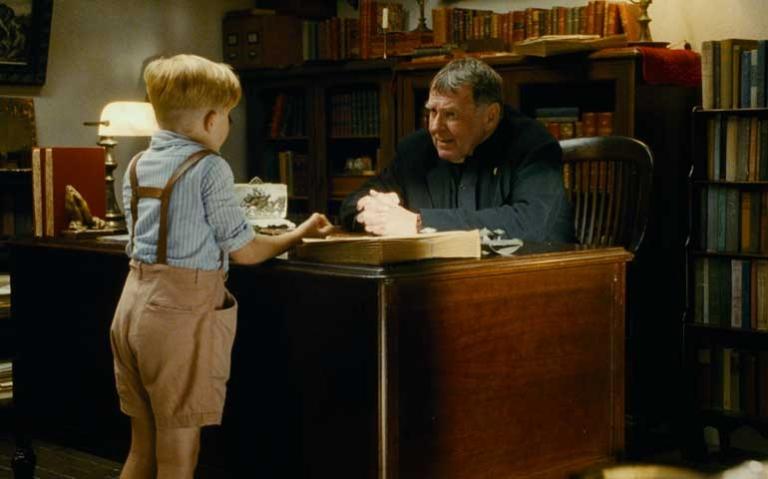
Fr. Oliver (Tom Wilkinson) talks to Little Boy. (©Metanoia Films)
Previous Post

April 15, 2015
Sr. Rose at the Movies #121 of Top Church Blogs
Next Post
April 17, 2015 'The Messengers' is like a Christian zombie movie for the small screen
Browse Our Archives
Select a Category Adolescent Adult Faith Formation Advertising Analysis Animals Pets Animation art Authors Awards best pope pictures Bible BioPic Blogs Book Reviews Books books into film Catechesis Catholic comedy Catholic Social Teaching Catholic Social Teaching (CST) Catholics in Media Christian genre Christmas movies Church and cinema Cognitive science Comedy Comics Commerntary Communication Cooking Courses Critics and Criticism Dance Daughters of St Paul news Devil movies digital games Documentary Drama Economics Ecumenical Education and Technology Education: Access and Empowerment electronic Environment Events Exorcism movies Eye on Entertainment Faith and film Faith formation Fantasy Film Essays Film Festivals Film History Film Retreat Film Reviews Film TV about Ultra Orthodox Jews Food General Grace Historical thriller History Horror How to Images INNdustry with Sister Rose Internet Interviews jesuits Kindness Lectures Lent Life Lists Literature media Media analysis Media Literacy/Media Mindfulness Music Musical National Catholic Reporter New on DVD Non-violence Nonviolence Obituaries On Faith and Media Oscars Ovis et bovis et universe pecore Parenting Pastoral Communication Pastoral communications Pauline Books & Media pax christi PCMS & Online Courses Peace Philosophy Photos Planning for Communication pope francis Popular Culture Radio RCL Benziger reality tv Reflections on life and grace religion Religious Lif Research Resources Retreat Rosary Sacraments Science and faith Social justice Social Media spirituality Spirituality and Media Sports Sr Rose Faith and Media Sr. Rose movies St. Anthony Messenger Stage & Theater stereotypes story Streaming series Survey Television the bible the bible movie The INNdustry with Sr Rose the voice Theater Themes of Catholic Social Teaching theologizing violence Theology theology of violence TV reviews and notes Uncategorized Video Video games Violence VR Games War War films Women World Film Young Adult YouTube
Select a Month September 2025 March 2025 December 2024 May 2024 April 2024 March 2024 May 2023 April 2023 March 2023 December 2022 October 2022 April 2022 March 2022 February 2022 January 2022 December 2021 November 2021 October 2021 September 2021 August 2021 May 2021 April 2021 February 2021 January 2021 December 2020 November 2020 October 2020 September 2020 May 2020 April 2020 March 2020 February 2020 December 2019 May 2019 April 2019 March 2019 January 2019 December 2018 October 2018 September 2018 August 2018 May 2018 April 2018 March 2018 February 2018 January 2018 December 2017 July 2017 June 2017 May 2017 April 2017 March 2017 February 2017 January 2017 December 2016 November 2016 October 2016 September 2016 August 2016 July 2016 June 2016 May 2016 April 2016 March 2016 February 2016 January 2016 December 2015 November 2015 October 2015 September 2015 August 2015 July 2015 June 2015 May 2015 April 2015 March 2015 February 2015 January 2015 December 2014 November 2014 October 2014 September 2014 August 2014 July 2014 June 2014 May 2014 April 2014 March 2014 February 2014 January 2014 December 2013 November 2013 October 2013 September 2013 August 2013 July 2013 June 2013 May 2013 April 2013 March 2013 February 2013 January 2013 December 2012 November 2012 October 2012 September 2012 August 2012 July 2012 June 2012 May 2012 April 2012 March 2012 February 2012 January 2012 December 2011 November 2011 October 2011 September 2011 August 2011 July 2011 June 2011 May 2011 April 2011 March 2011 February 2011 January 2011 December 2010 November 2010 October 2010 September 2010 August 2010 July 2010 June 2010 May 2010 March 2010 February 2010 January 2010 December 2009 November 2009 October 2009 September 2009 August 2009 July 2009 June 2009 May 2009 April 2009 March 2009 February 2009 January 2009 December 2008 November 2008 October 2008 September 2008 August 2008 July 2008 June 2008 May 2008 April 2008 March 2008 February 2008 January 2008 December 2007 November 2007 October 2007 September 2007 June 2007 May 2007 April 2007 March 2007 February 2007 January 2007 December 2006 November 2006 October 2006 September 2006 August 2006 July 2006 June 2006 May 2006 April 2006 March 2006 February 2006 January 2006 December 2005 November 2005 October 2005 September 2005 August 2005 July 2005 June 2005 May 2005 April 2005 March 2005 February 2005 January 2005 December 2004 November 2004 October 2004 September 2004 August 2004 July 2004 June 2004 May 2004 April 2004 March 2004 February 2004 January 2004 December 2003 November 2003 October 2003
TAKE THE
Religious Wisdom Quiz
How many stringed instruments were used in the Temple?
Select your answer to see how you score.
3 5 7 10
Related posts from Sister Rose Movies
Adolescence: Netflix series asks what lies beneath

New docudrama explains Immaculate Conception dogma
"Cabrini" hope of immigrants and first U.S. saint
Reflections on the Mysteries of the Rosary (thanks...
TRENDING AT PATHEOS Religious Music and Entertainment

The Problem with False Prophets
Miller’s Station UMC| 10/18/26| Anchor Verse: Jeremiah 23: 1, 9-23 I...

Emotion in Early Christianity by Andrew Crislip
Andrew Crislip’s Emotion in Early Christianity examines an often overlooked dimension of...

16 Spiritual Touchstones for a More Grounded Life
After decades of spiritual study, here are 16 principles I try...

Catholic Evangelization: Sharing Your Faith Every Day
Welcome back to the Graceful Awakening mini-series called, “From Faith to Mission.” ...

The Pillar of the Boatmen: the Ancient Monument...
The Pillar of the Boatmen is a Romano-Gaulish sculpture that dates from...

In one sense walking into Westminster Abbey is like walking down the...
view all Religious Music and Entertainment blogs
Ad-Free & Subscriber Log-In Subscription Support
- About Us
- 2026 Calendar
- Videos
- Podcasts
- Library of World Religions
- Faith In Media Tracker
- Advertise With Us
- Write for Us
- Privacy Policy
- Terms of Service
- Do Not Sell My Data
- Contact Us
- Radiant Digital
- Manage Newsletter Subscriptions
- Unsubscribe From Notifications
- Sitemap
Copyright 2008-2026, Patheos. All rights reserved.
Subscription Support Ad-Free & Subscriber Log-In
Follow Patheos