
BuddhistCatholicContemplativeEvangelicalGeneral ChristianHinduJewishLatter-day SaintMuslimNew VisionsProgressive Christian
Beliefs
- Buddhist
- Catholic
- Contemplative
- Evangelical
- General Christian
- Hindu
- Jewish
- Latter-day Saint
- More Voices
- Muslim
- New Visions
- Pagan
- Progressive Christian
Topics
- Religion News
- Food and Religion
- Sports and Religion
- Religious Art
- Religious Music and Entertainment
- Religious Events
- History and Religion
- Style and Religion
- Politics and Religion
- Women in Religion
- Recreation Outdoors and Religion
- Business Finance and Religion
- Careers Workplace and Religion
- Education and Religion
- Family Parenting and Religion
- Health Fitness and Religion
- Home and Religion
- Relationships and Religion
- Technology and Religion
- Travel and Religion
Columnists
- Buddhist Columnists
- Business Finance and Religion Columnists
- Careers Workplace and Religion Columnists
- Catholic Columnists
- Contemplative Columnists
- Education and Religion Columnists
- Evangelists Columnists
- Family Parenting and Religion Columnists
- General Christian Columnists
- Health Fitness and Religion Columnists
- Hindu Columnists
- History and Religion Columnists
- Home and Religion Columnists
- Jewish Columnists
- More Voices Columnists
- Latter Day Columnists
- Muslim Columnists
- New Visions Columnists
- Nonreligious Columnists
- Pagan Columnists
- Politics and Religion Columnists
- Progressive Columnists
- Recreation Outdoors and Religion Columnists
- Relationships and Religion Columnists
- Religion News Columnists
- Religious Art Columnists
- Religious Events Columnists
- Religious Music and Entertainment Columnists
- Sports and Religion Columnists
- Style and Religion Columnists
- Technology and Religion Columnists
- Travel and Religion Columnists
- Women in Religion Columnists
Resource Library
- 2026 Calendar
- Library of World Religions
- The 100 Most Holy Places on Earth
- Patheos Answers
- Podcasts
- Videos
- Faith Leaders Database
- Anglican Episcopalian
- Bahai
- Baptist
- Buddhism
- Christianity
- Confucianism
- Eastern Orthodoxy
- Hinduism
- Holiness and Pentecostal
- ISKCON
- Islam
- Judaism
- Lutheran
- Methodist
- The Church of Jesus Christ of Latter-day Saints
- New Age
- Paganism
- Presbytarian and Reformed
- Protestantism
- Religion Behind the Scenes
- Roman Catholic
- Scientology
- Shia Islam
- Sikhism
- Sufism
- Sunni Islam
- Taoism
- Zen
- See all religions
Research Tools
 Ad-Free & Subscriber Log-In Subscription Support
Ad-Free & Subscriber Log-In Subscription Support
Follow Patheos 

- Trending:
- Forgiveness
- |
- Marriage
- |
- Consciousness
- |
- Death Penalty
- |
- Election
- |
- Halloween
 I Have to Sit Down
- Home
- Contact me
- FAQses
- Simcha's Store
- Speaking
- All Posts
- The Sinner's Guide to NFP
- Shop Amazon Here!
- Home
- Catholic
- The Myth of the Macho Christ
The Myth of the Macho Christ
Last updated on: August 17, 2015 at 1:50 pm by Simcha Fisher
The Myth of the Macho Christ 2015-08-17T13:50:17-05:00 Simcha Fisher
Patheos Explore the world's faith through different perspectives on religion and spirituality! Patheos has the views of the prevalent religions and spiritualities of the world.
Last week, I talked about the masculine qualities of protecting the weak, and exercising self-control, sexual and otherwise. One reader responded:
If an affinity for babies and not having sex is manliness or courage or masculinity then some anemic nerd virgin gamer who babysits his cousins on the weekend is literally more manly and masculine than Achilles or Alexander the Great or Gengis Khan, since they fornicated. It’s absurd, but it’s truly the best approach to manliness people can come up with today. Actual manliness is unacceptable, so it has to be redefined as babysitting and not having sex. But described with real strong words. People want to throw men a bone because they care about their sons. But they can’t. They fail because actual manliness and masculinity imposes on women, and that’s officially out of bounds.
In charity, we’ll overlook the facts that Alexander the Great almost certainly had sex with men, and is best known for sitting down and crying, and we’ll address the point that the commenter meant to make: that “actual manliness” means having sex whenever you want it; that “actual men” get women (and other weak people) to do what the men want, because that’s what’s best for everyone; and “actual men” don’t have time for little, feminine things, like children, or other people, or inaction. His point is that men have, until the last few decades, been admired mainly for their muscle and their ability to dominate.
So I asked:
What’s your opinion of Jesus? I’m sincerely curious. He didn’t fight back like a real man would. He just let them hang him there. And He was one of them virgins, too. Thoughts? Still holding out for a more masculine savior?
He responded:
No, I’m not saying virginity or holding babies precludes masculinity, but that it doesn’t define it at all. Not having sex didn’t make Jesus masculine. Sacrificing himself to crush the enemy and prevent group extinction is masculine, though, like Thermopoly. Maybe Alexander the Great was a bad example, but what about Achilles and Gengis Khan? The point is that virginity and taking care of babies isn’t manliness or masculinity. It’s the exact opposite—both virginity and holding babies are archetypal feminine things.
There’s a lot of confusion here.
First, there’s the statement that virginity is an “archetypal feminine thing.” I’m having a hard time picturing a world where the women are all real women by being virgins, but the men are all men by being not-virgins. Even if we’re getting sheep involved, it just don’t add up.
He also, possibly willfully, misunderstood me. No, there’s nothing especially masculine about taking care of babies or being a virgin. I never said there was. My point was that there’s nothing especially masculine about despising babies, and nothing especially masculine about despising virginity. That there is something very masculine about having the power to kill and rape, and deciding to use your strength for something else, instead.
The confusion here is a very old one. I mean very old, as in pre-War In Heaven-old. It’s the classic mistake of falling for a parody — of confusing a distortion for the real thing. We’re too smart to do the opposite of what we should do, but we’re dumb enough to fall for a disastrously bad imitation.
I remember hearing a Metropolitan Opera broadcast of Don Giovanni, where some gabbling announcer said, “You know, despite everything, you really have to admire the Don. I mean, look how he stood up to that statue! He really held his ground and didn’t let it push him around!”
Yarr, this is true. And then the demons with torches dragged him down to Hell, and the opera ends with a cheerful chorus of survivors, singing, essentially, “Boy, did he deserve it.” The opera opens with the servant Leporello complaining about what a terrible boss he has, and at the end, he creeps off, presumably to find an employer who uses his noble birth justly and wisely, rather than as a license to murder and rape.
One of the main services that Christianity provided to the world (besides, you know, salvation) was to correct our model for femininity and masculinity, which got distorted almost as soon as the first man and woman were made. What needed correcting? Well, before Christ, the rest of the world was still laboring under the pagan delusion, the lapsarian distortion, that women are weak and that men are basically penises with swords. That’s what we revert to, when we listen to the distortions of sin.
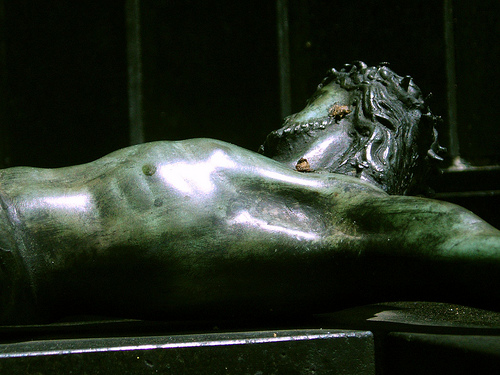
And what was the correction that Christ give us? He gave us woman clothed with the sun, queen of the angels, crusher of serpents. And a savior who poured out His life, not as a symbol, but for real. Who made Himself powerless, immobile, transfixed on the cross, open to shame, to spitting, to insults and humiliation. When Jesus died on the cross, no one said, “Look at this display of strength!” They saw Him fall; they saw Him overpowered. They saw Him dead. Ecce homo.
What do we know about this model of masculinity? He chose to let it happen. He had strength, and He chose to put away His strength, His manhood (never mind His Godhood). He chose to reserve it until it could be used the right way. He didn’t come to make unmistakable display of His power and might. There are still millions who don’t see it! He came, instead, to strengthen us, to protect us, to empty Himself out so that we might have life.
This is the new model of manhood. This is the kind of strength we’re talking about when we hold up Christ as a model for men. We glory in the risen Christ, but it’s the crucifix that we hang in our homes and above the altar.
If I were a man, I wouldn’t like it, either.
So I don’t blame the commenter for trying to go back to the old pagan ways, where men are expected to be walking, fighting, self-serving penises. That’s a hell of a lot easier to understand than the crucified Christ. Even my dog can understand that model of masculinity.
Even a doglike man, or a doglike woman, or a doglike angel can fall for a distortion, a grossly simplified counterfeit. This is what Eve did when she was offered wisdom, and instead chose information. She chose the clever counterfeit. This is what Adam did when he had Eve to advise him, and instead used her as someone to blame. He chose a clever counterfeit.
This is what Satan did when he refused to serve. The angels were created to glorify God, but Satan mistook his free will a sign that He was too good to serve God. He thought his freedom meant he was made to be independent of God.
God knows, he’s on his own now.
Hey, men. It’s really easy to go raging around, hitting stuff, yelling at people, and stuffing your penis into anything that doesn’t fight back. It’s really easy to impose on people, especially if you are bigger than the people you’re imposing on.
But that’s not what Jesus did. That’s not what Jesus did.
As long as we were talking about opera, let’s remember the Marriage of Figaro, where the faithless count uses his wealth, his power, and his charm to seduce his way through the first four acts. He only repents of his philandering ways when the masks are removed, and he discovers that the woman he was trying to seduce was his own betrayed wife in disguise.
The moral of this story, for those who have ears to hear is: look out for those disguises. Watch out for those counterfeits you think you want so badly. Maybe you’ll be lucky, and it will be your long-suffering spouse under the mask. Maybe she’ll forigve you, and maybe you’ll repent, and maybe all will be well.
Or maybe you’re not in an opera, and when the mask is pulled away, you’ll see who you’ve really fallen for. And then the demons come to take you away to your chosen home.
***
photo credit: ::paixão. via photopin (license)
Previous Post

August 14, 2015
25 Back-to-school Items Your Kids Can't Geek Without
Next Post
August 18, 2015 Food, Love, Law, Jesus: It's All the Same Thing
Browse Our Archives
Select a Category Uncategorized
Select a Month November 2015 October 2015 September 2015 August 2015 July 2015 June 2015 May 2015 April 2015 March 2015 February 2015 January 2015 December 2014 November 2014 October 2014 September 2014 August 2014 July 2014 June 2014 May 2014 April 2014 March 2014 February 2014 January 2014 December 2013 November 2013 October 2013 September 2013 August 2013 July 2013 June 2013 May 2013 April 2013 March 2013 February 2013 January 2013 December 2012 November 2012 October 2012 September 2012 August 2012 July 2012 June 2012 May 2012 April 2012 March 2012 February 2012 January 2012 December 2011 November 2011 October 2011 September 2011 August 2011 July 2011 June 2011 May 2011 April 2011 March 2011 February 2011 January 2011 December 2010 November 2010 October 2010 September 2010 August 2010 July 2010 June 2010
Follow Us!
TAKE THE
Religious Wisdom Quiz
What is the Christian view of "servant leadership"?
Select your answer to see how you score.
Leaders demand first Only the boss leads Greatest serves others Servants never lead
Related posts from I Have to Sit Down

The lady was sad, and MAD. (We showed...

TRENDING AT PATHEOS Catholic

The Parable Of The Sower And The Word...
One of Christ’s most famous parables is that of the sower who...

Rejecting Doom: Christian Hope And Human Action
Christianity is a religion of hope. We are to have hope and...

Why I Choose the Eucharist Over the Sermon
Choose the Eucharist, Not the Sermon What are we supposed to get...

5 Design Elements Found in Spiritually Rooted Homes
Putting Spirituality Into Home Decor Our homes are more than our living...

Credo: A Story of God Told with the...
About 10 years ago, I began to imagine a personal "Credo" that...

The Anatomy of Divine Revelation in Catholic Thought
The claim that God has made Himself known to human beings is...
view all Catholic blogs
Ad-Free & Subscriber Log-In Subscription Support
- About Us
- 2026 Calendar
- Videos
- Podcasts
- Library of World Religions
- Faith In Media Tracker
- Advertise With Us
- Write for Us
- Privacy Policy
- Terms of Service
- Do Not Sell My Data
- Contact Us
- Radiant Digital
- Manage Newsletter Subscriptions
- Unsubscribe From Notifications
- Sitemap
Copyright 2008-2026, Patheos. All rights reserved.
Subscription Support Ad-Free & Subscriber Log-In
Follow Patheos