
BuddhistCatholicContemplativeEvangelicalGeneral ChristianHinduJewishLatter-day SaintMuslimNew VisionsProgressive Christian
Beliefs
- Buddhist
- Catholic
- Contemplative
- Evangelical
- General Christian
- Hindu
- Jewish
- Latter-day Saint
- More Voices
- Muslim
- New Visions
- Pagan
- Progressive Christian
Topics
- Religion News
- Food and Religion
- Sports and Religion
- Religious Art
- Religious Music and Entertainment
- Religious Events
- History and Religion
- Style and Religion
- Politics and Religion
- Women in Religion
- Recreation Outdoors and Religion
- Business Finance and Religion
- Careers Workplace and Religion
- Education and Religion
- Family Parenting and Religion
- Health Fitness and Religion
- Home and Religion
- Relationships and Religion
- Technology and Religion
- Travel and Religion
Columnists
- Buddhist Columnists
- Business Finance and Religion Columnists
- Careers Workplace and Religion Columnists
- Catholic Columnists
- Contemplative Columnists
- Education and Religion Columnists
- Evangelists Columnists
- Family Parenting and Religion Columnists
- General Christian Columnists
- Health Fitness and Religion Columnists
- Hindu Columnists
- History and Religion Columnists
- Home and Religion Columnists
- Jewish Columnists
- More Voices Columnists
- Latter Day Columnists
- Muslim Columnists
- New Visions Columnists
- Nonreligious Columnists
- Pagan Columnists
- Politics and Religion Columnists
- Progressive Columnists
- Recreation Outdoors and Religion Columnists
- Relationships and Religion Columnists
- Religion News Columnists
- Religious Art Columnists
- Religious Events Columnists
- Religious Music and Entertainment Columnists
- Sports and Religion Columnists
- Style and Religion Columnists
- Technology and Religion Columnists
- Travel and Religion Columnists
- Women in Religion Columnists
Resource Library
- 2026 Calendar
- Library of World Religions
- The 100 Most Holy Places on Earth
- Patheos Answers
- Podcasts
- Videos
- Faith Leaders Database
- Anglican Episcopalian
- Bahai
- Baptist
- Buddhism
- Christianity
- Confucianism
- Eastern Orthodoxy
- Hinduism
- Holiness and Pentecostal
- ISKCON
- Islam
- Judaism
- Lutheran
- Methodist
- The Church of Jesus Christ of Latter-day Saints
- New Age
- Paganism
- Presbytarian and Reformed
- Protestantism
- Religion Behind the Scenes
- Roman Catholic
- Scientology
- Shia Islam
- Sikhism
- Sufism
- Sunni Islam
- Taoism
- Zen
- See all religions
Research Tools
 Ad-Free & Subscriber Log-In Subscription Support
Ad-Free & Subscriber Log-In Subscription Support
Follow Patheos 

- Trending:
- Forgiveness
- |
- Marriage
- |
- Consciousness
- |
- Death Penalty
- |
- Election
- |
- Halloween
 I Have to Sit Down
- Home
- Contact me
- FAQses
- Simcha's Store
- Speaking
- All Posts
- The Sinner's Guide to NFP
- Shop Amazon Here!
- Home
- Catholic
- Expose your kids to art! (Or vice versa)
Expose your kids to art! (Or vice versa)
Last updated on: July 27, 2015 at 10:05 am by Simcha Fisher
Expose your kids to art! (Or vice versa) 2015-07-27T10:05:37-05:00 Simcha Fisher
Patheos Explore the world's faith through different perspectives on religion and spirituality! Patheos has the views of the prevalent religions and spiritualities of the world.
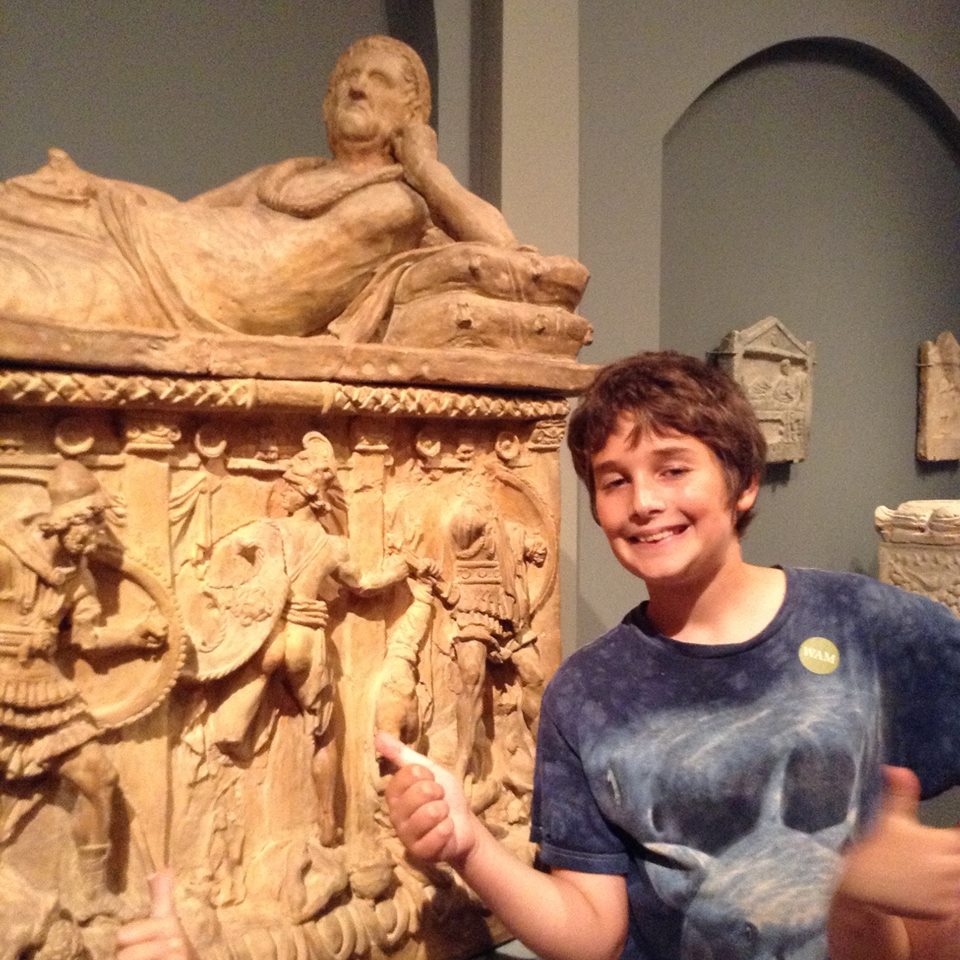
Portrait of a youth who stopped and looked closely at a work of fine art. This is a win.
The other week, we visited the Worcester Art Museum in MA. I heartily recommend it if you’re in the area (and it’s free all through August!). They had a world class collection with tons of variety, from pre-Columbian art to this guy; it was quite kid friendly (a docent in the armor display helped the kids try on helmets and gauntlets), the docents were genial and well-informed, and they had the exhibits arranged well to really help you see them. We saw everything in about three hours, and had time to go back and look at our favorite rooms. Looks like they have a pleasant cafe and a bunch of programs, classes, and demonstrations, too.
About what happened in the photo above, I take full responsibility. I’ve been reading them Black Ships before Troy: The Story of the Iliad and he got kind of hung up on Helen of the Fair Cheeks.
Of the Fair Cheeks.
I’m just glad he didn’t notice what was going on on the B side of some of those Grecian urns. Whoo-ee!
Anyway, we had such a good time that I want to encourage everyone to bring your kids to an art museum this summer, even if you don’t think of yourself as one of those high culture families. If you’re in New England, don’t forget about Free Fridays (which includes art museums and lots of other fun stuff).
Here’s something I wrote a few years ago, on that topic of why adults sometimes struggle with visiting art museums, and how kids can show us how to do it better. For more reading on this topic, check out “Introducing Children to Art” by an actual artist, John Herreid, who is raising three hilariously arty kids.
***
Remember the scene in Indiana Jones and the Last Crusade, when the Holy Grail is being snatched again by the bad guys? Indy cries out in righteous indignation: “That belongs in a museum!” I love me some Indiana Jones, but I have regretfully come to the conclusion that this line was not meant ironically. This really is the highest compliment that Americans can pay to an object of beauty and worth: that it belongs in a museum. I heard someone say the exact same thing in real life, when our college group first stepped out into one of the teeming, sun-drenched piazzas in Rome. There was a magnificent fountain in the middle of the square, featuring a sculpture carved by one of the giants of Western art. And people were sitting on it, and smoking, and drinking terrible wine, and flirting with each other, trying to sell socks out of a duffle bag, and generally acting like this timeless piece of art was theirs. Almost tearful with outrage, the fellow cried out, “That should be in a museum!”
He meant that it ought to be protected from the elements, and also from bird droppings and graffiti and vandals. But he also meant that it ought to be tucked away indoors, where the lighting could be controlled, where people would speak in hushed tones as they file past in reverence — where only the select few, acting in a very select way, would see it, and no one would get comfortable with it. And there, he was disastrously wrong.
Art museums are necessary because they are the most convenient way to preserve and share works of art which would otherwise be tucked away in the private homes of the very wealthy. But there is always the danger of museumishness taking over the work of art — making us forget why the artist made the piece in the first place. It’s a relatively new idea that art is here to “challenge” us, to jar us out of whatever cultural sin is currently considered intolerable. Instead, the great artists of every century have all said one thing: “I see something! You come and see it, too! Do you see?”
Well, that’s a pretty big topic. But in this little post, I can say that the problem with putting something in a museum is that it tends to give the impression that the question, “Do you see it, too?” is already answered. We feel like we have to stroke our chins gravely and say, “Yes, yes, of course I see,” whether we do or not, because there it is, in a museum. It must be Real Art. No wonder so many people have an aversion to art. They think they’re expected to respond like highly educated robots when the encounter it.
What’s the cure for a case of Stifling Museumishness? Take your kids to the museum with you . . . and do what they do.
Oh, listen, if your kids are awful, please don’t take them to a museum. If they can’t be controlled, don’t take them. If they can’t tell the difference between indoors and outdoors, and if they don’t obey you, and if otherwise kind people groan audibly when they see your family coming, then by all means, stay home.
But many parents underestimate how responsive their kids will be to good art. Kids in art museums will often behave in a way that is not only tolerable, but which the adult patrons should imitate.
Kids do not talk in whispers, as if they are at the bedside of a dying tyrant. Why do we whisper in front of art? We shouldn’t speak loudly, to distract other patrons; but a normal, conversational tone of voice is completely appropriate. Talking about what you’re seeing isn’t rude! It’s a natural thing to do, and makes the experience so much more rewarding, when you hear other people’s takes on what you’re seeing. I also like to eavesdrop on strangers’ conversations — so sue me.
Kids do not pretend to like things they don’t like. It’s one thing to have an open mind; it’s quite another to be a sucker. Many museums have extensive collections in the ever-popular genre of Egregious Crapola, and sometimes it really is only kids who are willing to point this out. Many adults have been duped into giving up on beauty; most kids have not. (But really, each kid is allowed to say, “I could have done that in ten minutes with a gallon of housepaint and a stick!” one time, and then they’re done. This comment may or may not be true, but it gets old fast.)
Kids are also remarkably open to admitting that there is more than meets the eye. They may shrug or grimace in front of a wonderful piece, but they are usually ready to listen if you point out, “No, look at how the light shines through that leaf!” or “See how realistic her hand looks — but get closer, and it’s just a bunch of paint” or “But why do you think this guy on the side has that look on his face?” or “Holy mackerel, what is this?!?”
Kids laugh at paintings — not only ones that look ridiculous, but ones which are meant to be funny. There is nothing sillier than a bunch of adults gravely appreciating the finer points of a work of art which is supposed to be hilarious.
Kids do not suffer from appreciation anxiety. Some adults who feel insecure in their grasp of art may spend their entire museum time wondering how obvious their lack of expertise is. Well, that’s no way get to be more of an expert! Kids don’t think about how they appear to others; they just look at the art.
Kids do not waste their time looking at exhibits that don’t interest them, out of a sense of duty or thrift. They will keep circling back to take another look at that one room or one piece they really like, and that is a much more natural response than trying to “do” the whole museum just because it’s there.
Okay, yes, and some kids will go berserk and behave like little demons, while their fond parents look on and do nothing. Or if you have a generally decent child who is temporarily going through a highly unreasonably, ridiculously loud stage, then this is probably not the best time to work on enhancing their cultural education. But really, if your kids are generally the non-demonic, non-berserker types, consider taking them to a small museum next time you have a chance. Wear comfortable clothes, discuss expectations ahead of time, plan a small treat for afterwards, and just relax. You will probably have a lovely time!
**
A version of this post originally ran in the National Catholic Register in March of 2013.
Previous Post

July 24, 2015
On complaining honestly about NFP (and other crosses)
Next Post

July 28, 2015 A simple reminder: Pray for police
Browse Our Archives
Select a Category Uncategorized
Select a Month November 2015 October 2015 September 2015 August 2015 July 2015 June 2015 May 2015 April 2015 March 2015 February 2015 January 2015 December 2014 November 2014 October 2014 September 2014 August 2014 July 2014 June 2014 May 2014 April 2014 March 2014 February 2014 January 2014 December 2013 November 2013 October 2013 September 2013 August 2013 July 2013 June 2013 May 2013 April 2013 March 2013 February 2013 January 2013 December 2012 November 2012 October 2012 September 2012 August 2012 July 2012 June 2012 May 2012 April 2012 March 2012 February 2012 January 2012 December 2011 November 2011 October 2011 September 2011 August 2011 July 2011 June 2011 May 2011 April 2011 March 2011 February 2011 January 2011 December 2010 November 2010 October 2010 September 2010 August 2010 July 2010 June 2010
Follow Us!
TAKE THE
Religious Wisdom Quiz
What is the longest book in the New Testament by word count?
Select your answer to see how you score.
Acts Luke Matthew Revelation
Related posts from I Have to Sit Down

12+ Scary Movies Our Kids Loved (including at...


Should I let my kid dress like a...

TRENDING AT PATHEOS Catholic

The Parable Of The Sower And The Word...
One of Christ’s most famous parables is that of the sower who...

Rejecting Doom: Christian Hope And Human Action
Christianity is a religion of hope. We are to have hope and...

Why I Choose the Eucharist Over the Sermon
Choose the Eucharist, Not the Sermon What are we supposed to get...

5 Design Elements Found in Spiritually Rooted Homes
Putting Spirituality Into Home Decor Our homes are more than our living...

Credo: A Story of God Told with the...
About 10 years ago, I began to imagine a personal "Credo" that...

The Anatomy of Divine Revelation in Catholic Thought
The claim that God has made Himself known to human beings is...
view all Catholic blogs
Ad-Free & Subscriber Log-In Subscription Support
- About Us
- 2026 Calendar
- Videos
- Podcasts
- Library of World Religions
- Faith In Media Tracker
- Advertise With Us
- Write for Us
- Privacy Policy
- Terms of Service
- Do Not Sell My Data
- Contact Us
- Radiant Digital
- Manage Newsletter Subscriptions
- Unsubscribe From Notifications
- Sitemap
Copyright 2008-2026, Patheos. All rights reserved.
Subscription Support Ad-Free & Subscriber Log-In
Follow Patheos