
BuddhistCatholicContemplativeEvangelicalGeneral ChristianHinduJewishLatter-day SaintMuslimNew VisionsProgressive Christian
Beliefs
- Buddhist
- Catholic
- Contemplative
- Evangelical
- General Christian
- Hindu
- Jewish
- Latter-day Saint
- More Voices
- Muslim
- New Visions
- Pagan
- Progressive Christian
Topics
- Religion News
- Food and Religion
- Sports and Religion
- Religious Art
- Religious Music and Entertainment
- Religious Events
- History and Religion
- Style and Religion
- Politics and Religion
- Women in Religion
- Recreation Outdoors and Religion
- Business Finance and Religion
- Careers Workplace and Religion
- Education and Religion
- Family Parenting and Religion
- Health Fitness and Religion
- Home and Religion
- Relationships and Religion
- Technology and Religion
- Travel and Religion
Columnists
- Buddhist Columnists
- Business Finance and Religion Columnists
- Careers Workplace and Religion Columnists
- Catholic Columnists
- Contemplative Columnists
- Education and Religion Columnists
- Evangelists Columnists
- Family Parenting and Religion Columnists
- General Christian Columnists
- Health Fitness and Religion Columnists
- Hindu Columnists
- History and Religion Columnists
- Home and Religion Columnists
- Jewish Columnists
- More Voices Columnists
- Latter Day Columnists
- Muslim Columnists
- New Visions Columnists
- Nonreligious Columnists
- Pagan Columnists
- Politics and Religion Columnists
- Progressive Columnists
- Recreation Outdoors and Religion Columnists
- Relationships and Religion Columnists
- Religion News Columnists
- Religious Art Columnists
- Religious Events Columnists
- Religious Music and Entertainment Columnists
- Sports and Religion Columnists
- Style and Religion Columnists
- Technology and Religion Columnists
- Travel and Religion Columnists
- Women in Religion Columnists
Resource Library
- 2026 Calendar
- Library of World Religions
- The 100 Most Holy Places on Earth
- Patheos Answers
- Podcasts
- Videos
- Faith Leaders Database
- Anglican Episcopalian
- Bahai
- Baptist
- Buddhism
- Christianity
- Confucianism
- Eastern Orthodoxy
- Hinduism
- Holiness and Pentecostal
- ISKCON
- Islam
- Judaism
- Lutheran
- Methodist
- The Church of Jesus Christ of Latter-day Saints
- New Age
- Paganism
- Presbytarian and Reformed
- Protestantism
- Religion Behind the Scenes
- Roman Catholic
- Scientology
- Shia Islam
- Sikhism
- Sufism
- Sunni Islam
- Taoism
- Zen
- See all religions
Research Tools
 Ad-Free & Subscriber Log-In Subscription Support
Ad-Free & Subscriber Log-In Subscription Support
Follow Patheos 

- Trending:
- Forgiveness
- |
- Marriage
- |
- Consciousness
- |
- Death Penalty
- |
- Election
- |
- Halloween
 I Have to Sit Down
- Home
- Contact me
- FAQses
- Simcha's Store
- Speaking
- All Posts
- The Sinner's Guide to NFP
- Shop Amazon Here!
- Home
- Catholic
- Am I my brother’s enabler?
Am I my brother’s enabler?
Last updated on: January 7, 2019 at 4:41 pm by Simcha Fisher
Am I my brother’s enabler? 2019-01-07T16:41:33-05:00 Simcha Fisher
Patheos Explore the world's faith through different perspectives on religion and spirituality! Patheos has the views of the prevalent religions and spiritualities of the world.
Don’t worry, I’m not going to write about Bruce/Caitlyn Jenner; not really. (The best take I’ve read on that topic is here.)
I do want to talk about a question circling, like a fly around an overripe peach, the topic of Jenner, transsexuals, sex, gender, gender dysphoria, and gender reassignment surgery: the question of whether we ought to call someone “she” just because that someone wants to be called “she,” even if we think that someone is really a he. It’s the question of how we should respond to someone whom we think is horribly mistaken.
How can we remain loyal to the truth, and to sanity, if we play along with a sick (and dangerously popular) fantasy? It’s not doing the person, or the world in general, any favors to pretend that up is down, so why should we pretend that he is she, just to avoid hurting someone’s feelings?
Well, you could make a good case that it’s just simple courtesy to refer to someone by their chosen name (and accompanying pronoun). How can we extend Christian love to someone while using a name that’s been rejected as foreign and hurtful? How can we have a conversation with someone if we offend them with our opening words?
On the other hand, you could also make a good case that of course it’s acceptable to say “he” of a man who has been surgically, chemically, and cosmetically altered to resemble a woman. Jeering and mockery are out, but many people simply can’t bring themselves to say “she” when that’s no woman. We can remain courteous, and refrain from any obnoxious grandstanding, and still refuse to be dragooned into using the vocabulary that E! Magazine insists we use.
Because I don’t know any trans people, it doesn’t matter much to me. I just say “Jenner” when referring to the trans person in the news, and I could go with either “he” or “she” and still sleep at night.
But here’s where I get hung up. From the camp that insists,”HIS name is BRUCE and HEEEE is a MAN,” I keep hearing that calling Jenner “Caitlyn” is enabling — that saying “she” is making it easier for a wounded, misguided, suffering, probably mentally ill person to persist in a self-immolating delusion. I hear that, by saying “she,” we’re complicit in a sin and a crime, and that we’re actually obligated to refrain from playing along with something so wrong.
“Enabling.” Well, there is such a thing, of course. Enabling is when you offer a shot of whiskey to someone who’s struggling to stop drinking, because hey, it’s his choice. Enabling is when you bail your no-good, DUI, vandal, rapist son out of jail because it might frighten him to spend a night in the tank with actual criminals. Enabling is when you lie to your buddy’s wife to cover up for his infidelity. Enabling is cleaning up the mess, sheltering a sinner from the consequences of his behavior, making it easy for someone to avoid facing the truth of what his life has become.
But it’s not “enabling” to treat someone with respect. It’s not “enabling” to treat someone as an equal. It’s not “enabling” to say, “Nah, I guess I don’t need to swat you down.” It’s not our place to treat everyone we meet as if they are in some way our patient, our spiritual underling, our disappointing ward.
And yet, lately, everyone with a keyboard and the ability to skim Wikipedia deems himself enough of a expert to dish out therapeutic protocols to everyone who crosses his path. It wouldn’t be good for you, with your complicated spiritual and psychological struggle you’ve been dealing with for decades, and which I have learned about just now via Reddit, to hear me use the pronoun “she.” I’ve never met you and never will, I don’t know anyone like you, and I know nothing about your condition, but I wouldn’t want to enable you, via the precious 450 pixels I could dish out to make up the pronoun “she.”
Uh huh.
Fulton Sheen once gave twenty bucks to a beggar on the street. His companion was annoyed, and asked, “How do you know he won’t spend that money on booze? How do you know he really needs it?” Sheen’s response: “I can’t take that chance.”
He wasn’t that man’s therapist. He wasn’t his substance abuse counselor, his confessor, his parole officer, his accountant, or his father. He was simply a stranger on the street, coming into brief contact with someone with an outstretched hand. There are worse things we can do then to enable the Holy Spirit to pass, with simple kindness, between us and a stranger.
***
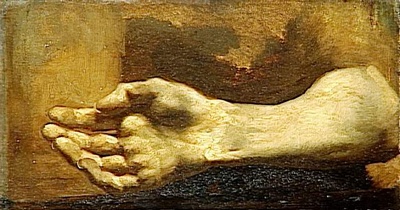
image via Wikimedia Commons (Gericault detail)


Next Post

June 4, 2015 Does pop psychology make us bad Christians?
Browse Our Archives
Select a Category Uncategorized
Select a Month November 2015 October 2015 September 2015 August 2015 July 2015 June 2015 May 2015 April 2015 March 2015 February 2015 January 2015 December 2014 November 2014 October 2014 September 2014 August 2014 July 2014 June 2014 May 2014 April 2014 March 2014 February 2014 January 2014 December 2013 November 2013 October 2013 September 2013 August 2013 July 2013 June 2013 May 2013 April 2013 March 2013 February 2013 January 2013 December 2012 November 2012 October 2012 September 2012 August 2012 July 2012 June 2012 May 2012 April 2012 March 2012 February 2012 January 2012 December 2011 November 2011 October 2011 September 2011 August 2011 July 2011 June 2011 May 2011 April 2011 March 2011 February 2011 January 2011 December 2010 November 2010 October 2010 September 2010 August 2010 July 2010 June 2010
Follow Us!
TAKE THE
Religious Wisdom Quiz
On which mountain did Moses receive the Ten Commandments?
Select your answer to see how you score.
Mount Hermon Mount Ararat Mount Carmel Mount Sinai
Related posts from I Have to Sit Down

The hardest part of being a woman


Hunger and Help: Are Community Fridges the Answer?

Grace is free, but not all fees are...
TRENDING AT PATHEOS Catholic

The Parable Of The Sower And The Word...
One of Christ’s most famous parables is that of the sower who...

Rejecting Doom: Christian Hope And Human Action
Christianity is a religion of hope. We are to have hope and...

Why I Choose the Eucharist Over the Sermon
Choose the Eucharist, Not the Sermon What are we supposed to get...

5 Design Elements Found in Spiritually Rooted Homes
Putting Spirituality Into Home Decor Our homes are more than our living...

Credo: A Story of God Told with the...
About 10 years ago, I began to imagine a personal "Credo" that...

The Anatomy of Divine Revelation in Catholic Thought
The claim that God has made Himself known to human beings is...
view all Catholic blogs
Ad-Free & Subscriber Log-In Subscription Support
- About Us
- 2026 Calendar
- Videos
- Podcasts
- Library of World Religions
- Faith In Media Tracker
- Advertise With Us
- Write for Us
- Privacy Policy
- Terms of Service
- Do Not Sell My Data
- Contact Us
- Radiant Digital
- Manage Newsletter Subscriptions
- Unsubscribe From Notifications
- Sitemap
Copyright 2008-2026, Patheos. All rights reserved.
Subscription Support Ad-Free & Subscriber Log-In
Follow Patheos