
BuddhistCatholicContemplativeEvangelicalGeneral ChristianHinduJewishLatter-day SaintMuslimNew VisionsProgressive Christian
Beliefs
- Buddhist
- Catholic
- Contemplative
- Evangelical
- General Christian
- Hindu
- Jewish
- Latter-day Saint
- More Voices
- Muslim
- New Visions
- Pagan
- Progressive Christian
Topics
- Religion News
- Food and Religion
- Sports and Religion
- Religious Art
- Religious Music and Entertainment
- Religious Events
- History and Religion
- Style and Religion
- Politics and Religion
- Women in Religion
- Recreation Outdoors and Religion
- Business Finance and Religion
- Careers Workplace and Religion
- Education and Religion
- Family Parenting and Religion
- Health Fitness and Religion
- Home and Religion
- Relationships and Religion
- Technology and Religion
- Travel and Religion
Columnists
- Buddhist Columnists
- Business Finance and Religion Columnists
- Careers Workplace and Religion Columnists
- Catholic Columnists
- Contemplative Columnists
- Education and Religion Columnists
- Evangelists Columnists
- Family Parenting and Religion Columnists
- General Christian Columnists
- Health Fitness and Religion Columnists
- Hindu Columnists
- History and Religion Columnists
- Home and Religion Columnists
- Jewish Columnists
- More Voices Columnists
- Latter Day Columnists
- Muslim Columnists
- New Visions Columnists
- Nonreligious Columnists
- Pagan Columnists
- Politics and Religion Columnists
- Progressive Columnists
- Recreation Outdoors and Religion Columnists
- Relationships and Religion Columnists
- Religion News Columnists
- Religious Art Columnists
- Religious Events Columnists
- Religious Music and Entertainment Columnists
- Sports and Religion Columnists
- Style and Religion Columnists
- Technology and Religion Columnists
- Travel and Religion Columnists
- Women in Religion Columnists
Resource Library
- 2026 Calendar
- Library of World Religions
- The 100 Most Holy Places on Earth
- Patheos Answers
- Podcasts
- Videos
- Faith Leaders Database
- Anglican Episcopalian
- Bahai
- Baptist
- Buddhism
- Christianity
- Confucianism
- Eastern Orthodoxy
- Hinduism
- Holiness and Pentecostal
- ISKCON
- Islam
- Judaism
- Lutheran
- Methodist
- The Church of Jesus Christ of Latter-day Saints
- New Age
- Paganism
- Presbytarian and Reformed
- Protestantism
- Religion Behind the Scenes
- Roman Catholic
- Scientology
- Shia Islam
- Sikhism
- Sufism
- Sunni Islam
- Taoism
- Zen
- See all religions
Research Tools
 Ad-Free & Subscriber Log-In Subscription Support
Ad-Free & Subscriber Log-In Subscription Support
Follow Patheos 

- Trending:
- Forgiveness
- |
- Marriage
- |
- Consciousness
- |
- Death Penalty
- |
- Election
- |
- Halloween
 Sick Pilgrim
- Home
- Catholic
- Dark Devotional: From Good Wine to Bitter Faith
Dark Devotional: From Good Wine to Bitter Faith
Last updated on: January 13, 2022 at 11:57 am by guest writer
Dark Devotional: From Good Wine to Bitter Faith 2022-01-13T11:57:32-05:00 guest writer
Patheos Explore the world's faith through different perspectives on religion and spirituality! Patheos has the views of the prevalent religions and spiritualities of the world.
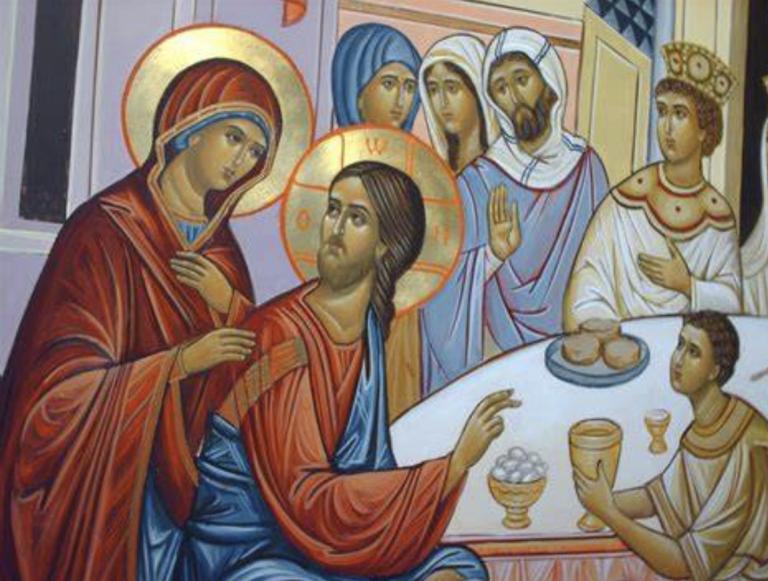
Weddings are stressful, even when everyone is behaving themselves. When people start misbehaving, weddings can be hell.
The first time I was involved in a wedding, the bride cheerfully announced at the outset that she planned to be a bridezilla. I laughed because I thought she was joking. Unfortunately, that wasn’t the case. By the day of the wedding, I had spent far beyond my projected budget, in part because of attire changes the bride demanded; I was stuffed into a dress I loathed; and I was running on two hours of sleep because the bride had kept her bridal maidens up past midnight, then woke us at 4 AM for professional hair and makeup. I drove home from the wedding, barely conscious, and fell into bed—only to spring up again to take a shower to wash out the spray that had turned my hair into a helmet.
After that experience, I never took part in planning a wedding again, and rarely chose to accept invitations to attend as a guest.
It’s easy then for me to imagine the Virgin Mary taking stock of the liquor supply at the wedding in Cana and groaning. We don’t know how she was related to the bridal couple, but she probably was related to them. Weddings were a big deal in ancient Israel, and families were deeply involved in planning and hosting the events. For a culture in which hospitality was a sacred obligation, running out of wine would be a major cause of embarrassment for the newlyweds and their parents.
The interesting question is why did Mary think her Son could do anything about the problem? With two thousand years of hindsight, it’s easy to think she just knew her Son could work miracles. But did she?
If you read St. Luke’s account of the Annunciation carefully, the archangel Gabriel doesn’t give Mary a lot of details about what being Son of the Most High would mean for her expected child. Does it mean that her Son will be favored by God in the same way Gabriel has just said Mary was favored by God (Luke 1:28–33)? If so, that doesn’t mean he’d necessarily be able to work miracles.
While some early Christian writers liked to imagine the Boy Jesus turning clay birds into live birds, theologians generally agree that the miracle at Cana was Jesus’ very first miracle, not merely his first public miracle. His miracles weren’t intended to be spectacles for the sake of the spectacular. They weren’t intended as divine shortcuts to getting what he wanted, or saving people trouble (much less saving them embarrassment). They were signs from heaven confirming his identity as God’s Son and the long-awaited Messiah of Israel:
“The signs worked by Jesus attest that the Father has sent him. They invite belief in him. To those who turn to him in faith, he grants what they ask. So miracles strengthen faith in the One who does his Father’s works; they bear witness that he is the Son of God. But his miracles can also be occasions for ‘offense’; they are not intended to satisfy people’s curiosity or desire for magic. Despite his evident miracles some people reject Jesus; he is even accused of acting by the power of demons” (Catechism of the Catholic Church 548).
So, why did Mary think Jesus could turn water into wine?
It’s pretty obvious from the story of the wedding at Cana that Mary wasn’t actually demanding her Son work a miracle. St. John said she merely presented Jesus with a problem that had cropped up during the wedding festivities. “They have no wine” (John 2:3). She didn’t even say anything about why that was a problem. She didn’t argue the case or ask her Son to do anything. When Jesus more or less asked her, “Why is this my problem?” she simply turned away and told the servers to “do whatever he tells you” (v. 5).
Perhaps Mary had no idea what Jesus would do in response to her concern. Maybe all she knew was that there was a problem, that the hosts (who may have been her own relatives) would be upset and embarrassed to run out of wine during the celebration of their child’s wedding. She took that problem to her Son and trusted him to do with it as he would.
Is this not the essence of prayer? Rather than treating Jesus as a divine bellhop, demanding that he do something already, Mary brought her problem to her Son and trusted him to respond in whatever manner he saw fit. When she talked to the servers, she didn’t tell them what Jesus was going to do. She told them to do “whatever” he told them to do. Had Jesus chosen not to act at all, it seems likely that Mary would have accepted that response without complaint.
All in all, it might be said that the wedding at Cana was a foreshadowing of Christ’s agony in the Garden of Gethsemane. There, we see Jesus as the supplicant before his heavenly Father, sweating blood in anticipation of the cross (Luke 22:44). At the wedding in Cana, the cup that Jesus had sent to the headwaiter was filled with fine wine, wine that tasted so good that the headwaiter was shocked his staff didn’t serve this wine first and save the inferior stuff for last (John 2:6–10). In Gethsemane, Jesus begged that he be spared from drinking from the cup offered to him, but pledged to fulfill his Father’s will regardless (Luke 22:42).
Perhaps prayer isn’t so much about getting what we want as it is about conditioning ourselves to accepting what will happen while trusting that God will bring good from a bad situation.
Which may be all well and good from a theological perspective, but is hardly satisfying when bad things happen to good people. Resigning ourselves to “the will of God” when crap happens is not far removed from fatalism, is it?
Fatalism is the belief that nothing we do matters. But Mary didn’t simply shrug when the wine ran out. She took her problem to her Son. In Gethsemane, Jesus brought his problem to his Father. The divine answers in each case were different—Jesus replenished the wine at Cana; in response to his prayer in Gethsemane, an angel was sent to strengthen Jesus for his task (Luke 22:43).
Unlike fatalism, faith is the trust that God will respond in some way to our need. He may not give us what we hope for, or even what we think we need, but faith is the belief that he hears us and answers us in some way.
Of course, that doesn’t mean that we’ll always like the answer we receive. Perhaps we don’t have to like the answer. After all, even though he was sent an angel to strengthen him in Gethsemane, Jesus still cried out from the cross about being abandoned by God (Matt. 27:46).
Perhaps an occasionally bitter faith is better than no faith at all.
Michelle Arnold was a staff apologist for Catholic Answers, a Catholic apologetics apostolate in the Diocese of San Diego, California, from 2003–2020, answering questions from clients about the Catholic faith via phone, letter, email, and online platforms. She contributed essays to Catholic Answers’ online and print magazines, and wrote four booklets for the apostolate’s 20 Answers series. Her 20 Answers booklets were on Judaism, the New Age, witchcraft and the occult, and the Church’s liturgical year. Now a freelance writer, editor, and proofreader, Michelle Arnold has a blog at the Patheos Catholic channel. A portfolio of her published essays is available at Authory.
Previous Post

January 7, 2022
Dark Devotional: Faith is a Tension
Next Post
January 17, 2022 Things Keeping Us Going: MLK Day Edition
Browse Our Archives
Select a Category Advent Approaching Mystery art Book Reviews Catholic Ghost Story Catholicism community Confession Current Events Dark Devotional Deconstruction Deconstruction Fellow Travelers I Want To Believe Interview Laudato Si Lent Mary Matthew's Letters Movie Reviews Music Reviews Our Charism Personal Essay Pilgrims Pope Francis Popular Piety Prayer Publishing Richard Beck Saints Satan Sheed and Ward Sick Pilgrim Charism Sick Pilgrim Chats Sick Pilgrim Events Sick Pilgrim Travelin' Medicine Show Sick Pilgrimage to The West Sick Pilgrims Small Joys Spiritual Autobiography Spooky Files of Ave Maria Magazine Spooky October Spooky Pilgrim Spooky Pilgrimage Strange Journey The Inklings Things Keeping Us Going Trying to Say God TV Reviews Uncategorized women in the Catholic Church Wonder Podcast Write the Vision
Select a Month February 2022 January 2022 December 2021 November 2021 October 2021 September 2021 August 2021 July 2021 June 2021 May 2021 April 2021 March 2021 February 2021 January 2021 December 2020 April 2020 March 2020 February 2020 January 2020 December 2019 October 2019 September 2019 July 2019 June 2019 May 2019 April 2019 March 2019 February 2019 January 2019 December 2018 November 2018 October 2018 September 2018 August 2018 July 2018 June 2018 May 2018 April 2018 March 2018 February 2018 January 2018 December 2017 November 2017 October 2017 September 2017 August 2017 July 2017 June 2017 May 2017 April 2017 March 2017 February 2017 January 2017 December 2016 November 2016 October 2016 September 2016 August 2016 July 2016 June 2016 May 2016 April 2016 March 2016 February 2016 January 2016 December 2015
Follow Us!
TAKE THE
Religious Wisdom Quiz
Who said, "The Lord will fight for you; you need only to be still"?
Select your answer to see how you score.
David Moses Solomon Joshua
Related posts from Sick Pilgrim

Dark Devotional: The Firelight of Life

Dark Devotional: Let Me Smite Him

Dark Devotional: Woe to Me, for I Have...

TRENDING AT PATHEOS Catholic

Rejecting Doom: Christian Hope And Human Action
Christianity is a religion of hope. We are to have hope and...

It’s What Comes From Within Which Matters
One of the most difficult things for us to understand is why...

Why I Choose the Eucharist Over the Sermon
Choose the Eucharist, Not the Sermon What are we supposed to get...

5 Design Elements Found in Spiritually Rooted Homes
Putting Spirituality Into Home Decor Our homes are more than our living...

Credo: A Story of God Told with the...
About 10 years ago, I began to imagine a personal "Credo" that...

The Anatomy of Divine Revelation in Catholic Thought
The claim that God has made Himself known to human beings is...
view all Catholic blogs
Ad-Free & Subscriber Log-In Subscription Support
- About Us
- 2026 Calendar
- Videos
- Podcasts
- Library of World Religions
- Faith In Media Tracker
- Advertise With Us
- Write for Us
- Privacy Policy
- Terms of Service
- Do Not Sell My Data
- Contact Us
- Radiant Digital
- Manage Newsletter Subscriptions
- Unsubscribe From Notifications
- Sitemap
Copyright 2008-2026, Patheos. All rights reserved.
Subscription Support Ad-Free & Subscriber Log-In
Follow Patheos