
BuddhistCatholicContemplativeEvangelicalGeneral ChristianHinduJewishLatter-day SaintMuslimNew VisionsProgressive Christian
Beliefs
- Buddhist
- Catholic
- Contemplative
- Evangelical
- General Christian
- Hindu
- Jewish
- Latter-day Saint
- More Voices
- Muslim
- New Visions
- Pagan
- Progressive Christian
Topics
- Religion News
- Food and Religion
- Sports and Religion
- Religious Art
- Religious Music and Entertainment
- Religious Events
- History and Religion
- Style and Religion
- Politics and Religion
- Women in Religion
- Recreation Outdoors and Religion
- Business Finance and Religion
- Careers Workplace and Religion
- Education and Religion
- Family Parenting and Religion
- Health Fitness and Religion
- Home and Religion
- Relationships and Religion
- Technology and Religion
- Travel and Religion
Columnists
- Buddhist Columnists
- Business Finance and Religion Columnists
- Careers Workplace and Religion Columnists
- Catholic Columnists
- Contemplative Columnists
- Education and Religion Columnists
- Evangelists Columnists
- Family Parenting and Religion Columnists
- General Christian Columnists
- Health Fitness and Religion Columnists
- Hindu Columnists
- History and Religion Columnists
- Home and Religion Columnists
- Jewish Columnists
- More Voices Columnists
- Latter Day Columnists
- Muslim Columnists
- New Visions Columnists
- Nonreligious Columnists
- Pagan Columnists
- Politics and Religion Columnists
- Progressive Columnists
- Recreation Outdoors and Religion Columnists
- Relationships and Religion Columnists
- Religion News Columnists
- Religious Art Columnists
- Religious Events Columnists
- Religious Music and Entertainment Columnists
- Sports and Religion Columnists
- Style and Religion Columnists
- Technology and Religion Columnists
- Travel and Religion Columnists
- Women in Religion Columnists
Resource Library
- 2026 Calendar
- Library of World Religions
- The 100 Most Holy Places on Earth
- Patheos Answers
- Podcasts
- Videos
- Faith Leaders Database
- Anglican Episcopalian
- Bahai
- Baptist
- Buddhism
- Christianity
- Confucianism
- Eastern Orthodoxy
- Hinduism
- Holiness and Pentecostal
- ISKCON
- Islam
- Judaism
- Lutheran
- Methodist
- The Church of Jesus Christ of Latter-day Saints
- New Age
- Paganism
- Presbytarian and Reformed
- Protestantism
- Religion Behind the Scenes
- Roman Catholic
- Scientology
- Shia Islam
- Sikhism
- Sufism
- Sunni Islam
- Taoism
- Zen
- See all religions
Research Tools
 Ad-Free & Subscriber Log-In Subscription Support
Ad-Free & Subscriber Log-In Subscription Support
Follow Patheos 

- Trending:
- Forgiveness
- |
- Marriage
- |
- Consciousness
- |
- Death Penalty
- |
- Election
- |
- Halloween
 Sick Pilgrim
- Home
- Catholic
- Fourth Sunday of Advent: Two Out of Three
Fourth Sunday of Advent: Two Out of Three
Last updated on: December 19, 2021 at 3:52 pm by guest writer
Fourth Sunday of Advent: Two Out of Three 2021-12-19T15:52:57-05:00 guest writer
Patheos Explore the world's faith through different perspectives on religion and spirituality! Patheos has the views of the prevalent religions and spiritualities of the world.
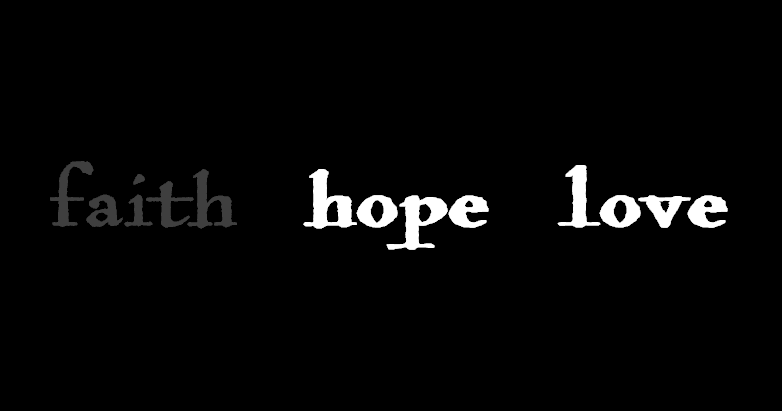
The Scriptures sacred to Christians say “These three abide: faith, hope and love; but the greatest of these is love.” [1 Cor. 13:13]
What happens for persons in whom faith no longer abides? Can they still practice hope and love?
A few weeks ago, friends who find they have lost their faith wrote of still setting up their Advent wreaths and candles out of lifelong habit and custom. But they were asking themselves why they were doing it.
Christianity acknowledges faith, hope and love as the three theological virtues. They are abilities whose origin is theological, that is, they come from God; their motive is God, and their object, their goal, is God.
For Christian faith, the Advent season has the motive and goal of making ready for the Second Advent (Second Coming) of Christ the Incarnate Son of God and making ready for Christmas, the yearly commemoration of Christ’s human birth in Bethlehem two thousand years ago. [At a deeper level, Advent does not make us ready for Christmas. It is the other way around: keeping Christmas and the rest of the Church year is part of how we make ready for the Advent of Christ’s Second Coming.]
Can those who no longer believe in God go on making use of Christian cultural observances and artifacts like the Advent wreath or the Christmas tree? If such persons do, I think they will invest those things with meanings, motives and goals that are no longer theological.
If theological faith were the only issue, then one would just need to stop observing Advent. But what about an Advent season of hope and love, particularly a hope and love that are non-theological?
Two out of three: the theological and non-theological versions of hope and love.
Paragraph 1817 of the official Catechism of the Catholic Church says: Hope is the theological virtue by which we desire the kingdom of heaven and eternal life as our happiness, placing our trust in Christ’s promises and relying not on our own strength, but on the help of the grace of the Holy Spirit.
But the Catechism’s next paragraph adds an anthropological assertion that can be appealing even if one does not believe in God: The virtue of hope responds to the aspiration to happiness which God has placed in the heart of every man….
So one could set up a wreath to keep a season marking the natural human hope for the advent of happiness. This hope is present in every human heart, whether or not one has faith in God.
And love?
Calling love “charity,” the Old English word derived through French from Latin, paragraph 1822 of the Catechism says: Charity is the theological virtue by which we love God above all things for his own sake, and our neighbor as ourselves for the love of God.
Going on, the Catechism says in paragraph 1827: The practice of all the virtues is animated and inspired by charity, which binds everything together in perfect harmony….
Practicing such love or charity, then, even without a theological motive and a theological goal, will involve service, generosity, altruism, moving ideally towards an advent of harmony and peace.
Even in the absence of the theological virtue of faith, one can still nobly celebrate, pursue and practice hope and love as earthly, human and humane virtues.
To the shame of us who have the Christian faith, many who used to have it, but no longer do, and many who have never been Christians were and still are scandalized to see those who profess the Christian faith acting without theological love, without charity, without service, without generosity, without altruism, but acting instead with selfishness, cruelty and even hatred.
Those who never had theological faith, or who have lost it, but are observing an Advent this year and for years to come— with lively hope for happiness and with a committed, effective practice of love for their fellow human beings— deserve the veneration of us Christians, for we must still love them, and we can still have faith and hope that Christ will bless them at the advent of his Second Coming in his glory, even if they never recognized or no longer recognize him as “Lord.”
In the twenty-fifth chapter of the holy Gospel according to Matthew, Jesus said:
When the Son of man comes in his glory, and all the angels with him, then he will sit on his glorious throne. Before him will be gathered all the nations, and he will separate them one from another as a shepherd separates the sheep from the goats, and he will place the sheep at his right hand, but the goats at the left. Then the King will say to those at his right hand, ‘Come, O blessed of my Father, inherit the kingdom prepared for you from the foundation of the world; for I was hungry and you gave me food, I was thirsty and you gave me drink, I was a stranger and you welcomed me, I was naked and you clothed me, I was sick and you visited me, I was in prison and you came to me.’ Then the righteous will answer him, ‘Lord, when did we see thee hungry and feed thee, or thirsty and give thee drink? And when did we see thee a stranger and welcome thee, or naked and clothe thee? And when did we see thee sick or in prison and visit thee?’ And the King will answer them, ‘Truly, I say to you, as you did it to one of the least of these my brethren, you did it to me.’ And the righteous will go into eternal life.
Hope and love!
Two out of three are not bad.
Rather, they can be most worthy of eternal blessing.
Previous Post
December 16, 2021
Dark Devotional: Mary, Motherhood, and Mixed Feelings
Next Post
December 23, 2021 Dark Devotional: The Virgin Mary's Guide to Biblical Motherhood
Browse Our Archives
Select a Category Advent Approaching Mystery art Book Reviews Catholic Ghost Story Catholicism community Confession Current Events Dark Devotional Deconstruction Deconstruction Fellow Travelers I Want To Believe Interview Laudato Si Lent Mary Matthew's Letters Movie Reviews Music Reviews Our Charism Personal Essay Pilgrims Pope Francis Popular Piety Prayer Publishing Richard Beck Saints Satan Sheed and Ward Sick Pilgrim Charism Sick Pilgrim Chats Sick Pilgrim Events Sick Pilgrim Travelin' Medicine Show Sick Pilgrimage to The West Sick Pilgrims Small Joys Spiritual Autobiography Spooky Files of Ave Maria Magazine Spooky October Spooky Pilgrim Spooky Pilgrimage Strange Journey The Inklings Things Keeping Us Going Trying to Say God TV Reviews Uncategorized women in the Catholic Church Wonder Podcast Write the Vision
Select a Month February 2022 January 2022 December 2021 November 2021 October 2021 September 2021 August 2021 July 2021 June 2021 May 2021 April 2021 March 2021 February 2021 January 2021 December 2020 April 2020 March 2020 February 2020 January 2020 December 2019 October 2019 September 2019 July 2019 June 2019 May 2019 April 2019 March 2019 February 2019 January 2019 December 2018 November 2018 October 2018 September 2018 August 2018 July 2018 June 2018 May 2018 April 2018 March 2018 February 2018 January 2018 December 2017 November 2017 October 2017 September 2017 August 2017 July 2017 June 2017 May 2017 April 2017 March 2017 February 2017 January 2017 December 2016 November 2016 October 2016 September 2016 August 2016 July 2016 June 2016 May 2016 April 2016 March 2016 February 2016 January 2016 December 2015
Follow Us!
TAKE THE
Religious Wisdom Quiz
Who was the mother of John Mark, whose house was a place of prayer in Jerusalem?
Select your answer to see how you score.
Mary Priscilla Lydia Tabitha
Related posts from Sick Pilgrim
The Third Sunday of Advent: Love is Coming

Things Keeping Us Going: Santa Barf Edition

Second Sunday in Advent: Let Me Love You...

First Sunday of Advent: What Are You Waiting...
TRENDING AT PATHEOS Catholic

Rejecting Doom: Christian Hope And Human Action
Christianity is a religion of hope. We are to have hope and...

It’s What Comes From Within Which Matters
One of the most difficult things for us to understand is why...

Why I Choose the Eucharist Over the Sermon
Choose the Eucharist, Not the Sermon What are we supposed to get...

5 Design Elements Found in Spiritually Rooted Homes
Putting Spirituality Into Home Decor Our homes are more than our living...

Credo: A Story of God Told with the...
About 10 years ago, I began to imagine a personal "Credo" that...

The Anatomy of Divine Revelation in Catholic Thought
The claim that God has made Himself known to human beings is...
view all Catholic blogs
Ad-Free & Subscriber Log-In Subscription Support
- About Us
- 2026 Calendar
- Videos
- Podcasts
- Library of World Religions
- Faith In Media Tracker
- Advertise With Us
- Write for Us
- Privacy Policy
- Terms of Service
- Do Not Sell My Data
- Contact Us
- Radiant Digital
- Manage Newsletter Subscriptions
- Unsubscribe From Notifications
- Sitemap
Copyright 2008-2026, Patheos. All rights reserved.
Subscription Support Ad-Free & Subscriber Log-In
Follow Patheos