
BuddhistCatholicContemplativeEvangelicalGeneral ChristianHinduJewishLatter-day SaintMuslimNew VisionsProgressive Christian
Beliefs
- Buddhist
- Catholic
- Contemplative
- Evangelical
- General Christian
- Hindu
- Jewish
- Latter-day Saint
- More Voices
- Muslim
- New Visions
- Pagan
- Progressive Christian
Topics
- Religion News
- Food and Religion
- Sports and Religion
- Religious Art
- Religious Music and Entertainment
- Religious Events
- History and Religion
- Style and Religion
- Politics and Religion
- Women in Religion
- Recreation Outdoors and Religion
- Business Finance and Religion
- Careers Workplace and Religion
- Education and Religion
- Family Parenting and Religion
- Health Fitness and Religion
- Home and Religion
- Relationships and Religion
- Technology and Religion
- Travel and Religion
Columnists
- Buddhist Columnists
- Business Finance and Religion Columnists
- Careers Workplace and Religion Columnists
- Catholic Columnists
- Contemplative Columnists
- Education and Religion Columnists
- Evangelists Columnists
- Family Parenting and Religion Columnists
- General Christian Columnists
- Health Fitness and Religion Columnists
- Hindu Columnists
- History and Religion Columnists
- Home and Religion Columnists
- Jewish Columnists
- More Voices Columnists
- Latter Day Columnists
- Muslim Columnists
- New Visions Columnists
- Nonreligious Columnists
- Pagan Columnists
- Politics and Religion Columnists
- Progressive Columnists
- Recreation Outdoors and Religion Columnists
- Relationships and Religion Columnists
- Religion News Columnists
- Religious Art Columnists
- Religious Events Columnists
- Religious Music and Entertainment Columnists
- Sports and Religion Columnists
- Style and Religion Columnists
- Technology and Religion Columnists
- Travel and Religion Columnists
- Women in Religion Columnists
Resource Library
- 2026 Calendar
- Library of World Religions
- The 100 Most Holy Places on Earth
- Patheos Answers
- Podcasts
- Videos
- Faith Leaders Database
- Anglican Episcopalian
- Bahai
- Baptist
- Buddhism
- Christianity
- Confucianism
- Eastern Orthodoxy
- Hinduism
- Holiness and Pentecostal
- ISKCON
- Islam
- Judaism
- Lutheran
- Methodist
- The Church of Jesus Christ of Latter-day Saints
- New Age
- Paganism
- Presbytarian and Reformed
- Protestantism
- Religion Behind the Scenes
- Roman Catholic
- Scientology
- Shia Islam
- Sikhism
- Sufism
- Sunni Islam
- Taoism
- Zen
- See all religions
Research Tools
 Ad-Free & Subscriber Log-In Subscription Support
Ad-Free & Subscriber Log-In Subscription Support
Follow Patheos 

- Trending:
- Forgiveness
- |
- Marriage
- |
- Consciousness
- |
- Death Penalty
- |
- Election
- |
- Halloween
 Sick Pilgrim
- Home
- Catholic
- Dark Devotional: Anointed Sheep, Shepherd and Queen
Dark Devotional: Anointed Sheep, Shepherd and Queen
Last updated on: April 23, 2021 at 5:49 am by guest writer
Dark Devotional: Anointed Sheep, Shepherd and Queen 2021-04-20T15:53:14-05:00 guest writer
Patheos Explore the world's faith through different perspectives on religion and spirituality! Patheos has the views of the prevalent religions and spiritualities of the world.
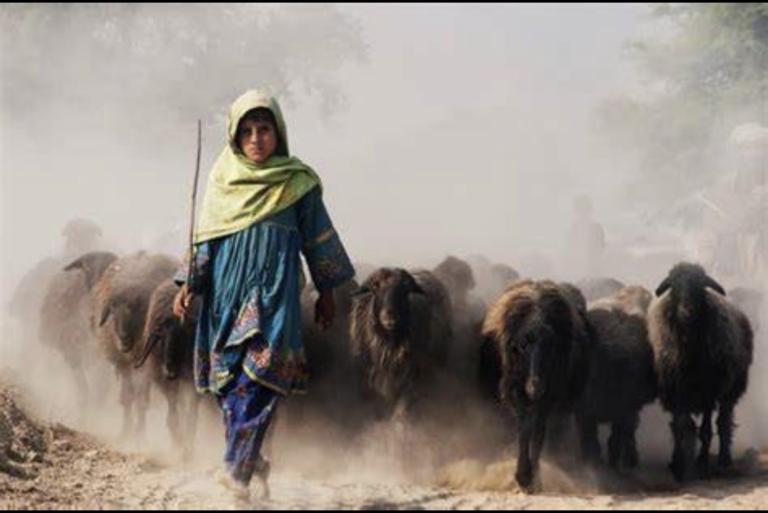
The parable of the Good Shepherd . . . This is a familiar one, especially for those of us who spend time in a Catechesis of the Good Shepherd “atrium,” that specially-prepared space where we gather with even the youngest children to “listen to God,” reflecting on Scripture together and “working with” materials that aid in that reflection. One of the most treasured materials in that atrium space is the sheepfold, wherein we slowly proclaim this parable of the Good Shepherd to the three- and four-year-olds as they move figures of a shepherd and his sheep through the space. We spend time with different dimensions of the story year after year, rejoicing when one or the other of the littles realizes that yes, it is we who are the sheep, we who are so loved by the Good Shepherd!
And no doubt, that is profoundly true: we are the sheep. Though as I read this Scripture again, away from the atrium, I can’t help but notice a different dimension. Remembering our Baptism, we recall that we too are anointed ones. By virtue of our Baptism, we too are called to be “little christs” in the world, acting as “priest, prophet and king.”
In our Scripture, Jesus says, “I am the good shepherd, and I know mine and mine know me, just as my Father knows me, and I know the Father.” One unbroken line. Jesus not only says he knows his own in the world, but also that we know him; we recognize him when we hear him. And not only that, but Jesus draws an equivalency between his own relationship with the Father, in the Godhead, and our relationship with him, in the Godhead. This reciprocal relationship implies both tenderness, as children of God, and empowered call, as those sent by the Father, just as Christ is sent.
That’s a little heavy. So if we are not only led, but also called to lead, what does that look like?
This moves us toward paradox, because leading as Christ led implies both recognition of our royal anointing as children of God, heirs to the Kingdom (the “kingly” dimension of that baptismal anointing), and a clear recollection that Christ’s kingliness is never about hoarding power, but about pouring it out in service to others. This Good Shepherd “lays down his life for his sheep,” and we are called to do the same.
At the same time, it is instructive to pay close attention to how Christ wields power. We recall the lines of Philippians 2:5-7: “Have among yourselves the same attitude that is also yours in Christ Jesus, who, though he was in the form of God, did not regard equality with God something to be grasped. Rather, he emptied himself.” In the kingly paradigm of Christ, power is never meant to be “grasped,” and is never meant for ourselves alone.
But neither can that power rightfully be taken. Within this Christian paradigm, we are called to make a gift of ourselves. That is, we are called to know our own worth, to stand in our own power as children of God, and from that vantage point of dignity, then we are called to pour ourselves out, to lay down our lives for the sheep.
The order of this matters, and we often get it wrong, especially if we live as women within Christian culture. We live in a society (even within our churches) where we receive messaging that tells us we have two options: snatch power violently from others, or have your power snatched. And if you’re a woman in this culture, there’s a good chance you’ve internalized the sense that allowing your power to be taken is the “self-giving martyrdom” required by Christ. We tend to miss the fact that we must have a functioning self to give in order to make a gift of it.
Let’s look closely at the final lines of this weekend’s Gospel. Jesus tells us, “No one takes it from me, but I lay it down on my own. I have power to lay it down, and power to take it up again. This command I have received from my Father.”
These lines are important: they indicate that no external force compels Jesus to sacrifice himself. No one takes Jesus’s life, in this sense. He sacrifices himself out of pure and total love, and from a consciousness of his own power.
This is the model we are called to follow, that of acknowledging, owning, standing proudly in our own dignity and power, and then, with discernment, trusting in the Father, we choose to make of our lives a gift.
Yet it bears repeating that this is not the messaging many women receive in the Church. How many of us, when serving in a leadership position at work, find ourselves asking forgiveness or permission for having a seat at the table, as though our presence were a privilege, rather than a long-overdue manifestation of justice? How many of us have remained in abusive relationships because we have internalized the idea that serving in love means taking whatever comes our way? How many of us have feared even looking someone straight in the eye because directness even in the realm of body language might make someone “uncomfortable” or make us appear “challenging?”
This picture of passive submission is not of Christ. Yes, we are sheep following the Good Shepherd (and we know his voice when we hear it, because he leads us out to fullness of life!), but/and we are also called to lead as the Shepherd leads.
In the atrium, we reflect on the prophets of the Old Testament. When we introduce the idea of prophet, we often tell the children that a prophet is someone who “listens to God with their whole being.” We know too that the word “obey” comes from the Latin “obedire,” meaning “to listen.” Obedience, then, is about hearing God’s special call to and for us, then acting on it.
In this weekend’s Gospel, Jesus says he has the “power to lay it down, and the power to take it up again.” Christ’s gift is given in freedom, and with full knowledge that he lays his life down in order to bring abundant life, both for himself and those he loves. No external pressure compels him; no one steals from him or diminishes him. Rather, he listens to his inner call.
“This command I have received from my Father,” Jesus says. We know from Jesus that he and the Father are one. When Jesus listens to his Father, he is obeying out of deference to the deepest Source of himself. We too are invited to obey the call that arises from our deepest Source. Whether following as sheep or leading as shepherd, “we know his voice, and we would not follow a stranger.”
Holly Mohr works in formation in Pittsburgh, PA. She shares a beautiful and slightly eccentric life with her husband and three children.
Previous Post

April 19, 2021
Things Keeping Us Going: Vaccinated Edition
Next Post

April 26, 2021 Things Keeping Us Going: Bonus Long Weekend Edition
Browse Our Archives
Select a Category Advent Approaching Mystery art Book Reviews Catholic Ghost Story Catholicism community Confession Current Events Dark Devotional Deconstruction Deconstruction Fellow Travelers I Want To Believe Interview Laudato Si Lent Mary Matthew's Letters Movie Reviews Music Reviews Our Charism Personal Essay Pilgrims Pope Francis Popular Piety Prayer Publishing Richard Beck Saints Satan Sheed and Ward Sick Pilgrim Charism Sick Pilgrim Chats Sick Pilgrim Events Sick Pilgrim Travelin' Medicine Show Sick Pilgrimage to The West Sick Pilgrims Small Joys Spiritual Autobiography Spooky Files of Ave Maria Magazine Spooky October Spooky Pilgrim Spooky Pilgrimage Strange Journey The Inklings Things Keeping Us Going Trying to Say God TV Reviews Uncategorized women in the Catholic Church Wonder Podcast Write the Vision
Select a Month February 2022 January 2022 December 2021 November 2021 October 2021 September 2021 August 2021 July 2021 June 2021 May 2021 April 2021 March 2021 February 2021 January 2021 December 2020 April 2020 March 2020 February 2020 January 2020 December 2019 October 2019 September 2019 July 2019 June 2019 May 2019 April 2019 March 2019 February 2019 January 2019 December 2018 November 2018 October 2018 September 2018 August 2018 July 2018 June 2018 May 2018 April 2018 March 2018 February 2018 January 2018 December 2017 November 2017 October 2017 September 2017 August 2017 July 2017 June 2017 May 2017 April 2017 March 2017 February 2017 January 2017 December 2016 November 2016 October 2016 September 2016 August 2016 July 2016 June 2016 May 2016 April 2016 March 2016 February 2016 January 2016 December 2015
Follow Us!
TAKE THE
Religious Wisdom Quiz
What city is known as the Holy City, sacred to Jews, Christians, and Muslims?
Select your answer to see how you score.
Athens Cairo Rome Jerusalem
Related posts from Sick Pilgrim

Dark Devotional: The Firelight of Life

Dark Devotional: Let Me Smite Him

Dark Devotional: Woe to Me, for I Have...

TRENDING AT PATHEOS Catholic

Rejecting Doom: Christian Hope And Human Action
Christianity is a religion of hope. We are to have hope and...

It’s What Comes From Within Which Matters
One of the most difficult things for us to understand is why...

Why I Choose the Eucharist Over the Sermon
Choose the Eucharist, Not the Sermon What are we supposed to get...

5 Design Elements Found in Spiritually Rooted Homes
Putting Spirituality Into Home Decor Our homes are more than our living...

Credo: A Story of God Told with the...
About 10 years ago, I began to imagine a personal "Credo" that...

The Anatomy of Divine Revelation in Catholic Thought
The claim that God has made Himself known to human beings is...
view all Catholic blogs
Ad-Free & Subscriber Log-In Subscription Support
- About Us
- 2026 Calendar
- Videos
- Podcasts
- Library of World Religions
- Faith In Media Tracker
- Advertise With Us
- Write for Us
- Privacy Policy
- Terms of Service
- Do Not Sell My Data
- Contact Us
- Radiant Digital
- Manage Newsletter Subscriptions
- Unsubscribe From Notifications
- Sitemap
Copyright 2008-2026, Patheos. All rights reserved.
Subscription Support Ad-Free & Subscriber Log-In
Follow Patheos