
BuddhistCatholicContemplativeEvangelicalGeneral ChristianHinduJewishLatter-day SaintMuslimNew VisionsProgressive Christian
Beliefs
- Buddhist
- Catholic
- Contemplative
- Evangelical
- General Christian
- Hindu
- Jewish
- Latter-day Saint
- More Voices
- Muslim
- New Visions
- Pagan
- Progressive Christian
Topics
- Religion News
- Food and Religion
- Sports and Religion
- Religious Art
- Religious Music and Entertainment
- Religious Events
- History and Religion
- Style and Religion
- Politics and Religion
- Women in Religion
- Recreation Outdoors and Religion
- Business Finance and Religion
- Careers Workplace and Religion
- Education and Religion
- Family Parenting and Religion
- Health Fitness and Religion
- Home and Religion
- Relationships and Religion
- Technology and Religion
- Travel and Religion
Columnists
- Buddhist Columnists
- Business Finance and Religion Columnists
- Careers Workplace and Religion Columnists
- Catholic Columnists
- Contemplative Columnists
- Education and Religion Columnists
- Evangelists Columnists
- Family Parenting and Religion Columnists
- General Christian Columnists
- Health Fitness and Religion Columnists
- Hindu Columnists
- History and Religion Columnists
- Home and Religion Columnists
- Jewish Columnists
- More Voices Columnists
- Latter Day Columnists
- Muslim Columnists
- New Visions Columnists
- Nonreligious Columnists
- Pagan Columnists
- Politics and Religion Columnists
- Progressive Columnists
- Recreation Outdoors and Religion Columnists
- Relationships and Religion Columnists
- Religion News Columnists
- Religious Art Columnists
- Religious Events Columnists
- Religious Music and Entertainment Columnists
- Sports and Religion Columnists
- Style and Religion Columnists
- Technology and Religion Columnists
- Travel and Religion Columnists
- Women in Religion Columnists
Resource Library
- 2026 Calendar
- Library of World Religions
- The 100 Most Holy Places on Earth
- Patheos Answers
- Podcasts
- Videos
- Faith Leaders Database
- Anglican Episcopalian
- Bahai
- Baptist
- Buddhism
- Christianity
- Confucianism
- Eastern Orthodoxy
- Hinduism
- Holiness and Pentecostal
- ISKCON
- Islam
- Judaism
- Lutheran
- Methodist
- The Church of Jesus Christ of Latter-day Saints
- New Age
- Paganism
- Presbytarian and Reformed
- Protestantism
- Religion Behind the Scenes
- Roman Catholic
- Scientology
- Shia Islam
- Sikhism
- Sufism
- Sunni Islam
- Taoism
- Zen
- See all religions
Research Tools
 Ad-Free & Subscriber Log-In Subscription Support
Ad-Free & Subscriber Log-In Subscription Support
Follow Patheos 

- Trending:
- Forgiveness
- |
- Marriage
- |
- Consciousness
- |
- Death Penalty
- |
- Election
- |
- Halloween
 Sick Pilgrim
- Home
- Catholic
- Mental Illness and and the Darkness of Lent
Mental Illness and and the Darkness of Lent
Last updated on: February 28, 2020 at 12:25 pm by Guest Contributor
Mental Illness and and the Darkness of Lent 2020-02-28T12:25:07-05:00 Guest Contributor
Patheos Explore the world's faith through different perspectives on religion and spirituality! Patheos has the views of the prevalent religions and spiritualities of the world.
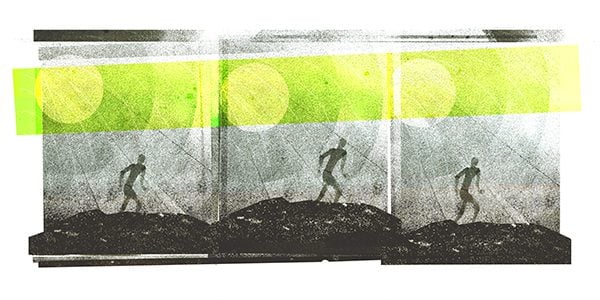
original art by Brian C. Jocks
As someone with depression and anxiety, it’s always with mixed emotions that I approach Lent–and this because the experience of darkness and desert and mourning are in some ways close to me all year round.
Yes, in one sense, Lent can be a blessing, since it is when Christ and the whole church suddenly join me amidst the darkness in solidarity. But in other ways, I can become a little annoyed and envious. In my more sour moods, it can seem like Lent is the time of year when all the privileged people get to do a little penitential cosplay–give up a few minor things and come out reborn and happy on the other side. Happiness for such people is often easily paused at the beginning of Lent and easily resumed afterward. It feels a bit unfair to us sufferers that the terrifying landscape we inhabit–the one we can’t remember the beginning of and can’t see the end of–suddenly becomes a playground for ever so many acts of spiritual romanticism. The desert gets crowded, and those of us who have been here a while watch the antics and quietly wait for the crowds to go away. We know the desert. Or perhaps to put it better, we know we don’t know.
What I mean by this, at least in reference to myself, is that it’s not as if I’m good at the desert. It’s not as if I’ve discovered “the trick” to living here or achieved incredible sagacity. If you try to master the desert, it will master you, and if you try to master it in any case, you’ve missed the point. The point of the desert experience is not to master it, but to survive intact, as a whole person, without giving in to temptation. It’s a deadly, dog-eat-dog place. Can you survive it without it turning you into something bitter, dry, and twisted too? Perhaps only by a miracle.
I realize that some will say I’m missing the point. Shouldn’t Lenten spirituality be something more healthy, perhaps directed toward prayer, fasting, and almsgiving? Well, yes. And I don’t deny the importance of these practices, but there’s still an ambiguous shadow side to Lent as well, a side that is dark and dangerous and sometimes fatal.
Christ met Satan in the desert. Many of the Israelites died in the wilderness. And to those who say the darkness of depression and anxiety are not the same darkness as that which we enter in Lent, well, darkness doesn’t come with a label. Sure, in retrospect it is easy to categorize and label, tracing with so many names what kind of darkness we have come through, after the fact. But part of the terror of darkness in the moment is that it is dark. If it gave us certainty about what it is, it wouldn’t, properly speaking, be darkness. Can depression and anxiety–provided we aren’t merely refusing health care and self-care as a twisted form of spiritual masochism–be part of our proper desert experience during Lent? I don’t see why not.
All this being said, I want to conclude this reflection with hope rather than despair.
First, Christ is with us regardless of the feeling of his nearness or absence. As a desert dweller, I take much comfort in that.
Second, I wonder if part of the point of Lent is that those surviving in the desert and those who are merely Lenten visitors should talk and swap stories. Maybe there is something a casual pilgrim in the land of suffering can learn from a desert dweller–though come to think of it, everybody suffers, and maybe there are no “casual” participants after all. Conversely, maybe long-time desert dwellers can learn something of hope from those who have touched it more recently or more thoroughly than they.
And so this Lent, I’m listening.
This reflection was contributed by Karl Persson, an assistant professor of literature at Our Lady Seat of Wisdom College in Barry’s Bay, Ontario in Canada.
Previous Post

February 28, 2020
Our Lenten Wilderness: Unknown Pleasures and Revelations
Next Post

March 3, 2020 Stardust to Dust: Lent as a Search for the Marvelous and Sacred
Browse Our Archives
Select a Category Advent Approaching Mystery art Book Reviews Catholic Ghost Story Catholicism community Confession Current Events Dark Devotional Deconstruction Deconstruction Fellow Travelers I Want To Believe Interview Laudato Si Lent Mary Matthew's Letters Movie Reviews Music Reviews Our Charism Personal Essay Pilgrims Pope Francis Popular Piety Prayer Publishing Richard Beck Saints Satan Sheed and Ward Sick Pilgrim Charism Sick Pilgrim Chats Sick Pilgrim Events Sick Pilgrim Travelin' Medicine Show Sick Pilgrimage to The West Sick Pilgrims Small Joys Spiritual Autobiography Spooky Files of Ave Maria Magazine Spooky October Spooky Pilgrim Spooky Pilgrimage Strange Journey The Inklings Things Keeping Us Going Trying to Say God TV Reviews Uncategorized women in the Catholic Church Wonder Podcast Write the Vision
Select a Month February 2022 January 2022 December 2021 November 2021 October 2021 September 2021 August 2021 July 2021 June 2021 May 2021 April 2021 March 2021 February 2021 January 2021 December 2020 April 2020 March 2020 February 2020 January 2020 December 2019 October 2019 September 2019 July 2019 June 2019 May 2019 April 2019 March 2019 February 2019 January 2019 December 2018 November 2018 October 2018 September 2018 August 2018 July 2018 June 2018 May 2018 April 2018 March 2018 February 2018 January 2018 December 2017 November 2017 October 2017 September 2017 August 2017 July 2017 June 2017 May 2017 April 2017 March 2017 February 2017 January 2017 December 2016 November 2016 October 2016 September 2016 August 2016 July 2016 June 2016 May 2016 April 2016 March 2016 February 2016 January 2016 December 2015
Follow Us!
TAKE THE
Religious Wisdom Quiz
What covered the sky during Jesus’ crucifixion?
Select your answer to see how you score.
Clouds Fire Rain Darkness
Related posts from Sick Pilgrim
Dark Devotional: Silence, the Love Language of God

Dark Devotional: The Petulant Winds of Elation

TRENDING AT PATHEOS Catholic

Rejecting Doom: Christian Hope And Human Action
Christianity is a religion of hope. We are to have hope and...

It’s What Comes From Within Which Matters
One of the most difficult things for us to understand is why...

Why I Choose the Eucharist Over the Sermon
Choose the Eucharist, Not the Sermon What are we supposed to get...

5 Design Elements Found in Spiritually Rooted Homes
Putting Spirituality Into Home Decor Our homes are more than our living...

Credo: A Story of God Told with the...
About 10 years ago, I began to imagine a personal "Credo" that...

The Anatomy of Divine Revelation in Catholic Thought
The claim that God has made Himself known to human beings is...
view all Catholic blogs
Ad-Free & Subscriber Log-In Subscription Support
- About Us
- 2026 Calendar
- Videos
- Podcasts
- Library of World Religions
- Faith In Media Tracker
- Advertise With Us
- Write for Us
- Privacy Policy
- Terms of Service
- Do Not Sell My Data
- Contact Us
- Radiant Digital
- Manage Newsletter Subscriptions
- Unsubscribe From Notifications
- Sitemap
Copyright 2008-2026, Patheos. All rights reserved.
Subscription Support Ad-Free & Subscriber Log-In
Follow Patheos