
BuddhistCatholicContemplativeEvangelicalGeneral ChristianHinduJewishLatter-day SaintMuslimNew VisionsProgressive Christian
Beliefs
- Buddhist
- Catholic
- Contemplative
- Evangelical
- General Christian
- Hindu
- Jewish
- Latter-day Saint
- More Voices
- Muslim
- New Visions
- Pagan
- Progressive Christian
Topics
- Religion News
- Food and Religion
- Sports and Religion
- Religious Art
- Religious Music and Entertainment
- Religious Events
- History and Religion
- Style and Religion
- Politics and Religion
- Women in Religion
- Recreation Outdoors and Religion
- Business Finance and Religion
- Careers Workplace and Religion
- Education and Religion
- Family Parenting and Religion
- Health Fitness and Religion
- Home and Religion
- Relationships and Religion
- Technology and Religion
- Travel and Religion
Columnists
- Buddhist Columnists
- Business Finance and Religion Columnists
- Careers Workplace and Religion Columnists
- Catholic Columnists
- Contemplative Columnists
- Education and Religion Columnists
- Evangelists Columnists
- Family Parenting and Religion Columnists
- General Christian Columnists
- Health Fitness and Religion Columnists
- Hindu Columnists
- History and Religion Columnists
- Home and Religion Columnists
- Jewish Columnists
- More Voices Columnists
- Latter Day Columnists
- Muslim Columnists
- New Visions Columnists
- Nonreligious Columnists
- Pagan Columnists
- Politics and Religion Columnists
- Progressive Columnists
- Recreation Outdoors and Religion Columnists
- Relationships and Religion Columnists
- Religion News Columnists
- Religious Art Columnists
- Religious Events Columnists
- Religious Music and Entertainment Columnists
- Sports and Religion Columnists
- Style and Religion Columnists
- Technology and Religion Columnists
- Travel and Religion Columnists
- Women in Religion Columnists
Resource Library
- 2026 Calendar
- Library of World Religions
- The 100 Most Holy Places on Earth
- Patheos Answers
- Podcasts
- Videos
- Faith Leaders Database
- Anglican Episcopalian
- Bahai
- Baptist
- Buddhism
- Christianity
- Confucianism
- Eastern Orthodoxy
- Hinduism
- Holiness and Pentecostal
- ISKCON
- Islam
- Judaism
- Lutheran
- Methodist
- The Church of Jesus Christ of Latter-day Saints
- New Age
- Paganism
- Presbytarian and Reformed
- Protestantism
- Religion Behind the Scenes
- Roman Catholic
- Scientology
- Shia Islam
- Sikhism
- Sufism
- Sunni Islam
- Taoism
- Zen
- See all religions
Research Tools
 Ad-Free & Subscriber Log-In Subscription Support
Ad-Free & Subscriber Log-In Subscription Support
Follow Patheos 

- Trending:
- Forgiveness
- |
- Marriage
- |
- Consciousness
- |
- Death Penalty
- |
- Election
- |
- Halloween
 Sick Pilgrim
- Home
- Catholic
- Iconoclasm and Misogyny at the Amazonian Synod
Iconoclasm and Misogyny at the Amazonian Synod
Last updated on: October 22, 2019 at 3:17 pm by Maren Grossman
Iconoclasm and Misogyny at the Amazonian Synod 2019-10-22T15:17:58-05:00 Maren Grossman
Patheos Explore the world's faith through different perspectives on religion and spirituality! Patheos has the views of the prevalent religions and spiritualities of the world.
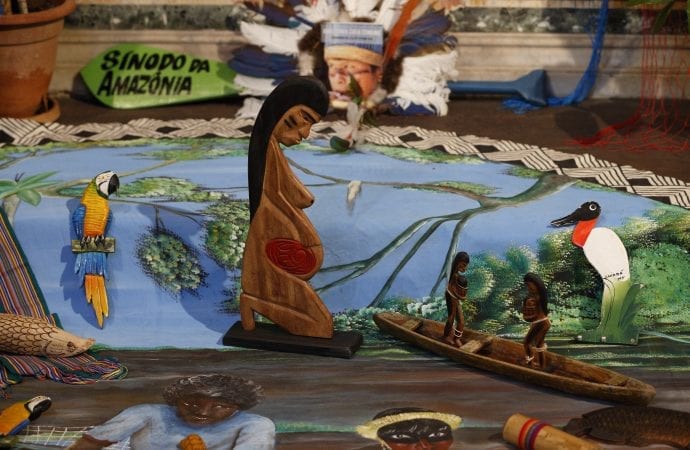
Yesterday, as the Amazonian Synod in Rome comes to an end, it was reported that a statue that symbolized the Synod (Our Lady of the Amazon) was stolen and thrown into the Tiber River. Some celebrated (which was gross). Some were dismayed and cried “racism” and “iconoclasm” (which was correct). Henry Karlson had a particularly nice discussion of iconoclasm over at his blog this morning.
The Amazonian Synod was controversial before it even began. It was known that the question of married priests was going to be discussed. Catholicism in the Amazon is not particularly sustainable as is. There are so few priests that the Mass is not accessible. Protestant Churches, particularly evangelical churches, are much more available. If a Catholic wants to participate in a service that worships God and celebrates Christ, their only option is often to attend a Protestant church. Amazonian Catholics often become Protestant by default because Protestant Christianity is local and Catholicism isn’t. Allowing married men to be ordained offers perhaps the most practical solution to this problem, but this is a break from Catholic norms and there was wide objection to this possible change.
After the Synod opened, it continued to be controversial. Amazonian imagery dominated (for obvious reasons) and care of the earth emerged as a major theme (also for obvious reasons). Discussions and documents used the phrase “Mother Earth” in a serious way, leading to the objection that the Synod was invoking an Amazonian goddess. In addition, the role of women has turned out to be a major theme of the Synod. Women religious have spoken about their role in hearing confessions and ministering to the dying. While they don’t claim that their ministrations are the same as that of a priest administering the sacraments, the fact remains that they are performing roles that are often reserved for the clergy. In recognition of this, the question of women deacons is again under discussion.
It has become apparent that, in the Amazon, women play a larger role in community than is customary for the Catholic Church. Questions of Catholic evangelization in the Amazon have become questions about the role of women in ministry. Should women be married to priests? Should women be deacons? What is the role of nuns and sisters in ministry?
One indigenous representative, Anitalia Pijachi, who addressed the bishops with a message from her elders said,
“I believe it is very important that the synod give women a place in decision making, the autonomy to act…. I reminded the men that they do not have to be afraid of us…. The only way a man can be born is if he comes from a woman. Before he saw the light of day, he was born through a woman’s vagina. So why, after I gave him life, I who am his mother, why does he reject me and send me off to a corner?”
What is astonishing about this Synod is that there is a startling new kind of evangelization at play. We are used to thinking about evangelization as imposition. We, Catholics or Christians, go to a place where people don’t know about Christ and the Church and we tell them how it is. We are right. They are wrong and must be corrected. Full stop. With the Amazonian Synod, indigenous people are telling the Church about their experience, their culture, and their lived realities – and the Church seems to be listening and showing signs that it may change in response.
Of course some Catholics are reacting badly. It’s a different model of evangelization. It’s a model that makes the Church open to being itself evangelized. It’s a model that is de-colonialist, that has the potential to center indigenous people and women.* It provokes hostility because it challenges habits of racism, colonialism, and misogyny that are, unfortunately, so deeply ingrained that Catholics don’t even notice them most of the time.
For example, I’ve yet to see anyone say that the destruction of Our Lady of the Amazon was an instance of misogyny.
Yesterday morning, someone determined that it was acceptable to take a statue of a naked, pregnant woman and throw it into a river. This action was judged not only acceptable, but virtuous and necessary because such a statue in a sacred space is blasphemy. It was claimed that the statue represents a pagan goddess.
Fr. Fernando Lopez, who was part of the group that brought the statue to the synod, spoke to Crux movingly about how the statue represents the Christian God.
“We were all born from a mother, and we all have a mother who was pregnant and delivered us to life,” he told Crux. “It’s a mystery, life itself, that signifies in a way that God is also mother, he’s engendered us and cares for life.”
“We can understand the mystery of life as a great pregnancy of God, who loves us so that he delivered us into this world.”
“Life matters to us all, regardless of our religious beliefs,” he said. “It gives meaning to all of us, and we want our children and the children of our children to continue the dance of life on Mother Earth.”
Asked if it was part of a pagan ritual, the priest offered a flat, “no.”
“There’s something wrong with us if we’re scared by a pregnant woman.”
The statue did not represent an indigenous goddess or even Mary. It represented God himself.
At a synod that explored a greater role for women in the Catholic Church in the Amazon, a statue representing God as a pregnant mother was destroyed because it was judged to be blasphemy. I don’t doubt that the men who destroyed it believed that the statue portrayed a pagan goddess. It’s part of the network of unspoken assumptions that we have as Catholics that God CANNOT be a woman, and CANNOT be portrayed in a woman’s body. They almost certainly took it as a given that the statue cannot have represented our God if it also represented a pregnant woman.**
Racism and colonialism have absolutely fueled the harsh responses to the Amazonian Synod, but I think we have to recognize the role that misogyny has been playing too. The strong objections to the synod and to indigenous cultures have frequently been responses to imagery that centers women (Mother Earth, God as Mother) and to practices that may give greater influence to women in the Church (the diaconate, married priests). Yesterday this culminated in a piece of political/religious theater that portrayed a scene of violence against a pregnant woman. This should horrify us.
In speaking to Crux, Fr. Lopez said that there’s something wrong with us if we’re that frightened of a pregnant woman. He’s right.
*Skeptical readers may say, “Aha! Gotcha! The Church isn’t supposed to center indigenous people and women. It’s supposed to center Christ!” And yet, you don’t center Christ by denigrating the humanity of others. Denying the value of a person’s contributions or ability to contribute is a way of denying their humanity. Exclusion is a message that says “you are less than me.”
** It’s not lost on me that even as I identify misogyny in these actions, I wrote above that “the statue did not represent an indigenous goddess or even Mary. It represented God himself.” The resistance to portraying God as female runs deep.
Photo credit: CNS
Previous Post

October 1, 2019
What I Learned from Dating a Catholic Priest: Part 1
Next Post

October 31, 2019 Untangling the Bones
Browse Our Archives
Select a Category Advent Approaching Mystery art Book Reviews Catholic Ghost Story Catholicism community Confession Current Events Dark Devotional Deconstruction Deconstruction Fellow Travelers I Want To Believe Interview Laudato Si Lent Mary Matthew's Letters Movie Reviews Music Reviews Our Charism Personal Essay Pilgrims Pope Francis Popular Piety Prayer Publishing Richard Beck Saints Satan Sheed and Ward Sick Pilgrim Charism Sick Pilgrim Chats Sick Pilgrim Events Sick Pilgrim Travelin' Medicine Show Sick Pilgrimage to The West Sick Pilgrims Small Joys Spiritual Autobiography Spooky Files of Ave Maria Magazine Spooky October Spooky Pilgrim Spooky Pilgrimage Strange Journey The Inklings Things Keeping Us Going Trying to Say God TV Reviews Uncategorized women in the Catholic Church Wonder Podcast Write the Vision
Select a Month February 2022 January 2022 December 2021 November 2021 October 2021 September 2021 August 2021 July 2021 June 2021 May 2021 April 2021 March 2021 February 2021 January 2021 December 2020 April 2020 March 2020 February 2020 January 2020 December 2019 October 2019 September 2019 July 2019 June 2019 May 2019 April 2019 March 2019 February 2019 January 2019 December 2018 November 2018 October 2018 September 2018 August 2018 July 2018 June 2018 May 2018 April 2018 March 2018 February 2018 January 2018 December 2017 November 2017 October 2017 September 2017 August 2017 July 2017 June 2017 May 2017 April 2017 March 2017 February 2017 January 2017 December 2016 November 2016 October 2016 September 2016 August 2016 July 2016 June 2016 May 2016 April 2016 March 2016 February 2016 January 2016 December 2015
Follow Us!
TAKE THE
Religious Wisdom Quiz
Who was David's oldest brother, critical of him at the battlefield?
Select your answer to see how you score.
Jesse Shammah Abinadab Eliab
Related posts from Sick Pilgrim

Second Sunday in Advent: Let Me Love You...
Dark Devotional: Am I an Atheist?

Dark Devotional: Your Daughters Shall Prophesy
TRENDING AT PATHEOS Catholic

Rejecting Doom: Christian Hope And Human Action
Christianity is a religion of hope. We are to have hope and...

It’s What Comes From Within Which Matters
One of the most difficult things for us to understand is why...

Why I Choose the Eucharist Over the Sermon
Choose the Eucharist, Not the Sermon What are we supposed to get...

5 Design Elements Found in Spiritually Rooted Homes
Putting Spirituality Into Home Decor Our homes are more than our living...

Credo: A Story of God Told with the...
About 10 years ago, I began to imagine a personal "Credo" that...

The Anatomy of Divine Revelation in Catholic Thought
The claim that God has made Himself known to human beings is...
view all Catholic blogs
Ad-Free & Subscriber Log-In Subscription Support
- About Us
- 2026 Calendar
- Videos
- Podcasts
- Library of World Religions
- Faith In Media Tracker
- Advertise With Us
- Write for Us
- Privacy Policy
- Terms of Service
- Do Not Sell My Data
- Contact Us
- Radiant Digital
- Manage Newsletter Subscriptions
- Unsubscribe From Notifications
- Sitemap
Copyright 2008-2026, Patheos. All rights reserved.
Subscription Support Ad-Free & Subscriber Log-In
Follow Patheos