
BuddhistCatholicContemplativeEvangelicalGeneral ChristianHinduJewishLatter-day SaintMuslimNew VisionsProgressive Christian
Beliefs
- Buddhist
- Catholic
- Contemplative
- Evangelical
- General Christian
- Hindu
- Jewish
- Latter-day Saint
- More Voices
- Muslim
- New Visions
- Pagan
- Progressive Christian
Topics
- Religion News
- Food and Religion
- Sports and Religion
- Religious Art
- Religious Music and Entertainment
- Religious Events
- History and Religion
- Style and Religion
- Politics and Religion
- Women in Religion
- Recreation Outdoors and Religion
- Business Finance and Religion
- Careers Workplace and Religion
- Education and Religion
- Family Parenting and Religion
- Health Fitness and Religion
- Home and Religion
- Relationships and Religion
- Technology and Religion
- Travel and Religion
Columnists
- Buddhist Columnists
- Business Finance and Religion Columnists
- Careers Workplace and Religion Columnists
- Catholic Columnists
- Contemplative Columnists
- Education and Religion Columnists
- Evangelists Columnists
- Family Parenting and Religion Columnists
- General Christian Columnists
- Health Fitness and Religion Columnists
- Hindu Columnists
- History and Religion Columnists
- Home and Religion Columnists
- Jewish Columnists
- More Voices Columnists
- Latter Day Columnists
- Muslim Columnists
- New Visions Columnists
- Nonreligious Columnists
- Pagan Columnists
- Politics and Religion Columnists
- Progressive Columnists
- Recreation Outdoors and Religion Columnists
- Relationships and Religion Columnists
- Religion News Columnists
- Religious Art Columnists
- Religious Events Columnists
- Religious Music and Entertainment Columnists
- Sports and Religion Columnists
- Style and Religion Columnists
- Technology and Religion Columnists
- Travel and Religion Columnists
- Women in Religion Columnists
Resource Library
- 2026 Calendar
- Library of World Religions
- The 100 Most Holy Places on Earth
- Patheos Answers
- Podcasts
- Videos
- Faith Leaders Database
- Anglican Episcopalian
- Bahai
- Baptist
- Buddhism
- Christianity
- Confucianism
- Eastern Orthodoxy
- Hinduism
- Holiness and Pentecostal
- ISKCON
- Islam
- Judaism
- Lutheran
- Methodist
- The Church of Jesus Christ of Latter-day Saints
- New Age
- Paganism
- Presbytarian and Reformed
- Protestantism
- Religion Behind the Scenes
- Roman Catholic
- Scientology
- Shia Islam
- Sikhism
- Sufism
- Sunni Islam
- Taoism
- Zen
- See all religions
Research Tools
 Ad-Free & Subscriber Log-In Subscription Support
Ad-Free & Subscriber Log-In Subscription Support
Follow Patheos 

- Trending:
- Forgiveness
- |
- Marriage
- |
- Consciousness
- |
- Death Penalty
- |
- Election
- |
- Halloween
 Sick Pilgrim
- Home
- Catholic
- Dark Devotional: Jesus and Awkward Questions about Intimacy
Dark Devotional: Jesus and Awkward Questions about Intimacy
Last updated on: May 4, 2019 at 8:48 am by Guest Contributor
Dark Devotional: Jesus and Awkward Questions about Intimacy 2019-05-04T08:48:36-05:00 Guest Contributor
Patheos Explore the world's faith through different perspectives on religion and spirituality! Patheos has the views of the prevalent religions and spiritualities of the world.
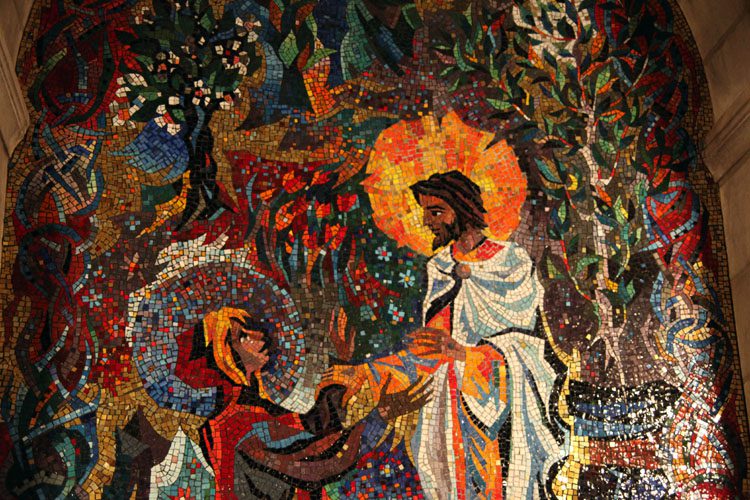
Post-Resurrection, Jesus shows up in some unexpected ways. He takes a stroll with his disciples on the path to Emmaus. He appears to Mary Magdalene as a gardener. In this week’s Gospel, Jesus arrives at the Sea of Tiberias, helps his disciples catch some fish, and eats an early morning breakfast with them.
We’re supposed to notice several things here: first, Jesus’s miraculous aid in the disciples’ capacity to catch fish, which had been eluding the group until Jesus got there; next, the fact of Jesus’s eating—ghosts don’t eat, so this indicates a truly enfleshed Resurrection; and finally, Jesus’s call to Peter to “feed his sheep,” underscoring both Peter’s special vocation as leader in the Church, and the universal call to serve.
These are undoubtedly the theologically rich elements of the text. But today, I notice something different, and it catches me off guard. This is a Gospel written by John, but it’s largely about the intimate relationship between Jesus and Peter. John refers to himself, as usual, as “the disciple whom Jesus loved.” I’m reminded of the Last Supper, where John nestles into Jesus’s chest, or John at the foot of the cross, being given as a gift to Mary, Jesus’s own mother. It seems safe to say that in the scheme of things, John could be called (anachronistically, sure) Jesus’s BFF.
But what does that mean? Did (or more unsettlingly, does) Jesus have favorites? I find myself heating up in jealousy at the very thought. But he was/is a person, even as he is part of the Godhead.
Did it irk John to notice Jesus’s intimate conversation with Peter, recorded in this Gospel? After breakfast, Jesus seems to take Peter aside, away from the crowd and all his other friends. I can see Jesus looking deeply into Peter’s eyes, maybe placing a firm, gentle hand on Peter’s shoulder, asking, “Peter, do you love me?”
And by the way, what kind of a question is that? The conversation turns into a commission—Jesus is giving Peter serious work to do, “feeding his sheep,” leading Peter to acceptance of his own cross. But the question isn’t, “Peter, do you wish to honor God?” or “Peter, are you ready to do the work to build up the Kingdom of heaven?” It’s the supremely intimate, person-to-person moment of reckoning: “Do you love me?” And Jesus poses it three times!
I mean, seriously, we’re all taught God loves us, Jesus loves us. But just picture this scene for a moment. Your friend, with whom you have this incredibly complicated and vulnerable relationship, takes you aside, and asks you over and over again, “Do you love me?” What kind of feels are happening there?
And we know John gets a little jealous about the relationship between Jesus and Peter, right? I mean, he throws an occasional petty aside into his Scripture accounts. We know John beat Peter in the race to the tomb; we know, thanks to John, that Peter had to “tuck in his garments, because he was lightly clad,” at the sight of Jesus in this scene. John notices an awful lot of details about Peter.
So maybe this tells us something about John, and about Peter. They’re human (and fallen, like the rest of us). Maybe they’re prone to jealousy of one another, vying for “best friendship” with Jesus. We hope that Jesus’s love is more expansive, hospitable even to the whole human race.
I picture Jesus as able to look deeply into anyone’s eyes, drawing out the soul of every one of us. I picture him able to connect to the true and the beautiful in every single individual, effortlessly finding a way to forge intimacy with every human on the planet.
And yet I’m also reminded that as a human on earth, Jesus had limits. Maybe not flaws, but limits. And I’m reminded that even though Jesus treats women in the Scriptures with a respect, a friendship, even a love that was totally uncharacteristic of his era (hell, it’s arguably uncharacteristic even of the present era), he still operates with some reserve with the women.
I can’t shake the image of Mary Magdalene realizing Jesus stands before her, when she had previously thought he was the gardener. “Rabbouni!” she cries, with some kind of helpless relief and love.
And Jesus’s response? “Don’t cling to me, Mary.”
How must that have felt? Mary Magdalene is the first one at the tomb, the first to announce the truth of the Resurrection. She clearly shares some kind of real intimacy with Jesus, yet when he presents himself to her in his resurrected state, he seems to admonish her love for him, as though getting too close to a woman is dangerous. As though he knows she can’t help but go too far.
“Don’t cling to me, Mary.”
But Peter did the opposite of cling, right? At the first challenge, Peter runs; he denies Christ. And Jesus gives him another shot. Not only another shot, but the prime responsibility of leading the Church. In his resurrected state, Jesus draws closer to Peter, giving him the intimacy Mary seems only to hope for.
And maybe there’s something right about that. Jesus knew his friends better than we do, left as we are with only a few Scriptural accounts of their friendships. Friendships between men and women are complicated. Maybe Jesus knew that to let Mary Magdalene too close would be detrimental to both of them, sidetracking them from their mission to build up the Kingdom. A bro-ship is undoubtedly safer.
But what do I do with that as a woman? Where does Jesus the man end, and Jesus the Christ begin? And aren’t we incorporated into Jesus, the Christ, precisely through relationship with Jesus, the man?
Augustine’s assertion that “I am closer to God than I am to myself,” has always rung true, and brought me much comfort. But between Jesus and me—can we get that close? Must a distance exist, because I am a woman? Because Jesus isn’t giving me “the keys to the Kingdom,” does it follow that he’s warning me not to cling to him? Or has he mellowed into the Godhead since the Ascension, capable of the same level of intimacy and friendship with all of us?
“My heart is restless until I rest in you, Lord.” Augustine again. And like Peter, I have to ask: seriously Lord, if not into your arms, where else can I go?
But the question nags at me. Am I invited?
Holly Mohr lives and works in Pittsburgh, PA with her husband and 2.5 children. She can’t wait until her baby is born and she can break the “2.5 statistical stereotype” of her generation. She loves Jesus, but she sometimes fights with him, too.
Image courtesy of Tim Evanson, via Wylio
Previous Post

April 26, 2019
Dark Devotional: Sitting on the Porch of Catholicism
Next Post

May 10, 2019 Dark Devotional: What the Good Shepherd Teaches Us about Parables
Browse Our Archives
Select a Category Advent Approaching Mystery art Book Reviews Catholic Ghost Story Catholicism community Confession Current Events Dark Devotional Deconstruction Deconstruction Fellow Travelers I Want To Believe Interview Laudato Si Lent Mary Matthew's Letters Movie Reviews Music Reviews Our Charism Personal Essay Pilgrims Pope Francis Popular Piety Prayer Publishing Richard Beck Saints Satan Sheed and Ward Sick Pilgrim Charism Sick Pilgrim Chats Sick Pilgrim Events Sick Pilgrim Travelin' Medicine Show Sick Pilgrimage to The West Sick Pilgrims Small Joys Spiritual Autobiography Spooky Files of Ave Maria Magazine Spooky October Spooky Pilgrim Spooky Pilgrimage Strange Journey The Inklings Things Keeping Us Going Trying to Say God TV Reviews Uncategorized women in the Catholic Church Wonder Podcast Write the Vision
Select a Month February 2022 January 2022 December 2021 November 2021 October 2021 September 2021 August 2021 July 2021 June 2021 May 2021 April 2021 March 2021 February 2021 January 2021 December 2020 April 2020 March 2020 February 2020 January 2020 December 2019 October 2019 September 2019 July 2019 June 2019 May 2019 April 2019 March 2019 February 2019 January 2019 December 2018 November 2018 October 2018 September 2018 August 2018 July 2018 June 2018 May 2018 April 2018 March 2018 February 2018 January 2018 December 2017 November 2017 October 2017 September 2017 August 2017 July 2017 June 2017 May 2017 April 2017 March 2017 February 2017 January 2017 December 2016 November 2016 October 2016 September 2016 August 2016 July 2016 June 2016 May 2016 April 2016 March 2016 February 2016 January 2016 December 2015
Follow Us!
TAKE THE
Religious Wisdom Quiz
What is the effect of the Red Horse's arrival in revelations?
Select your answer to see how you score.
The sun turns black Peace is taken from the earth People fall into a deep sleep Plagues spread across the land
Related posts from Sick Pilgrim

Dark Devotional: The Firelight of Life

Dark Devotional: Let Me Smite Him

Dark Devotional: Woe to Me, for I Have...

TRENDING AT PATHEOS Catholic

Rejecting Doom: Christian Hope And Human Action
Christianity is a religion of hope. We are to have hope and...

It’s What Comes From Within Which Matters
One of the most difficult things for us to understand is why...

Why I Choose the Eucharist Over the Sermon
Choose the Eucharist, Not the Sermon What are we supposed to get...

5 Design Elements Found in Spiritually Rooted Homes
Putting Spirituality Into Home Decor Our homes are more than our living...

Credo: A Story of God Told with the...
About 10 years ago, I began to imagine a personal "Credo" that...

The Anatomy of Divine Revelation in Catholic Thought
The claim that God has made Himself known to human beings is...
view all Catholic blogs
Ad-Free & Subscriber Log-In Subscription Support
- About Us
- 2026 Calendar
- Videos
- Podcasts
- Library of World Religions
- Faith In Media Tracker
- Advertise With Us
- Write for Us
- Privacy Policy
- Terms of Service
- Do Not Sell My Data
- Contact Us
- Radiant Digital
- Manage Newsletter Subscriptions
- Unsubscribe From Notifications
- Sitemap
Copyright 2008-2026, Patheos. All rights reserved.
Subscription Support Ad-Free & Subscriber Log-In
Follow Patheos