
BuddhistCatholicContemplativeEvangelicalGeneral ChristianHinduJewishLatter-day SaintMuslimNew VisionsProgressive Christian
Beliefs
- Buddhist
- Catholic
- Contemplative
- Evangelical
- General Christian
- Hindu
- Jewish
- Latter-day Saint
- More Voices
- Muslim
- New Visions
- Pagan
- Progressive Christian
Topics
- Religion News
- Food and Religion
- Sports and Religion
- Religious Art
- Religious Music and Entertainment
- Religious Events
- History and Religion
- Style and Religion
- Politics and Religion
- Women in Religion
- Recreation Outdoors and Religion
- Business Finance and Religion
- Careers Workplace and Religion
- Education and Religion
- Family Parenting and Religion
- Health Fitness and Religion
- Home and Religion
- Relationships and Religion
- Technology and Religion
- Travel and Religion
Columnists
- Buddhist Columnists
- Business Finance and Religion Columnists
- Careers Workplace and Religion Columnists
- Catholic Columnists
- Contemplative Columnists
- Education and Religion Columnists
- Evangelists Columnists
- Family Parenting and Religion Columnists
- General Christian Columnists
- Health Fitness and Religion Columnists
- Hindu Columnists
- History and Religion Columnists
- Home and Religion Columnists
- Jewish Columnists
- More Voices Columnists
- Latter Day Columnists
- Muslim Columnists
- New Visions Columnists
- Nonreligious Columnists
- Pagan Columnists
- Politics and Religion Columnists
- Progressive Columnists
- Recreation Outdoors and Religion Columnists
- Relationships and Religion Columnists
- Religion News Columnists
- Religious Art Columnists
- Religious Events Columnists
- Religious Music and Entertainment Columnists
- Sports and Religion Columnists
- Style and Religion Columnists
- Technology and Religion Columnists
- Travel and Religion Columnists
- Women in Religion Columnists
Resource Library
- 2026 Calendar
- Library of World Religions
- The 100 Most Holy Places on Earth
- Patheos Answers
- Podcasts
- Videos
- Faith Leaders Database
- Anglican Episcopalian
- Bahai
- Baptist
- Buddhism
- Christianity
- Confucianism
- Eastern Orthodoxy
- Hinduism
- Holiness and Pentecostal
- ISKCON
- Islam
- Judaism
- Lutheran
- Methodist
- The Church of Jesus Christ of Latter-day Saints
- New Age
- Paganism
- Presbytarian and Reformed
- Protestantism
- Religion Behind the Scenes
- Roman Catholic
- Scientology
- Shia Islam
- Sikhism
- Sufism
- Sunni Islam
- Taoism
- Zen
- See all religions
Research Tools
 Ad-Free & Subscriber Log-In Subscription Support
Ad-Free & Subscriber Log-In Subscription Support
Follow Patheos 

- Trending:
- Forgiveness
- |
- Marriage
- |
- Consciousness
- |
- Death Penalty
- |
- Election
- |
- Halloween
 Sick Pilgrim
- Home
- Catholic
- The Strangeness of Mary’s Body
The Strangeness of Mary’s Body
Last updated on: November 19, 2018 at 4:57 pm by Jessica Mesman Griffith
The Strangeness of Mary’s Body 2018-11-19T16:57:38-05:00 Jessica Mesman Griffith
Patheos Explore the world's faith through different perspectives on religion and spirituality! Patheos has the views of the prevalent religions and spiritualities of the world.
“Can you comment on the self as grotesque?”
The men on the panel at the conference looked bewildered, but the woman knew exactly what the questioner meant. Is experiencing one’s body as strange, even as grotesque, just part of being a woman?
Later many of us shared our stories–tales of embarrassment and horror over what our bodies can do, can make, can shed. Each of us had them. Each of us nodded in agreement and empathy as the others spoke.
Almost all those stories revolved around menstruation and childbirth. Getting your period, not getting your period. Having babies, being unable to have babies. Choosing to forego pregnancy for whatever reason, choosing the have ten babies for whatever reason. Why the taboo, the stigma, the shame, even now? I would have said because we were Catholic, but not all of us shared the same religious heritage.
It does seem strange to me, though, given our attribution of heavenly queenship of the saints to a human mother, Mary of Nazareth, that we should all be so ashamed of what our bodies can do, when surely her body did the same. (Though a quick search of the sentence “Did Mary menstruate?” will produce all sorts of bizarre theological argument for and against.) My own experience of Mary as a lifelong Catholic was not as a real woman, a woman who bleeds, but as a cold stone statue wreathed in fake flowers. No wonder I never connected with her.
I considered the question again when I received the cover image of Ethel Zine, where I recently contributed. The image roundly shocked the group of women in which it was shared–Christians, agnostics, churched and unchurched.
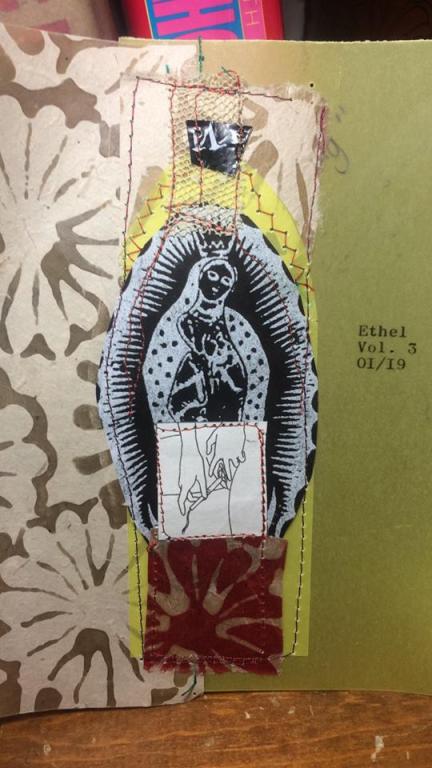
Cover of Ethel Zine by Sara Lefsyk
But why?
Menstruating women see the diagram overlaying the image of Mary as the Virgin of Guadalupe every time they open a box of tampons. I remember studying that image for hours even before I started my period, finding it mysterious and even titillating, though I had all the same parts depicted. And yet, when I finally started my period, I still couldn’t figure out how to insert a tampon. I left the plastic applicator in for four hours before I gave up, thinking the problem must be with me.
For so much of my life, my own body was a mystery to me. When I gave birth, the nurse asked if I wanted to watch the baby crown, and I recoiled. I’d never held a mirror up to myself before. I couldn’t bear to look.
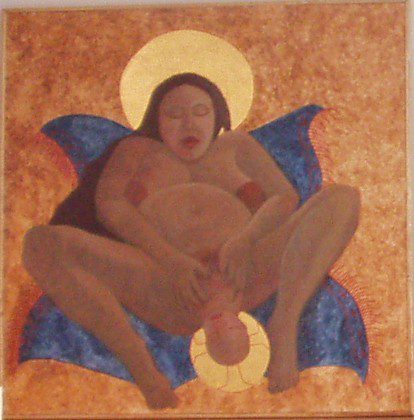
The Crowning by Sara Star
What might it have meant to me to have grown up with images of Mary like these? How might it have changed my experience of menstruation, childbirth?
To connect the workings of my body to the workings of a woman’s body deemed sacred, holy, adored?
There is a tradition of Maria Lactans, or the lactating Virgin, but Lord knows I never saw them in school or church or anywhere at all, until I was a nursing mother and a nun pulled me aside at an art show to show me an example. Still, these images are often sexualized and just flat-out anatomically bizarre, not representative of any human woman’s experience. And perhaps that was the point.
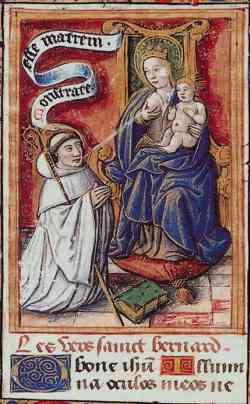
Medieval image of Maria Lactans, public domain
The truth is the images of Mary created by Sara Lefsyk and Sara Star, though they may be initially shocking in their newness to me–Catholics remove Mary to the pedestal and protestants largely ignore her for fear of Mariolatry–make me love Mary a little more. Hell, they make me love me a little more.
Meditating on these images of Mary not just as maiden or mother but as woman, I find myself less grotesque. I can imagine my body as other than a site of pain, shame, or even mystery or titillation. I can’t go so far as to say I imagine myself as potentially holy or adored or even powerful, but there’s a gift in seeing your own body, and Mary’s, as less strange.
Previous Post
November 7, 2018
Why I Can't Stay
Next Post
December 11, 2018 Strange Bodies, Strange Questions
Browse Our Archives
Select a Category Advent Approaching Mystery art Book Reviews Catholic Ghost Story Catholicism community Confession Current Events Dark Devotional Deconstruction Deconstruction Fellow Travelers I Want To Believe Interview Laudato Si Lent Mary Matthew's Letters Movie Reviews Music Reviews Our Charism Personal Essay Pilgrims Pope Francis Popular Piety Prayer Publishing Richard Beck Saints Satan Sheed and Ward Sick Pilgrim Charism Sick Pilgrim Chats Sick Pilgrim Events Sick Pilgrim Travelin' Medicine Show Sick Pilgrimage to The West Sick Pilgrims Small Joys Spiritual Autobiography Spooky Files of Ave Maria Magazine Spooky October Spooky Pilgrim Spooky Pilgrimage Strange Journey The Inklings Things Keeping Us Going Trying to Say God TV Reviews Uncategorized women in the Catholic Church Wonder Podcast Write the Vision
Select a Month February 2022 January 2022 December 2021 November 2021 October 2021 September 2021 August 2021 July 2021 June 2021 May 2021 April 2021 March 2021 February 2021 January 2021 December 2020 April 2020 March 2020 February 2020 January 2020 December 2019 October 2019 September 2019 July 2019 June 2019 May 2019 April 2019 March 2019 February 2019 January 2019 December 2018 November 2018 October 2018 September 2018 August 2018 July 2018 June 2018 May 2018 April 2018 March 2018 February 2018 January 2018 December 2017 November 2017 October 2017 September 2017 August 2017 July 2017 June 2017 May 2017 April 2017 March 2017 February 2017 January 2017 December 2016 November 2016 October 2016 September 2016 August 2016 July 2016 June 2016 May 2016 April 2016 March 2016 February 2016 January 2016 December 2015
Follow Us!
TAKE THE
Religious Wisdom Quiz
Which Psalm expresses confession: "Against you, you only, have I sinned"?
Select your answer to see how you score.
Psalm 73 Psalm 24 Psalm 51 Psalm 100
Related posts from Sick Pilgrim
TKUG--Rev. Dr. Martin Luther King, Jr. Edition
Stardust to Dust: Lent as a Search for...
Toni Morrison and the White Blindness of First...
TRENDING AT PATHEOS Catholic

Rejecting Doom: Christian Hope And Human Action
Christianity is a religion of hope. We are to have hope and...

It’s What Comes From Within Which Matters
One of the most difficult things for us to understand is why...

Why I Choose the Eucharist Over the Sermon
Choose the Eucharist, Not the Sermon What are we supposed to get...

5 Design Elements Found in Spiritually Rooted Homes
Putting Spirituality Into Home Decor Our homes are more than our living...

Credo: A Story of God Told with the...
About 10 years ago, I began to imagine a personal "Credo" that...

The Anatomy of Divine Revelation in Catholic Thought
The claim that God has made Himself known to human beings is...
view all Catholic blogs
Ad-Free & Subscriber Log-In Subscription Support
- About Us
- 2026 Calendar
- Videos
- Podcasts
- Library of World Religions
- Faith In Media Tracker
- Advertise With Us
- Write for Us
- Privacy Policy
- Terms of Service
- Do Not Sell My Data
- Contact Us
- Radiant Digital
- Manage Newsletter Subscriptions
- Unsubscribe From Notifications
- Sitemap
Copyright 2008-2026, Patheos. All rights reserved.
Subscription Support Ad-Free & Subscriber Log-In
Follow Patheos