
BuddhistCatholicContemplativeEvangelicalGeneral ChristianHinduJewishLatter-day SaintMuslimNew VisionsProgressive Christian
Beliefs
- Buddhist
- Catholic
- Contemplative
- Evangelical
- General Christian
- Hindu
- Jewish
- Latter-day Saint
- More Voices
- Muslim
- New Visions
- Pagan
- Progressive Christian
Topics
- Religion News
- Food and Religion
- Sports and Religion
- Religious Art
- Religious Music and Entertainment
- Religious Events
- History and Religion
- Style and Religion
- Politics and Religion
- Women in Religion
- Recreation Outdoors and Religion
- Business Finance and Religion
- Careers Workplace and Religion
- Education and Religion
- Family Parenting and Religion
- Health Fitness and Religion
- Home and Religion
- Relationships and Religion
- Technology and Religion
- Travel and Religion
Columnists
- Buddhist Columnists
- Business Finance and Religion Columnists
- Careers Workplace and Religion Columnists
- Catholic Columnists
- Contemplative Columnists
- Education and Religion Columnists
- Evangelists Columnists
- Family Parenting and Religion Columnists
- General Christian Columnists
- Health Fitness and Religion Columnists
- Hindu Columnists
- History and Religion Columnists
- Home and Religion Columnists
- Jewish Columnists
- More Voices Columnists
- Latter Day Columnists
- Muslim Columnists
- New Visions Columnists
- Nonreligious Columnists
- Pagan Columnists
- Politics and Religion Columnists
- Progressive Columnists
- Recreation Outdoors and Religion Columnists
- Relationships and Religion Columnists
- Religion News Columnists
- Religious Art Columnists
- Religious Events Columnists
- Religious Music and Entertainment Columnists
- Sports and Religion Columnists
- Style and Religion Columnists
- Technology and Religion Columnists
- Travel and Religion Columnists
- Women in Religion Columnists
Resource Library
- 2026 Calendar
- Library of World Religions
- The 100 Most Holy Places on Earth
- Patheos Answers
- Podcasts
- Videos
- Faith Leaders Database
- Anglican Episcopalian
- Bahai
- Baptist
- Buddhism
- Christianity
- Confucianism
- Eastern Orthodoxy
- Hinduism
- Holiness and Pentecostal
- ISKCON
- Islam
- Judaism
- Lutheran
- Methodist
- The Church of Jesus Christ of Latter-day Saints
- New Age
- Paganism
- Presbytarian and Reformed
- Protestantism
- Religion Behind the Scenes
- Roman Catholic
- Scientology
- Shia Islam
- Sikhism
- Sufism
- Sunni Islam
- Taoism
- Zen
- See all religions
Research Tools
 Ad-Free & Subscriber Log-In Subscription Support
Ad-Free & Subscriber Log-In Subscription Support
Follow Patheos 

- Trending:
- Forgiveness
- |
- Marriage
- |
- Consciousness
- |
- Death Penalty
- |
- Election
- |
- Halloween
 Sick Pilgrim
- Home
- Catholic
- I Want To Believe: Theresa’s Story
I Want To Believe: Theresa’s Story
Last updated on: August 13, 2018 at 10:13 am by Guest Contributor
I Want To Believe: Theresa’s Story 2018-08-13T10:13:33-05:00 Guest Contributor
Patheos Explore the world's faith through different perspectives on religion and spirituality! Patheos has the views of the prevalent religions and spiritualities of the world.
The theater is tiny, curtained on all sides, with carpeted benches rather than seats. There I perch, legs curled sideways, ankles crossed.
One film after another. Jugglers and clowns. Pointy-breasted showgirls. A rattlesnake. A painted cave. Pina Bausch, dancing en pointe with cow flesh in her slippers.
My neighbors gasp, and sigh. They exhale wonder, and it fills the room like smoke.
I grit my teeth, head turned at an ugly angle, my body twisted and tense. Supremely unreasonable, I am a crooked woman with crooked eyes, crooked sight, stubbornly refusing to look away.
To see in three dimensions, the viewer needs two functioning eyes, placed at a slight distance apart, with the ability to focus synchronously on a single object. The brain takes these two differing signals, finds their convergence, and creates a picture with depth. Binocular vision, it is called. Humans have it, and eagles, and wolves. Predator species, mainly, although sheep have it as well.
I don’t.
A quirk of genetics gave me a weak eye and stronger eye, the weak eye turned slightly inward. As a result, my brain can only process one image at a time. A surgery in my teens corrected the cosmetic misalignment, but if you are very observant you might notice that I keep my head cocked slightly off-center. This tiny adjustment means that my good eye always has an optimal view of what is in front of me. A binocular field of vision can extend up to one hundred eighty degrees to either side, but mine tops out at a narrow ninety to one hundred degrees. Once decoded by my brain, the picture I see is flat as a photograph.
Depth perception, for me, requires motion. Species with monocular vision (myself, squirrels, and other prey) predominantly perceive distance and depth through something called motion parallax, defined as the speed at which objects appear to move in relation to the movement of the observer.
It’s easier to understand if you picture yourself as a child, sleepily gazing out the window of your mother’s car. The dark shapes of trees whip past. The street sign in the distance appears to approach slowly. The moon travels with you, a fixed point in the racing world. Your brain understands what all this means. Near, farther, farthest. Parallax.
Motion parallax is enough for most of us to avoid wolves, or sharks, or walking into telephone poles, but it is not a tremendous help when it comes to playing volleyball in gym class, and it functions not at all when it comes to the illusion of 3D, in art or otherwise.
So, what am I doing here? Why am I spending an hour with art I cannot see?
A docent hands me a pair of red and green tinted glasses.
All experiences of art consist of both the seen and the unseen. We approach the work as limited beings, all a little broken, a little blind. Ready to receive, we strain to see. We believe we comprehend, or we struggle and are frustrated.
I don my cardboard spectacles and approach an exhibit. My view is red, with only a blurry hint of green in the left corner, like a drop of watercolor paint.
I squint. Strain. Glasses on, glasses off. Cocking my head this way and that. What if I hold the glasses out? Sideways? Upside down? Nothing. Of course, nothing. It would be unreasonable to expect otherwise.
Perception is subjective, so I have heard, so I dispose of the glasses and try to value the uniqueness of my own vision. Those around me are delighted, laughing, grabbing at the empty space.
Forget them. What do I see?
Dozens of photographs mounted side by side. Blurred paintings, images and patterns, red and green lines always slightly askew.
My view, I reason with myself, is as legitimate as any. There is no such thing as true sight.
A small boy next to me is elated as a screen shows him a mid-century ballplayer, pitching a baseball toward the camera again and again. His grin pierces the veil of my philosophy.
Spoilsport.
I move on to the next gallery, which is larger, empty, and quiet as a church.
***
Some bird species optimize their depth perception by bobbing their heads. Up and down they go, their tiny brains rapidly calculating fine ratios of differentiated movement. Me, perched high in the choir loft at Sweetest Heart of Mary, I sway.
My habit is to shift my weight to one side, then the other, then carefully forward and back, while my field of vision swoops and soars. With my good eye, I follow the relative movement of the columns, the statues, the soaring arches and the stained glass. Quick as a bird, my brain processes what I can see, calibrates signals from my inner ear, measures the echo of my voice as it reverberates, and combines them all according to its own mysterious algorithm.
I recognize what is below me, above me, before me. On my right side and my left. Enormity, obviously, and beauty, but mostly empty, echoing space, as still and imposing as the gallery of a vast museum.
Sweetest Heart of Mary Church, where I currently serve as a musician, is a gorgeously gothic mess in a nearly abandoned corner of Detroit. The migration from the city over the past generation or three has done its work, and where there was once a thriving community of blue-collar households, family-owned shops, and parish schools, there are now hulking industrial complexes, abandoned warehouses, a juvenile hall, and a few more austere buildings belonging to the city.
In its heyday, Sweetest Heart was an ethnically Polish parish established a block away from another ethnically Polish Parish. Two eyes, a slight distance from each other, focused on the same object.
Or rather, that would be the analogy I would use if it were not slightly misaligned. Sweetest Heart of Mary does, in fact, exist a block from another Polish parish, St. Josaphat, but also two blocks from a third, St. Albertus. All three constructed in the 19th century to serve the city’s booming population of Polish Catholic immigrants, they exist now in various states of disrepair.
St. Albertus was deconsecrated in 1985. It unlocks its doors occasionally, and tourists of urban decay can walk down its echoing aisles, necks craned towards the cracked ceilings. Supported financially by an organization called the “Polish American Historic Site Association,” it hosts infrequent special Masses and regular fundraising suppers.
St. Josaphat is clustered with Sweetest Heart into a single parish: “Mother of Divine Mercy.” Although there are still a handful of devoted congregants, it hosts only one mass per weekend– a Novus Ordo in Latin—which is never more than lightly attended. and a handful of modest weddings. It has a makeshift organ and cracked plaster. Its days, one assumes, are numbered.
Sweetest Heart was built between these two, like the mystical third eye. It survives to serve a few hundred families, most of whom commute from the suburbs for Sunday masses. On Christmas and Easter, it is crowded with generations and generations of middle and upper-middle class Catholics, both faithful and semi-lapsed, many or most with last names ending in -ski. The most photogenic of the three churches, Sweetest Heart of Mary is maintained substantially with the income from dozens of elaborate weddings per year. Funding for the current steeple renovation is secure.
Three churches, three objects, three points of reflected light, fixed in place as the city moves on. One stationary. One barely creeping. One moving forward.
Parallax.
When these three churches opened their doors well over a century ago, they were built specifically to inspire and express the transcendent belief of migrant people. I am humbled, grateful to serve their memory with my own art. In my limited way, I appreciate all that they created in faith.
In hindsight, it was only a few short (and long) years ago that my throat vibrated and my vision swayed to the tune of my own devotion. Time and trouble moved me along despite myself, and for whatever reason, my sight is weaker now, narrower. On a bad day, when I am feeling particularly unreasonable, it is flat. Flat as a photograph. Maybe I’m just a little too crooked.
I still sing from the loft, of course. I am there to serve as an artist, suspended among the work of hundreds of faithful artists long dead, doing my best for the devoted who remain. I sing, and sway, and search my own mind for remembered visions, hoping to find the convergence of what I see, and what I have seen. From above I can see the faithful, heads lifted, eyes wide open in wonder.
It all must look pretty cool in 3D.
***
Back at LACMA I queue for fifteen minutes before another docent allows me into a theater. Handing me a fresh pair of glasses, he explains that inside are about forty minutes of film clips playing on a loop, a history of 3D filmmaking. Inside, I claim a bench where I sit and stare for ten, twenty, forty minutes.
I don’t even know what I am hoping to see.
Restless, I find myself shifting. Swaying. Despite myself, I am doing my best to see what those around me cannot help but reach for. Straining, I am twisted, squinting, cockeyed.
Mickey Mouse. Errol Flynn. Godard. A butterfly migration.
A butterfly migration. That’s when it happens.
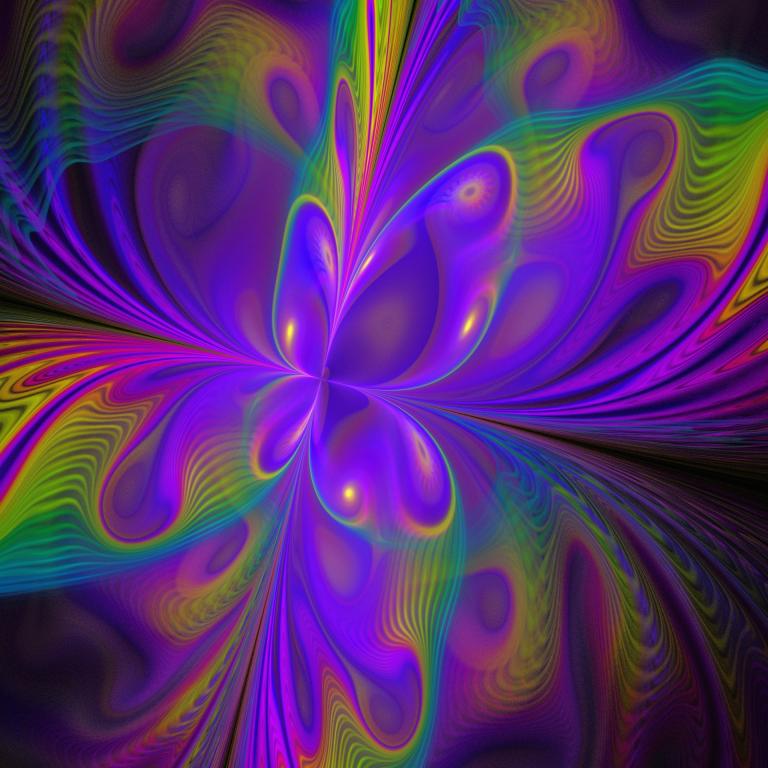
For a moment only, half a moment, I see something. A flash of gold, then detail, shape. The light creates a form, my eyes receive a reflection, my brain sculpts her the air, and my soul recognizes her. Convergence. In the liminal space between my eyes and the screen, a single butterfly is with me.
But, really with me.
Hello, you.
I am seeing. I have never seen.
I am seeing. I have never seen.
I gasp.
I reach out to grasp at empty space, but I am not disappointed.
Resonance is not tangible. Reflection cannot be held in place. Near, farther, farthest, none of these matter, because I am her, and she is me, and we are convergence. We are the third eye, the fixed moon, the baseball thrown again and again, the boy who will never stop trying to catch it. We are parallax.
A flash, a quick cut, a new film.
Goodbye, I tell her, or maybe, see you later.
All my crooked eyes see now is flickering light, flat and finite as the projection screen. Exhale.
Rising, I remove my glasses and duck through the dark curtain back into the gallery, then out into the bright afternoon. I am floating, driven by hope, casting my sight before me, measuring and calculating.
If blind eyes can be made to see, even for a single moment, it is reasonable to believe that they might see again. It is reasonable to believe there may be an invisible depth, a dimension beyond my broken sight. It is reasonable to believe that maybe it waits for me.
Maybe she waits for me.
Maybe all I have to do right now is move forward, squinting at what my eyes can see near, farther, way off in the distance. Measuring. Calculating. Doing my best.
Hoping for convergence, or conversion. Hoping that someday, someday I might reach, fight, fly beyond the flatness of my own perception.
Maybe I will still be singing then. Suspended, but not in emptiness. Surrounded. Flashes of gold before me, below me, to my right and to my left. Flying into the light. Swooping to one side, then the other. Vision that can’t be measured in degrees. A butterfly. A million million butterflies, and me.
Me, and her, and a great migration.
*****
Theresa Marier Weiler is a Detroit-area musician and educator.
Previous Post

August 9, 2018
Dark Devotional: Going it Alone
Next Post
August 15, 2018 Dear Catholic Bishops, Time's Up
Browse Our Archives
Select a Category Advent Approaching Mystery art Book Reviews Catholic Ghost Story Catholicism community Confession Current Events Dark Devotional Deconstruction Deconstruction Fellow Travelers I Want To Believe Interview Laudato Si Lent Mary Matthew's Letters Movie Reviews Music Reviews Our Charism Personal Essay Pilgrims Pope Francis Popular Piety Prayer Publishing Richard Beck Saints Satan Sheed and Ward Sick Pilgrim Charism Sick Pilgrim Chats Sick Pilgrim Events Sick Pilgrim Travelin' Medicine Show Sick Pilgrimage to The West Sick Pilgrims Small Joys Spiritual Autobiography Spooky Files of Ave Maria Magazine Spooky October Spooky Pilgrim Spooky Pilgrimage Strange Journey The Inklings Things Keeping Us Going Trying to Say God TV Reviews Uncategorized women in the Catholic Church Wonder Podcast Write the Vision
Select a Month February 2022 January 2022 December 2021 November 2021 October 2021 September 2021 August 2021 July 2021 June 2021 May 2021 April 2021 March 2021 February 2021 January 2021 December 2020 April 2020 March 2020 February 2020 January 2020 December 2019 October 2019 September 2019 July 2019 June 2019 May 2019 April 2019 March 2019 February 2019 January 2019 December 2018 November 2018 October 2018 September 2018 August 2018 July 2018 June 2018 May 2018 April 2018 March 2018 February 2018 January 2018 December 2017 November 2017 October 2017 September 2017 August 2017 July 2017 June 2017 May 2017 April 2017 March 2017 February 2017 January 2017 December 2016 November 2016 October 2016 September 2016 August 2016 July 2016 June 2016 May 2016 April 2016 March 2016 February 2016 January 2016 December 2015
Follow Us!
TAKE THE
Religious Wisdom Quiz
How many clean animal pairs were in Noah's Ark?
Select your answer to see how you score.
6 3 5 7
Related posts from Sick Pilgrim
Dark Devotional: Faith is a Tension
Dark Devotional: Seeing Is Believing
Dark Devotional: I Have Questions
When a Good Catholic Girl Goes Bad
TRENDING AT PATHEOS Catholic

The Parable Of The Sower And The Word...
One of Christ’s most famous parables is that of the sower who...

Rejecting Doom: Christian Hope And Human Action
Christianity is a religion of hope. We are to have hope and...

Why I Choose the Eucharist Over the Sermon
Choose the Eucharist, Not the Sermon What are we supposed to get...

5 Design Elements Found in Spiritually Rooted Homes
Putting Spirituality Into Home Decor Our homes are more than our living...

Credo: A Story of God Told with the...
About 10 years ago, I began to imagine a personal "Credo" that...

The Anatomy of Divine Revelation in Catholic Thought
The claim that God has made Himself known to human beings is...
view all Catholic blogs
Ad-Free & Subscriber Log-In Subscription Support
- About Us
- 2026 Calendar
- Videos
- Podcasts
- Library of World Religions
- Faith In Media Tracker
- Advertise With Us
- Write for Us
- Privacy Policy
- Terms of Service
- Do Not Sell My Data
- Contact Us
- Radiant Digital
- Manage Newsletter Subscriptions
- Unsubscribe From Notifications
- Sitemap
Copyright 2008-2026, Patheos. All rights reserved.
Subscription Support Ad-Free & Subscriber Log-In
Follow Patheos