
BuddhistCatholicContemplativeEvangelicalGeneral ChristianHinduJewishLatter-day SaintMuslimNew VisionsProgressive Christian
Beliefs
- Buddhist
- Catholic
- Contemplative
- Evangelical
- General Christian
- Hindu
- Jewish
- Latter-day Saint
- More Voices
- Muslim
- New Visions
- Pagan
- Progressive Christian
Topics
- Religion News
- Food and Religion
- Sports and Religion
- Religious Art
- Religious Music and Entertainment
- Religious Events
- History and Religion
- Style and Religion
- Politics and Religion
- Women in Religion
- Recreation Outdoors and Religion
- Business Finance and Religion
- Careers Workplace and Religion
- Education and Religion
- Family Parenting and Religion
- Health Fitness and Religion
- Home and Religion
- Relationships and Religion
- Technology and Religion
- Travel and Religion
Columnists
- Buddhist Columnists
- Business Finance and Religion Columnists
- Careers Workplace and Religion Columnists
- Catholic Columnists
- Contemplative Columnists
- Education and Religion Columnists
- Evangelists Columnists
- Family Parenting and Religion Columnists
- General Christian Columnists
- Health Fitness and Religion Columnists
- Hindu Columnists
- History and Religion Columnists
- Home and Religion Columnists
- Jewish Columnists
- More Voices Columnists
- Latter Day Columnists
- Muslim Columnists
- New Visions Columnists
- Nonreligious Columnists
- Pagan Columnists
- Politics and Religion Columnists
- Progressive Columnists
- Recreation Outdoors and Religion Columnists
- Relationships and Religion Columnists
- Religion News Columnists
- Religious Art Columnists
- Religious Events Columnists
- Religious Music and Entertainment Columnists
- Sports and Religion Columnists
- Style and Religion Columnists
- Technology and Religion Columnists
- Travel and Religion Columnists
- Women in Religion Columnists
Resource Library
- 2026 Calendar
- Library of World Religions
- The 100 Most Holy Places on Earth
- Patheos Answers
- Podcasts
- Videos
- Faith Leaders Database
- Anglican Episcopalian
- Bahai
- Baptist
- Buddhism
- Christianity
- Confucianism
- Eastern Orthodoxy
- Hinduism
- Holiness and Pentecostal
- ISKCON
- Islam
- Judaism
- Lutheran
- Methodist
- The Church of Jesus Christ of Latter-day Saints
- New Age
- Paganism
- Presbytarian and Reformed
- Protestantism
- Religion Behind the Scenes
- Roman Catholic
- Scientology
- Shia Islam
- Sikhism
- Sufism
- Sunni Islam
- Taoism
- Zen
- See all religions
Research Tools
 Ad-Free & Subscriber Log-In Subscription Support
Ad-Free & Subscriber Log-In Subscription Support
Follow Patheos 

- Trending:
- Forgiveness
- |
- Marriage
- |
- Consciousness
- |
- Death Penalty
- |
- Election
- |
- Halloween
 Sick Pilgrim
- Home
- Catholic
- Heavenly Protest: On the Afterlife of Radiohead
Heavenly Protest: On the Afterlife of Radiohead
Last updated on: August 1, 2018 at 8:13 am by Guest Contributor
Heavenly Protest: On the Afterlife of Radiohead 2018-08-01T08:13:36-05:00 Guest Contributor
Patheos Explore the world's faith through different perspectives on religion and spirituality! Patheos has the views of the prevalent religions and spiritualities of the world.
On June 16th, 2012, as Radiohead’s crew was setting up the elaborate LED stage lighting system for the band’s show in Downsview Park in Toronto, the stage suffered a collapse, injuring three and killing the tour’s drum technician, Scott Johnson. The show was cancelled, the sellout crowd sent home, and the media speculated about whether the band would continue the globe-spanning tour behind their eighth album, The King of Limbs. Not only did the collapse damage their custom lighting system (a key component of their live show), but the trauma of losing their friend and crew member clearly struck deep among the band’s members. On the band’s website, drummer Phil Selway described the band as “shattered” by the loss. Lead singer Thom Yorke later described finishing the global tour as his toughest achievement as a band member.
The band first took the stage again several weeks after the accident, with a significantly pared-down set of screens and lights illuminating the stage. The setlists on the King of Limbs tour had, to that point, generally begun with the album’s opener, “Bloom,” which in live form – aided by the addition of a second tour drummer, Portishead’s Clive Deamer – had become a polyrhythmic, propulsive launch to a high-energy set. As the band entered and took up their instruments, however, the visual and sonic landscape that opened the set was very different.
Under bare lighting, guitarist Ed O’Brien began scraping the top of his guitar neck above the bridge. Strumming in eighth notes filtered through a Boss reverb pedal, O’Brien slowly filled the arena with the ambient opener of “Lucky,” a standout track from the album that took the band from relative alternative rock anonymity to critical acclaim, 1997’s OK Computer. While on the King of Limbs tour the band had regularly played the song as part of its sets, but to open the show with it was unusual; indeed, it had not happened since 1998.
The lyrics quickly sent the contextual message:
“Pull me out of the air crash…pull me out of the wreck.”
As the band conjured the horrors of machinery crushing flesh (a regular theme in Yorke’s writing since the band’s first album), the song’s rousing affirmation – one of the few times in Radiohead concerts where the crowd is actively encouraged to sing along – “It’s gonna be a glorious day,” took on a whole new meaning. This was flesh, this was art, protesting against the impersonal forces – fate, machinery, modern technological existence – whose casualties sometimes come home in very personal ways. Mark Greif identifies such moments as notes of “defiance” as opposed to “revolution” in Radiohead’s art:
The difference between revolution and defiance is the difference between an overthrow of the existing order and one person’s shaken fist. When the former isn’t possible, you still have to enact the latter, if only so as to remember that you’re human. Defiance is the insistence of individual power to confront an overwhelming force that it cannot undo. You know that you cannot strike the colossus, but you can defy it with words and signs. In the assertion that you can fight a superior power, in the declaration that you will fight, an absurd overstatement gains dignity by exposing you, however uselessly, to risk. Unable to stop it in its tracks, you dare the crushing power to begin its devastation with you.
Greif goes on to argue that “at its best, Radiohead’s music reactivates the moods in which you once noticed you ought to refuse. It can abet an impersonal defiance. This is not a doctrine the band advances, but an effect of the aesthetic.” As we will see throughout the book, this last point is crucial. For the most part, Yorke’s lyrics are oblique and evocative enough to resist easy co-opting into a particular life philosophy or political agenda (with the possible exception of global climate change; more on that later). It is impossible to slot Radiohead as a “political act” in the same category as their early contemporaries Rage Against the Machine, or as a quasi-spiritual act like their fellow arena-fillers U2. But, partly because of the lack of one to one correspondence between art and agenda, the band is masterful at the art of defiance – the defiance of the flesh against the machine, of the individual against the masses, perhaps even of life against death.
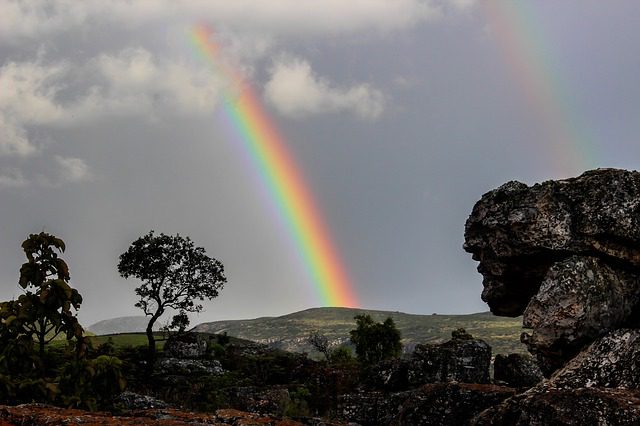
Anyone tempted to think that this was an overread of the opening of the show could have no doubts by the end. After its characteristic two-hour show, one that regularly earns the band high honors in the “Best Live Acts” category of music publications, the band added an uncharacteristic third encore. As images of Johnson were projected onto the screens above the band, Selway and Deamer launched into the bold opening percussion of “Reckoner” – a track from 2008’s In Rainbows. Like many of Radiohead’s songs – “Videotape,” “Pyramid Song,” “Paranoid Android” – the song features images of the afterlife and the apocalyptic; unlike those tracks, however, “Reckoner” places the imagery in a sonically and lyrically hopeful key. Over a shimmering arpeggio and driving percussion, Yorke’s falsetto soars: “Because we separate like ripples on a blank shore, in rainbows…take me with you.”
The note sounded was not a religious one – no Radiohead members indicate a particular bent towards either organized religion or even “spirituality” in a recognizable sense. Unlike many ham-fisted religious “tributes” to departed souls, the implication was not that Johnson was now in some heaven that makes up for the tragedy of the loss. Such would be the sort of cheap religious consolation derided by Marx, Freud, Nietzsche and others – religion as an opiate, a fantasy designed to make life on earth somehow more tolerable.
However, between “Lucky” and “Reckoner,” and the hours of experimental rock in between, a different sort of affirmation could be discerned. Christian theologians often debate the necessary balance in theology between “transcendence” (the aspects of truth that supersede what is evident to the senses and common experience) and “immanence” (the realities that are grounded in material, concrete, “here and now” life as we experience it). Increasingly, however, Christian thinkers such as the 20th-century German Dietrich Bonhoeffer, whose life was marked among other things by resistance to the Nazi regime which eventually executed him, have argued that for Christians who worship a God made flesh in Jesus Christ, the choice between truth in immanence and truth in transcendence is ultimately a false dichotomy. Indeed, it is IN and THROUGH deep immersion into the real as such that ultimate truth – for Christians, God’s own truth – can be found. We don’t find truth by moving away from the concrete earth into the ethereal heavens; we find God by going as deeply into the real as God in Christ did.
Radiohead’s resolute refusal of cheap consolation, its aesthetically unswerving commitment to the depths of human suffering in a world coming apart under overlapping regimes of falsehood, bureaucracy, and indifference to catastrophe on an individual and global scale (such as climate change) sets an important standard for theology’s own necessary commitments to authenticity in truth-telling. If so much religion lends itself to excuses that close one’s eyes to the world’s need in favor of chimeric narratives of optimism (“the best you can is good enough”), then Radiohead’s marshalling of beauty in the face of the crushing machine provides a soundtrack to hope – gritty, realistic, fragile hope. The latter is the province of theology that gives life rather than abets death. Contrary to its occasionally well-deserved reputation, theology should be an implacable opponent of bullshit. Radiohead is one source for teaching theologians what sustaining such opposition looks like.
Robert Saler is associate dean and research professor of Lutheran studies at Christian Theological Seminary in Indianapolis, IN.
*****
1- As of the time of writing, the entire concert can be viewed via fan footage on Youtube: https://www.youtube.com/watch?v=NI_AE3fikvg
2- Greif, “Radiohead, or the Philosophy of Pop” in Brandon W. Forbes and George A. Reisch (eds.), Radiohead and Philosophy: Fitter, Happier, More Deductive (Chicago: Open Court, 2009), 30-31.
Previous Post

July 30, 2018
I Want To Believe: Matt's Story
Next Post

August 3, 2018 Dark Devotional: No Grumbling for the Grumleys
Browse Our Archives
Select a Category Advent Approaching Mystery art Book Reviews Catholic Ghost Story Catholicism community Confession Current Events Dark Devotional Deconstruction Deconstruction Fellow Travelers I Want To Believe Interview Laudato Si Lent Mary Matthew's Letters Movie Reviews Music Reviews Our Charism Personal Essay Pilgrims Pope Francis Popular Piety Prayer Publishing Richard Beck Saints Satan Sheed and Ward Sick Pilgrim Charism Sick Pilgrim Chats Sick Pilgrim Events Sick Pilgrim Travelin' Medicine Show Sick Pilgrimage to The West Sick Pilgrims Small Joys Spiritual Autobiography Spooky Files of Ave Maria Magazine Spooky October Spooky Pilgrim Spooky Pilgrimage Strange Journey The Inklings Things Keeping Us Going Trying to Say God TV Reviews Uncategorized women in the Catholic Church Wonder Podcast Write the Vision
Select a Month February 2022 January 2022 December 2021 November 2021 October 2021 September 2021 August 2021 July 2021 June 2021 May 2021 April 2021 March 2021 February 2021 January 2021 December 2020 April 2020 March 2020 February 2020 January 2020 December 2019 October 2019 September 2019 July 2019 June 2019 May 2019 April 2019 March 2019 February 2019 January 2019 December 2018 November 2018 October 2018 September 2018 August 2018 July 2018 June 2018 May 2018 April 2018 March 2018 February 2018 January 2018 December 2017 November 2017 October 2017 September 2017 August 2017 July 2017 June 2017 May 2017 April 2017 March 2017 February 2017 January 2017 December 2016 November 2016 October 2016 September 2016 August 2016 July 2016 June 2016 May 2016 April 2016 March 2016 February 2016 January 2016 December 2015
Follow Us!
TAKE THE
Religious Wisdom Quiz
Who was Aquila's wife?
Select your answer to see how you score.
Mary Lydia Ruth Priscilla
Related posts from Sick Pilgrim


Things Keeping Us Going, March 2020
Mental Illness and and the Darkness of Lent
Our Lenten Wilderness: Unknown Pleasures and Revelations
TRENDING AT PATHEOS Catholic

Creation, Preservation, and Teleology in Catholic Theology
As I write this, it is very early Monday morning. Like millions...

The Parable Of The Sower And The Word...
One of Christ’s most famous parables is that of the sower who...

Rejecting Doom: Christian Hope And Human Action
Christianity is a religion of hope. We are to have hope and...

Why I Choose the Eucharist Over the Sermon
Choose the Eucharist, Not the Sermon What are we supposed to get...

5 Design Elements Found in Spiritually Rooted Homes
Putting Spirituality Into Home Decor Our homes are more than our living...

Credo: A Story of God Told with the...
About 10 years ago, I began to imagine a personal "Credo" that...
view all Catholic blogs
Ad-Free & Subscriber Log-In Subscription Support
- About Us
- 2026 Calendar
- Videos
- Podcasts
- Library of World Religions
- Faith In Media Tracker
- Advertise With Us
- Write for Us
- Privacy Policy
- Terms of Service
- Do Not Sell My Data
- Contact Us
- Radiant Digital
- Manage Newsletter Subscriptions
- Unsubscribe From Notifications
- Sitemap
Copyright 2008-2026, Patheos. All rights reserved.
Subscription Support Ad-Free & Subscriber Log-In
Follow Patheos