
BuddhistCatholicContemplativeEvangelicalGeneral ChristianHinduJewishLatter-day SaintMuslimNew VisionsProgressive Christian
Beliefs
- Buddhist
- Catholic
- Contemplative
- Evangelical
- General Christian
- Hindu
- Jewish
- Latter-day Saint
- More Voices
- Muslim
- New Visions
- Pagan
- Progressive Christian
Topics
- Religion News
- Food and Religion
- Sports and Religion
- Religious Art
- Religious Music and Entertainment
- Religious Events
- History and Religion
- Style and Religion
- Politics and Religion
- Women in Religion
- Recreation Outdoors and Religion
- Business Finance and Religion
- Careers Workplace and Religion
- Education and Religion
- Family Parenting and Religion
- Health Fitness and Religion
- Home and Religion
- Relationships and Religion
- Technology and Religion
- Travel and Religion
Columnists
- Buddhist Columnists
- Business Finance and Religion Columnists
- Careers Workplace and Religion Columnists
- Catholic Columnists
- Contemplative Columnists
- Education and Religion Columnists
- Evangelists Columnists
- Family Parenting and Religion Columnists
- General Christian Columnists
- Health Fitness and Religion Columnists
- Hindu Columnists
- History and Religion Columnists
- Home and Religion Columnists
- Jewish Columnists
- More Voices Columnists
- Latter Day Columnists
- Muslim Columnists
- New Visions Columnists
- Nonreligious Columnists
- Pagan Columnists
- Politics and Religion Columnists
- Progressive Columnists
- Recreation Outdoors and Religion Columnists
- Relationships and Religion Columnists
- Religion News Columnists
- Religious Art Columnists
- Religious Events Columnists
- Religious Music and Entertainment Columnists
- Sports and Religion Columnists
- Style and Religion Columnists
- Technology and Religion Columnists
- Travel and Religion Columnists
- Women in Religion Columnists
Resource Library
- 2026 Calendar
- Library of World Religions
- The 100 Most Holy Places on Earth
- Patheos Answers
- Podcasts
- Videos
- Faith Leaders Database
- Anglican Episcopalian
- Bahai
- Baptist
- Buddhism
- Christianity
- Confucianism
- Eastern Orthodoxy
- Hinduism
- Holiness and Pentecostal
- ISKCON
- Islam
- Judaism
- Lutheran
- Methodist
- The Church of Jesus Christ of Latter-day Saints
- New Age
- Paganism
- Presbytarian and Reformed
- Protestantism
- Religion Behind the Scenes
- Roman Catholic
- Scientology
- Shia Islam
- Sikhism
- Sufism
- Sunni Islam
- Taoism
- Zen
- See all religions
Research Tools
 Ad-Free & Subscriber Log-In Subscription Support
Ad-Free & Subscriber Log-In Subscription Support
Follow Patheos 

- Trending:
- Forgiveness
- |
- Marriage
- |
- Consciousness
- |
- Death Penalty
- |
- Election
- |
- Halloween
 Sick Pilgrim
- Home
- Catholic
- Things Keeping Us Alive – May 2018, Marian Edition
Things Keeping Us Alive – May 2018, Marian Edition
Last updated on: June 4, 2018 at 12:24 pm by Maren Grossman
Things Keeping Us Alive – May 2018, Marian Edition 2018-06-04T12:24:16-05:00 Maren Grossman
Patheos Explore the world's faith through different perspectives on religion and spirituality! Patheos has the views of the prevalent religions and spiritualities of the world.
It’s June! The grass is green, the robins are feeding their babies in the nest outside my window, and we’re talking about things that kept us alive in May.
Specifically, we’re talking about Mary.
Marian devotion can be complicated. Mary can seem remote, even though she is a figure who invites us to draw closer to the divine. Mary can seem anachronistic. Lingering Victorian sensibilities can make Mary seem like a feminine type that is oppressive, or even antithetical, to the realities of being a woman. Some of us may have had bad experiences with Marian devotion that make Mary seem like someone to be feared, and not like someone who loves us.
And, of course, a devotion that is inviting to one person may be thoroughly off-putting to another (ahem, St. Louis de Montfort, I’m looking at you).
In the spirit of Things Keeping Us Alive, we at Sick Pilgrim are talking about Marian things that keep us alive: our own particular ways of thinking about Mary, our peculiar devotions, and favorite images.
For me, one of the most compelling images of Mary was painted by Giotto and is found in the Scrovegni Chapel. Mary is so often shown to be completely serene. When she’s being visited by an angel, when she’s telling Christ what to do at the wedding at Cana, when she’s being assumed into heaven – she’s nearly always looks as though she’s in command of the situation.
In Giotto’s Lamentation of Christ, Mary is not serene. Her face is full of emotion, and she is grieving. She looks real. She looks like someone who is, maybe, kind of intense. She is no stranger to strong emotion. It’s an image that disrupts the sense that I can only be like Mary if I negate any kind of inner intensity.

Another quasi-Marian devotion I have is the movie Moonstruck. Bear with me here. (And notice that I’m pinch hitting for Matt LaFleur this month, who is probably not as enthusiastic about the movie Moonstruck as I am.)
It occurred to me recently that Mary is reflected in a number of female character in Moonstruck.
She’s the lady in the convenience store who has seen a wolf in everyone she’s ever met, and she sees the wolf in you.
She’s Cher’s character, knowing the real reasons why we do the crazy things we do, and telling us to snap out of it.
She’s Olympia Dukakis, who does not sin because she knows who she is.
She knows that we sin because we fear death.
And she reminds us that our lives are not built on nothing – because she loves us.
Marybeth Chuey Bishop lives in Annapolis with her husband and children, two dogs, and some scruffy plants. She likes to walk, wear socks with kraken or Poe on them, and write with her blogging partner-in-crime Kristen at Crone Café. You can find them on Facebook or at cronecafe.wordpress.com.
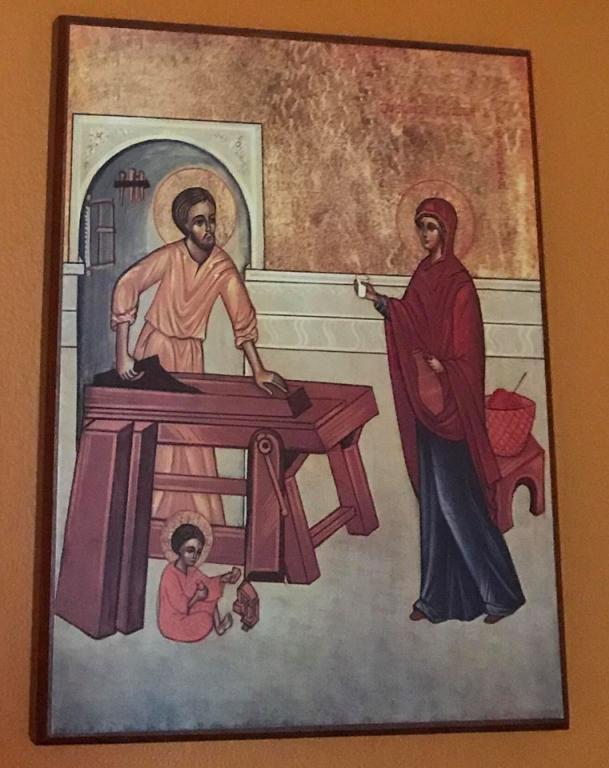
I’ve already written about the statue of Mary that I inherited from my parents, which is probably my very favorite physical Marian item since it holds so many memories of my family. A close second would be this icon of the Holy Family. I love how they are depicted doing very ordinary things with love—Joseph is pausing in his work; Mary is bringing him a drink of water; Jesus is playing at their feet. There’s nothing flashy here, just a family serving God by doing their work and loving each other.
The other Marian devotion that is special to me is Mary’s relationship with her cousin Elizabeth. I like to think of too-young-for-this Mary learning the ropes of pregnancy, labor, delivery, and those first fragile days of motherhood from too-old-for-this Elizabeth. We know they prayed together. I hope they laughed together. They almost certainly cried together, held each other’s hands, maybe even braided each other’s hair. I’d love to sit in the presence of these two strong, holy women as they learn from each other and just enjoy one another’s company.

John Farrell is a freelance writer from the Boston area, who writes with a particular focus on the history of science, and science and religion. He also writes short stories and has been known to publish an occasional poem.
I like to think of Mary (or Miriam, as she would have been known in Hebrew) as delightfully–odd. As someone who already perhaps had a reputation in a very small village. A reputation for being…strange. And far from being unattractive–she was striking, but in an unusual –very un-iconic way. Perhaps her eyes were considered too deep set over a nose some thought too prominent–and yet she could disarm people by an unwavering gaze–something her parents insisted she had always done, even as a child.
She disturbed people. Old people especially.
Was Miriam a problem child? Did she like wandering off into the nearby desert–the way her own son would years later? And what might she have seen and heard out there, so unprotected? Did her parents disbelieve her when she came back one late afternoon and told them she was pregnant? How could they inquire without raising suspicion? And yet out of fear that she really was–they married her off as soon as possible.
Had Joseph been married before? Was he a widower with small children when he agreed to marry her? [Thus Jesus would have grown up with older siblings–older siblings who might have been embarrassed by his adult ministry– at first. Though James came around–and became a leader in the early Christian movement–before being executed.]
Would Joseph, a widower with young children, be an ideal match in the eyes of an older couple alarmed about their young daughter Miriam’s apparent pregnancy, and fearful of the consequences if she was found out? But the widower was willing to remarry right away on account of his urgency in finding a mother for his children.
And over the years, was all this forgotten by the time the evangelists integrated it into the Gospels?
Previous Post

June 1, 2018
In My End is My Beginning - A Dark Devotional
Next Post

June 14, 2018 Sick Pilgrim Goes to the Movies: Adrift
Browse Our Archives
Select a Category Advent Approaching Mystery art Book Reviews Catholic Ghost Story Catholicism community Confession Current Events Dark Devotional Deconstruction Deconstruction Fellow Travelers I Want To Believe Interview Laudato Si Lent Mary Matthew's Letters Movie Reviews Music Reviews Our Charism Personal Essay Pilgrims Pope Francis Popular Piety Prayer Publishing Richard Beck Saints Satan Sheed and Ward Sick Pilgrim Charism Sick Pilgrim Chats Sick Pilgrim Events Sick Pilgrim Travelin' Medicine Show Sick Pilgrimage to The West Sick Pilgrims Small Joys Spiritual Autobiography Spooky Files of Ave Maria Magazine Spooky October Spooky Pilgrim Spooky Pilgrimage Strange Journey The Inklings Things Keeping Us Going Trying to Say God TV Reviews Uncategorized women in the Catholic Church Wonder Podcast Write the Vision
Select a Month February 2022 January 2022 December 2021 November 2021 October 2021 September 2021 August 2021 July 2021 June 2021 May 2021 April 2021 March 2021 February 2021 January 2021 December 2020 April 2020 March 2020 February 2020 January 2020 December 2019 October 2019 September 2019 July 2019 June 2019 May 2019 April 2019 March 2019 February 2019 January 2019 December 2018 November 2018 October 2018 September 2018 August 2018 July 2018 June 2018 May 2018 April 2018 March 2018 February 2018 January 2018 December 2017 November 2017 October 2017 September 2017 August 2017 July 2017 June 2017 May 2017 April 2017 March 2017 February 2017 January 2017 December 2016 November 2016 October 2016 September 2016 August 2016 July 2016 June 2016 May 2016 April 2016 March 2016 February 2016 January 2016 December 2015
Follow Us!
TAKE THE
Religious Wisdom Quiz
What was primary method of debt resolution in Biblical times?
Select your answer to see how you score.
Public trial Slavery Fine payment Community service
Related posts from Sick Pilgrim
Dark Devotional: From Good Wine to Bitter Faith

Dark Devotional: The Virgin Mary's Guide to Biblical...
Dark Devotional: Mary, Motherhood, and Mixed Feelings

Second Sunday in Advent: Let Me Love You...
TRENDING AT PATHEOS Catholic

Rejecting Doom: Christian Hope And Human Action
Christianity is a religion of hope. We are to have hope and...

It’s What Comes From Within Which Matters
One of the most difficult things for us to understand is why...

Why I Choose the Eucharist Over the Sermon
Choose the Eucharist, Not the Sermon What are we supposed to get...

5 Design Elements Found in Spiritually Rooted Homes
Putting Spirituality Into Home Decor Our homes are more than our living...

Credo: A Story of God Told with the...
About 10 years ago, I began to imagine a personal "Credo" that...

The Anatomy of Divine Revelation in Catholic Thought
The claim that God has made Himself known to human beings is...
view all Catholic blogs
Ad-Free & Subscriber Log-In Subscription Support
- About Us
- 2026 Calendar
- Videos
- Podcasts
- Library of World Religions
- Faith In Media Tracker
- Advertise With Us
- Write for Us
- Privacy Policy
- Terms of Service
- Do Not Sell My Data
- Contact Us
- Radiant Digital
- Manage Newsletter Subscriptions
- Unsubscribe From Notifications
- Sitemap
Copyright 2008-2026, Patheos. All rights reserved.
Subscription Support Ad-Free & Subscriber Log-In
Follow Patheos