
BuddhistCatholicContemplativeEvangelicalGeneral ChristianHinduJewishLatter-day SaintMuslimNew VisionsProgressive Christian
Beliefs
- Buddhist
- Catholic
- Contemplative
- Evangelical
- General Christian
- Hindu
- Jewish
- Latter-day Saint
- More Voices
- Muslim
- New Visions
- Pagan
- Progressive Christian
Topics
- Religion News
- Food and Religion
- Sports and Religion
- Religious Art
- Religious Music and Entertainment
- Religious Events
- History and Religion
- Style and Religion
- Politics and Religion
- Women in Religion
- Recreation Outdoors and Religion
- Business Finance and Religion
- Careers Workplace and Religion
- Education and Religion
- Family Parenting and Religion
- Health Fitness and Religion
- Home and Religion
- Relationships and Religion
- Technology and Religion
- Travel and Religion
Columnists
- Buddhist Columnists
- Business Finance and Religion Columnists
- Careers Workplace and Religion Columnists
- Catholic Columnists
- Contemplative Columnists
- Education and Religion Columnists
- Evangelists Columnists
- Family Parenting and Religion Columnists
- General Christian Columnists
- Health Fitness and Religion Columnists
- Hindu Columnists
- History and Religion Columnists
- Home and Religion Columnists
- Jewish Columnists
- More Voices Columnists
- Latter Day Columnists
- Muslim Columnists
- New Visions Columnists
- Nonreligious Columnists
- Pagan Columnists
- Politics and Religion Columnists
- Progressive Columnists
- Recreation Outdoors and Religion Columnists
- Relationships and Religion Columnists
- Religion News Columnists
- Religious Art Columnists
- Religious Events Columnists
- Religious Music and Entertainment Columnists
- Sports and Religion Columnists
- Style and Religion Columnists
- Technology and Religion Columnists
- Travel and Religion Columnists
- Women in Religion Columnists
Resource Library
- 2026 Calendar
- Library of World Religions
- The 100 Most Holy Places on Earth
- Patheos Answers
- Podcasts
- Videos
- Faith Leaders Database
- Anglican Episcopalian
- Bahai
- Baptist
- Buddhism
- Christianity
- Confucianism
- Eastern Orthodoxy
- Hinduism
- Holiness and Pentecostal
- ISKCON
- Islam
- Judaism
- Lutheran
- Methodist
- The Church of Jesus Christ of Latter-day Saints
- New Age
- Paganism
- Presbytarian and Reformed
- Protestantism
- Religion Behind the Scenes
- Roman Catholic
- Scientology
- Shia Islam
- Sikhism
- Sufism
- Sunni Islam
- Taoism
- Zen
- See all religions
Research Tools
 Ad-Free & Subscriber Log-In Subscription Support
Ad-Free & Subscriber Log-In Subscription Support
Follow Patheos 

- Trending:
- Forgiveness
- |
- Marriage
- |
- Consciousness
- |
- Death Penalty
- |
- Election
- |
- Halloween
 Sick Pilgrim
- Home
- Catholic
- In My End is My Beginning – A Dark Devotional
In My End is My Beginning – A Dark Devotional
Last updated on: June 1, 2018 at 9:42 am by Guest Contributor
In My End is My Beginning – A Dark Devotional 2018-06-01T09:42:16-05:00 Guest Contributor
Patheos Explore the world's faith through different perspectives on religion and spirituality! Patheos has the views of the prevalent religions and spiritualities of the world.
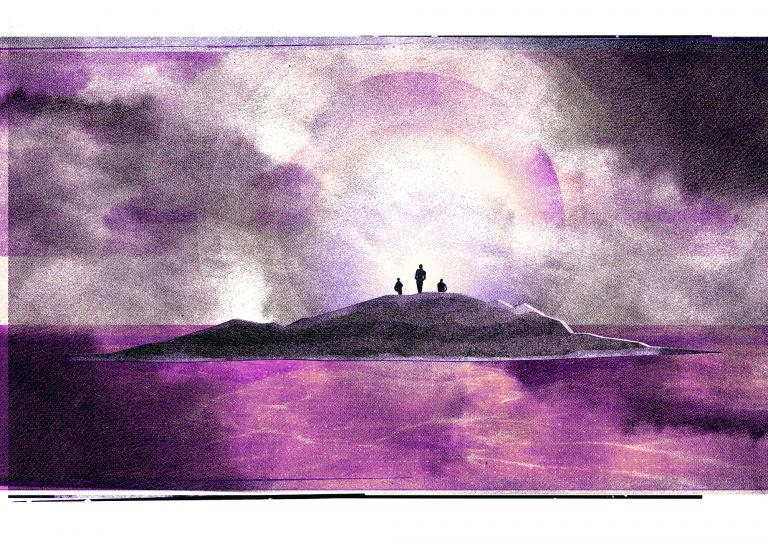
Art by the stranded and purple Brian Jocks.
I’m writing this in a tiny cottage in Dorset, in southern England. My sister and I came here this week to visit the little country church of East Coker, and thus complete a literary pilgrimage that began over twenty years ago, when she and I and a group of friends visited The Dry Salvages, a clump of unremarkable rocks off the coast of Massachusetts, from which T.S. Eliot took inspiration and a title for one of his Four Quartets, a collection of long meditation-poems tying place to spirit, exploring the nature of time.
It was a grey, windy day in March when we traipsed into that small New England town, asking around for the rocks we’d come to see. “What do you want to see the Salvages for?” one man asked. It was not easy to explain: “You know T.S. Eliot? The poet? No? Well, okay, there’s this poem…”
Once we’d found our way, we stood out on the rocks and passed the book around, pretentiously declaiming the poet’s words as the sea drowned out our young voices. “I do not know much about gods…” Afterwards, we went back to a twee little shop and bought some rather horrible hats. I’m pretty sure I remember thinking I knew all about gods.
A few years later, my sister had moved to England, and a friend and I, with my mother, visited her there, and traveled to the country estate of Burnt Norton. The rose garden was pallid in late winter, but at least the guide in the village building knew why we were there: for T.S. Eliot’s poem. The poet’s adopted country of England remembers him better than his birthplace does. How deep do our roots go, after all?
There are voices in the rose garden, but it’s never entirely clear whose. Perhaps we find it more beguiling when we never know: “Human kind can not bear very much reality.”
It would be another eighteen years before I returned to England to visit my sister again, and make a third stop on our journey, this time at the tiny church of St. John’s in Little Gidding, where long ago King Charles I took refuge while fleeing for his life from the revolutionaries who ultimately would have his head. A small religious community tends the place, and the walls are adorned with quotations from this last of the Quartets, the one in which the dead speak with tongues of fire.
We visited the Quartets sites completely out of order, since “Burnt Norton” is actually the first in the collection, and “Little Gidding” is the last, but I think Eliot would have approved this, because the central theme of the poems is the illusory nature of time, chronos. “In my end is my beginning,” he writes in East Coker, and appropriately, since the grey church by a green field was where his remote ancestors worshiped, and where he – having tracked them down – is now buried, interred, ashes now.
…So here I am, in the middle way,
Having had twenty years-
Twenty years largely wasted…
Oh, ouch.
I read this aloud, sitting inappropriately on one of the lichen-spotted coffin-shaped graves beside the church, and then afterwards read it again silently, thinking about those twenty years. About how much I knew then, how ambitious and arrogant I was, marching off to get my honors and degrees, sure that glorious triumphs lay ahead of me. How I used to be a person who would wear a white floppy hat. How professors I used to respect would later betray me. And so did some of the friends who had stood out on those grey rocks, and helped me choose my awful hat.
(And yeah, I betrayed myself, a time or two).
“Listen, Eliot,” I said to his ashes, as I left. “You ought to know that some of the shitheads who supposedly love your work are now supporting a slobbering vulgarian tyrant. If time past is present in time future it seems to reside in a passionate commitment to repeat our worst mistakes.” Also, Eliot’s friend the great poet Ezra Pound supported Mussolini, so there goes my faith in literature as enlightenment.
After our visit to East Coker, we drove on down into the country, and walked ten miles over the green undulating ridges of Monarch’s Way, to Cadbury, believed to have been the location of King Arthur’s Camelot. There were a lot of sheep, newly shorn, and a mysterious white falcon that local walkers said they couldn’t identify. Up on Cadbury cows grazed, and I was reminded of Tolkien’s description of the Barrow Downs, where sheep graze on the unquiet hills – and of T.H. White’s less unsettling account of the Castle of Forest Sauvage, where the old clean bones of the watchman lie beneath the grass. He keeps his watch no longer. You keep it now, for him.
I dug my fingers down into the dirt, probably cowshit turned to good soil, time past in time present. Thinking of Arthur and his failed dream, I rubbed the dirt across my wrists, not quite sure why, maybe thinking it might ward me against danger, or that the ash of the long-dead might mark me with their knowledge.
I suppose I should be thinking about the dead with their tongues of flame, about Christ the Tiger, the Word within the Word, but I am thinking these days about where incarnation happens, about dung and dirt, about Merlyn and Morgan le Fay, the Old Ones who knew things about the earth, that there is power in it. It outlasts us, maybe carrying something of chairos as it wheels through the chronos of our making, like the dancers on the field Eliot wrote of:
“If you do not come too close, if you do not come too close,
On a summer midnight you can hear the music
Of the weak pipe and the little drum
And see them dancing around the bonfire…
…Feet rising and falling.
Eating and drinking. Dung and death…”
War and betrayal, bone gone to ash, waste lands, white falcons carrying white feathers: the dead have seen it all, seen it circle again and again.
We keep their watch for them, looking out – for what?
For the rose in the garden.
For the dancers in the field
For the god in the river.
For the tongues of flame.
For whatever it was we set out looking for.
For the gift half-guessed, incarnation.
Fill in the blank.
*****
Rebecca Bratten Weiss is a writer and eco-grower residing in eastern Ohio, but often pretends to be in other places. She has co-authored two novels, as well as poems and essays in a variety of publications, and edits the arts journal Convivium, as well as teaching online for the Convivium School.
Previous Post
May 29, 2018
Something About Mary
Next Post
June 4, 2018 Things Keeping Us Alive - May 2018, Marian Edition
Browse Our Archives
Select a Category Advent Approaching Mystery art Book Reviews Catholic Ghost Story Catholicism community Confession Current Events Dark Devotional Deconstruction Deconstruction Fellow Travelers I Want To Believe Interview Laudato Si Lent Mary Matthew's Letters Movie Reviews Music Reviews Our Charism Personal Essay Pilgrims Pope Francis Popular Piety Prayer Publishing Richard Beck Saints Satan Sheed and Ward Sick Pilgrim Charism Sick Pilgrim Chats Sick Pilgrim Events Sick Pilgrim Travelin' Medicine Show Sick Pilgrimage to The West Sick Pilgrims Small Joys Spiritual Autobiography Spooky Files of Ave Maria Magazine Spooky October Spooky Pilgrim Spooky Pilgrimage Strange Journey The Inklings Things Keeping Us Going Trying to Say God TV Reviews Uncategorized women in the Catholic Church Wonder Podcast Write the Vision
Select a Month February 2022 January 2022 December 2021 November 2021 October 2021 September 2021 August 2021 July 2021 June 2021 May 2021 April 2021 March 2021 February 2021 January 2021 December 2020 April 2020 March 2020 February 2020 January 2020 December 2019 October 2019 September 2019 July 2019 June 2019 May 2019 April 2019 March 2019 February 2019 January 2019 December 2018 November 2018 October 2018 September 2018 August 2018 July 2018 June 2018 May 2018 April 2018 March 2018 February 2018 January 2018 December 2017 November 2017 October 2017 September 2017 August 2017 July 2017 June 2017 May 2017 April 2017 March 2017 February 2017 January 2017 December 2016 November 2016 October 2016 September 2016 August 2016 July 2016 June 2016 May 2016 April 2016 March 2016 February 2016 January 2016 December 2015
Follow Us!
TAKE THE
Religious Wisdom Quiz
What is the effect of the Red Horse's arrival in revelations?
Select your answer to see how you score.
The sun turns black Peace is taken from the earth People fall into a deep sleep Plagues spread across the land
Related posts from Sick Pilgrim

Dark Devotional: The Firelight of Life

Dark Devotional: Let Me Smite Him

Dark Devotional: Woe to Me, for I Have...

TRENDING AT PATHEOS Catholic

Rejecting Doom: Christian Hope And Human Action
Christianity is a religion of hope. We are to have hope and...

It’s What Comes From Within Which Matters
One of the most difficult things for us to understand is why...

Why I Choose the Eucharist Over the Sermon
Choose the Eucharist, Not the Sermon What are we supposed to get...

5 Design Elements Found in Spiritually Rooted Homes
Putting Spirituality Into Home Decor Our homes are more than our living...

Credo: A Story of God Told with the...
About 10 years ago, I began to imagine a personal "Credo" that...

The Anatomy of Divine Revelation in Catholic Thought
The claim that God has made Himself known to human beings is...
view all Catholic blogs
Ad-Free & Subscriber Log-In Subscription Support
- About Us
- 2026 Calendar
- Videos
- Podcasts
- Library of World Religions
- Faith In Media Tracker
- Advertise With Us
- Write for Us
- Privacy Policy
- Terms of Service
- Do Not Sell My Data
- Contact Us
- Radiant Digital
- Manage Newsletter Subscriptions
- Unsubscribe From Notifications
- Sitemap
Copyright 2008-2026, Patheos. All rights reserved.
Subscription Support Ad-Free & Subscriber Log-In
Follow Patheos