
BuddhistCatholicContemplativeEvangelicalGeneral ChristianHinduJewishLatter-day SaintMuslimNew VisionsProgressive Christian
Beliefs
- Buddhist
- Catholic
- Contemplative
- Evangelical
- General Christian
- Hindu
- Jewish
- Latter-day Saint
- More Voices
- Muslim
- New Visions
- Pagan
- Progressive Christian
Topics
- Religion News
- Food and Religion
- Sports and Religion
- Religious Art
- Religious Music and Entertainment
- Religious Events
- History and Religion
- Style and Religion
- Politics and Religion
- Women in Religion
- Recreation Outdoors and Religion
- Business Finance and Religion
- Careers Workplace and Religion
- Education and Religion
- Family Parenting and Religion
- Health Fitness and Religion
- Home and Religion
- Relationships and Religion
- Technology and Religion
- Travel and Religion
Columnists
- Buddhist Columnists
- Business Finance and Religion Columnists
- Careers Workplace and Religion Columnists
- Catholic Columnists
- Contemplative Columnists
- Education and Religion Columnists
- Evangelists Columnists
- Family Parenting and Religion Columnists
- General Christian Columnists
- Health Fitness and Religion Columnists
- Hindu Columnists
- History and Religion Columnists
- Home and Religion Columnists
- Jewish Columnists
- More Voices Columnists
- Latter Day Columnists
- Muslim Columnists
- New Visions Columnists
- Nonreligious Columnists
- Pagan Columnists
- Politics and Religion Columnists
- Progressive Columnists
- Recreation Outdoors and Religion Columnists
- Relationships and Religion Columnists
- Religion News Columnists
- Religious Art Columnists
- Religious Events Columnists
- Religious Music and Entertainment Columnists
- Sports and Religion Columnists
- Style and Religion Columnists
- Technology and Religion Columnists
- Travel and Religion Columnists
- Women in Religion Columnists
Resource Library
- 2026 Calendar
- Library of World Religions
- The 100 Most Holy Places on Earth
- Patheos Answers
- Podcasts
- Videos
- Faith Leaders Database
- Anglican Episcopalian
- Bahai
- Baptist
- Buddhism
- Christianity
- Confucianism
- Eastern Orthodoxy
- Hinduism
- Holiness and Pentecostal
- ISKCON
- Islam
- Judaism
- Lutheran
- Methodist
- The Church of Jesus Christ of Latter-day Saints
- New Age
- Paganism
- Presbytarian and Reformed
- Protestantism
- Religion Behind the Scenes
- Roman Catholic
- Scientology
- Shia Islam
- Sikhism
- Sufism
- Sunni Islam
- Taoism
- Zen
- See all religions
Research Tools
 Ad-Free & Subscriber Log-In Subscription Support
Ad-Free & Subscriber Log-In Subscription Support
Follow Patheos 

- Trending:
- Forgiveness
- |
- Marriage
- |
- Consciousness
- |
- Death Penalty
- |
- Election
- |
- Halloween
 Sick Pilgrim
- Home
- Catholic
- The Theotokos: A Protestant Love Song
The Theotokos: A Protestant Love Song
Last updated on: May 15, 2018 at 9:32 pm by Guest Contributor
The Theotokos: A Protestant Love Song 2018-05-15T21:32:39-05:00 Guest Contributor
Patheos Explore the world's faith through different perspectives on religion and spirituality! Patheos has the views of the prevalent religions and spiritualities of the world.
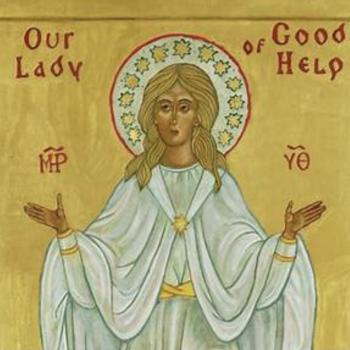
A deep spiritual friend and mentor is the founder of an Orthodox monastery on the Isle of Mull, which among other things seeks to recover Egyptian iconographic style within a Celtic context. When he sent me the image of a Theotokos icon that he had commissioned, I could not look away from her eyes. Thus began a relationship with the icon that has led to its original now having pride of place in my home.
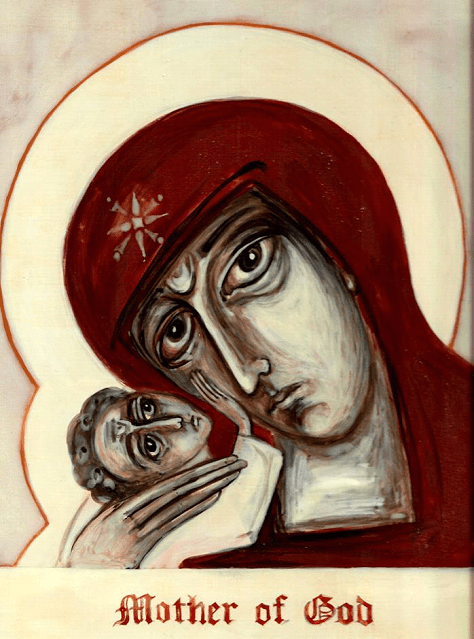
I am a Protestant captivated by Mary, Theotokos. Is this an odd thing? Does it require explanation?
The history of the shifting fate of Mary within Protestantism is a long, complex story that would have to include so many fraught moments:
- How Martin Luther saw Mary in her humanity – her obedience to God’s call as an unwed, scared teenage woman chosen by God precisely as another instance of God bringing salvation out of that which is unimpressive – as a crucial protagonist of the story of humanity’s redemption. He regularly defended her title Theotokos against Nestorian tendencies and he personally believed in her perpetual virginity, although belief in the latter is not mandated by the Lutheran Confessions.
- How subsequent Lutheranism and other Protestant movements, in a frenzy to distinguish their piety from Roman Catholicism, gradually identified Marian devotion with idolatry and went overboard in denigrating her standing (see Beth Kreitzer’s sobering study, Reforming Mary (Oxford University Press, 2004)). This split was of course exacerbated by the fact that Marian devotion became tied up with controversies over papal infallibility, with both undisputed ex cathedra pronouncements by Popes in history related to Marian dogma.
- How the fall of Mary within Protestantism coincided with the rise of the domestic ideal of family within European and North American Protestantism especially – instead of Marian feasts, we have Mother’s Day as the new liturgical ground zero of pious vocation.
- The sense that many Protestants who ordain women to the ministry have that Marian devotion often functions as a way of “promoting women sideways” – honoring a specific woman in her vocation so as to undercut the possibility that women might move into other vocations, such as the priesthood.
Both post-Vatican II ecumenism and plain old postmodernity have colluded, though, to make the lines around Marian appreciation that have hardened over the last 500 years more porous. Christians among different streams of the tradition are better able to receive each other’s gifts; and perhaps even more importantly, in an increasingly secular age defined by multiple and shifting identities and loyalties even among those who consider themselves “the faithful,” raw human connection sometimes supersedes rote confessionalism to allow for new modes of devotion.
That has been the case for me. When Marian devotion is presented to me laden with what I take to be distracting superadditions to her humanity – and here I have to include the formalization of the Immaculate Conception as well as insistence upon perpetual virginity – then she seems quite far away from even the most tradition-friendly Protestant piety. But when it is precisely as a broken, fragile human who took the incredible risk of saying “yes” to a God whom she surely could not have understood at that moment, or in so many moments along the way: it is then that I can cast eyes on her – and feel her eyes on me – as the Mother of the faith that so often seems crazy and dangerous to me as well.
As a professor at a relatively progressive seminary, I have been formed in enough feminist theology to where I do not suffer from an overly masculinized God image; thus, I do not need Mary to somehow feminize the face of God. But Protestants have a different problem. We have – along with much of Western Christianity in general – often succumbed to understandings of sin and atonement that turn God into the problem to be solved – God’s wrath, God’s justice, rather than the forces of sin and death that hold humanity captive, become the problems to which atonement is addressed. Marian devotion can, of course, exacerbate this theological trend if her mediation between God and the believer is understood to be that of a “soft” advocate who can somehow wrangle mercy out of an otherwise implacable Triune judge. But the figure of Mary also stands at the center of an arguably more ancient understanding of atonement – one in which Christ recapitulates the broken actions of the collective “adam” (humanity) in such a way that Christ fulfills the potential of humanity as God intended us to be. This is, after all, the real point of the doctrine of Christ’s sinlessness – that sin is not constitutive of humanity but in fact diminishes it, such that Christ in fulfilling God’s purposes for humanity is in fact more human than we are.
Mary is not Christ. But her recapitulating actions, her courageous faithfulness, over and against the brokenness of human disobedience to the call of life in God (often captured iconographically in Eve/Mary comparisons, although these should be deployed with an awareness of some difficult gender moments in the tradition) allows her to shine as our advocate precisely as one who makes the brave choice for God’s “yes” in the midst of deep danger and uncertainty. She fulfills life precisely as one who knows its brokenness like a sword that pierces hearts.
Mary’s Magnificat is the hymn of praise to precisely this reality: God’s faithfulness as a restoration of human possibility over and against the principalities and powers that bind us. She is the obedient one who shows a more abundant life in obedience than can be found in the fetters of unlimited license within the arenas of exploitation and death with which she and all her people would have been intimately familiar in occupied Roman territory. She says yes to bearing the life that she will see those forces kill on the cross. Her song announces resurrection as insurrection.
It is from within the depth of brokenness and death – the real problems to be solved – that she chooses God’s future. She is the risky “yes” that God intends for our lives to be. And I believe she remains so, with her eyes upon us as the call of that risk continues.
*****
Robert Saler is a new regular contributor to Sick Pilgrim. He is associate dean and research professor of Lutheran studies at Christian Theological Seminary in Indianapolis, IN.
Previous Post

May 14, 2018
When NFP Doesn't Work: A Conclusion to Our 'You Are Not Alone' Series
Next Post

May 16, 2018 To the Top of the Bleachers! - FA Awareness Day
Browse Our Archives
Select a Category Advent Approaching Mystery art Book Reviews Catholic Ghost Story Catholicism community Confession Current Events Dark Devotional Deconstruction Deconstruction Fellow Travelers I Want To Believe Interview Laudato Si Lent Mary Matthew's Letters Movie Reviews Music Reviews Our Charism Personal Essay Pilgrims Pope Francis Popular Piety Prayer Publishing Richard Beck Saints Satan Sheed and Ward Sick Pilgrim Charism Sick Pilgrim Chats Sick Pilgrim Events Sick Pilgrim Travelin' Medicine Show Sick Pilgrimage to The West Sick Pilgrims Small Joys Spiritual Autobiography Spooky Files of Ave Maria Magazine Spooky October Spooky Pilgrim Spooky Pilgrimage Strange Journey The Inklings Things Keeping Us Going Trying to Say God TV Reviews Uncategorized women in the Catholic Church Wonder Podcast Write the Vision
Select a Month February 2022 January 2022 December 2021 November 2021 October 2021 September 2021 August 2021 July 2021 June 2021 May 2021 April 2021 March 2021 February 2021 January 2021 December 2020 April 2020 March 2020 February 2020 January 2020 December 2019 October 2019 September 2019 July 2019 June 2019 May 2019 April 2019 March 2019 February 2019 January 2019 December 2018 November 2018 October 2018 September 2018 August 2018 July 2018 June 2018 May 2018 April 2018 March 2018 February 2018 January 2018 December 2017 November 2017 October 2017 September 2017 August 2017 July 2017 June 2017 May 2017 April 2017 March 2017 February 2017 January 2017 December 2016 November 2016 October 2016 September 2016 August 2016 July 2016 June 2016 May 2016 April 2016 March 2016 February 2016 January 2016 December 2015
Follow Us!
TAKE THE
Religious Wisdom Quiz
Which New Testament book quotes Psalm 110 to describe Jesus as the eternal High Priest?
Select your answer to see how you score.
Revelation Romans Hebrews Acts
Related posts from Sick Pilgrim
Dark Devotional: From Good Wine to Bitter Faith
Dark Devotional: The Virgin Mary's Guide to Biblical...
Dark Devotional: Mary, Motherhood, and Mixed Feelings
Dark Devotional: When the Virgin Cast Off Her...
TRENDING AT PATHEOS Catholic

Rejecting Doom: Christian Hope And Human Action
Christianity is a religion of hope. We are to have hope and...

It’s What Comes From Within Which Matters
One of the most difficult things for us to understand is why...

Why I Choose the Eucharist Over the Sermon
Choose the Eucharist, Not the Sermon What are we supposed to get...

5 Design Elements Found in Spiritually Rooted Homes
Putting Spirituality Into Home Decor Our homes are more than our living...

Credo: A Story of God Told with the...
About 10 years ago, I began to imagine a personal "Credo" that...

The Anatomy of Divine Revelation in Catholic Thought
The claim that God has made Himself known to human beings is...
view all Catholic blogs
Ad-Free & Subscriber Log-In Subscription Support
- About Us
- 2026 Calendar
- Videos
- Podcasts
- Library of World Religions
- Faith In Media Tracker
- Advertise With Us
- Write for Us
- Privacy Policy
- Terms of Service
- Do Not Sell My Data
- Contact Us
- Radiant Digital
- Manage Newsletter Subscriptions
- Unsubscribe From Notifications
- Sitemap
Copyright 2008-2026, Patheos. All rights reserved.
Subscription Support Ad-Free & Subscriber Log-In
Follow Patheos