
BuddhistCatholicContemplativeEvangelicalGeneral ChristianHinduJewishLatter-day SaintMuslimNew VisionsProgressive Christian
Beliefs
- Buddhist
- Catholic
- Contemplative
- Evangelical
- General Christian
- Hindu
- Jewish
- Latter-day Saint
- More Voices
- Muslim
- New Visions
- Pagan
- Progressive Christian
Topics
- Religion News
- Food and Religion
- Sports and Religion
- Religious Art
- Religious Music and Entertainment
- Religious Events
- History and Religion
- Style and Religion
- Politics and Religion
- Women in Religion
- Recreation Outdoors and Religion
- Business Finance and Religion
- Careers Workplace and Religion
- Education and Religion
- Family Parenting and Religion
- Health Fitness and Religion
- Home and Religion
- Relationships and Religion
- Technology and Religion
- Travel and Religion
Columnists
- Buddhist Columnists
- Business Finance and Religion Columnists
- Careers Workplace and Religion Columnists
- Catholic Columnists
- Contemplative Columnists
- Education and Religion Columnists
- Evangelists Columnists
- Family Parenting and Religion Columnists
- General Christian Columnists
- Health Fitness and Religion Columnists
- Hindu Columnists
- History and Religion Columnists
- Home and Religion Columnists
- Jewish Columnists
- More Voices Columnists
- Latter Day Columnists
- Muslim Columnists
- New Visions Columnists
- Nonreligious Columnists
- Pagan Columnists
- Politics and Religion Columnists
- Progressive Columnists
- Recreation Outdoors and Religion Columnists
- Relationships and Religion Columnists
- Religion News Columnists
- Religious Art Columnists
- Religious Events Columnists
- Religious Music and Entertainment Columnists
- Sports and Religion Columnists
- Style and Religion Columnists
- Technology and Religion Columnists
- Travel and Religion Columnists
- Women in Religion Columnists
Resource Library
- 2026 Calendar
- Library of World Religions
- The 100 Most Holy Places on Earth
- Patheos Answers
- Podcasts
- Videos
- Faith Leaders Database
- Anglican Episcopalian
- Bahai
- Baptist
- Buddhism
- Christianity
- Confucianism
- Eastern Orthodoxy
- Hinduism
- Holiness and Pentecostal
- ISKCON
- Islam
- Judaism
- Lutheran
- Methodist
- The Church of Jesus Christ of Latter-day Saints
- New Age
- Paganism
- Presbytarian and Reformed
- Protestantism
- Religion Behind the Scenes
- Roman Catholic
- Scientology
- Shia Islam
- Sikhism
- Sufism
- Sunni Islam
- Taoism
- Zen
- See all religions
Research Tools
 Ad-Free & Subscriber Log-In Subscription Support
Ad-Free & Subscriber Log-In Subscription Support
Follow Patheos 

- Trending:
- Forgiveness
- |
- Marriage
- |
- Consciousness
- |
- Death Penalty
- |
- Election
- |
- Halloween
 Sick Pilgrim
- Home
- Catholic
- Mary and the Cosmos
Mary and the Cosmos
Last updated on: May 21, 2018 at 10:01 am by Guest Contributor
Mary and the Cosmos 2018-05-21T10:01:27-05:00 Guest Contributor
Patheos Explore the world's faith through different perspectives on religion and spirituality! Patheos has the views of the prevalent religions and spiritualities of the world.
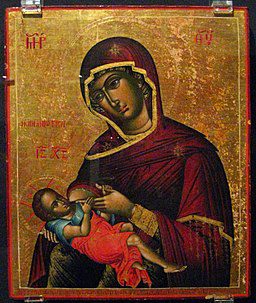
The incarnation is cosmic in its significance. God the Word, the Logos, became man. He who is the first and the last, the alpha and omega, the beginning and the end, entered into time. The eschaton was immanentized. Heaven joined with earth. All of creation found itself included in the work and ministry of Jesus Christ as the one who is Lord over entered into the world to become the servant of all. The waters were made pure and holy as he was baptized into the Jordan. The earth not only received his body when it was placed in the tomb, but it also received his blood, both when tears of blood flowed down his face as well as when his body was pieced and placed upon the cross. The heavens opened up and received Jesus as he ascended into the kingdom of God. He who lowered himself to the depths of the abyss raised himself up and took with him all that he found, reconfiguring the whole of creation, healing it from the wounds of sin.
The Logos who created all things became the servant of all things in order to open up creation to the kingdom of God. The whole of creation is deified by him. For those who have eyes to see, they can discern that all that he said and did had an effect on all things, as all things are interconnected with each other.
Through her relationship with Jesus, being his mother, Mary, likewise found her life to be cosmic in significance. This is not because we can see her interacting with creation in the same fashion as Jesus; she was only human, and as such, she acted with creation in a perfectly human fashion. But the consequences of her extraordinary and yet ordinary life filled the whole of creation with graces; the whole of creation is linked together as one in Jesus, and it is through Mary that this union took place, as St. Maximus declared in wonder:
Truly you have surpassed the limits of nature, not only in the unfathomable Nativity, but also in preternatural benevolence. Through you the curse of the first mother has been undone. Through you the dividing wall of hostility has been torn down (cf. Eph 2.13). Through you the dominion of death has been destroyed. Through you we have become victorious over sin. Through you virginity has been planted among humanity. Through you we have learned courage in good deeds. Through you we have been given wisdom, humility, love, and every other virtue.¹
Heaven and earth are one in Jesus; St. Maria Maddalena de’ Pazzi expressed this in her many peculiar spiritual dialogues, such as how she described Mary nurturing heaven and earth through her breasts:
desire inspired, love inflamed, will comforted, intellect glared and died [silence] with the right breast she sprinkled and nourished heaven and with the left [she sprinkled and nourished] earth; one makes sprout the other makes fructify. You could really say that you were mother of every beautiful charity [silence] your charity had every beauty, even though it could only be a superior beauty because it joined the Word and adjusted to It; and [even though] it could be measured with the Word’s measurement [silence] her face had those beautiful eyes; with one she looked with compassion and with the other [she looked] in order to grant fruition of it [silence] that sweet mouth that tasted his indescribable glory, and our infinite nothingness.²
Traditional understanding of “right and left,” with the right being greater than the left, help us understand the application St. Maria Maddalena implied with her expression. Mary’s right breast is said to nourish the heavens and the left, the earth, because in Jesus we find the combination of heaven with earth, and so he takes and is nourished in both fashions. Likewise, as he was nourished by Mary, Jesus takes what is given by her and shares it with the whole of creation. The mere act of breastfeeding, a normal, typical activity of mothers done daily, is shown to be a thing of great beauty, a thing of great holiness, a thing which demonstrates Mary’s cosmic significance. It is not that Mary is herself literally sprinkling the heavens and the earth with her milk, but rather, it is in the self-giving love of breastfeeding, the whole of creation is shown to benefit from her love. She is great not because she did wondrous miracles, but because she was truly human, truly a woman who embraced the glory of her maternity. For it is in ordinary activity true greatness can be found; we do not have to go seeking it out as if the kingdom of God is outside of ourselves.
The world needs healing, and this is done in acts of selfless devotion, in acts of love. Greatness accepts the small, ordinary things of life and finds in them true greatness. Mary, to many, would have been seen as an ordinary Jewish woman of her time. Those who look for glory will not see it in her, because she did not have to show off to have such glory. It was always with her, and it can be with us in similar fashion. All we need to do is be like her and follow after the depth of glory revealed in Jesus, a glory which is established in self-kensosis instead of self-promotion. Those who hold on to themselves do not make room for grace, while those who open themselves up and engage others in love, denying any attempt of vainglory, make room for the grace and virtue they need for true greatness. It is because of her perfect love revealed in her humility she was revealed as queen over all, as St. Maximus the Confessor understood:
But more than anyone else, her holy soul was full of benevolence and compassion, and in this way she was more than anyone else an imitator of her good and compassionate son, having a tranquil and humble mind with such an abundance of virtue and excess of grace. Truly she was the queen exalted above every nature in word and deed, and thought, for she was to become the mother of the true king of all things who then became poor and was humbled for our sake unto death by death on a cross (Phil. 2.8).³
Mary’s cosmic significance is found in her willingness to embrace the ordinary with all her love so as to raise it up as something extraordinary. She found God immanent in creation before she found him inside herself, taking of herself and her love, transforming what was taken to be a part of himself. Thus, St. John of Damascus, talking about her, said:
You are called the spiritual Eden, holier and more divine than that of old; for in the former Eden the earthly Adam dwelt, but in you the Lord from heaven. The ark prefigured you (cf. Gen. 6:14), in that it guarded the seeds of a second world; for you gave birth to Christ, the world’s salvation, who overwhelmed sin and calmed its ways. 4
Mary did not seek greatness for herself, she was not attached to it. She was able to find the great things in the world right in front of her; whatever was to be done in the moment was enough, and yet because of the way the world is interconnected, it was also the means by which she influenced the whole of creation. All that happens in creation is interconnected; greatness is achieved in doing what should be done when it is motivated by a pure, simple love. Mary was queen of heaven because she did not forget her place on earth.
We are now called to imitate her; we should give birth to the Son in our lives, to be simple in our actions and great in love, so that what we do can and will be raised up to heaven, revealing in that assumption, the cosmic significance which is to be found in the virtue of our everyday deeds. Mary’s greatness not just something for us to sing about, but something which should inspire us, to help us realize that what we do matters, even if our life seems stuck in the mire of the earth.
1 St. Maximus the Confessor, The Life of The Virgin. Trans. Stephen J. Shoemaker (New Haven: Yale University
Press, 2012), 156.
2 St. Maria Maddalena de’ Pazzi. “The Dialogues” in Selected Revelations. Trans. Armandon Maggi (New York:
Paulist Press, 2000), 100.
3 St. Maximus the Confessor, The Life of The Virgin. Trans. Stephen J. Shoemaker (New Haven: Yale University
Press, 2012), 44.
4 St. John of Damascus, “Homily I On The Dormition” in On the Dormition: Early Patristic Homilies. Trans. Brian
E. Daley, S.J. (Crestwood, NY: St. Vladimir’s Seminary Press, 1998), 192.
Henry Karlson is a Byzantine Catholic and independent scholar. He is the author of the book The Eschatological Judgment of Christ, published by Wipf and Stock. He blogs on A Little Bit of Nothing.
Previous Post

May 16, 2018
To the Top of the Bleachers! - FA Awareness Day
Next Post
May 23, 2018 Family Photos, Statues, and Intergenerational Worry
Browse Our Archives
Select a Category Advent Approaching Mystery art Book Reviews Catholic Ghost Story Catholicism community Confession Current Events Dark Devotional Deconstruction Deconstruction Fellow Travelers I Want To Believe Interview Laudato Si Lent Mary Matthew's Letters Movie Reviews Music Reviews Our Charism Personal Essay Pilgrims Pope Francis Popular Piety Prayer Publishing Richard Beck Saints Satan Sheed and Ward Sick Pilgrim Charism Sick Pilgrim Chats Sick Pilgrim Events Sick Pilgrim Travelin' Medicine Show Sick Pilgrimage to The West Sick Pilgrims Small Joys Spiritual Autobiography Spooky Files of Ave Maria Magazine Spooky October Spooky Pilgrim Spooky Pilgrimage Strange Journey The Inklings Things Keeping Us Going Trying to Say God TV Reviews Uncategorized women in the Catholic Church Wonder Podcast Write the Vision
Select a Month February 2022 January 2022 December 2021 November 2021 October 2021 September 2021 August 2021 July 2021 June 2021 May 2021 April 2021 March 2021 February 2021 January 2021 December 2020 April 2020 March 2020 February 2020 January 2020 December 2019 October 2019 September 2019 July 2019 June 2019 May 2019 April 2019 March 2019 February 2019 January 2019 December 2018 November 2018 October 2018 September 2018 August 2018 July 2018 June 2018 May 2018 April 2018 March 2018 February 2018 January 2018 December 2017 November 2017 October 2017 September 2017 August 2017 July 2017 June 2017 May 2017 April 2017 March 2017 February 2017 January 2017 December 2016 November 2016 October 2016 September 2016 August 2016 July 2016 June 2016 May 2016 April 2016 March 2016 February 2016 January 2016 December 2015
Follow Us!
TAKE THE
Religious Wisdom Quiz
Vanity of vanities! Everything is fleeting and meaningless. Where is this pessimistic proclamation found?
Select your answer to see how you score.
Psalms Ecclesiastes Proverbs Job
Related posts from Sick Pilgrim
Dark Devotional: From Good Wine to Bitter Faith
Dark Devotional: The Virgin Mary's Guide to Biblical...
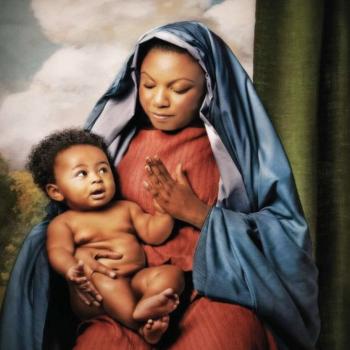
Dark Devotional: Mary, Motherhood, and Mixed Feelings

Second Sunday in Advent: Let Me Love You...
TRENDING AT PATHEOS Catholic

Rejecting Doom: Christian Hope And Human Action
Christianity is a religion of hope. We are to have hope and...

It’s What Comes From Within Which Matters
One of the most difficult things for us to understand is why...

Why I Choose the Eucharist Over the Sermon
Choose the Eucharist, Not the Sermon What are we supposed to get...

5 Design Elements Found in Spiritually Rooted Homes
Putting Spirituality Into Home Decor Our homes are more than our living...

Credo: A Story of God Told with the...
About 10 years ago, I began to imagine a personal "Credo" that...

The Anatomy of Divine Revelation in Catholic Thought
The claim that God has made Himself known to human beings is...
view all Catholic blogs
Ad-Free & Subscriber Log-In Subscription Support
- About Us
- 2026 Calendar
- Videos
- Podcasts
- Library of World Religions
- Faith In Media Tracker
- Advertise With Us
- Write for Us
- Privacy Policy
- Terms of Service
- Do Not Sell My Data
- Contact Us
- Radiant Digital
- Manage Newsletter Subscriptions
- Unsubscribe From Notifications
- Sitemap
Copyright 2008-2026, Patheos. All rights reserved.
Subscription Support Ad-Free & Subscriber Log-In
Follow Patheos