
BuddhistCatholicContemplativeEvangelicalGeneral ChristianHinduJewishLatter-day SaintMuslimNew VisionsProgressive Christian
Beliefs
- Buddhist
- Catholic
- Contemplative
- Evangelical
- General Christian
- Hindu
- Jewish
- Latter-day Saint
- More Voices
- Muslim
- New Visions
- Pagan
- Progressive Christian
Topics
- Religion News
- Food and Religion
- Sports and Religion
- Religious Art
- Religious Music and Entertainment
- Religious Events
- History and Religion
- Style and Religion
- Politics and Religion
- Women in Religion
- Recreation Outdoors and Religion
- Business Finance and Religion
- Careers Workplace and Religion
- Education and Religion
- Family Parenting and Religion
- Health Fitness and Religion
- Home and Religion
- Relationships and Religion
- Technology and Religion
- Travel and Religion
Columnists
- Buddhist Columnists
- Business Finance and Religion Columnists
- Careers Workplace and Religion Columnists
- Catholic Columnists
- Contemplative Columnists
- Education and Religion Columnists
- Evangelists Columnists
- Family Parenting and Religion Columnists
- General Christian Columnists
- Health Fitness and Religion Columnists
- Hindu Columnists
- History and Religion Columnists
- Home and Religion Columnists
- Jewish Columnists
- More Voices Columnists
- Latter Day Columnists
- Muslim Columnists
- New Visions Columnists
- Nonreligious Columnists
- Pagan Columnists
- Politics and Religion Columnists
- Progressive Columnists
- Recreation Outdoors and Religion Columnists
- Relationships and Religion Columnists
- Religion News Columnists
- Religious Art Columnists
- Religious Events Columnists
- Religious Music and Entertainment Columnists
- Sports and Religion Columnists
- Style and Religion Columnists
- Technology and Religion Columnists
- Travel and Religion Columnists
- Women in Religion Columnists
Resource Library
- 2026 Calendar
- Library of World Religions
- The 100 Most Holy Places on Earth
- Patheos Answers
- Podcasts
- Videos
- Faith Leaders Database
- Anglican Episcopalian
- Bahai
- Baptist
- Buddhism
- Christianity
- Confucianism
- Eastern Orthodoxy
- Hinduism
- Holiness and Pentecostal
- ISKCON
- Islam
- Judaism
- Lutheran
- Methodist
- The Church of Jesus Christ of Latter-day Saints
- New Age
- Paganism
- Presbytarian and Reformed
- Protestantism
- Religion Behind the Scenes
- Roman Catholic
- Scientology
- Shia Islam
- Sikhism
- Sufism
- Sunni Islam
- Taoism
- Zen
- See all religions
Research Tools
 Ad-Free & Subscriber Log-In Subscription Support
Ad-Free & Subscriber Log-In Subscription Support
Follow Patheos 

- Trending:
- Forgiveness
- |
- Marriage
- |
- Consciousness
- |
- Death Penalty
- |
- Election
- |
- Halloween
 Sick Pilgrim
- Home
- Catholic
- Mystery and Absurdity: Colin Dickey’s Afterlives of the Saints
Mystery and Absurdity: Colin Dickey’s Afterlives of the Saints
Last updated on: May 4, 2018 at 8:36 am by Guest Contributor
Mystery and Absurdity: Colin Dickey’s Afterlives of the Saints 2018-05-04T08:36:37-05:00 Guest Contributor
Patheos Explore the world's faith through different perspectives on religion and spirituality! Patheos has the views of the prevalent religions and spiritualities of the world.
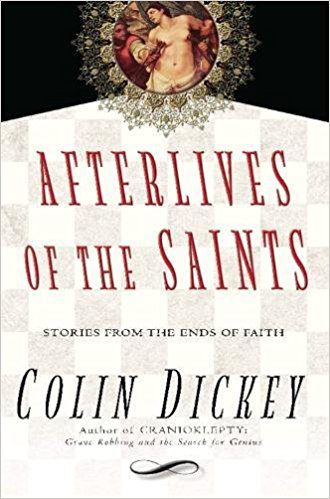
Think of the Catholic Church and you might think of pedophile clerics, financial malfeasance. Even before such scandals erupted–even if they had never occurred–some have found plenty to criticize about official Church policies in the last couple of decades: its intolerance of other religions; its hostility to women’s ordination; its long-term campaign to undermine liberation theology.
Outside observers might ask why Catholics who oppose such policies don’t simply leave. I put this question to a Sister of Charity some years ago. Her answer: “The bishops don’t get to decide what it means to be a Catholic.” Galileo was threatened with torture and condemned for heresy but still didn’t break with the Church; for him, the problem wasn’t with Catholicism, but with the scoundrels in positions of power. For the 14th century mystic Marguerite Porete, the Church hierarchy was the “Lesser Church,” in contrast to the “Greater Church,” those who truly loved God. It seems rank-and-file Catholics have always made a distinction between their day-to-day spiritual practices and a distant, privileged hierarchy.
This is where the saints come in, so to speak. As Colin Dickey tells us in his entertaining and thought-provoking essay collection Afterlives of the Saints (2012), “Catholicism reveals its folk aspect, its native traditions and local customs” in the beliefs that spring up around the saints, the miracles attributed to them, the treatment of their relics, and their representations in paintings and sculpture.
Take, for example, Lawrence, a third-century martyr who, “according to legend, was executed on a gridiron over an open flame. As he was being burned alive, so the story goes, he cried out to his tormentors, ‘This side’s done; turn me over and have a bite.’” Dickey first heard of Lawrence from his high school chemistry teacher, who read to his students every day from a book of saints’ lives. When the students laughed at Lawrence’s clever line, the teacher angrily insisted that it wasn’t funny. “Like so many believers,” Dickey observes, the teacher
conflated the sacred and the solemn. Patriarchal religions like Christianity tend to be like this. . . . But in other religions, laughter is integral. The anthropologist Byrd Gibbens writes, ‘Many native traditions held clowns and tricksters as essential to any contact with the sacred.’ . . . Because of this, Lawrence seems to me a saint imported from another religion, closer to Coyote or Raven than to Stephen or Catherine.
This passage demonstrates several of Dickey’s great strengths as an essayist, already familiar to readers of his work in Lapham’s Quarterly and elsewhere: not only is he widely read and knowledgeable, but he goes beyond the amusing anecdote and raises larger issues. Moreover, it’s clear he’s spent a great deal of time thinking about his subject-matter; several times he mentions that he has pondered a particular photograph, painting, or anecdote for years before writing about it.
There are 17 essays here, each focused on a different saint or, in the last two chapters, on people who perhaps should have been canonized (the third-century philosopher Origen and the fifteenth-century mystic Margery of Kemp). The breadth of the author’s knowledge and interests is evident in every chapter. The essay on St. Lucy, for example, also touches upon Vincent van Gogh, Dante, and John Donne. In the course of reading the collection, we learn about anatomy and dissection in sixteenth-century Italy and about the Skoptsy cult of self-castraters in nineteenth-century Russia; we hear from authors like Chaucer, Flaubert, Kafka, Borges, and the Romanian philosopher E. M. Cioran.
The most intriguing discovery for me was Saint Foy, a third-century virgin-martyr about whom almost nothing is known. When Foy’s relics were relocated to the Conques monastery in France in the ninth century, the locals started reporting visions of a young woman who performed miraculous cures, including restoring eyesight. More oddly, she was known to resurrect animals from the dead, and some of Foy’s activities were “so bizarre that the nobility began referring to them as Foy’s ‘jokes.’” One of these “jokes” involved a knight who prayed to Foy for relief of a hernia; the advice she gave him (in a vision) involved placing his scrotum on an anvil and having a blacksmith hit it with his hammer. What ensued could have come straight from a Three Stooges skit. As reported by Foy’s eleventh-century biographer, Bernard of Angers, the terrified knight dove out of the way of the hammer and “his herniated intestines were sucked back inside so completely that they never ruptured again.” Foy could be cruel, too, inflicting devastating punishments on those who offended her monks: a roof collapsed on one such unfortunate; another was felled by an “arrow from heaven” that pierced his brain. Dickey is uneasy with Foy: “Of all the saints,” he writes, “the only one I truly fear is this young girl from southwestern France.”
Other essays in the collection provide similarly odd details. In the essay on the apostle Bartholomew, who was believed to have been flayed alive, Dickey notes that many paintings depict the saint holding, “in addition to his own skin, the tool used to cut that skin off, a tool that looks sort of like a cheese cutter, so Florentine cheese merchants took Bartholomew as their patron.” But Dickey isn’t interested in a carnival-barker approach (step right up, folks, and look at these wacky Catholics!). Instead, he asks what the saints’ exploits tell us about what it means to be human. He asks what the beliefs, stories, and images, no matter how bizarre, tell us about faith.
And he is deeply sympathetic to his subjects, including Paula, the wealthy Roman woman who supported and accompanied Saint Jerome but has been eclipsed by Jerome’s fame. He gives a poignant account of the 6th century ascetic queen Saint Radegund, providing generous excerpts from her long poem “The Thuringian War,” in which her despair and loneliness are much more evident than her devotion to Christ. He champions the cause of Margery Kemp, the eccentric visionary known for her copious weeping:
The reasons Margery has never been canonized are painfully obvious. She was already a married woman, with children, when Christ came to her fully. . . . She could have retired to a convent but chose not to do so, nor did she subordinate herself under a powerful male protector. . . . She chose instead to remain her own person, to wander, to cause trouble. . . . . . . Margery’s love is difficult, uncompromising, but readers . . . keep finding her, finding kinship with that love. . . . A community of believers, the wasted and the hopeful, the freaks and the dreamers, gradually grows around her. Perhaps sainthood will find her yet.
Though Dickey doesn’t discuss it here, it’s interesting to think about the basic assumption underlying a belief in saints: that the living and the dead can indeed communicate with each other. The dead (whether saints or not) appear to us, speak to us, perform miracles. The living affect the dead, too: Our urgent requests can inspire the miracles. Our prayers for the souls in Purgatory can ease their suffering (a belief that particularly irked Protestant reformers, especially adherents of predestination). One could argue that it is this basic mindset, more than acceptance of the pope’s infallibility–or even his authority–that makes a Catholic a Catholic. So while the Vatican is embroiled in scandal, ordinary folk take solace from the saints, their mysteries, their occasional absurdities.
“The image of the saint,” Dickey tells us, “works like a parable: It doesn’t tell a story so much as hide it. . . . Or, as Kafka put it, ‘all these parables are really set out to say merely that the incomprehensible is incomprehensible, and we know that already.”
Rosalie Morales Kearns, author of the novel Kingdom of Women (Jaded Ibis Press, 2017), is a writer of Puerto Rican and Pennsylvania Dutch descent. She’s the founder of the feminist publishing house Shade Mountain Press, author of the story collection Virgins & Tricksters (Aqueous Books, 2012) and editor of the short story anthology The Female Complaint: Tales of Unruly Women (Shade Mountain, 2015). A product of Catholic schooling from kindergarten through college, Kearns has a B.A. in theology and an M.F.A. in creative writing. This article was originally published in 2013 in the Philadelphia Review of Books.

Next Post
May 8, 2018 Reclaiming Mary
Browse Our Archives
Select a Category Advent Approaching Mystery art Book Reviews Catholic Ghost Story Catholicism community Confession Current Events Dark Devotional Deconstruction Deconstruction Fellow Travelers I Want To Believe Interview Laudato Si Lent Mary Matthew's Letters Movie Reviews Music Reviews Our Charism Personal Essay Pilgrims Pope Francis Popular Piety Prayer Publishing Richard Beck Saints Satan Sheed and Ward Sick Pilgrim Charism Sick Pilgrim Chats Sick Pilgrim Events Sick Pilgrim Travelin' Medicine Show Sick Pilgrimage to The West Sick Pilgrims Small Joys Spiritual Autobiography Spooky Files of Ave Maria Magazine Spooky October Spooky Pilgrim Spooky Pilgrimage Strange Journey The Inklings Things Keeping Us Going Trying to Say God TV Reviews Uncategorized women in the Catholic Church Wonder Podcast Write the Vision
Select a Month February 2022 January 2022 December 2021 November 2021 October 2021 September 2021 August 2021 July 2021 June 2021 May 2021 April 2021 March 2021 February 2021 January 2021 December 2020 April 2020 March 2020 February 2020 January 2020 December 2019 October 2019 September 2019 July 2019 June 2019 May 2019 April 2019 March 2019 February 2019 January 2019 December 2018 November 2018 October 2018 September 2018 August 2018 July 2018 June 2018 May 2018 April 2018 March 2018 February 2018 January 2018 December 2017 November 2017 October 2017 September 2017 August 2017 July 2017 June 2017 May 2017 April 2017 March 2017 February 2017 January 2017 December 2016 November 2016 October 2016 September 2016 August 2016 July 2016 June 2016 May 2016 April 2016 March 2016 February 2016 January 2016 December 2015
Follow Us!
TAKE THE
Religious Wisdom Quiz
According to 1 Peter, believers are to abstain from what, which wages war against the soul?
Select your answer to see how you score.
The world Gentiles Evil Sinful desires
Related posts from Sick Pilgrim
Things Keeping Us Going: All Saints Edition


Dark Devotional: After the Fire
TRENDING AT PATHEOS Catholic

Rejecting Doom: Christian Hope And Human Action
Christianity is a religion of hope. We are to have hope and...

It’s What Comes From Within Which Matters
One of the most difficult things for us to understand is why...

Why I Choose the Eucharist Over the Sermon
Choose the Eucharist, Not the Sermon What are we supposed to get...

5 Design Elements Found in Spiritually Rooted Homes
Putting Spirituality Into Home Decor Our homes are more than our living...

Credo: A Story of God Told with the...
About 10 years ago, I began to imagine a personal "Credo" that...

The Anatomy of Divine Revelation in Catholic Thought
The claim that God has made Himself known to human beings is...
view all Catholic blogs
Ad-Free & Subscriber Log-In Subscription Support
- About Us
- 2026 Calendar
- Videos
- Podcasts
- Library of World Religions
- Faith In Media Tracker
- Advertise With Us
- Write for Us
- Privacy Policy
- Terms of Service
- Do Not Sell My Data
- Contact Us
- Radiant Digital
- Manage Newsletter Subscriptions
- Unsubscribe From Notifications
- Sitemap
Copyright 2008-2026, Patheos. All rights reserved.
Subscription Support Ad-Free & Subscriber Log-In
Follow Patheos