
BuddhistCatholicContemplativeEvangelicalGeneral ChristianHinduJewishLatter-day SaintMuslimNew VisionsProgressive Christian
Beliefs
- Buddhist
- Catholic
- Contemplative
- Evangelical
- General Christian
- Hindu
- Jewish
- Latter-day Saint
- More Voices
- Muslim
- New Visions
- Pagan
- Progressive Christian
Topics
- Religion News
- Food and Religion
- Sports and Religion
- Religious Art
- Religious Music and Entertainment
- Religious Events
- History and Religion
- Style and Religion
- Politics and Religion
- Women in Religion
- Recreation Outdoors and Religion
- Business Finance and Religion
- Careers Workplace and Religion
- Education and Religion
- Family Parenting and Religion
- Health Fitness and Religion
- Home and Religion
- Relationships and Religion
- Technology and Religion
- Travel and Religion
Columnists
- Buddhist Columnists
- Business Finance and Religion Columnists
- Careers Workplace and Religion Columnists
- Catholic Columnists
- Contemplative Columnists
- Education and Religion Columnists
- Evangelists Columnists
- Family Parenting and Religion Columnists
- General Christian Columnists
- Health Fitness and Religion Columnists
- Hindu Columnists
- History and Religion Columnists
- Home and Religion Columnists
- Jewish Columnists
- More Voices Columnists
- Latter Day Columnists
- Muslim Columnists
- New Visions Columnists
- Nonreligious Columnists
- Pagan Columnists
- Politics and Religion Columnists
- Progressive Columnists
- Recreation Outdoors and Religion Columnists
- Relationships and Religion Columnists
- Religion News Columnists
- Religious Art Columnists
- Religious Events Columnists
- Religious Music and Entertainment Columnists
- Sports and Religion Columnists
- Style and Religion Columnists
- Technology and Religion Columnists
- Travel and Religion Columnists
- Women in Religion Columnists
Resource Library
- 2026 Calendar
- Library of World Religions
- The 100 Most Holy Places on Earth
- Patheos Answers
- Podcasts
- Videos
- Faith Leaders Database
- Anglican Episcopalian
- Bahai
- Baptist
- Buddhism
- Christianity
- Confucianism
- Eastern Orthodoxy
- Hinduism
- Holiness and Pentecostal
- ISKCON
- Islam
- Judaism
- Lutheran
- Methodist
- The Church of Jesus Christ of Latter-day Saints
- New Age
- Paganism
- Presbytarian and Reformed
- Protestantism
- Religion Behind the Scenes
- Roman Catholic
- Scientology
- Shia Islam
- Sikhism
- Sufism
- Sunni Islam
- Taoism
- Zen
- See all religions
Research Tools
 Ad-Free & Subscriber Log-In Subscription Support
Ad-Free & Subscriber Log-In Subscription Support
Follow Patheos 

- Trending:
- Forgiveness
- |
- Marriage
- |
- Consciousness
- |
- Death Penalty
- |
- Election
- |
- Halloween
 Sick Pilgrim
- Home
- Catholic
- Dark Devotional: How can I call myself a Christian?
Dark Devotional: How can I call myself a Christian?
Last updated on: March 9, 2018 at 10:51 am by Guest Contributor
Dark Devotional: How can I call myself a Christian? 2018-03-09T10:51:31-05:00 Guest Contributor
Patheos Explore the world's faith through different perspectives on religion and spirituality! Patheos has the views of the prevalent religions and spiritualities of the world.
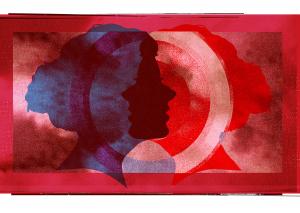 Art by the crimson and reflective Brian Jocks.
My sophomore year at Taylor University, a small Christian college in Indiana, I sat between two friends on a couch, watching a movie in our dorm. I was eating a snack-size package of bland vanilla cookies — the only sweet thing they’d had for sale at the front desk. They weren’t very good, but I couldn’t stop eating them. I didn’t know why, didn’t investigate why. But I was the only one eating anything on that couch, sitting between two friends with bodies much smaller than my own, one of whom I wished would be more than a friend. I knew that it was because I could not stop eating cookies — the reason he would never be more than a friend.
At night I had alternating thoughts before sleep. I’d fantasize about my friend sneaking down from the floor above me where he lived. I envisioned him climbing up into the top bunk beside me, above my sleeping roommate. He’d hold me and we’d kiss, and I’d know I was worthy of affection, attention, maybe even love.
I also imagined breakfast in the dining commons: the build-your-own waffle, eggs with cheese, sugary peaches that came with whatever that dried granola substance was. Nearly every student on our small campus ate our three meals in the commons within the strict hours it was open. It was a relief to eat when others ate– to know now was the appropriate time to feed myself– although I’d sneak peeks at my friend’s plates to make sure mine wasn’t more loaded with food than theirs.
I went to see a therapist on campus. In our first session, “Kim” gave me a book of personal essays on compulsive overeating. Suddenly my fears and my behaviors could all be grouped together, and they had a name! She told me to read the book, come see her next week, and we’d talk about whether any of it hit home. I saw myself in their stories. There was recognition but no healing.
For a few sessions, Kim only asked questions, and I dug into my relationships with food, family, and my peers. My fears of being un-datable and my sneaking suspicion that it was because I was “too big.”
I grew impatient. In her office, I might’ve been uncovering truths about myself, but I wasn’t gaining new tools with which to handle them.
Finally, at the end of maybe our fifth or sixth session, she gave me homework. “Go back to your dorm,” she told me, “and find a mirror. Look yourself in the eye and tell yourself that God loves you.”
I never went back to see Kim.
For God so loved the world that They gave Their only Son, that everyone who believes in him might not perish but might have eternal life.
What does it mean to abide in God’s love?
I want to say I was right for the reasons I never went back: knowing God loved me did not reassure me that someone else would – that I was worthy of romantic love and affection. I did not believe embracing God’s love was the answer to my unhealthy view of my body or my relationship to food.
But the truth is, I can’t even begin to fathom what truly embracing and abiding in God’s love might be like — who I might be if I more consistently, more whole-heartedly invested in my relationship with God; listened to the still, small voice; let it humble and embolden me.
Still, I don’t think Kim was going to teach me how to abide in God’s love.
I believe she was under the impression that God’s love was supposed to be the platform on which my entire self-worth was based (a problematic idea I think is common in American Christian communities). I needed my own: a foundation of self-worth based not on who God is, but who I am: a queer and curvy woman, adorably awkward, regrettably anxious, and proudly bold.
So why does all of this come to mind for me when I read John 3:16?
Because if God’s love is defined by Jesus’s sacrifice, then his sacrifice should also inform how I am supposed to live in God’s love.
My platform of self-worth feels a lot more solid when I reject the idea that God would create me inherently unworthy of Their love. Even in my sinful state, why should I need a go-between?
For God so loved the world that They gave Their only Son, that everyone who believes in him might not perish but might have eternal life.
Since my senior year at Taylor, when I rejected the belief that Christianity was the only right spiritual path, I’ve been uncomfortable with this verse, unsure what the death of Jesus meant to me.
My self-image is somehow intimately tied into whether I accept and abide in the love of God, and growing up within evangelical Christian communities, my image of others was supposed to be rooted in whether or not they agreed with me. I struggle with the former and full-out reject the latter.
At times, I’ve felt like a fraud. How can I call myself a Christian when I’m uncomfortable with the very idea of salvation?
In his book The Heart of Christianity, Marcus Borg writes:
Jesus is, for us as Christians, the decisive revelation of what a life full of God looks like. Radically centered in God and filled with the Spirit, he is the decisive disclosure and epiphany of what can be seen of God embodied in a human life. As the Word and Wisdom and Spirit of God become flesh, his life incarnates the character of God, indeed, the passion of God. In him we see God’s passion.
And we can say that he is the decisive revelation of God for us as Christians without needing to say that he is the only and exclusive revelation of God … To paraphrase William Sloane Coffin, a contemporary author and activist: for us as Christians, God is defined by Jesus, but not confined to Jesus.
Borg became the first in a line of theologians, followed by folks like James Cone, Marcella Althaus-Reid, and Kelly Brown Douglas, that I’ve consumed, hungry for their vision of Jesus: his compassion, his affection for Abba, his understanding of justice. The workings of salvation are still a mystery to me, but I think that I’m beginning to understand what it means to be a follower of Christ.
For God so loved the world
It’s been 15 years since I graduated from Taylor, and I might have an eating disorder. I still have plenty of issues around food and body image. But I’ve done significant work with two (secular) therapists who have never felt the need to attribute the label. Probably because I’m in no danger to myself. Overall, I’m pretty physically healthy.
Maybe staring into a mirror and telling myself God loves me would help me — I’m not sure. But what has helped are all the people I’ve confided in who have confided back, and all my loved ones over the years who have affirmed through their words and actions that I’m lovable and desirable, just as I am.
Through all of them, I feel the love of God.
*****
Jera Brown is a queer Christian activist, intersectional feminist, and freelance writer whose work engages sensitive issues around sexuality and spirituality. She is the editor of Sacred and Subversive, a multi-faith blog and anthology project offering queer perspectives on the future of faith communities and Church of the Scarlet Letter, her personal blog about being a queer, kinky, polyamorous Christian.
Full portfolio: jera.journoportfolio.com
Twitter @thejerabrown
Previous Post

March 7, 2018
What does the moon sound like?
Next Post

March 11, 2018 Introducing Robert Saler - On Being Protestant and a Sick Pilgrim
Browse Our Archives
Select a Category Advent Approaching Mystery art Book Reviews Catholic Ghost Story Catholicism community Confession Current Events Dark Devotional Deconstruction Deconstruction Fellow Travelers I Want To Believe Interview Laudato Si Lent Mary Matthew's Letters Movie Reviews Music Reviews Our Charism Personal Essay Pilgrims Pope Francis Popular Piety Prayer Publishing Richard Beck Saints Satan Sheed and Ward Sick Pilgrim Charism Sick Pilgrim Chats Sick Pilgrim Events Sick Pilgrim Travelin' Medicine Show Sick Pilgrimage to The West Sick Pilgrims Small Joys Spiritual Autobiography Spooky Files of Ave Maria Magazine Spooky October Spooky Pilgrim Spooky Pilgrimage Strange Journey The Inklings Things Keeping Us Going Trying to Say God TV Reviews Uncategorized women in the Catholic Church Wonder Podcast Write the Vision
Select a Month February 2022 January 2022 December 2021 November 2021 October 2021 September 2021 August 2021 July 2021 June 2021 May 2021 April 2021 March 2021 February 2021 January 2021 December 2020 April 2020 March 2020 February 2020 January 2020 December 2019 October 2019 September 2019 July 2019 June 2019 May 2019 April 2019 March 2019 February 2019 January 2019 December 2018 November 2018 October 2018 September 2018 August 2018 July 2018 June 2018 May 2018 April 2018 March 2018 February 2018 January 2018 December 2017 November 2017 October 2017 September 2017 August 2017 July 2017 June 2017 May 2017 April 2017 March 2017 February 2017 January 2017 December 2016 November 2016 October 2016 September 2016 August 2016 July 2016 June 2016 May 2016 April 2016 March 2016 February 2016 January 2016 December 2015
Follow Us!
TAKE THE
Religious Wisdom Quiz
What did the Israelites put on their doorposts during Passover?
Select your answer to see how you score.
Lamb’s blood Incense Olive oil Gold dust
Related posts from Sick Pilgrim

Dark Devotional: The Firelight of Life

Dark Devotional: Let Me Smite Him

Dark Devotional: Woe to Me, for I Have...

TRENDING AT PATHEOS Catholic

Rejecting Doom: Christian Hope And Human Action
Christianity is a religion of hope. We are to have hope and...

It’s What Comes From Within Which Matters
One of the most difficult things for us to understand is why...

Why I Choose the Eucharist Over the Sermon
Choose the Eucharist, Not the Sermon What are we supposed to get...

5 Design Elements Found in Spiritually Rooted Homes
Putting Spirituality Into Home Decor Our homes are more than our living...

Credo: A Story of God Told with the...
About 10 years ago, I began to imagine a personal "Credo" that...

The Anatomy of Divine Revelation in Catholic Thought
The claim that God has made Himself known to human beings is...
view all Catholic blogs
Ad-Free & Subscriber Log-In Subscription Support
- About Us
- 2026 Calendar
- Videos
- Podcasts
- Library of World Religions
- Faith In Media Tracker
- Advertise With Us
- Write for Us
- Privacy Policy
- Terms of Service
- Do Not Sell My Data
- Contact Us
- Radiant Digital
- Manage Newsletter Subscriptions
- Unsubscribe From Notifications
- Sitemap
Copyright 2008-2026, Patheos. All rights reserved.
Subscription Support Ad-Free & Subscriber Log-In
Follow Patheos