
BuddhistCatholicContemplativeEvangelicalGeneral ChristianHinduJewishLatter-day SaintMuslimNew VisionsProgressive Christian
Beliefs
- Buddhist
- Catholic
- Contemplative
- Evangelical
- General Christian
- Hindu
- Jewish
- Latter-day Saint
- More Voices
- Muslim
- New Visions
- Pagan
- Progressive Christian
Topics
- Religion News
- Food and Religion
- Sports and Religion
- Religious Art
- Religious Music and Entertainment
- Religious Events
- History and Religion
- Style and Religion
- Politics and Religion
- Women in Religion
- Recreation Outdoors and Religion
- Business Finance and Religion
- Careers Workplace and Religion
- Education and Religion
- Family Parenting and Religion
- Health Fitness and Religion
- Home and Religion
- Relationships and Religion
- Technology and Religion
- Travel and Religion
Columnists
- Buddhist Columnists
- Business Finance and Religion Columnists
- Careers Workplace and Religion Columnists
- Catholic Columnists
- Contemplative Columnists
- Education and Religion Columnists
- Evangelists Columnists
- Family Parenting and Religion Columnists
- General Christian Columnists
- Health Fitness and Religion Columnists
- Hindu Columnists
- History and Religion Columnists
- Home and Religion Columnists
- Jewish Columnists
- More Voices Columnists
- Latter Day Columnists
- Muslim Columnists
- New Visions Columnists
- Nonreligious Columnists
- Pagan Columnists
- Politics and Religion Columnists
- Progressive Columnists
- Recreation Outdoors and Religion Columnists
- Relationships and Religion Columnists
- Religion News Columnists
- Religious Art Columnists
- Religious Events Columnists
- Religious Music and Entertainment Columnists
- Sports and Religion Columnists
- Style and Religion Columnists
- Technology and Religion Columnists
- Travel and Religion Columnists
- Women in Religion Columnists
Resource Library
- 2026 Calendar
- Library of World Religions
- The 100 Most Holy Places on Earth
- Patheos Answers
- Podcasts
- Videos
- Faith Leaders Database
- Anglican Episcopalian
- Bahai
- Baptist
- Buddhism
- Christianity
- Confucianism
- Eastern Orthodoxy
- Hinduism
- Holiness and Pentecostal
- ISKCON
- Islam
- Judaism
- Lutheran
- Methodist
- The Church of Jesus Christ of Latter-day Saints
- New Age
- Paganism
- Presbytarian and Reformed
- Protestantism
- Religion Behind the Scenes
- Roman Catholic
- Scientology
- Shia Islam
- Sikhism
- Sufism
- Sunni Islam
- Taoism
- Zen
- See all religions
Research Tools
 Ad-Free & Subscriber Log-In Subscription Support
Ad-Free & Subscriber Log-In Subscription Support
Follow Patheos 

- Trending:
- Forgiveness
- |
- Marriage
- |
- Consciousness
- |
- Death Penalty
- |
- Election
- |
- Halloween
 Sick Pilgrim
- Home
- Catholic
- Approaching Mystery: Joanna Penn Cooper Stares into a Puddle
Approaching Mystery: Joanna Penn Cooper Stares into a Puddle
Last updated on: December 6, 2017 at 10:19 am by Joanna Penn Cooper
Approaching Mystery: Joanna Penn Cooper Stares into a Puddle 2017-12-06T10:19:43-05:00 Joanna Penn Cooper
Patheos Explore the world's faith through different perspectives on religion and spirituality! Patheos has the views of the prevalent religions and spiritualities of the world.
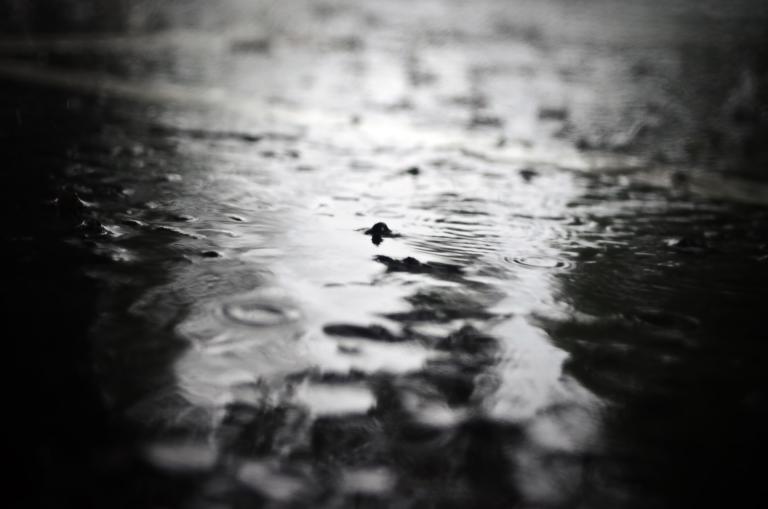
“Think, dear sir, of the world you carry within you, and call this thinking what you will; whether it be remembering your own childhood or yearning toward your future—only be attentive to that which rises up in you and set it above everything that you observe about you.”
–Rainer Maria Rilke, Letters to a Young Poet, Letter Six
Puddle Apocalypse: In Praise of Forgetfulness
As solstice approaches, and I meditate on Advent in an online course with Rebecca Bratten Weiss and Jessica Mesman Griffith, I am drawn to the idea of “rending the veil.” As Rebecca recently wrote in a lovely essay on her blog, “We’ve forgotten, after all, that ‘apocalypse’ does not, technically, refer to things blowing up and keeling over, nor even to ‘end times stuff’ – but rather to revelation. Literally, the lifting of the veil. That which was hidden from the foundation of the world is made present to us. Reality rushes up, right at us, right in the face.” A friend is preparing to have surgery next week, and I told her I would write in December to make up for writing she can’t do at the moment. I will pick up that thread. But what am I to write about, in the face of the truths of illness and surgery, in the face of the social climate in which we live? What do I make of the truth that is eagerly “rushing up … right at [my] face,” as Rebecca put it? And how am I to make room right now for the silence in which grace can enter?
*
When I was a graduate student in Philadelphia, I lived in a studio apartment in a brownstone at 20th and Spruce, and in my off time, I wandered around the city keeping myself company by watching pigeons and trees and people. One of my favorite activities was to take a walk at dusk and look into the finely appointed homes of wealthy people who had not yet closed the blinds, before climbing the three flights back up to my studio apartment to perch on my futon couch and study the tree out my back window. In winter, the sidewalks in the neighborhood were never shoveled, and pedestrians’ tread merely wore a trough down the middle of the icy surface as the snow partially melted and re-froze. One afternoon, as I made my way back home, the spool of thought unwinding in my head caused the movement of my body to wind to a halt. And there I stood, standing and staring into a puddle, lost in thought.
I had paused in the middle of a block in front of an alleyway—the puddle of choppy ice and water was indeed daunting. Probably what had happened was my thoughts had been interrupted by another momentary thought—“How do I get around this puddle?” This thought had been followed by study of the puddle, and perhaps then followed by interest in the look of the puddle, at which point my mind picked back up on its previous thread, whatever it had been. Maybe I was thinking about a poet friend who was about to become, for a time, my lover. Or maybe I was thinking about a book or writing a poem in my head. I don’t remember. That afternoon, I only realized I was stuck in front of the puddle when a car slowed, then paused next to me, the driver partly unrolling the window to ask if I needed help. (I must have looked so odd, standing and staring for the entire time that it had taken the person to drive down the block toward me.) I was startled then, and, I have to admit, filled with a wave of interest and amusement in myself, in the character of me who could come to a complete stop in front of an icy puddle on a freezing winter afternoon and lose track of the fact that I had been walking. I don’t remember if the driver was a man or a woman. I believe it was a person of middle age and benign countenance who possibly had a daughter or niece or student my age. I laughed and thanked the person, then waited for the car to pass before clumsily skirting or vaulting over the water.
So, where does grace enter? The answer, I think, lies in letting go the thread of narrative drumming through our American heads, one that drives us toward measuring ourselves only in terms of external success. As Muriel Rukeyser wrote in The Life of Poetry, “In art, of course, the mysticism of success and failure will not hold. The world of business is open warfare, cold iron through every throat, and the battle-shriek ‘Success!’ But in art, these terms cannot apply.” Whether artist or not, there is comfort to be found in the dark corridors of one’s own mind. On and off since childhood, I have been followed by what Churchill called the black dog, a sadness that slows me down, a dark sludge moving through the body. That isn’t the darkness I’m referring to here, but rather one that has run alongside it, a pensiveness tinged by melancholy that does not pull me down, but carries me along on a stream of spirit—what a boyfriend in my 20s referred to as my “only child syndrome”—an ability at times to be utterly content in my own mind, following threads of thought. “Surely goodness and mercy shall follow me all the days of my life.” And if I’m lucky, the melancholy forgetfulness of that young poet I was, wandering alone, losing myself into grace.
Joanna Penn Cooper is the author of The Itinerant Girl’s Guide to Self-Hypnosis (Brooklyn Arts Press), a book of lyrical shorts, and What Is a Domicile (Noctuary Press), a book of poems. She lives in Durham, North Carolina. She curates the “Approaching Mystery” series for Sick Pilgrim, publishing flash essays by writers encountering the unseen, the uncanny, and the unresolvable.
Previous Post
December 3, 2017
Write the Vision: God's Kingdom Come
Next Post
December 7, 2017 Dark Devotional: Desert Breath
Browse Our Archives
Select a Category Advent Approaching Mystery art Book Reviews Catholic Ghost Story Catholicism community Confession Current Events Dark Devotional Deconstruction Deconstruction Fellow Travelers I Want To Believe Interview Laudato Si Lent Mary Matthew's Letters Movie Reviews Music Reviews Our Charism Personal Essay Pilgrims Pope Francis Popular Piety Prayer Publishing Richard Beck Saints Satan Sheed and Ward Sick Pilgrim Charism Sick Pilgrim Chats Sick Pilgrim Events Sick Pilgrim Travelin' Medicine Show Sick Pilgrimage to The West Sick Pilgrims Small Joys Spiritual Autobiography Spooky Files of Ave Maria Magazine Spooky October Spooky Pilgrim Spooky Pilgrimage Strange Journey The Inklings Things Keeping Us Going Trying to Say God TV Reviews Uncategorized women in the Catholic Church Wonder Podcast Write the Vision
Select a Month February 2022 January 2022 December 2021 November 2021 October 2021 September 2021 August 2021 July 2021 June 2021 May 2021 April 2021 March 2021 February 2021 January 2021 December 2020 April 2020 March 2020 February 2020 January 2020 December 2019 October 2019 September 2019 July 2019 June 2019 May 2019 April 2019 March 2019 February 2019 January 2019 December 2018 November 2018 October 2018 September 2018 August 2018 July 2018 June 2018 May 2018 April 2018 March 2018 February 2018 January 2018 December 2017 November 2017 October 2017 September 2017 August 2017 July 2017 June 2017 May 2017 April 2017 March 2017 February 2017 January 2017 December 2016 November 2016 October 2016 September 2016 August 2016 July 2016 June 2016 May 2016 April 2016 March 2016 February 2016 January 2016 December 2015
Follow Us!
TAKE THE
Religious Wisdom Quiz
Who was the first king of Israel?
Select your answer to see how you score.
David Josiah Solomon Saul
Related posts from Sick Pilgrim

Second Sunday in Advent: Let Me Love You...
Things Keeping Us Going: Reading & Writing Edition
Our Lenten Wilderness: Unknown Pleasures and Revelations
Strange Bodies, Strange Questions
TRENDING AT PATHEOS Catholic

The Parable Of The Sower And The Word...
One of Christ’s most famous parables is that of the sower who...

Rejecting Doom: Christian Hope And Human Action
Christianity is a religion of hope. We are to have hope and...

Why I Choose the Eucharist Over the Sermon
Choose the Eucharist, Not the Sermon What are we supposed to get...

5 Design Elements Found in Spiritually Rooted Homes
Putting Spirituality Into Home Decor Our homes are more than our living...

Credo: A Story of God Told with the...
About 10 years ago, I began to imagine a personal "Credo" that...

The Anatomy of Divine Revelation in Catholic Thought
The claim that God has made Himself known to human beings is...
view all Catholic blogs
Ad-Free & Subscriber Log-In Subscription Support
- About Us
- 2026 Calendar
- Videos
- Podcasts
- Library of World Religions
- Faith In Media Tracker
- Advertise With Us
- Write for Us
- Privacy Policy
- Terms of Service
- Do Not Sell My Data
- Contact Us
- Radiant Digital
- Manage Newsletter Subscriptions
- Unsubscribe From Notifications
- Sitemap
Copyright 2008-2026, Patheos. All rights reserved.
Subscription Support Ad-Free & Subscriber Log-In
Follow Patheos