
BuddhistCatholicContemplativeEvangelicalGeneral ChristianHinduJewishLatter-day SaintMuslimNew VisionsProgressive Christian
Beliefs
- Buddhist
- Catholic
- Contemplative
- Evangelical
- General Christian
- Hindu
- Jewish
- Latter-day Saint
- More Voices
- Muslim
- New Visions
- Pagan
- Progressive Christian
Topics
- Religion News
- Food and Religion
- Sports and Religion
- Religious Art
- Religious Music and Entertainment
- Religious Events
- History and Religion
- Style and Religion
- Politics and Religion
- Women in Religion
- Recreation Outdoors and Religion
- Business Finance and Religion
- Careers Workplace and Religion
- Education and Religion
- Family Parenting and Religion
- Health Fitness and Religion
- Home and Religion
- Relationships and Religion
- Technology and Religion
- Travel and Religion
Columnists
- Buddhist Columnists
- Business Finance and Religion Columnists
- Careers Workplace and Religion Columnists
- Catholic Columnists
- Contemplative Columnists
- Education and Religion Columnists
- Evangelists Columnists
- Family Parenting and Religion Columnists
- General Christian Columnists
- Health Fitness and Religion Columnists
- Hindu Columnists
- History and Religion Columnists
- Home and Religion Columnists
- Jewish Columnists
- More Voices Columnists
- Latter Day Columnists
- Muslim Columnists
- New Visions Columnists
- Nonreligious Columnists
- Pagan Columnists
- Politics and Religion Columnists
- Progressive Columnists
- Recreation Outdoors and Religion Columnists
- Relationships and Religion Columnists
- Religion News Columnists
- Religious Art Columnists
- Religious Events Columnists
- Religious Music and Entertainment Columnists
- Sports and Religion Columnists
- Style and Religion Columnists
- Technology and Religion Columnists
- Travel and Religion Columnists
- Women in Religion Columnists
Resource Library
- 2026 Calendar
- Library of World Religions
- The 100 Most Holy Places on Earth
- Patheos Answers
- Podcasts
- Videos
- Faith Leaders Database
- Anglican Episcopalian
- Bahai
- Baptist
- Buddhism
- Christianity
- Confucianism
- Eastern Orthodoxy
- Hinduism
- Holiness and Pentecostal
- ISKCON
- Islam
- Judaism
- Lutheran
- Methodist
- The Church of Jesus Christ of Latter-day Saints
- New Age
- Paganism
- Presbytarian and Reformed
- Protestantism
- Religion Behind the Scenes
- Roman Catholic
- Scientology
- Shia Islam
- Sikhism
- Sufism
- Sunni Islam
- Taoism
- Zen
- See all religions
Research Tools
 Ad-Free & Subscriber Log-In Subscription Support
Ad-Free & Subscriber Log-In Subscription Support
Follow Patheos 

- Trending:
- Forgiveness
- |
- Marriage
- |
- Consciousness
- |
- Death Penalty
- |
- Election
- |
- Halloween
 Sick Pilgrim
- Home
- Catholic
- Trapped in the Nightmare: A Bloomsday Dark Devotional
Trapped in the Nightmare: A Bloomsday Dark Devotional
Last updated on: June 16, 2017 at 12:01 pm by Guest Contributor
Trapped in the Nightmare: A Bloomsday Dark Devotional 2017-06-16T12:01:26-05:00 Guest Contributor
Patheos Explore the world's faith through different perspectives on religion and spirituality! Patheos has the views of the prevalent religions and spiritualities of the world.
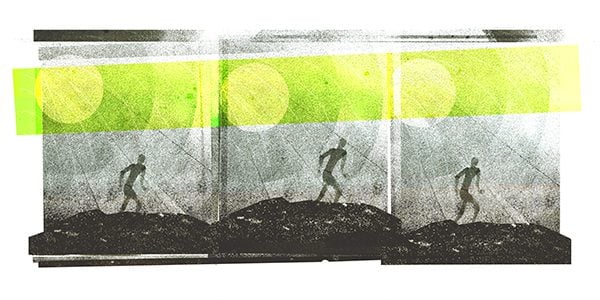
Cyclical, original art by Brian C. Jocks
June 16 is Bloomsday — a special day for Irish literary geeks, on which fans of James Joyce’s Ulysses gather in Dublin to retrace the steps–and drink the drinks–of the novel’s hero, Leopold Bloom, who both starts and finishes his surreal Odyssean journey in his wife’s bed.
Ulysses, with its ring-like structure and themes of transformation, is a story for moderns trapped within the cyclical “nightmare” of history, from which the only escape is a kind of mythic re-imagining of everything. Like other modern aesthetes – Friedrich Nietzsche, Isak Dinesen, Tennessee Williams – Joyce seeks to practice a kind of aesthetic redemption, everything becoming bearable through art. Art transforms the dingy into the shining, makes of a lonely man on a dusty road a long shadow, cast across our shared imaginations.
But before the cyclical Odyssean journey in Ulysses, there was the journey of Chesterton’s Innocent Smith, who has to leave his home and set out around the world until he can come home to his own wife. Like Bloom, Smith breaks into his own house. He courts his own wife again and again, as she poses in different aliases.
Usually we think of our Christian journey as a pilgrimage from Point A to Point B, not as cyclical. Pilgrimage presupposes destination. In Canterbury Tales, one presumes, everyone eventually makes it to the shrine, even if they don’t deserve it (grace: unmerited favor). Dante gets out of the dark wood, even if he has to go through hell and across Satan’s thigh to emerge and see the beauty of the stars.
But the motif of cycling, turning and returning, is as much present in the Catholic imagination as in the mythic neo-pagan one, as we see in Chesterton’s story. Repetition is liturgical, after all. Dante’s Divine Comedy is organized in terms of rings and cycles. Both the damned lovers in hell and the beatified ones in heaven follow the same motion, swirling round and round.
This motif of repetition and cycling connected with the spiritual longing both to escape and to find home. We hunger for strangeness and wildness. Love means a breaking down of barriers, a shattering of walls. But also we long to belong. To rest one’s head.
But – as the patterns in Dante’s Inferno point out – repetition is also terrifying. It feels like doom, like the Myth of Sysiphus, like cycles of addiction and toxic relationships, like being trapped in mental illness. It feels like history, with our wars and genocides and our praise of pompous demagogues.
Is this what they call the dark night of the soul? I don’t think so. The Dark Night seems to manifest presence by absence. God was there, and now is gone.
Oh yes, a shattered romance is greatly improved, rendered enjoyable even, by the cunning application of melancholy music and strong drink. Dinesen said all things could be cured by salt water: tears, sweat, or the sea. We can dream of breaking our mild fetters, setting off west…
But the fetters are not always mild, and it’s not just a broken heart that has to mend. What can art do for the drowned refugee child? For the dying in South Sudan? We can make them beautiful and remembered, but this we do for ourselves.
Not that it isn’t a good thing to do. But it isn’t enough on its own. Leopold Bloom escapes the Cyclops, as Odysseus does, and Chesterton’s hero manages to avoid being shipwrecked or slaughtered in civil war. But the cyclical journey fails because for many of us, we are clinging to jetsam in the stormy bay, trapped in the Dark Wood, going round and round, no light in sight, no artist to pluck you burning from the torment. This is the pilgrimage of the broken. Far off drumbeats speak to you of doom, or perhaps they are hammers in the dark. Hammering what?
Bloomsday is an attempt to make it okay that you just end up where you started. It’s a noble attempt, but it won’t suffice. By the end of it, you might be drunk enough to feel that myth will repair the world’s sorrows, but this is only illusion. The addict seeks this illusion again and again: another cycling.
The Canterbury Pilgrims reach their shrine, but where is the favor for the wanderer in the wood to whom no guide is sent, as the drums beat on?
Where for Dante’s teacher, Brunetto Latini, running round and round upon the sterile sands of the Seventh Circle of Hell? Latini who once wrote: “And I, in such anguish, thinking with head downcast, lost the great highway, and took the crossroad through a strange wood…”
Yes, Dante stole his opening lines from his beloved teacher, as well as putting him in hell. But maybe it’s less a theft than a recognition. The Dark Wood is there. Are you going to get around it, or cut across a corner of it, maybe fight giant spiders, fall into the stream of enchanted sleep, meet with La Belle Dame Sans Merci, be imprisoned in a stony grotto for a hundred years while your armor rusts, finally emerge to tell a cautionary tale? Will you seek out the drumbeats in the dark? Is it fairies, and will they make you dance a dance that will never end, in red-hot iron slippers?
What if you go through your whole life and never get out? What if you pass the shattered tree and cairn of rocks over and over and over? Beatrice never sent a guide. She never even knew you existed.
There are drumbeats in the wood, or perhaps footfalls, or perhaps the strike of a hammer. There are trees in the wood, gnarled and misshapen. On such a tree was hung the Son of Man, who left his home never to return. The hammers are all the hammers of the world, driving nails into his hands and feet, into our hands and feet. He is with us here, in the dark. His blood mingles with our tears, and whispers to us of some redemption beyond what we can see or hear now, lost in the woods.
Rebecca Bratten Weiss is a writer, teacher, farmer, and Christian rebel. She edits the journal Convivium and blogs at Suspended in Her Jar.
Previous Post
June 14, 2017
Pest's Letters: To My Friend Who Died of an Overdose

Browse Our Archives
Select a Category Advent Approaching Mystery art Book Reviews Catholic Ghost Story Catholicism community Confession Current Events Dark Devotional Deconstruction Deconstruction Fellow Travelers I Want To Believe Interview Laudato Si Lent Mary Matthew's Letters Movie Reviews Music Reviews Our Charism Personal Essay Pilgrims Pope Francis Popular Piety Prayer Publishing Richard Beck Saints Satan Sheed and Ward Sick Pilgrim Charism Sick Pilgrim Chats Sick Pilgrim Events Sick Pilgrim Travelin' Medicine Show Sick Pilgrimage to The West Sick Pilgrims Small Joys Spiritual Autobiography Spooky Files of Ave Maria Magazine Spooky October Spooky Pilgrim Spooky Pilgrimage Strange Journey The Inklings Things Keeping Us Going Trying to Say God TV Reviews Uncategorized women in the Catholic Church Wonder Podcast Write the Vision
Select a Month February 2022 January 2022 December 2021 November 2021 October 2021 September 2021 August 2021 July 2021 June 2021 May 2021 April 2021 March 2021 February 2021 January 2021 December 2020 April 2020 March 2020 February 2020 January 2020 December 2019 October 2019 September 2019 July 2019 June 2019 May 2019 April 2019 March 2019 February 2019 January 2019 December 2018 November 2018 October 2018 September 2018 August 2018 July 2018 June 2018 May 2018 April 2018 March 2018 February 2018 January 2018 December 2017 November 2017 October 2017 September 2017 August 2017 July 2017 June 2017 May 2017 April 2017 March 2017 February 2017 January 2017 December 2016 November 2016 October 2016 September 2016 August 2016 July 2016 June 2016 May 2016 April 2016 March 2016 February 2016 January 2016 December 2015
Follow Us!
TAKE THE
Religious Wisdom Quiz
What does Paul tell the Thessalonians to do without ceasing?
Select your answer to see how you score.
Pray Rejoice Study the word Give thanks
Related posts from Sick Pilgrim

Dark Devotional: The Firelight of Life

Dark Devotional: Let Me Smite Him

Dark Devotional: Woe to Me, for I Have...

TRENDING AT PATHEOS Catholic

Rejecting Doom: Christian Hope And Human Action
Christianity is a religion of hope. We are to have hope and...

It’s What Comes From Within Which Matters
One of the most difficult things for us to understand is why...

Why I Choose the Eucharist Over the Sermon
Choose the Eucharist, Not the Sermon What are we supposed to get...

5 Design Elements Found in Spiritually Rooted Homes
Putting Spirituality Into Home Decor Our homes are more than our living...

Credo: A Story of God Told with the...
About 10 years ago, I began to imagine a personal "Credo" that...

The Anatomy of Divine Revelation in Catholic Thought
The claim that God has made Himself known to human beings is...
view all Catholic blogs
Ad-Free & Subscriber Log-In Subscription Support
- About Us
- 2026 Calendar
- Videos
- Podcasts
- Library of World Religions
- Faith In Media Tracker
- Advertise With Us
- Write for Us
- Privacy Policy
- Terms of Service
- Do Not Sell My Data
- Contact Us
- Radiant Digital
- Manage Newsletter Subscriptions
- Unsubscribe From Notifications
- Sitemap
Copyright 2008-2026, Patheos. All rights reserved.
Subscription Support Ad-Free & Subscriber Log-In
Follow Patheos