
BuddhistCatholicContemplativeEvangelicalGeneral ChristianHinduJewishLatter-day SaintMuslimNew VisionsProgressive Christian
Beliefs
- Buddhist
- Catholic
- Contemplative
- Evangelical
- General Christian
- Hindu
- Jewish
- Latter-day Saint
- More Voices
- Muslim
- New Visions
- Pagan
- Progressive Christian
Topics
- Religion News
- Food and Religion
- Sports and Religion
- Religious Art
- Religious Music and Entertainment
- Religious Events
- History and Religion
- Style and Religion
- Politics and Religion
- Women in Religion
- Recreation Outdoors and Religion
- Business Finance and Religion
- Careers Workplace and Religion
- Education and Religion
- Family Parenting and Religion
- Health Fitness and Religion
- Home and Religion
- Relationships and Religion
- Technology and Religion
- Travel and Religion
Columnists
- Buddhist Columnists
- Business Finance and Religion Columnists
- Careers Workplace and Religion Columnists
- Catholic Columnists
- Contemplative Columnists
- Education and Religion Columnists
- Evangelists Columnists
- Family Parenting and Religion Columnists
- General Christian Columnists
- Health Fitness and Religion Columnists
- Hindu Columnists
- History and Religion Columnists
- Home and Religion Columnists
- Jewish Columnists
- More Voices Columnists
- Latter Day Columnists
- Muslim Columnists
- New Visions Columnists
- Nonreligious Columnists
- Pagan Columnists
- Politics and Religion Columnists
- Progressive Columnists
- Recreation Outdoors and Religion Columnists
- Relationships and Religion Columnists
- Religion News Columnists
- Religious Art Columnists
- Religious Events Columnists
- Religious Music and Entertainment Columnists
- Sports and Religion Columnists
- Style and Religion Columnists
- Technology and Religion Columnists
- Travel and Religion Columnists
- Women in Religion Columnists
Resource Library
- 2026 Calendar
- Library of World Religions
- The 100 Most Holy Places on Earth
- Patheos Answers
- Podcasts
- Videos
- Faith Leaders Database
- Anglican Episcopalian
- Bahai
- Baptist
- Buddhism
- Christianity
- Confucianism
- Eastern Orthodoxy
- Hinduism
- Holiness and Pentecostal
- ISKCON
- Islam
- Judaism
- Lutheran
- Methodist
- The Church of Jesus Christ of Latter-day Saints
- New Age
- Paganism
- Presbytarian and Reformed
- Protestantism
- Religion Behind the Scenes
- Roman Catholic
- Scientology
- Shia Islam
- Sikhism
- Sufism
- Sunni Islam
- Taoism
- Zen
- See all religions
Research Tools
 Ad-Free & Subscriber Log-In Subscription Support
Ad-Free & Subscriber Log-In Subscription Support
Follow Patheos 

- Trending:
- Forgiveness
- |
- Marriage
- |
- Consciousness
- |
- Death Penalty
- |
- Election
- |
- Halloween
 Sick Pilgrim
- Home
- Catholic
- Dark Devotional: About All the Things
Dark Devotional: About All the Things
Last updated on: April 28, 2017 at 1:48 pm by Guest Contributor
Dark Devotional: About All the Things 2017-04-28T13:48:21-05:00 Guest Contributor
Patheos Explore the world's faith through different perspectives on religion and spirituality! Patheos has the views of the prevalent religions and spiritualities of the world.
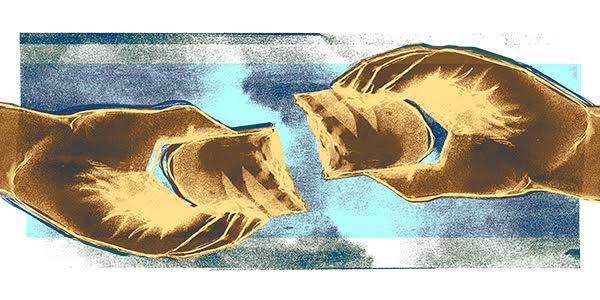
original art by Brian C. Jocks
Ostensibly, I created all my social media accounts to keep in touch with friends and family. Increasingly, however, platforms that were once about sharing pictures and keeping in touch are also the means by which I receive wave after wave of bad news. I’ve digitally surrounded myself with the socially concerned, and the world is a mess.
In our gospel reading this Sunday, we find two disciples whose situation seems similar.
“That very day, the first day of the week, two of Jesus’ disciples were going to a village seven miles from Jerusalem called Emmaus, and they were conversing about all the things that had occurred. And it happened that while they were conversing and debating, Jesus himself drew near and walked with them, but their eyes were prevented from recognizing him.”
My usual tendency would be to jump to the end of this passage, past this conversation and to the forthcoming revelation of who Jesus is, and I’ll get there, but that seems too easy. By chance, an old article I read this week by the French philosopher Jean-Luc Marion called me back to the importance of the men’s conversation: why would these two men talk with so much vigor about the “all the things?” Because they’ve just been through a major trauma. Their rabbi is dead. They grieve. They pine for a kingdom to come that now seems out of reach, wholly beyond possibility. And they do not recognize him when he walks beside them – “their eyes were prevented.” “By what, exactly?” Marion asks. They are next to him! They physically hear the sound of his voice, which taught them! They don’t recognize him because they won’t let themselves. The evidence in front of their eyes is such that the obvious truth of it is unimaginable. The notion that this might be their rabbi never crosses their minds. As Marion puts it, “the dead man is dead, period.”
And their minds begin to doubt… “Isn’t he?”
I still wonder… Isn’t he?
Because I see pictures of Syrian and Iraqi children, dead or in shock, and they remind me of my children, of holy innocents, and I don’t see the resurrection; I see the crucifixion, I see Christ being crucified. And if he isn’t dead yet, we’ll keep trying. But maybe that’s enough for hope. If we have to keep trying, that’s enough for that holy doubt, the moment when I think that there’s still a chance. Even when those disciples on the road to Emmaus were consoling one another and talking and arguing, Jesus drew near. In their sorrow and their confusion, even if they didn’t recognize him, he drew near. And even though they didn’t recognize him, he sat with them and helped them sort through the grief and the trauma of our shouts of “Hosanna!” turning into cries for blood.
“As they approached the village to which they were going, he gave the impression that he was going on farther. But they urged him, “Stay with us, for it is nearly evening and the day is almost over.” So he went in to stay with them. And it happened that, while he was with them at table, he took bread, said the blessing, broke it, and gave it to them. With that their eyes were opened and they recognized him, but he vanished from their sight.
…he was made known to them in the breaking of the bread.”
What strikes me as I think about this passage is the agency of Jesus and the cooperation of the disciples. It isn’t initially the disciples who come to Jesus – he comes alongside them. And yet, as a visitor, a stranger, he is the recipient of their hospitable welcome, “Stay with us.” And so the Christ abides with them, but in doing so makes them his companions, in the most literal manner, by taking up bread, blessing, breaking, and sharing it with them. Known to us in the breaking of the bread, so that our communion with those we come alongside makes new life possible. As Simone Weil once wrote, every morsel of bread we take, bless, break, and share with one another is an invitation for the presence of Christ to be received: “something like a real communion,” she says. Christ makes us his companions, we see him for who he is, and then he is gone from our sight. Alive to us, but invisible. Christ seems absent when he is present and is paradoxically even more present when absent. So why am I so lonely and blind?
“So it happened, one day, that while I was conversing and debating, Jesus drew near and walked with me, but I prevented my eyes from recognizing him.” My loneliness was the loneliness of one who refused to see the person right next to me. In a commentary on a different passage (Matthew 25), Weil writes that even if the gospel emphasizes the presence of Christ in the suffering, those who turn their attention to the suffering become Christ to them, by taking, blessing, breaking, and giving ourselves, by our real presence to their distress, by our coming alongside, by making one another companions. Being concerned and “[online] debating” is not enough for me to see the risen Christ – I only begin to despair. They knew him in the breaking, and then they were left alone to do the work, to come alongside and break for others.
Can I do the same?
Jacob W. Torbeck is an ENFP, a Slytherin, a husband, father, and doctoral candidate at Loyola University Chicago, where he studies the concept and use of vision in Christian spirituality and theology.
Previous Post

April 27, 2017
Things Keeping Us Alive, April '17
Next Post

May 3, 2017 Jason Harrod: Trying to Say God
Browse Our Archives
Select a Category Advent Approaching Mystery art Book Reviews Catholic Ghost Story Catholicism community Confession Current Events Dark Devotional Deconstruction Deconstruction Fellow Travelers I Want To Believe Interview Laudato Si Lent Mary Matthew's Letters Movie Reviews Music Reviews Our Charism Personal Essay Pilgrims Pope Francis Popular Piety Prayer Publishing Richard Beck Saints Satan Sheed and Ward Sick Pilgrim Charism Sick Pilgrim Chats Sick Pilgrim Events Sick Pilgrim Travelin' Medicine Show Sick Pilgrimage to The West Sick Pilgrims Small Joys Spiritual Autobiography Spooky Files of Ave Maria Magazine Spooky October Spooky Pilgrim Spooky Pilgrimage Strange Journey The Inklings Things Keeping Us Going Trying to Say God TV Reviews Uncategorized women in the Catholic Church Wonder Podcast Write the Vision
Select a Month February 2022 January 2022 December 2021 November 2021 October 2021 September 2021 August 2021 July 2021 June 2021 May 2021 April 2021 March 2021 February 2021 January 2021 December 2020 April 2020 March 2020 February 2020 January 2020 December 2019 October 2019 September 2019 July 2019 June 2019 May 2019 April 2019 March 2019 February 2019 January 2019 December 2018 November 2018 October 2018 September 2018 August 2018 July 2018 June 2018 May 2018 April 2018 March 2018 February 2018 January 2018 December 2017 November 2017 October 2017 September 2017 August 2017 July 2017 June 2017 May 2017 April 2017 March 2017 February 2017 January 2017 December 2016 November 2016 October 2016 September 2016 August 2016 July 2016 June 2016 May 2016 April 2016 March 2016 February 2016 January 2016 December 2015
Follow Us!
TAKE THE
Religious Wisdom Quiz
According to Hebrews, what two things cannot be shaken?
Select your answer to see how you score.
The word and Spirit Faith and love A kingdom that cannot be shaken Heaven and earth
Related posts from Sick Pilgrim

Dark Devotional: The Firelight of Life

Dark Devotional: Let Me Smite Him

Dark Devotional: Woe to Me, for I Have...

TRENDING AT PATHEOS Catholic

Rejecting Doom: Christian Hope And Human Action
Christianity is a religion of hope. We are to have hope and...

It’s What Comes From Within Which Matters
One of the most difficult things for us to understand is why...

Why I Choose the Eucharist Over the Sermon
Choose the Eucharist, Not the Sermon What are we supposed to get...

5 Design Elements Found in Spiritually Rooted Homes
Putting Spirituality Into Home Decor Our homes are more than our living...

Credo: A Story of God Told with the...
About 10 years ago, I began to imagine a personal "Credo" that...

The Anatomy of Divine Revelation in Catholic Thought
The claim that God has made Himself known to human beings is...
view all Catholic blogs
Ad-Free & Subscriber Log-In Subscription Support
- About Us
- 2026 Calendar
- Videos
- Podcasts
- Library of World Religions
- Faith In Media Tracker
- Advertise With Us
- Write for Us
- Privacy Policy
- Terms of Service
- Do Not Sell My Data
- Contact Us
- Radiant Digital
- Manage Newsletter Subscriptions
- Unsubscribe From Notifications
- Sitemap
Copyright 2008-2026, Patheos. All rights reserved.
Subscription Support Ad-Free & Subscriber Log-In
Follow Patheos