
BuddhistCatholicContemplativeEvangelicalGeneral ChristianHinduJewishLatter-day SaintMuslimNew VisionsProgressive Christian
Beliefs
- Buddhist
- Catholic
- Contemplative
- Evangelical
- General Christian
- Hindu
- Jewish
- Latter-day Saint
- More Voices
- Muslim
- New Visions
- Pagan
- Progressive Christian
Topics
- Religion News
- Food and Religion
- Sports and Religion
- Religious Art
- Religious Music and Entertainment
- Religious Events
- History and Religion
- Style and Religion
- Politics and Religion
- Women in Religion
- Recreation Outdoors and Religion
- Business Finance and Religion
- Careers Workplace and Religion
- Education and Religion
- Family Parenting and Religion
- Health Fitness and Religion
- Home and Religion
- Relationships and Religion
- Technology and Religion
- Travel and Religion
Columnists
- Buddhist Columnists
- Business Finance and Religion Columnists
- Careers Workplace and Religion Columnists
- Catholic Columnists
- Contemplative Columnists
- Education and Religion Columnists
- Evangelists Columnists
- Family Parenting and Religion Columnists
- General Christian Columnists
- Health Fitness and Religion Columnists
- Hindu Columnists
- History and Religion Columnists
- Home and Religion Columnists
- Jewish Columnists
- More Voices Columnists
- Latter Day Columnists
- Muslim Columnists
- New Visions Columnists
- Nonreligious Columnists
- Pagan Columnists
- Politics and Religion Columnists
- Progressive Columnists
- Recreation Outdoors and Religion Columnists
- Relationships and Religion Columnists
- Religion News Columnists
- Religious Art Columnists
- Religious Events Columnists
- Religious Music and Entertainment Columnists
- Sports and Religion Columnists
- Style and Religion Columnists
- Technology and Religion Columnists
- Travel and Religion Columnists
- Women in Religion Columnists
Resource Library
- 2026 Calendar
- Library of World Religions
- The 100 Most Holy Places on Earth
- Patheos Answers
- Podcasts
- Videos
- Faith Leaders Database
- Anglican Episcopalian
- Bahai
- Baptist
- Buddhism
- Christianity
- Confucianism
- Eastern Orthodoxy
- Hinduism
- Holiness and Pentecostal
- ISKCON
- Islam
- Judaism
- Lutheran
- Methodist
- The Church of Jesus Christ of Latter-day Saints
- New Age
- Paganism
- Presbytarian and Reformed
- Protestantism
- Religion Behind the Scenes
- Roman Catholic
- Scientology
- Shia Islam
- Sikhism
- Sufism
- Sunni Islam
- Taoism
- Zen
- See all religions
Research Tools
 Ad-Free & Subscriber Log-In Subscription Support
Ad-Free & Subscriber Log-In Subscription Support
Follow Patheos 

- Trending:
- Forgiveness
- |
- Marriage
- |
- Consciousness
- |
- Death Penalty
- |
- Election
- |
- Halloween
 Sick Pilgrim
- Home
- Catholic
- Lower than Death: An Easter Dark Devotional
Lower than Death: An Easter Dark Devotional
Last updated on: April 14, 2017 at 2:35 pm by Guest Contributor
Lower than Death: An Easter Dark Devotional 2017-04-14T14:35:50-05:00 Guest Contributor
Patheos Explore the world's faith through different perspectives on religion and spirituality! Patheos has the views of the prevalent religions and spiritualities of the world.
Original art by Brian C. Jocks
“Did You ever know loneliness, did You ever know need?
Do You remember just how long a night can get?
When You were barely holding on and Your friends fall asleep
And don’t see the blood that’s running in Your sweat
Will those who mourn be left uncomforted
While You’re up there just playing hard to get?”
– from “Hard to Get” by Rich Mullins
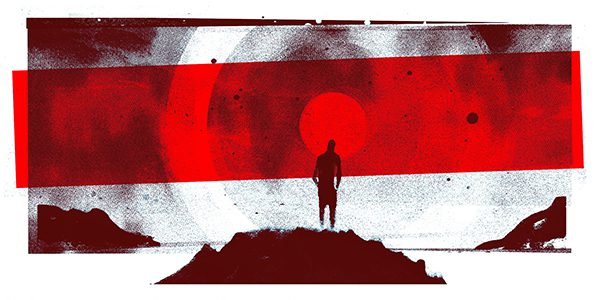
I wish it were only a sick pilgrim thing, trying to find the object of dark devotion on the happiest day of the liturgical calendar, milking as much Good Friday as we can until Easter Sunday. However I’ve noticed a number of people over the years who associate Easter primarily with the crucifixion. I’m not sure if this is evidence of Biblical illiteracy or modernist doubt in the resurrection. Maybe it’s just the experience of their faith being voiced subconsciously. Sure, the Master has called me forth from my metaphorical grave like he did Lazarus; even the people who loved me and believed Jesus were certain I stank. Those moments were nothing like the glorious resurrection of the Lord.
On the other hand, I know plenty about crucifixion. I’ve inflicted a few and suffered a few more. Hardly the innocent lamb, I can be a pretty decent imitation of St. Dismas, the good thief who died next to Jesus on the cross, on some occasions. Other days I’m hell bent on getting what I deserve. I also have lost loved ones, and the hope of seeing them again is almost too much. Easter serves as a bittersweet reminder. I believe the reunion will come; but damn me if I have to continue waiting. Do you really expect me to spiffy up my Sunday’s best for this?
I believe the resurrected Lord is alive in me. Why do I sometimes feel lower than death?
Perhaps I’ve made my bed in some hell to which the Lord descended. Christian tradition has usually depicted that part of the creed with images of triumph in a rout. Jesus marches in with his banner raised, preaching to the righteous waiting on their redemption, and ultimately leads them out of hell. This may very well be true, and I don’t have it in me to argue with the consensus among orthodox theologians throughout the ages. But it sounds easy. This account of the harrowing of hell doesn’t sound especially harrowing, particularly in comparison to Christ’s suffering on the cross.
Hans Urs von Balthasar challenged this account in his grand Christology, Mysterium Paschale. Balthasar, the Swiss theologian and ex-Jesuit, was no Mickey Mouse theologian. He co-founded the journal Communio http://www.communio-icr.com/ along with luminaries like Henri de Lubac and Joseph Ratzinger (better known as Pope Benedict XVI), both of whom honored him as “perhaps the most cultured man of our time.” St. John Paul II offered him a cardinal’s hat three times. Balthasar turned it down twice, said yes on the third offer, and died before the consistory that would have made it official. He is remembered for his theology of beauty and his vision of a vibrant laity providing an evangelical witness to the world. Balthasar was hardly a theologian who mistook novelty as innovation, yet his scholarly work led him to believe Christ’s passion did not end on the cross. Balthasar believed the descent into hell involved Jesus suffering human damnation, that God mysteriously experienced estrangement from God.
In his introduction to the latest edition of Mysterium Paschale, Aidan Nichols writes:
*“*Balthasar stresses Christ’s solidarity with the dead, his passivity, his finding himself in a situation of total self-estrangement and alienation from the Father. For Balthasar, the Descent ‘solves’ the problem of theodicy, by showing us the conditions on which God accepted our foreknown abuse of freedom: namely, his own plan to take to himself our self-damnation in Hell. It also demonstrates the costliness of our redemption: the divine Son underwent the experience of Godlessness. Finally, it shows that the God revealed by the Redeemer is a Trinity. Only if the Spirit, as vinculum amoris between the Father and the Son, can re-relate Father and Son in their estrangement in the Descent, can the unity of the Revealed and Revealer be maintained. In this final humiliation of the forma servi, the glorious forma Dei shines forth via its lowest pitch of self-giving love.”
Mysterium Paschale is the most controversial of Balthasar’s works, surpassing even Dare We Hope That All Men Be Saved?, the book where he suggested hoping for a hell empty of human souls was a Christian duty. Praise, criticism, charges of heresy, and attempts to reconcile Balthasar’s opinion with the traditional consensus abound on the internet, but he died with the favor of John Paul II, and he was a significant influence on both Benedict XVI and Francis.
Still, I’m not interested in the controversies today. My focus is on the human need that might desire Balthasar’s belief to be true. A God who has experienced the pain of being abandoned by God has something more in common with the sick pilgrim and is a step removed from being a Superman without the challenge of a dilemma beyond his capabilities. If this is ever defined as a heresy, it certainly has been a helpful heresy for strugglers of all sorts. It speaks to a deficiency in our understanding of how closely Christ identifies with us, a truth that is Truth even if Balthasar is wrong.
Perhaps Balthasar also explains the condition of people who can’t escape Good Friday on Easter Sunday. In the same volume, he wrote:
“Since we stand under the law of the Risen One, he places us on the way of the Cross, and we travel our way of the Cross only in his power, and his hope who, as the Risen One, has already won the victory. This is why the Church, and Christians, can occupy no determinate place within the Mysterium Paschale. Their place is neither in front of the Cross nor behind it, but on both its sides: without ever settling for the one vantage point or the other they look from now one, now the other, as ceaselessly directed.”
This game of back and forth is beautifully illustrated in the song “Hard to Get” by Rich Mullins.
https://www.youtube.com/watch?v=j2STr5qPlIM
After a series of lamentations interrupted by recollections of how deeply human Jesus was, Mullins asks one last question before making his confession of torment, confusion, and resignation to mystery:
All I really need to know
Is if You who live in eternity
Hear the prayers of those of us who live in time
We can’t see what’s ahead
And we can not get free of what we’ve left behind
I’m reeling from these voices that keep screaming in my ears
All the words of shame and doubt, blame and regretI can’t see how You’re leading me unless You’ve led me here
Where I’m lost enough to let myself be led
And so You’ve been here all along I guess
It’s just Your ways and You are just plain hard to get.
We may question the mystery, but we need not be crushed by it. Broken, battered, crucified lot that we are, we are the Easter people that we are becoming through Christ, and we praise him even in our sighs and groans.
Toby D’Anna is a middle school English teacher in Tacoma, Washington, and a frequent contributor to Sick Pilgrim.
Brian C. Jocks is an award-winning illustrator with a B.A. in fine art from the University of Louisiana. Brian’s art makes its way online on Tumblr, Instagram, and Twitter.
Click the donate button to help us continue to publish spiritual writing that accompanies the spiritually sick on their journeys.


Next Post

April 21, 2017 Dark Devotional: Pardoning Thomas
Browse Our Archives
Select a Category Advent Approaching Mystery art Book Reviews Catholic Ghost Story Catholicism community Confession Current Events Dark Devotional Deconstruction Deconstruction Fellow Travelers I Want To Believe Interview Laudato Si Lent Mary Matthew's Letters Movie Reviews Music Reviews Our Charism Personal Essay Pilgrims Pope Francis Popular Piety Prayer Publishing Richard Beck Saints Satan Sheed and Ward Sick Pilgrim Charism Sick Pilgrim Chats Sick Pilgrim Events Sick Pilgrim Travelin' Medicine Show Sick Pilgrimage to The West Sick Pilgrims Small Joys Spiritual Autobiography Spooky Files of Ave Maria Magazine Spooky October Spooky Pilgrim Spooky Pilgrimage Strange Journey The Inklings Things Keeping Us Going Trying to Say God TV Reviews Uncategorized women in the Catholic Church Wonder Podcast Write the Vision
Select a Month February 2022 January 2022 December 2021 November 2021 October 2021 September 2021 August 2021 July 2021 June 2021 May 2021 April 2021 March 2021 February 2021 January 2021 December 2020 April 2020 March 2020 February 2020 January 2020 December 2019 October 2019 September 2019 July 2019 June 2019 May 2019 April 2019 March 2019 February 2019 January 2019 December 2018 November 2018 October 2018 September 2018 August 2018 July 2018 June 2018 May 2018 April 2018 March 2018 February 2018 January 2018 December 2017 November 2017 October 2017 September 2017 August 2017 July 2017 June 2017 May 2017 April 2017 March 2017 February 2017 January 2017 December 2016 November 2016 October 2016 September 2016 August 2016 July 2016 June 2016 May 2016 April 2016 March 2016 February 2016 January 2016 December 2015
Follow Us!
TAKE THE
Religious Wisdom Quiz
True or False: Song of Solomon is also called Song of Songs.
Select your answer to see how you score.
TRUE FALSE
Related posts from Sick Pilgrim

Dark Devotional: The Firelight of Life

Dark Devotional: Let Me Smite Him

Dark Devotional: Woe to Me, for I Have...

TRENDING AT PATHEOS Catholic

Rejecting Doom: Christian Hope And Human Action
Christianity is a religion of hope. We are to have hope and...

It’s What Comes From Within Which Matters
One of the most difficult things for us to understand is why...

Why I Choose the Eucharist Over the Sermon
Choose the Eucharist, Not the Sermon What are we supposed to get...

5 Design Elements Found in Spiritually Rooted Homes
Putting Spirituality Into Home Decor Our homes are more than our living...

Credo: A Story of God Told with the...
About 10 years ago, I began to imagine a personal "Credo" that...

The Anatomy of Divine Revelation in Catholic Thought
The claim that God has made Himself known to human beings is...
view all Catholic blogs
Ad-Free & Subscriber Log-In Subscription Support
- About Us
- 2026 Calendar
- Videos
- Podcasts
- Library of World Religions
- Faith In Media Tracker
- Advertise With Us
- Write for Us
- Privacy Policy
- Terms of Service
- Do Not Sell My Data
- Contact Us
- Radiant Digital
- Manage Newsletter Subscriptions
- Unsubscribe From Notifications
- Sitemap
Copyright 2008-2026, Patheos. All rights reserved.
Subscription Support Ad-Free & Subscriber Log-In
Follow Patheos