
BuddhistCatholicContemplativeEvangelicalGeneral ChristianHinduJewishLatter-day SaintMuslimNew VisionsProgressive Christian
Beliefs
- Buddhist
- Catholic
- Contemplative
- Evangelical
- General Christian
- Hindu
- Jewish
- Latter-day Saint
- More Voices
- Muslim
- New Visions
- Pagan
- Progressive Christian
Topics
- Religion News
- Food and Religion
- Sports and Religion
- Religious Art
- Religious Music and Entertainment
- Religious Events
- History and Religion
- Style and Religion
- Politics and Religion
- Women in Religion
- Recreation Outdoors and Religion
- Business Finance and Religion
- Careers Workplace and Religion
- Education and Religion
- Family Parenting and Religion
- Health Fitness and Religion
- Home and Religion
- Relationships and Religion
- Technology and Religion
- Travel and Religion
Columnists
- Buddhist Columnists
- Business Finance and Religion Columnists
- Careers Workplace and Religion Columnists
- Catholic Columnists
- Contemplative Columnists
- Education and Religion Columnists
- Evangelists Columnists
- Family Parenting and Religion Columnists
- General Christian Columnists
- Health Fitness and Religion Columnists
- Hindu Columnists
- History and Religion Columnists
- Home and Religion Columnists
- Jewish Columnists
- More Voices Columnists
- Latter Day Columnists
- Muslim Columnists
- New Visions Columnists
- Nonreligious Columnists
- Pagan Columnists
- Politics and Religion Columnists
- Progressive Columnists
- Recreation Outdoors and Religion Columnists
- Relationships and Religion Columnists
- Religion News Columnists
- Religious Art Columnists
- Religious Events Columnists
- Religious Music and Entertainment Columnists
- Sports and Religion Columnists
- Style and Religion Columnists
- Technology and Religion Columnists
- Travel and Religion Columnists
- Women in Religion Columnists
Resource Library
- 2026 Calendar
- Library of World Religions
- The 100 Most Holy Places on Earth
- Patheos Answers
- Podcasts
- Videos
- Faith Leaders Database
- Anglican Episcopalian
- Bahai
- Baptist
- Buddhism
- Christianity
- Confucianism
- Eastern Orthodoxy
- Hinduism
- Holiness and Pentecostal
- ISKCON
- Islam
- Judaism
- Lutheran
- Methodist
- The Church of Jesus Christ of Latter-day Saints
- New Age
- Paganism
- Presbytarian and Reformed
- Protestantism
- Religion Behind the Scenes
- Roman Catholic
- Scientology
- Shia Islam
- Sikhism
- Sufism
- Sunni Islam
- Taoism
- Zen
- See all religions
Research Tools
 Ad-Free & Subscriber Log-In Subscription Support
Ad-Free & Subscriber Log-In Subscription Support
Follow Patheos 

- Trending:
- Forgiveness
- |
- Marriage
- |
- Consciousness
- |
- Death Penalty
- |
- Election
- |
- Halloween
 Sick Pilgrim
- Home
- Catholic
- That Old Catholic Magic: Jacob Popcak Explains St. Patrick’s Day to Sick Pilgrim
That Old Catholic Magic: Jacob Popcak Explains St. Patrick’s Day to Sick Pilgrim
Last updated on: March 16, 2017 at 8:29 am by Jessica Mesman Griffith
That Old Catholic Magic: Jacob Popcak Explains St. Patrick’s Day to Sick Pilgrim 2017-03-16T08:29:09-05:00 Jessica Mesman Griffith
Patheos Explore the world's faith through different perspectives on religion and spirituality! Patheos has the views of the prevalent religions and spiritualities of the world.

Giving the Eucharist to a werewolf is totally above board, as long as the werewolf hasn’t been divorced and remarried.
We invited some Sick Pilgrims over to talk about one of our favorite saints, St Patrick, in honor of his feast day this Friday, March 17. And then Jacob Popcak took us all to school.
First things first. St. Patrick wasn’t Irish.
Jacob Popcak: Patrick was a slave of the Irish, who escaped, became a priest, and came back to convert his captors. He loved them. Which is … insane, from a modern perspective.
David Russell Mosley: He wasn’t “Celtic,” or at least not Irish.
Jonathan Ryan: He was most likely Welsh/Roman.
Jacob: To get some context: Ireland was seen as the Wild West, even into the 1800s. So when you went there as a missionary, you knew what you were getting into. Ireland was seen as a group of people not worth saving, and Patrick wouldn’t stamp out their culture. His mission was to bridge the gap between pagans and Christianity, to endow pre-existsing pagan theologies with meaning. He established a relationship of reverence and respect which the Celtic people ultimately returned. He became so popular and beloved by the people – who didn’t always understand him and his fellow priests, but revered them – that they were fighting about where he’d be buried BEFORE HE DIED.
Jonathan: Everyone is talking about the Benedict Option, but I think the Patrick Option is way better. The Irish monks went out as a community, built communities and then invited the pagan communities to come and see.
Jess: They were evangelists.
David: And I think it key that Patrick’s evangelical mission was primarily to out-narrate the local religions.
Jonathan:Really, I think he’s the perfect patron for our time.
St. Patrick probably didn’t write the beloved “St. Patrick’s Breastplate” prayer.
Jess: It’s my favorite prayer–in it, Patrick calls on the power of Christ to protect him from the powers of witches and potions and spells and incantations.
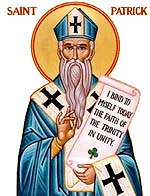 Jacob: It’s based on his writings but not necessarily written by him. But even if it were, this is a guy acknowledging that magic existed as far as he knew, bravely asking God to protect him from it, and then going out and ministering – sacramentally and otherwise – to witches anyway. It’s like the Italian priests who acknowledged plague, acknowledged that they couldn’t understand what was causing plague, and that plague would probably kill them … so they prayed for protection and went out and healed people anyway, even when doing so was futile. Patrick did the same thing for spiritual and – in the view of the people of that day – magical plagues. It created a paradigm in which the mystical, magical, “vveird” (to use the Old English term) world wasn’t squashed or celebrated, but reverenced and called on to something far deeper.
Jonathan: That’s why he’s the saint for our time–because of his ability to combine story, mystery, and theology to re-enchant the world. That’s what we’ve lost. We think it has to be just one, when it needs to be all of them working together.
Jacob: Speaking of story… there’s a really amazing Irish legend, one of many actually, that says a priest was walking down the road when he encountered two wolves. At first he was afraid, but the story goes that the wolves spoke to him and told him that they were in fact werewolves cursed by sin to remain in that form. The shewolf was supposedly dying, and her mate requested that she be given last rights so that she would not be damned. The priest was concerned that he would be breaking some dogmatic rule, but was ultimately convinced by the wolves’ ability to speak and administered the Eucharist to the she-wolf before she passed away. That story, I think, is indicative of a broader view point within Irish Catholicism: that there are just some things that we can’t understand and that, while those things don’t necessarily deserve our endorsement, they do deserve our reverence and respect as being a part of a mysterious world that we as humble human beings cannot totally grasp.
Kevin Johnson: That’s what I wish we still had. But that mindset is often seen in contemporary times as superstitious. “You mean you think there could be fairies or ghosts or werewolves or the paranormal? Don’t you trust science and the explanation of the natural world that has given us so much technology, etc?”
Jacob: It’s important to mention, though, that the view point I mentioned wasn’t all leprechauns and roses. There was really dark crap too. THat kind of reverence for the mysterious comes with some dark territory that we should also learn from and get wise to. We can’t turn a blind eye to the dark, but we can’t try to stamp it out either. We have to take the sacraments and everything the church teaches with us like a Batman toolbelt and be willing to get our hands dirty, but also be humble enough to realize that there are just going to be some things at the end of the day that are a little too weird and a little too dark for us to possibly wrestle with, and furthermore recognize that that stuff belongs to God too.
St. Patrick’s Day is a much-needed festival of the weird (…and a travesty of faux-Irish culture.)
Rebecca Bratten Weiss: I think St Patrick’s day in the United States is a) a travesty of actual Irish culture, but also b) a fascinating indication of our bottled up need for carnivale, as well as the weird and upside down.
Jess: There is still something magical about St Patrick’s day. We make the rivers run green, we throw cabbage from parade floats, we get wildly drunk. There is a Lord of Misrule quality to the day, which the leprechaun embodies.
Kevin: It’s the last of the remnants of the “festival”–which we also see in Mardi Gras–the ancient and medieval world view about the relationship between the natural and supernatural. And the understanding of what ritual and such did/does. The “modern” world view approached it differently and so we are now in the modern and its aftermath. But people still crave to talk about and engage the mystery — that ineffable part of life — and the contemporary world view has no categories for it. We either rationalize it or dismiss it. There is no third box.
Jacob: St Patrick’s Day, Mardi Gras… these festivals are a collection of lots of different pagan/human desires longing to be fulfilled. Desires which, ultimately, only the Church and God can fulfill. For instance, we see in Saint Patrick’s Day and other examples of the “festival” trend Kevin mentions a longing for tradition, rituals, routines, things to look forward to … The Church, in answer, is sitting on literally a calendar of ritual and routine, and it’s worth noting that She invented most of these festivals in the first place. So as far as people’s longing for tradition and ritual goes, we’ve got them covered. We can give them more ritual and routine than they can handle, we can color coordinate the hell out of those rituals, and then we can endow it all with Divine meaning to boot.
Partying on St. Patrick’s Day is your obligation as a Catholic. Sort of. Not really. But you can make a case for it.
Jacob: And another Saint Patty’s Day example, regarding desire: drunkenness, while arguably wrong in most contexts, represents a deeper longing for communion and also, to an extent, a response to human suffering. I say this as a clinical mental health counselor who once mostly served alcoholics and heroin addicts. One learns pretty quickly in that clinical environment that people are either getting drunk to get close to others and to feel intimately connected to those around them — to a degree that they wouldn’t allow themselves to otherwise be vulnerable – or they’re trying to momentarily let go of their pain. The Church has the true answer to both.
Kevin: And drunkenness is about ecstasy. There is a legitimate aspect of the human that engages with transcendence. Stepping outside one’s self. Literal ek static. Our culture doesn’t want to talk about that either. It’s all “self.” Self empowerment. Self help. Etc. But there is an aspect of self that is paradoxically outside of oneself. And if the culture won’t speak to it we get drunk, rave, practice high endurance sports.
Jacob: There’s room in the Church for these customs. There’s room for the revelry. But there’s also room in the customs themselves to be endowed with sacramental meaning. We need to follow St. Patrick’s legacy and get down with the endowing.
Kevin: The arts, when done well, speak to that space [of ecstasy]. Point to it. We need Catholic art … pointing to transcendence … where the word experience doesn’t apply any more.
Jacob: In counseling, we have a rule developed by the Gottman Institute that says that, statistically, a healthy marriage can’t exist unless there’s a 4/1 ratio of positive interactions to criticisms. That’s the same relationship, I think, that the Church needs to have with every given issue. We need to spend 4/5 of the time pointing out what’s good and meaningful, and the other 1/5 of the time pointing out why the other 4 parts haven’t actually gone far enough.
I mean, there’s a reason why addicts and artists like Shakespeare and Warhol loved the Catholic mass. We took their need for something that’d overwhelm them and said, “Yeah, but we can hook you up with sensory overload FOR JESUS.”
As Catholics we’re trapped on this spectrum between fetishizing the old and vintage like a couple of coffee shop hipsters or castrating ourselves liturgically in the name of “welcoming everybody” like a couple of dime store hippies. Instead, we should be focusing on moving towards transcendence and overwhelming people with God. Giving them more that they can handle. That’s been the driving force behind every evangelical, liturgical, artistic, or narrative movement the Church has gotten right over the last 2000 years.
There are lots of ways to celebrate St. Patrick’s Day.
Jonathan: Drink beer and act absurd to the glory of God and to laugh at the princes of the world. Be holy fools.
Rebecca: I always wear black on St Patrick’s day to mourn the evil that the church did in Ireland in the modern world. Like attacking Parnell.
But acting absurd can be meaningful. Not in a Dadaist way, but in a breaking forth sort of way.
Jacob: If we were to humbly and desirously do what Jonathan said, while also accepting some of the meaning that the Church would endow such customs with, the evil will ultimately fall by the wayside. I might be accused of being overly optimistic here, but I’m tired of focusing on evil, be it conservative or liberal. If we just focus on the beautiful and the joyful and the mysterious and the Godly, the evil will just fall away.
However you celebrate St. Patrick’s Day, take some time to meditate on what it is you really desire. Hint: It’s probably not green beer.
Jacob: Whether we’re talking about drunkenness, or partying, or revelry, or desire to believe that werewolves and fairies exist out there in the dark somewhere, we’re still talking about the same thing. We’re talking about desire, as St. Augustine and St. John Paul II and St. Patrick all talked about. If we’re willing to sufficiently question our desires in the motives behind them, we’ll always always end up with God. If we question the longing for communion that erroneously drives us to indulge in green beer, we’re going to end up in communion with God. If we question the need for celebration that ultimately leads us to the ritual and routine of the church, we’re going to end up with God. If we go out and set traps for werewolves … well, I honestly don’t know what will happen, but I bet it will lead us to God.
Desire is the first thing, but humility is the second thing. It honestly takes a lot of humility to realize that there is stuff out there in the dark that we can’t wrestle with, and that furthermore would probably eat us if we let it. But it takes even more humility to realize that such stuff isn’t bigger than our God, and that, through baptism, He has given us the capacity to look the dark in the eye.
Rebecca; God often comes through the dark.
Kevin: Yes! God is the dazzling dark.
Happy St. Patrick’s Day, Pilgrims!

Next Post

March 16, 2017 Introducing Brian Jocks, Sick Pilgrim's Illustrator
Browse Our Archives
Select a Category Advent Approaching Mystery art Book Reviews Catholic Ghost Story Catholicism community Confession Current Events Dark Devotional Deconstruction Deconstruction Fellow Travelers I Want To Believe Interview Laudato Si Lent Mary Matthew's Letters Movie Reviews Music Reviews Our Charism Personal Essay Pilgrims Pope Francis Popular Piety Prayer Publishing Richard Beck Saints Satan Sheed and Ward Sick Pilgrim Charism Sick Pilgrim Chats Sick Pilgrim Events Sick Pilgrim Travelin' Medicine Show Sick Pilgrimage to The West Sick Pilgrims Small Joys Spiritual Autobiography Spooky Files of Ave Maria Magazine Spooky October Spooky Pilgrim Spooky Pilgrimage Strange Journey The Inklings Things Keeping Us Going Trying to Say God TV Reviews Uncategorized women in the Catholic Church Wonder Podcast Write the Vision
Select a Month February 2022 January 2022 December 2021 November 2021 October 2021 September 2021 August 2021 July 2021 June 2021 May 2021 April 2021 March 2021 February 2021 January 2021 December 2020 April 2020 March 2020 February 2020 January 2020 December 2019 October 2019 September 2019 July 2019 June 2019 May 2019 April 2019 March 2019 February 2019 January 2019 December 2018 November 2018 October 2018 September 2018 August 2018 July 2018 June 2018 May 2018 April 2018 March 2018 February 2018 January 2018 December 2017 November 2017 October 2017 September 2017 August 2017 July 2017 June 2017 May 2017 April 2017 March 2017 February 2017 January 2017 December 2016 November 2016 October 2016 September 2016 August 2016 July 2016 June 2016 May 2016 April 2016 March 2016 February 2016 January 2016 December 2015
Follow Us!
TAKE THE
Religious Wisdom Quiz
What is the name for the Jewish prayer shawl?
Select your answer to see how you score.
Kippah Tallit Mezuzah Tefillin
Related posts from Sick Pilgrim
Dark Devotional: Holding the Door for Jesus

Second Sunday in Advent: Let Me Love You...
Things Keeping Us Going: All Saints Edition
Dark Devotional: Am I an Atheist?
TRENDING AT PATHEOS Catholic

Rejecting Doom: Christian Hope And Human Action
Christianity is a religion of hope. We are to have hope and...

It’s What Comes From Within Which Matters
One of the most difficult things for us to understand is why...

Why I Choose the Eucharist Over the Sermon
Choose the Eucharist, Not the Sermon What are we supposed to get...

5 Design Elements Found in Spiritually Rooted Homes
Putting Spirituality Into Home Decor Our homes are more than our living...

Credo: A Story of God Told with the...
About 10 years ago, I began to imagine a personal "Credo" that...

The Anatomy of Divine Revelation in Catholic Thought
The claim that God has made Himself known to human beings is...
view all Catholic blogs
Ad-Free & Subscriber Log-In Subscription Support
- About Us
- 2026 Calendar
- Videos
- Podcasts
- Library of World Religions
- Faith In Media Tracker
- Advertise With Us
- Write for Us
- Privacy Policy
- Terms of Service
- Do Not Sell My Data
- Contact Us
- Radiant Digital
- Manage Newsletter Subscriptions
- Unsubscribe From Notifications
- Sitemap
Copyright 2008-2026, Patheos. All rights reserved.
Subscription Support Ad-Free & Subscriber Log-In
Follow Patheos