
BuddhistCatholicContemplativeEvangelicalGeneral ChristianHinduJewishLatter-day SaintMuslimNew VisionsProgressive Christian
Beliefs
- Buddhist
- Catholic
- Contemplative
- Evangelical
- General Christian
- Hindu
- Jewish
- Latter-day Saint
- More Voices
- Muslim
- New Visions
- Pagan
- Progressive Christian
Topics
- Religion News
- Food and Religion
- Sports and Religion
- Religious Art
- Religious Music and Entertainment
- Religious Events
- History and Religion
- Style and Religion
- Politics and Religion
- Women in Religion
- Recreation Outdoors and Religion
- Business Finance and Religion
- Careers Workplace and Religion
- Education and Religion
- Family Parenting and Religion
- Health Fitness and Religion
- Home and Religion
- Relationships and Religion
- Technology and Religion
- Travel and Religion
Columnists
- Buddhist Columnists
- Business Finance and Religion Columnists
- Careers Workplace and Religion Columnists
- Catholic Columnists
- Contemplative Columnists
- Education and Religion Columnists
- Evangelists Columnists
- Family Parenting and Religion Columnists
- General Christian Columnists
- Health Fitness and Religion Columnists
- Hindu Columnists
- History and Religion Columnists
- Home and Religion Columnists
- Jewish Columnists
- More Voices Columnists
- Latter Day Columnists
- Muslim Columnists
- New Visions Columnists
- Nonreligious Columnists
- Pagan Columnists
- Politics and Religion Columnists
- Progressive Columnists
- Recreation Outdoors and Religion Columnists
- Relationships and Religion Columnists
- Religion News Columnists
- Religious Art Columnists
- Religious Events Columnists
- Religious Music and Entertainment Columnists
- Sports and Religion Columnists
- Style and Religion Columnists
- Technology and Religion Columnists
- Travel and Religion Columnists
- Women in Religion Columnists
Resource Library
- 2026 Calendar
- Library of World Religions
- The 100 Most Holy Places on Earth
- Patheos Answers
- Podcasts
- Videos
- Faith Leaders Database
- Anglican Episcopalian
- Bahai
- Baptist
- Buddhism
- Christianity
- Confucianism
- Eastern Orthodoxy
- Hinduism
- Holiness and Pentecostal
- ISKCON
- Islam
- Judaism
- Lutheran
- Methodist
- The Church of Jesus Christ of Latter-day Saints
- New Age
- Paganism
- Presbytarian and Reformed
- Protestantism
- Religion Behind the Scenes
- Roman Catholic
- Scientology
- Shia Islam
- Sikhism
- Sufism
- Sunni Islam
- Taoism
- Zen
- See all religions
Research Tools
 Ad-Free & Subscriber Log-In Subscription Support
Ad-Free & Subscriber Log-In Subscription Support
Follow Patheos 

- Trending:
- Forgiveness
- |
- Marriage
- |
- Consciousness
- |
- Death Penalty
- |
- Election
- |
- Halloween
 Sick Pilgrim
- Home
- Catholic
- Dark Devotional: Lazarus
Dark Devotional: Lazarus
Last updated on: April 3, 2017 at 9:59 am by Guest Contributor
Dark Devotional: Lazarus 2017-04-03T09:59:27-05:00 Guest Contributor
Patheos Explore the world's faith through different perspectives on religion and spirituality! Patheos has the views of the prevalent religions and spiritualities of the world.
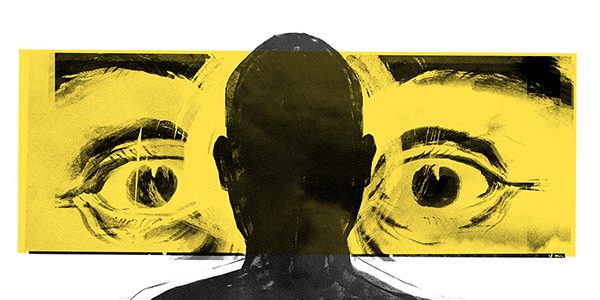
Lazarus, original art by Brian Jocks
My uncle died a few weeks before Easter last year, an uncle who lived a complicated life wrought with struggle and isolating mental illness. Given the difficult task of planning a way to commemorate his life, my mom called to ask me if I would be the one to officiate the services. Not only had I not spoken to my uncle in about two decades, but he was a paranoid alcoholic, an angry recluse who was estranged from his family. Officiate his funeral?! To say what exactly? His life seemed uncorrectable and reflecting on it gracefully sounded unachievable.
Over the phone, I shut my eyes tight and said, “I can’t, I can’t, I can’t.”
Then I heard God whisper, “I can.”
_______________________________________
Jesus was close to Mary, Martha and their brother Lazarus. When Martha called out to the Lord because her brother was dying, He stayed away. He sat still for her heart break. He didn’t step in. He didn’t intervene. Not during trial and turmoil, sickness and sadness, not even at the last hour.
The sisters were forced to say goodbye to their brother, plan a funeral, and commune with mourners all without the support of their dear friend. In the midst of their grief, they had to face what must have been a mysterious silence from Jesus.
When Martha heard Jesus was finally coming, she set out to meet Him.
I wonder what must have been going through her mind as she made her disenchanted way towards the Lord?
I imagine she saw His frame from a long way off. I suppose she recognized His gait as He came nearer… and then nearer. Like me, would she have rehearsed a silver-tongued scene between the two of them where she was all at once breezy, yet razor sharp? Would she feign facetious concern about his time away with a casual, “How was your trip? No sand storms, I hope. Good time, was it? Healing strangers? Yeah, yeah, I heard, born blind. Hey listen, don’t worry, the one you loved, he asked for you several times, but we assured him you probably hadn’t heard he was so ill. The funeral was nice.”
I’m pretty sure, if I were Martha, my glare would have been arctic, and my smile would have been tight. My voice would have been measured with just the right amount of lilt so I could postulate compassion instead of calculation in case throwing a passive agressive temper tantrum with God all came crashing down. But that’s just me.
Martha and Mary, famously unalike, were actually quite respectful with Jesus and delivered the same statement, putting it to Him plainly, “If you would have come my brother wouldn’t have had to die.”
I read that and my heart breaks as I feel alongside them in this moment. The betrayal they must have experienced, certainly no longer able to pretend that Jesus simply didn’t get their message, but instead, He matter of factly chose not to answer it. Polite and courteous, but nuanced, behind their comment, I hear questions. “What’s the point now, Jesus? He’s already dead. I called for you days ago and we had a funeral without you. You wouldn’t even come. Are we friends or not? Are you a friend to me at all?”
Their response is familiar to me because death, pain, rejection, and frankly far less dramatic situations can all send me into a storm of questioning the Lord.
It has potential to go like this: God if you’re there… and if you love me… then…You’ll fix this situation for me.
Perhaps much like Martha and Mary, I think I know how the Lord can love me the best. I make a demand or beg for a solution and then I wait for Him to show up when I have suggested. And if He doesn’t? Well, He obviously didn’t hear me. He is obviously punishing me. He obviously doesn’t care.
Upon inspection I have learned that my demands aren’t really about my desires. Not really. My demands are more often about my desire to know that He cares. What I am after is proof that Jesus will show up if I ask Him to. That would mean He is willing to involve Himself in my daily life in a way that matters to me, that He loves me in a way I understand as love.
I use demands as a strategy to try to find out who I am dealing with.
Are you a friend to me at all?
In my attempt to find out who I am dealing with, I look for ways to see and touch God’s devotion. And there seems to be something about my humanity that insists on measuring His devotion my very own way.
In John’s gospel, even though God’s word reads contradictorily and Jesus’ actions seem inconsistent– He loved him so he stayed two days longer— I simply have to trust that Jesus always reconciles.
True, Jesus isn’t explaining Himself gently over lunch. But during His silent moments can I still wait and trust that if God isn’t rushing to heal, then there must something to gain from the hurt? Can I lean into the uncomplicated parts of His character when I am confounded and trust that even if He is slow in coming, He is still coming?
Because if God is good, could I ever know how good? If God is powerful, is it possible for me to know how powerful?
Mary and Martha trusted Jesus but only minimally when He countered their expectations. And it wasn’t just his kindness they questioned. They were skeptical of His power, too.
When Jesus tells Martha her brother will rise again, Martha acknowledges what she believes Jesus is capable of in the heavenly realms, on His turf, where He is at home. “I know that he will rise again in the resurrection on the last day,” she says. But Martha couldn’t fully acknowledge the extent of Jesus’ power in the here and now. She trusted Jesus to do godly things in godly ways, but in the midst of their humanity? No way. In the thick of their four day stench? She couldn’t conceive it.
“Take me there,” He says. “Remove the barrier”.
Jesus asked her if she believed. And then He raised Lazarus healed.
This story makes me feel a lot. Some parts make me angry. Other parts make me sad. But when I consider everyone’s shock after the resurrection? Now that’s just fun. Maybe it’s what led up to the dramatic scene. Of course, there’s Mary and Martha frantically trying to guess the workings of the Lord and feeling abandoned when they don’t get it right. Then there’s doubting Thomas wanting to die along with Lazarus. For what, solidarity? No one is able to make sense of Jesus’ tears if he loved Lazarus so. Lastly, Martha is insistent that perhaps four days of what death can do to a body is beyond the Lord. All of their confusion, their wobbly human faith, their doubt, their suspicion– the whole thing; it’s chaos!
And then there’s Jesus. He arrives with calculation, compassion, power and divinty. He allows His heart to break and then thanks God for answering His prayer before He even prayed it.
So controlled.
Humanity verses Divinity. Such disparate responses in the throes of loss.
And it is glorious! All of it. We are told that it is so. “This is for the glory of God.”
I think the lesson is accepting our lives, welcoming them wholly, and in a way consenting to the external events that confront us knowing that drawing good out of good and bad out of bad is something easily managed. But drawing good out of evil? It is something only God can do in His love and wisdom.
Our only job is to believe that it is so. The raising of Lazarus invites us to this profound degree of trust. Do you believe? That’s what Jesus wanted to know.
We buried my uncle that day in the Spring.
His troubles made up most of his life and there was really no way to account for his time here on earth without mentioning them. As we gathered together, six people who tried to love him anyway, we stared at our feet and silently wondered if all was lost, if it was far too late. We wrung our hands ready to give up and accept death. As mourners we sought only to contain the ruin, or bury the loss. And as I stood there in front of our intimate crowd, looking at the readings for that day, it became clear that the only story to tell was the story of Lazarus. We grieved and read and learned that Jesus is coming, coming to heal no matter the shambles and despite the turmoil. We held hands and felt hope that there is no estrangement, no addiction, no mental illness, no disease, no death, nothing in heaven or on earth that can place the world or anyone in it outside of God’s redemption.
When Jesus heals our scrapes, our minor bumps and bruises, it’s a delight, an enchantment, a novelty. But when He takes us to our furthest edge to just pull us back again, when He literally brings us back to life, we’re undone to see even more of His power.
Lazarus’s resurrection foreshadowed His own. We are privileged to know beyond question that death has nothing on our God who specializes in restoration, redemption and resurrection.
The times that feel godless, they may shake my world but somehow, in a way only God could work out, they are strengthening my faith. My prayers, I’m learning, aren’t a script for the Lord to show up when I have written Him in. My prayers are a way to surrender my heart knowing the offering is never contingent upon swift answers. Because if Lazarus has taught me anything at all, it is that desparation best showcases our Lord’s work.
I can’t. I can’t. I can’t.
I can.
***
 Allison M. Sullivan is the author of the essay collection Rock, Paper, Scissors. She lives in Bryan, Texas, with her husband, Seth, and their four children, Sylas, Amelia, Blaise, and Wren. While in the trenches of motherhood, she’s currently applying her degrees in special education and cynology outside of the classroom. She is on the board of Elizabeth House Maternity Home and teaches a re-entry course at a women’s prison. She also teaches yoga.
Previous Post

March 30, 2017
Sick Confessions: I'm a Bad Pray-er

Browse Our Archives
Select a Category Advent Approaching Mystery art Book Reviews Catholic Ghost Story Catholicism community Confession Current Events Dark Devotional Deconstruction Deconstruction Fellow Travelers I Want To Believe Interview Laudato Si Lent Mary Matthew's Letters Movie Reviews Music Reviews Our Charism Personal Essay Pilgrims Pope Francis Popular Piety Prayer Publishing Richard Beck Saints Satan Sheed and Ward Sick Pilgrim Charism Sick Pilgrim Chats Sick Pilgrim Events Sick Pilgrim Travelin' Medicine Show Sick Pilgrimage to The West Sick Pilgrims Small Joys Spiritual Autobiography Spooky Files of Ave Maria Magazine Spooky October Spooky Pilgrim Spooky Pilgrimage Strange Journey The Inklings Things Keeping Us Going Trying to Say God TV Reviews Uncategorized women in the Catholic Church Wonder Podcast Write the Vision
Select a Month February 2022 January 2022 December 2021 November 2021 October 2021 September 2021 August 2021 July 2021 June 2021 May 2021 April 2021 March 2021 February 2021 January 2021 December 2020 April 2020 March 2020 February 2020 January 2020 December 2019 October 2019 September 2019 July 2019 June 2019 May 2019 April 2019 March 2019 February 2019 January 2019 December 2018 November 2018 October 2018 September 2018 August 2018 July 2018 June 2018 May 2018 April 2018 March 2018 February 2018 January 2018 December 2017 November 2017 October 2017 September 2017 August 2017 July 2017 June 2017 May 2017 April 2017 March 2017 February 2017 January 2017 December 2016 November 2016 October 2016 September 2016 August 2016 July 2016 June 2016 May 2016 April 2016 March 2016 February 2016 January 2016 December 2015
Follow Us!
TAKE THE
Religious Wisdom Quiz
Who predicted Persia's rise?
Select your answer to see how you score.
Jeremiah Ezekiel Isaiah Daniel
Related posts from Sick Pilgrim

Dark Devotional: The Firelight of Life

Dark Devotional: Let Me Smite Him

Dark Devotional: Woe to Me, for I Have...

TRENDING AT PATHEOS Catholic

Rejecting Doom: Christian Hope And Human Action
Christianity is a religion of hope. We are to have hope and...

It’s What Comes From Within Which Matters
One of the most difficult things for us to understand is why...

Why I Choose the Eucharist Over the Sermon
Choose the Eucharist, Not the Sermon What are we supposed to get...

5 Design Elements Found in Spiritually Rooted Homes
Putting Spirituality Into Home Decor Our homes are more than our living...

Credo: A Story of God Told with the...
About 10 years ago, I began to imagine a personal "Credo" that...

The Anatomy of Divine Revelation in Catholic Thought
The claim that God has made Himself known to human beings is...
view all Catholic blogs
Ad-Free & Subscriber Log-In Subscription Support
- About Us
- 2026 Calendar
- Videos
- Podcasts
- Library of World Religions
- Faith In Media Tracker
- Advertise With Us
- Write for Us
- Privacy Policy
- Terms of Service
- Do Not Sell My Data
- Contact Us
- Radiant Digital
- Manage Newsletter Subscriptions
- Unsubscribe From Notifications
- Sitemap
Copyright 2008-2026, Patheos. All rights reserved.
Subscription Support Ad-Free & Subscriber Log-In
Follow Patheos