
BuddhistCatholicContemplativeEvangelicalGeneral ChristianHinduJewishLatter-day SaintMuslimNew VisionsProgressive Christian
Beliefs
- Buddhist
- Catholic
- Contemplative
- Evangelical
- General Christian
- Hindu
- Jewish
- Latter-day Saint
- More Voices
- Muslim
- New Visions
- Pagan
- Progressive Christian
Topics
- Religion News
- Food and Religion
- Sports and Religion
- Religious Art
- Religious Music and Entertainment
- Religious Events
- History and Religion
- Style and Religion
- Politics and Religion
- Women in Religion
- Recreation Outdoors and Religion
- Business Finance and Religion
- Careers Workplace and Religion
- Education and Religion
- Family Parenting and Religion
- Health Fitness and Religion
- Home and Religion
- Relationships and Religion
- Technology and Religion
- Travel and Religion
Columnists
- Buddhist Columnists
- Business Finance and Religion Columnists
- Careers Workplace and Religion Columnists
- Catholic Columnists
- Contemplative Columnists
- Education and Religion Columnists
- Evangelists Columnists
- Family Parenting and Religion Columnists
- General Christian Columnists
- Health Fitness and Religion Columnists
- Hindu Columnists
- History and Religion Columnists
- Home and Religion Columnists
- Jewish Columnists
- More Voices Columnists
- Latter Day Columnists
- Muslim Columnists
- New Visions Columnists
- Nonreligious Columnists
- Pagan Columnists
- Politics and Religion Columnists
- Progressive Columnists
- Recreation Outdoors and Religion Columnists
- Relationships and Religion Columnists
- Religion News Columnists
- Religious Art Columnists
- Religious Events Columnists
- Religious Music and Entertainment Columnists
- Sports and Religion Columnists
- Style and Religion Columnists
- Technology and Religion Columnists
- Travel and Religion Columnists
- Women in Religion Columnists
Resource Library
- 2026 Calendar
- Library of World Religions
- The 100 Most Holy Places on Earth
- Patheos Answers
- Podcasts
- Videos
- Faith Leaders Database
- Anglican Episcopalian
- Bahai
- Baptist
- Buddhism
- Christianity
- Confucianism
- Eastern Orthodoxy
- Hinduism
- Holiness and Pentecostal
- ISKCON
- Islam
- Judaism
- Lutheran
- Methodist
- The Church of Jesus Christ of Latter-day Saints
- New Age
- Paganism
- Presbytarian and Reformed
- Protestantism
- Religion Behind the Scenes
- Roman Catholic
- Scientology
- Shia Islam
- Sikhism
- Sufism
- Sunni Islam
- Taoism
- Zen
- See all religions
Research Tools
 Ad-Free & Subscriber Log-In Subscription Support
Ad-Free & Subscriber Log-In Subscription Support
Follow Patheos 

- Trending:
- Forgiveness
- |
- Marriage
- |
- Consciousness
- |
- Death Penalty
- |
- Election
- |
- Halloween
 Sick Pilgrim
- Home
- Catholic
- Dark Devotional: Baptism in the Crapper
Dark Devotional: Baptism in the Crapper
Last updated on: January 9, 2017 at 6:20 pm by Guest Contributor
Dark Devotional: Baptism in the Crapper 2017-01-09T18:20:01-05:00 Guest Contributor
Patheos Explore the world's faith through different perspectives on religion and spirituality! Patheos has the views of the prevalent religions and spiritualities of the world.
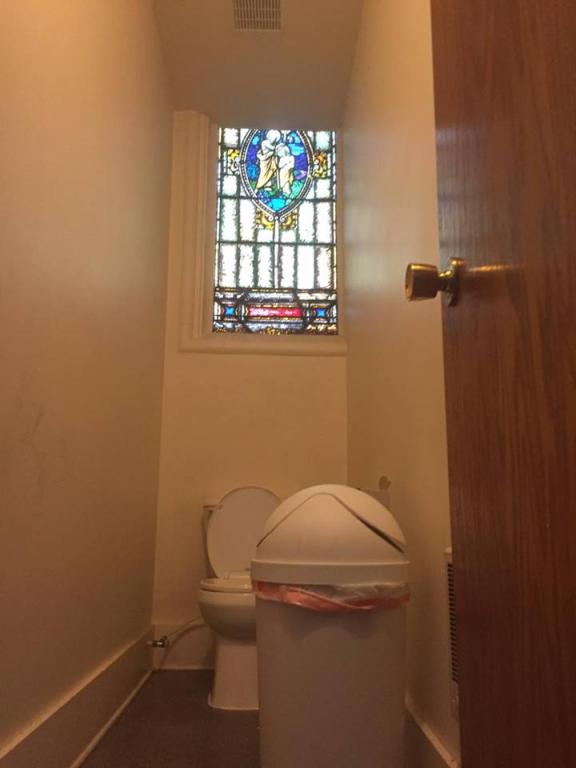
My parish has persevered for over a century, resisting many of the trends that reduced the religious experience from the quest for transcendence to something a little more relevant, a little bit folksy, perhaps even tacky, and tackiness only ceases to be a sin when certain aesthetes critique the religious practices of apparently lesser souls. Both the interior and exterior of our parish are monuments to Tridentine beauty, and the choir doesn’t sing “Mary, Did You Know?” at Christmas time anymore thanks to the liturgical guidance of the last two pastors.
Still, we own a secret shame. Somewhere along the way, whether for the sake of utility and creature comfort or compromise with modern church design, the baptismal font on the left side of the narthex was replaced with a restroom. I imagine there are longtime parishioners, once infants dressed in white and baptized in this spot, who answer nature’s call and sit on the toilet below the stained glass image of Jesus being baptized by John in the Jordan River, and if they are anything like me, they reflect on how much of their crap Jesus has had to wade through just to get them to heaven.
I realize this line of thinking about defecation and the spiritual life is both sketchy and unoriginal. My contemporaries may recall the Golgothan shit demon from Kevin Smith’s Dogma (1999), but I’m not wanting to court the wrath of the Catholic League. I’m referring to someone who was definitely more vulgar and perhaps even more heretical than Kevin Smith, none other than Martin Luther, who once had an argument with the devil while sitting on the toilet and proclaimed, “I am cleansing my bowels and worshipping God Almighty; You deserve what descends and God what ascends.”
 Golgothan shit demon, from Dogma
The father of the Reformation claimed to have experienced a number of spiritual revelations on the toilet, and he had a bizarre predilection for using feces. This use included the metaphorical, teaching that justification was imputed to Christians like snow covering dung and thus denying the transformative power of God’s grace to truly make us new creations, but it extended to the literal, using opposing religious tracts as toilet paper which would be sent back to the authors.
Luther’s shitty behavior even got the better of St. Thomas More. More desired to “throw back into your paternity’s shitty mouth, truly the shit-pool of all shit, all the muck and shit which your damnable rottenness has vomited up, and to empty out all the sewers and privies onto your crown divested of the dignity of the priestly crown.” More, the patron saint of statesmen, would also write that someone should “shit into (Luther’s) mouth,” that Luther “farts anathema,” and was a “shit-demon.” Perhaps it’s not a coincidence that Golgothan creator Kevin Smith is a fan of the More biopic A Man for All Seasons (1966), although the film version of the martyred saint is quite sanitized.
But enough about the crappy relationship between Catholics and Protestants. Today is the celebration of the Baptism of the Lord, and I’m writing a dark devotional inspired by the juxtaposition of a lovely stained glass image above a commode that replaced a baptismal font. This is not the language of polite pieties; indeed, it’s difficult to talk about. We Catholics believe man is deprived rather than depraved as a result of original sin, that the image of God has not been erased, and that concupiscence is not a sin. We are the new creation of grace. We profess Christian hope in its fullness. But then we consider our sins and how we have been sinned against by our coreligionists. Martin Luther once exclaimed, “I am ripe shit, so is the world a great wide asshole; eventually we will part.” What sick pilgrim hasn’t despaired with similar world weariness, church weariness even, and above all, self loathing?
When Johnny Cash covered Nine Inch Nails’s epic ballad of regret “Hurt”, he effectively cleaned up Trent Reznor’s lyrics. Reznor wrote, “I wear this crown of shit upon my liar’s chair,” and Cash changed the word “shit” to “thorns.” I don’t think Cash was pandering to an amen choir of goody two shoes whose virgin ears needed protecting. The shit was still explicit if unspoken in the rest of Reznor’s lyrics, but with this change of one word, the song spoke a profound truth about our humanity being wrapped up in Christ’s passion. The late Father Benedict Groeschel in his meditations on the Rosary identified Christ’s crowning with thorns as his identification with all of our anxieties and mental maladies. New creatures that we are, we nevertheless hurt ourselves by retaining our crown of thorns, our crown of shit, our sense of being unlovable and irredeemable. (N.B. Neither Groeschel nor I nor any spiritually balanced person nor any somewhat rational Sick Pilgrim believes Christ’s passion “did it all” in regards to treating mental illness. The prosperity gospel moves from being theologically illiterate to being poisonous in this case. Please keep taking your meds and seeing your therapist.)
“Hurt” ends with an impossible wish of starting again a million miles away where the singer might keep himself. Baptism is our new start, our initiation into the divine life of the Trinity, where we find theological virtues and spiritual gifts, where we begin to belong to Christ forever. All of that and more is happening this side of kingdom come. But how will we ever learn to live like this? One of the overlapping story arcs in P.T. Anderson’s Magnolia (1999) may give us a clue.
Officer Jim Kurring, portrayed by John C. Reilly, is a divorcée, a bumbling cop who has lost his gun, and apparently a Catholic (he crosses himself when he prays). Claudia Gator (Melora Walters) suffers from the trauma of childhood sexual abuse and trades sex for drugs. Jim is sent to check on Claudia because her loud music is disturbing the neighbors, and instead of finding anything suspicious, he awkwardly flirts with her and gets a date.
During the date, Claudia proposes complete honesty as the foundation of their relationship, saying “I’ll tell you everything and you tell me everything and maybe we can get through all the piss, shit and lies that kill other people.” Jim’s initial shock at Claudia’s vulgarity and polite apology for the discomfort he caused prompts Claudia to retreat from the table. She comes back, thinking he’s got it all together and tries to prepare him for her messy self-revelation when Jim confesses losing his gun and all of his insecurities. They kiss, and she offers him these heartbreaking words, “Now that I’ve met you, would you object to never seeing me again?”
How often is this our attitude toward Christ who bends down towards us in love when the moment demands our confession. Jim, the poor imitator of Christ that he is, rises to the occasion, seeking out Claudia at the end of the film, reminding her she is good and beautiful, and that he won’t stand for her self hatred.
He says, “You want to be with me, then be with me.”
The film ends with Claudia smiling into the camera with all of the radiance of a person who has been transformed by love. Sure, she may stumble, and Jim habitually stumbles. So do you and I, but be assured there’s grace that fills our every defect. If you’re struggling with the promises of your baptism, confess it. Let Jesus reveal his love and remind you who you are.
Toby D’Anna is a Louisiana native and former nondenominational charismatic who entered the Catholic Church in 1999. He and his wife Emily live in Tacoma, Washington. He teaches middle school English, assists in his parish’s RCIA program, and is a member of Communion and Liberation, a lay ecclesial movement within the Catholic Church.
Previous Post

January 6, 2017
Dark Devotional: Joy to the World. Darkness Covers the Earth
Next Post

January 10, 2017 Praying with Depression (and Children)
Browse Our Archives
Select a Category Advent Approaching Mystery art Book Reviews Catholic Ghost Story Catholicism community Confession Current Events Dark Devotional Deconstruction Deconstruction Fellow Travelers I Want To Believe Interview Laudato Si Lent Mary Matthew's Letters Movie Reviews Music Reviews Our Charism Personal Essay Pilgrims Pope Francis Popular Piety Prayer Publishing Richard Beck Saints Satan Sheed and Ward Sick Pilgrim Charism Sick Pilgrim Chats Sick Pilgrim Events Sick Pilgrim Travelin' Medicine Show Sick Pilgrimage to The West Sick Pilgrims Small Joys Spiritual Autobiography Spooky Files of Ave Maria Magazine Spooky October Spooky Pilgrim Spooky Pilgrimage Strange Journey The Inklings Things Keeping Us Going Trying to Say God TV Reviews Uncategorized women in the Catholic Church Wonder Podcast Write the Vision
Select a Month February 2022 January 2022 December 2021 November 2021 October 2021 September 2021 August 2021 July 2021 June 2021 May 2021 April 2021 March 2021 February 2021 January 2021 December 2020 April 2020 March 2020 February 2020 January 2020 December 2019 October 2019 September 2019 July 2019 June 2019 May 2019 April 2019 March 2019 February 2019 January 2019 December 2018 November 2018 October 2018 September 2018 August 2018 July 2018 June 2018 May 2018 April 2018 March 2018 February 2018 January 2018 December 2017 November 2017 October 2017 September 2017 August 2017 July 2017 June 2017 May 2017 April 2017 March 2017 February 2017 January 2017 December 2016 November 2016 October 2016 September 2016 August 2016 July 2016 June 2016 May 2016 April 2016 March 2016 February 2016 January 2016 December 2015
Follow Us!
TAKE THE
Religious Wisdom Quiz
Who said, "The Lord said to my Lord, ‘Sit at my right hand’"?
Select your answer to see how you score.
Isaiah Moses Solomon David
Related posts from Sick Pilgrim

Dark Devotional: The Firelight of Life

Dark Devotional: Let Me Smite Him

Dark Devotional: Woe to Me, for I Have...

TRENDING AT PATHEOS Catholic

Rejecting Doom: Christian Hope And Human Action
Christianity is a religion of hope. We are to have hope and...

It’s What Comes From Within Which Matters
One of the most difficult things for us to understand is why...

Why I Choose the Eucharist Over the Sermon
Choose the Eucharist, Not the Sermon What are we supposed to get...

5 Design Elements Found in Spiritually Rooted Homes
Putting Spirituality Into Home Decor Our homes are more than our living...

Credo: A Story of God Told with the...
About 10 years ago, I began to imagine a personal "Credo" that...

The Anatomy of Divine Revelation in Catholic Thought
The claim that God has made Himself known to human beings is...
view all Catholic blogs
Ad-Free & Subscriber Log-In Subscription Support
- About Us
- 2026 Calendar
- Videos
- Podcasts
- Library of World Religions
- Faith In Media Tracker
- Advertise With Us
- Write for Us
- Privacy Policy
- Terms of Service
- Do Not Sell My Data
- Contact Us
- Radiant Digital
- Manage Newsletter Subscriptions
- Unsubscribe From Notifications
- Sitemap
Copyright 2008-2026, Patheos. All rights reserved.
Subscription Support Ad-Free & Subscriber Log-In
Follow Patheos