
BuddhistCatholicContemplativeEvangelicalGeneral ChristianHinduJewishLatter-day SaintMuslimNew VisionsProgressive Christian
Beliefs
- Buddhist
- Catholic
- Contemplative
- Evangelical
- General Christian
- Hindu
- Jewish
- Latter-day Saint
- More Voices
- Muslim
- New Visions
- Pagan
- Progressive Christian
Topics
- Religion News
- Food and Religion
- Sports and Religion
- Religious Art
- Religious Music and Entertainment
- Religious Events
- History and Religion
- Style and Religion
- Politics and Religion
- Women in Religion
- Recreation Outdoors and Religion
- Business Finance and Religion
- Careers Workplace and Religion
- Education and Religion
- Family Parenting and Religion
- Health Fitness and Religion
- Home and Religion
- Relationships and Religion
- Technology and Religion
- Travel and Religion
Columnists
- Buddhist Columnists
- Business Finance and Religion Columnists
- Careers Workplace and Religion Columnists
- Catholic Columnists
- Contemplative Columnists
- Education and Religion Columnists
- Evangelists Columnists
- Family Parenting and Religion Columnists
- General Christian Columnists
- Health Fitness and Religion Columnists
- Hindu Columnists
- History and Religion Columnists
- Home and Religion Columnists
- Jewish Columnists
- More Voices Columnists
- Latter Day Columnists
- Muslim Columnists
- New Visions Columnists
- Nonreligious Columnists
- Pagan Columnists
- Politics and Religion Columnists
- Progressive Columnists
- Recreation Outdoors and Religion Columnists
- Relationships and Religion Columnists
- Religion News Columnists
- Religious Art Columnists
- Religious Events Columnists
- Religious Music and Entertainment Columnists
- Sports and Religion Columnists
- Style and Religion Columnists
- Technology and Religion Columnists
- Travel and Religion Columnists
- Women in Religion Columnists
Resource Library
- 2026 Calendar
- Library of World Religions
- The 100 Most Holy Places on Earth
- Patheos Answers
- Podcasts
- Videos
- Faith Leaders Database
- Anglican Episcopalian
- Bahai
- Baptist
- Buddhism
- Christianity
- Confucianism
- Eastern Orthodoxy
- Hinduism
- Holiness and Pentecostal
- ISKCON
- Islam
- Judaism
- Lutheran
- Methodist
- The Church of Jesus Christ of Latter-day Saints
- New Age
- Paganism
- Presbytarian and Reformed
- Protestantism
- Religion Behind the Scenes
- Roman Catholic
- Scientology
- Shia Islam
- Sikhism
- Sufism
- Sunni Islam
- Taoism
- Zen
- See all religions
Research Tools
 Ad-Free & Subscriber Log-In Subscription Support
Ad-Free & Subscriber Log-In Subscription Support
Follow Patheos 

- Trending:
- Forgiveness
- |
- Marriage
- |
- Consciousness
- |
- Death Penalty
- |
- Election
- |
- Halloween
 Sick Pilgrim
- Home
- Catholic
- Feast of St. Nicholas: Slap a Heretic Day. Or Why Are We Hitting Ourselves?
Feast of St. Nicholas: Slap a Heretic Day. Or Why Are We Hitting Ourselves?
Last updated on: December 4, 2016 at 11:59 pm by Jonathan Ryan
Feast of St. Nicholas: Slap a Heretic Day. Or Why Are We Hitting Ourselves? 2016-12-04T23:59:47-05:00 Jonathan Ryan
Patheos Explore the world's faith through different perspectives on religion and spirituality! Patheos has the views of the prevalent religions and spiritualities of the world.
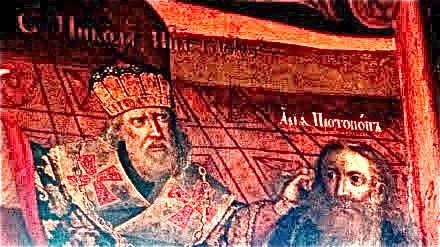
Icon of St. Nicholas Slapping a Heretic.
Tuesday is the feast day of St. Nicholas and as usual, the story of him slapping Arius in the face during the Council of Nicea is making the rounds on social media. To be honest, I used to think the story was funny and I applauded the spirit. That is, get so passionate about truth that you end up punching someone in the mouth over it.
In my Mark Driscoll Presbyterian Minister Days, I engaged in many passionate and useless theological debates with people who disagreed with me. As a staunch Calvinist, I would argue with Armenians, Anglicans, Atheists, and (shudder) Catholics.
And, while I didn’t actually slap anyone in the face, I had “the look.” Someone would start talking what I deemed theological nonsense and my face would scrunch in a grimace. I realize now I might as well have just punched them in the face. Indeed, my undisguised scorn probably did more damage than my fist ever would.
When I became a Catholic, I delved further into the story of St. Nicholas. What I found was not the heretic-slapping ideologue I had previously embraced. Instead, I found the courageous fourth-century bishop of Myra who endured extreme torture and was one of the most merciful bishops of the early church. By all credible accounts, he financially redeemed three daughters of a poor man so they would not be forced into prostitution. This doesn’t sound like a man who would go around slapping people. He was obviously passionate about the truth, since he endured persecution. But that love of truth developed a passion for pastoral mercy.
Lately, I’ve been thinking about this story in regards to ongoing battles between the so-called “conservative” and “liberal” wings of the Catholic Church. This is best illustrated in the latest flap when four Cardinals publicly (contrary to the usual respectful protocol to do so in private) asked Pope Francis to clarify Amoris laetitia, especially in the areas of divorced people receiving communion. Scott Eric Alt and Rebecca Bratten Weiss both offer contrasting opinions on the matter here at Patheos.
But I wonder if we don’t miss something that is vitally important in this entire discussion. That is, the beautiful grace-filled tension between the Magisterium (or Teaching of the Church) and the pastoral concerns of the church.
When I converted, everyone in the Protestant world was surprised, thinking I would go the so-called “Liberal Protestant” route. That’s because they underestimated my commitment to historical Christianity. In the Catholic Church, I found a deposit of faith that didn’t change much and if it did, it happened slowly. For me and my wandering life, it’s an unspeakable comfort. This annoys and angers many people, but that may be because some of them are thinking in a superficial way. Consider it. Would you want the Church to change for every historical movement or thought process that happens to become popular? Or change for your personal whim? Or everyone’s whim? Trust me, that never ends well. It’s these historical truths that have enabled the church to do amazing and beautiful things. Indeed, it’s a return to these teachings that often inspires renewal and change movements in the church itself.
On the other hand, we live in a broken and sinful world. Things are often very gray and complicated. Nothing is ever neat and tidy. I’m divorced after sixteen years of marriage. Having gotten an annulment, I was never sacramentally married. Yet, I have three beautiful kids. And my situation is not even close to being as complicated as the countless cases I hear about from various friends across the country. These complications often make us want to do away with absolute truths and live in the nebulous gray. It seems reasonable to do away with the truths of the Church that the so-called right and left wings want to convey.
This, however, makes me realize how much of a heretic I am for wanting that sort of simplicity. Real heretics always want to simplify because it’s easier. There are teachings in the Magisterium that bother me, anger me; instructions I certainly don’t keep. Some of the doctrines of the Church are very hard for me to accept. According to some Catholics on both the right and left, I might rightly be branded a heretic, if not in practice, at least in my heart.
Don’t get me wrong: I believe in the teachings in the Church and see them as the mark I’m stumbling towards in my everyday life. But it’s also true that I’m terrible at them. I’m not very charitable. I don’t give to the poor. I abuse God’s creation on a regular basis. My theology of life is not very consistent. And most terrible of all, I lack mercy. There is a whole litany of my heretical sins that would fill the Devil’s liturgical book.
But, God is merciful. Always. He meets me where I am but doesn’t allow me to stay there. In every way, he is the good shepherd who seeks me out, and puts me on his back to carry me. I’ve said it in other places, but one of the most terrifying parables Christ ever told was the one about the unmerciful servant who beats a fellow servant who owes him a debt. He does this after the master forgives him of a far more crippling debt. Of course, the master brings severe justice against the unmerciful servant. I don’t understand how you can hear that parable, and not be terrified for your own soul.
Mercy is not doing away with truth. Rather, it means forgiving and receiving forgiveness. It assumes you’ve done something that requires mercy. The reality of sin is not softened. But God’s response to sin is not to slap us around. He picks us back up, dusts us off and reorients us. Christ in the Eucharist is the very bridge between the truths of God and this vale of tears.
Thus, it is so vital that the Catholic Church (and other Christian churches) live in that creative, beautiful tension of the teachings of the Church and pastoral mercy. Is it easy? Not a bit. I’m pretty sure the reason people (on the right and left) want to slap heretics around is because it’s very simple. It’s far, far easier to punch someone in the face than to listen to them and bear their hurts alongside them.
Walking with people is much harder. It requires patience. It requires time. It requires a broken heart of your own. And it requires that we become comfortable with not knowing all the right answers all the time. Every time I think about it, I realize how impossible it seems for me to walk with someone or for them to walk with me. I’m busy. I’ve got things to do. People have hurt me.
But through Christ, there comes a broken heart that can heal and not slap someone in the face. And I start finding mercy and giving it.
Lord, break my heart.
St. Nicholas, pray for us.
Previous Post

December 1, 2016
Dark Devotional: Tourists vs. Pilgrims
Next Post
December 7, 2016 Holy Crap! A Bad Gift Guide for Catholics
Browse Our Archives
Select a Category Advent Approaching Mystery art Book Reviews Catholic Ghost Story Catholicism community Confession Current Events Dark Devotional Deconstruction Deconstruction Fellow Travelers I Want To Believe Interview Laudato Si Lent Mary Matthew's Letters Movie Reviews Music Reviews Our Charism Personal Essay Pilgrims Pope Francis Popular Piety Prayer Publishing Richard Beck Saints Satan Sheed and Ward Sick Pilgrim Charism Sick Pilgrim Chats Sick Pilgrim Events Sick Pilgrim Travelin' Medicine Show Sick Pilgrimage to The West Sick Pilgrims Small Joys Spiritual Autobiography Spooky Files of Ave Maria Magazine Spooky October Spooky Pilgrim Spooky Pilgrimage Strange Journey The Inklings Things Keeping Us Going Trying to Say God TV Reviews Uncategorized women in the Catholic Church Wonder Podcast Write the Vision
Select a Month February 2022 January 2022 December 2021 November 2021 October 2021 September 2021 August 2021 July 2021 June 2021 May 2021 April 2021 March 2021 February 2021 January 2021 December 2020 April 2020 March 2020 February 2020 January 2020 December 2019 October 2019 September 2019 July 2019 June 2019 May 2019 April 2019 March 2019 February 2019 January 2019 December 2018 November 2018 October 2018 September 2018 August 2018 July 2018 June 2018 May 2018 April 2018 March 2018 February 2018 January 2018 December 2017 November 2017 October 2017 September 2017 August 2017 July 2017 June 2017 May 2017 April 2017 March 2017 February 2017 January 2017 December 2016 November 2016 October 2016 September 2016 August 2016 July 2016 June 2016 May 2016 April 2016 March 2016 February 2016 January 2016 December 2015
Follow Us!
TAKE THE
Religious Wisdom Quiz
In which miracle did Jesus provide wine at a wedding?
Select your answer to see how you score.
Turning water into wine at Cana Healing a centurion's servant Walking on water Feeding 4000
Related posts from Sick Pilgrim
Fourth Sunday of Advent: Two Out of Three
Dark Devotional: Mary, Motherhood, and Mixed Feelings
The Third Sunday of Advent: Love is Coming

Things Keeping Us Going: Santa Barf Edition
TRENDING AT PATHEOS Catholic

Rejecting Doom: Christian Hope And Human Action
Christianity is a religion of hope. We are to have hope and...

It’s What Comes From Within Which Matters
One of the most difficult things for us to understand is why...

Why I Choose the Eucharist Over the Sermon
Choose the Eucharist, Not the Sermon What are we supposed to get...

5 Design Elements Found in Spiritually Rooted Homes
Putting Spirituality Into Home Decor Our homes are more than our living...

Credo: A Story of God Told with the...
About 10 years ago, I began to imagine a personal "Credo" that...

The Anatomy of Divine Revelation in Catholic Thought
The claim that God has made Himself known to human beings is...
view all Catholic blogs
Ad-Free & Subscriber Log-In Subscription Support
- About Us
- 2026 Calendar
- Videos
- Podcasts
- Library of World Religions
- Faith In Media Tracker
- Advertise With Us
- Write for Us
- Privacy Policy
- Terms of Service
- Do Not Sell My Data
- Contact Us
- Radiant Digital
- Manage Newsletter Subscriptions
- Unsubscribe From Notifications
- Sitemap
Copyright 2008-2026, Patheos. All rights reserved.
Subscription Support Ad-Free & Subscriber Log-In
Follow Patheos