
BuddhistCatholicContemplativeEvangelicalGeneral ChristianHinduJewishLatter-day SaintMuslimNew VisionsProgressive Christian
Beliefs
- Buddhist
- Catholic
- Contemplative
- Evangelical
- General Christian
- Hindu
- Jewish
- Latter-day Saint
- More Voices
- Muslim
- New Visions
- Pagan
- Progressive Christian
Topics
- Religion News
- Food and Religion
- Sports and Religion
- Religious Art
- Religious Music and Entertainment
- Religious Events
- History and Religion
- Style and Religion
- Politics and Religion
- Women in Religion
- Recreation Outdoors and Religion
- Business Finance and Religion
- Careers Workplace and Religion
- Education and Religion
- Family Parenting and Religion
- Health Fitness and Religion
- Home and Religion
- Relationships and Religion
- Technology and Religion
- Travel and Religion
Columnists
- Buddhist Columnists
- Business Finance and Religion Columnists
- Careers Workplace and Religion Columnists
- Catholic Columnists
- Contemplative Columnists
- Education and Religion Columnists
- Evangelists Columnists
- Family Parenting and Religion Columnists
- General Christian Columnists
- Health Fitness and Religion Columnists
- Hindu Columnists
- History and Religion Columnists
- Home and Religion Columnists
- Jewish Columnists
- More Voices Columnists
- Latter Day Columnists
- Muslim Columnists
- New Visions Columnists
- Nonreligious Columnists
- Pagan Columnists
- Politics and Religion Columnists
- Progressive Columnists
- Recreation Outdoors and Religion Columnists
- Relationships and Religion Columnists
- Religion News Columnists
- Religious Art Columnists
- Religious Events Columnists
- Religious Music and Entertainment Columnists
- Sports and Religion Columnists
- Style and Religion Columnists
- Technology and Religion Columnists
- Travel and Religion Columnists
- Women in Religion Columnists
Resource Library
- 2026 Calendar
- Library of World Religions
- The 100 Most Holy Places on Earth
- Patheos Answers
- Podcasts
- Videos
- Faith Leaders Database
- Anglican Episcopalian
- Bahai
- Baptist
- Buddhism
- Christianity
- Confucianism
- Eastern Orthodoxy
- Hinduism
- Holiness and Pentecostal
- ISKCON
- Islam
- Judaism
- Lutheran
- Methodist
- The Church of Jesus Christ of Latter-day Saints
- New Age
- Paganism
- Presbytarian and Reformed
- Protestantism
- Religion Behind the Scenes
- Roman Catholic
- Scientology
- Shia Islam
- Sikhism
- Sufism
- Sunni Islam
- Taoism
- Zen
- See all religions
Research Tools
 Ad-Free & Subscriber Log-In Subscription Support
Ad-Free & Subscriber Log-In Subscription Support
Follow Patheos 

- Trending:
- Forgiveness
- |
- Marriage
- |
- Consciousness
- |
- Death Penalty
- |
- Election
- |
- Halloween
 Sick Pilgrim
- Home
- Catholic
- Advent: A Brief History of Time
Advent: A Brief History of Time
Last updated on: December 1, 2016 at 12:48 pm by Jessica Mesman Griffith
Advent: A Brief History of Time 2016-12-01T12:48:11-05:00 Jessica Mesman Griffith
Patheos Explore the world's faith through different perspectives on religion and spirituality! Patheos has the views of the prevalent religions and spiritualities of the world.
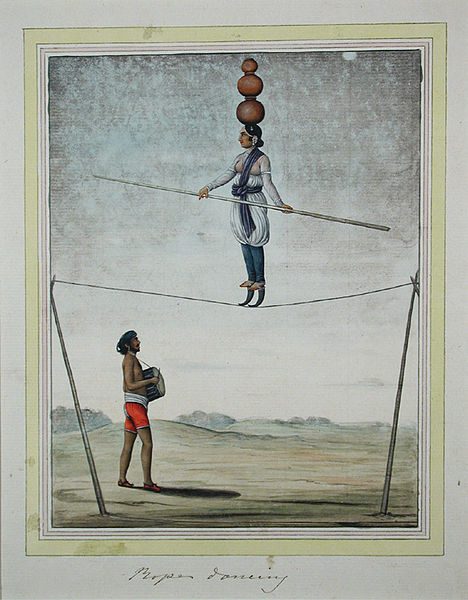
image source, wikipedia
The first Sunday of Advent begins the Catholic Church’s New Year, and in his homily, our priest took the chance to reminded us that here, in the Church, time works differently.
Secular time is a straight line, stretching out ahead indefinitely. I picture the diagram of “the flea and the acrobat” that the science teacher in Stranger Things draws on a paper plate to illustrate how one might exist in an alternate dimension. In fact, I draw it on my song sheet, a straight line and a stick figure, an acrobat walking a wire. She is fixed in the present, the past safely behind, and ahead of her, the unknowable future, which she can’t help but inch toward, however scary it might be.
But in church time, God’s time, it’s not that simple. Or maybe it is much simpler. In God’s time, I am not just the acrobat in the teacher’s diagram; I’m the flea–not limited by the boundaries of clock time, but existing, somehow, during the Mass at least, in some other dimension, one where I am not confined to forward motion. I can move side to side. I can travel around the wire and end up where I started, repeating moments indefinitely. Eternity. Here, I exist in a state of possibility: on the line, inside it, underneath it, or, terrifyingly, nowhere at all. Or perhaps God is the flea, moving at will wherever God likes.
Have I mangled quantum mechanics–not to mention the Catechism–yet? Let me try again.
Christ came. In the past, in the flesh, born in a manger, dressed in swaddling clothes. A human baby was born to a human mother, two thousand years or so ago, and that baby was God, who came to life in a poor man’s body and died among thieves. He was achingly, disturbingly human. Real. The priest mentions the gift of the Rosary, the way the Mysteries walk us through Christ’s life on earth, and I imagine each bead, each prayer, as another step backward on the line, the acrobat suspended above the crowd, gingerly lifting a foot and placing it behind her, the audience holding its breath.
Christ is here. Now, in this church, in this very building. The priest extends his arm to reveal the invisible presence. We come here to meet God, to adore God, to receive God, to taste God, to take God into our bodies. The Acrobat flips to the middle of the wire and lands with a flourish. The crowd gasps.
Christ will come again. In the future, at The End. But this End is not my end. It is only the end of clock time, the destruction of the destroyer: chronos, time, which is nothing less than death, which wears all things to dust. Adventus means coming, and what is coming is not just Christ but the last things: death, judgment, hell and heaven. The acrobat dashes for the safety of the platform. The wire snaps, disappears, poof. A cloud of smoke, a shower of sparks. Or nothing. End scene.
This is what we celebrate on the feast of Christmas. We celebrate the apocalypse, the end of the oppressive reign of chronos, the ushering of us all into kairos, that enduring, eternal moment when everything happens. “Advent is the time to focus on Christ out of time,” says the priest, but later I find that I wrote it down in my notes as “the time to focus on Christ out of mind,” conflating the priest’s words with Bob Dylan’s, which makes me think of Michael Delp writing about Bob Dylan singing to the Good Thief in Paradise, and how this is as good an Advent image as any, all good things gathered together in the enduring moment.
Because Advent, which, in secular America, is little more than an over-scheduled season of frantic rushing from one thing to the next, a grueling forward march from Thanksgiving to Christmas Eve, is, in the Church, a study in eternity.
Adventus. What is coming? Christ is coming. Everything is coming.
I receive the Host from the hands of a fellow parishioner, examine it briefly, imagine in that second that it contains every moment of every soul who ever lived, the births and deaths and everything in between of every body beloved or hated or forgotten, from the first tick of the clock to the last. The Good Thief and Bob Dylan, in my palm and on my tongue.
I balance on the wire.
Previous Post

November 30, 2016
Secret Krampus This Way Comes
Next Post

December 1, 2016 Dark Devotional: Tourists vs. Pilgrims
Browse Our Archives
Select a Category Advent Approaching Mystery art Book Reviews Catholic Ghost Story Catholicism community Confession Current Events Dark Devotional Deconstruction Deconstruction Fellow Travelers I Want To Believe Interview Laudato Si Lent Mary Matthew's Letters Movie Reviews Music Reviews Our Charism Personal Essay Pilgrims Pope Francis Popular Piety Prayer Publishing Richard Beck Saints Satan Sheed and Ward Sick Pilgrim Charism Sick Pilgrim Chats Sick Pilgrim Events Sick Pilgrim Travelin' Medicine Show Sick Pilgrimage to The West Sick Pilgrims Small Joys Spiritual Autobiography Spooky Files of Ave Maria Magazine Spooky October Spooky Pilgrim Spooky Pilgrimage Strange Journey The Inklings Things Keeping Us Going Trying to Say God TV Reviews Uncategorized women in the Catholic Church Wonder Podcast Write the Vision
Select a Month February 2022 January 2022 December 2021 November 2021 October 2021 September 2021 August 2021 July 2021 June 2021 May 2021 April 2021 March 2021 February 2021 January 2021 December 2020 April 2020 March 2020 February 2020 January 2020 December 2019 October 2019 September 2019 July 2019 June 2019 May 2019 April 2019 March 2019 February 2019 January 2019 December 2018 November 2018 October 2018 September 2018 August 2018 July 2018 June 2018 May 2018 April 2018 March 2018 February 2018 January 2018 December 2017 November 2017 October 2017 September 2017 August 2017 July 2017 June 2017 May 2017 April 2017 March 2017 February 2017 January 2017 December 2016 November 2016 October 2016 September 2016 August 2016 July 2016 June 2016 May 2016 April 2016 March 2016 February 2016 January 2016 December 2015
Follow Us!
TAKE THE
Religious Wisdom Quiz
Who was the villain plotting to destroy the Jews in Esther?
Select your answer to see how you score.
Haman Tobiah Sanballat Ben-Hadad
Related posts from Sick Pilgrim
Fourth Sunday of Advent: Two Out of Three
The Third Sunday of Advent: Love is Coming

Things Keeping Us Going: Santa Barf Edition

Second Sunday in Advent: Let Me Love You...
TRENDING AT PATHEOS Catholic

Rejecting Doom: Christian Hope And Human Action
Christianity is a religion of hope. We are to have hope and...

It’s What Comes From Within Which Matters
One of the most difficult things for us to understand is why...

Why I Choose the Eucharist Over the Sermon
Choose the Eucharist, Not the Sermon What are we supposed to get...

5 Design Elements Found in Spiritually Rooted Homes
Putting Spirituality Into Home Decor Our homes are more than our living...

Credo: A Story of God Told with the...
About 10 years ago, I began to imagine a personal "Credo" that...

The Anatomy of Divine Revelation in Catholic Thought
The claim that God has made Himself known to human beings is...
view all Catholic blogs
Ad-Free & Subscriber Log-In Subscription Support
- About Us
- 2026 Calendar
- Videos
- Podcasts
- Library of World Religions
- Faith In Media Tracker
- Advertise With Us
- Write for Us
- Privacy Policy
- Terms of Service
- Do Not Sell My Data
- Contact Us
- Radiant Digital
- Manage Newsletter Subscriptions
- Unsubscribe From Notifications
- Sitemap
Copyright 2008-2026, Patheos. All rights reserved.
Subscription Support Ad-Free & Subscriber Log-In
Follow Patheos