
BuddhistCatholicContemplativeEvangelicalGeneral ChristianHinduJewishLatter-day SaintMuslimNew VisionsProgressive Christian
Beliefs
- Buddhist
- Catholic
- Contemplative
- Evangelical
- General Christian
- Hindu
- Jewish
- Latter-day Saint
- More Voices
- Muslim
- New Visions
- Pagan
- Progressive Christian
Topics
- Religion News
- Food and Religion
- Sports and Religion
- Religious Art
- Religious Music and Entertainment
- Religious Events
- History and Religion
- Style and Religion
- Politics and Religion
- Women in Religion
- Recreation Outdoors and Religion
- Business Finance and Religion
- Careers Workplace and Religion
- Education and Religion
- Family Parenting and Religion
- Health Fitness and Religion
- Home and Religion
- Relationships and Religion
- Technology and Religion
- Travel and Religion
Columnists
- Buddhist Columnists
- Business Finance and Religion Columnists
- Careers Workplace and Religion Columnists
- Catholic Columnists
- Contemplative Columnists
- Education and Religion Columnists
- Evangelists Columnists
- Family Parenting and Religion Columnists
- General Christian Columnists
- Health Fitness and Religion Columnists
- Hindu Columnists
- History and Religion Columnists
- Home and Religion Columnists
- Jewish Columnists
- More Voices Columnists
- Latter Day Columnists
- Muslim Columnists
- New Visions Columnists
- Nonreligious Columnists
- Pagan Columnists
- Politics and Religion Columnists
- Progressive Columnists
- Recreation Outdoors and Religion Columnists
- Relationships and Religion Columnists
- Religion News Columnists
- Religious Art Columnists
- Religious Events Columnists
- Religious Music and Entertainment Columnists
- Sports and Religion Columnists
- Style and Religion Columnists
- Technology and Religion Columnists
- Travel and Religion Columnists
- Women in Religion Columnists
Resource Library
- 2026 Calendar
- Library of World Religions
- The 100 Most Holy Places on Earth
- Patheos Answers
- Podcasts
- Videos
- Faith Leaders Database
- Anglican Episcopalian
- Bahai
- Baptist
- Buddhism
- Christianity
- Confucianism
- Eastern Orthodoxy
- Hinduism
- Holiness and Pentecostal
- ISKCON
- Islam
- Judaism
- Lutheran
- Methodist
- The Church of Jesus Christ of Latter-day Saints
- New Age
- Paganism
- Presbytarian and Reformed
- Protestantism
- Religion Behind the Scenes
- Roman Catholic
- Scientology
- Shia Islam
- Sikhism
- Sufism
- Sunni Islam
- Taoism
- Zen
- See all religions
Research Tools
 Ad-Free & Subscriber Log-In Subscription Support
Ad-Free & Subscriber Log-In Subscription Support
Follow Patheos 

- Trending:
- Forgiveness
- |
- Marriage
- |
- Consciousness
- |
- Death Penalty
- |
- Election
- |
- Halloween
 Sick Pilgrim
- Home
- Catholic
- Radical Spaces of Welcome
Radical Spaces of Welcome
Last updated on: November 14, 2016 at 12:20 pm by Guest Contributor
Radical Spaces of Welcome 2016-11-14T12:20:57-05:00 Guest Contributor
Patheos Explore the world's faith through different perspectives on religion and spirituality! Patheos has the views of the prevalent religions and spiritualities of the world.
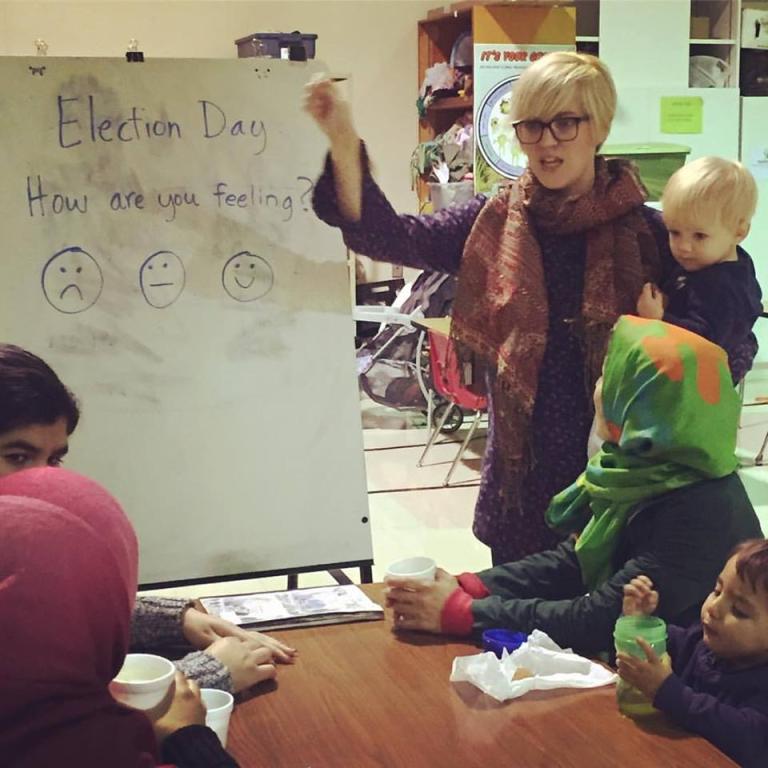
The author teaching at the Welcome Center for new parents at her daughter’s school.
“That’s one kind of localism, I guess, and one kind of politics – doing your utmost to keep that chain connected, unbroken. Our arms are linked – we try to be neighbors of His, and to speak up for his principles. That’s a lifetime’s job.” –Dorothy Day
Growing up in a conservative Christian family, I found my role models as I could: usually missionary biographies depicting strong, intense, driven women who went out into the world and changed it, despite severe challenges and pushbacks. When I was in my early 20s, I first heard of Dorothy Day, the co-founder of the Catholic Worker Movement, and I knew I had found my person. The first quote I heard of hers was this one: “if you have two coats, you have stolen one from the poor.” I actually bought a button that said this and proudly wore it on my one, orange-plaid corduroy coat for many years. Finally, here was somebody who didn’t sugarcoat the inequalities of our world, and the responsibilities of those who had more than our fair share. But as I grew older I realized how nuanced Day was–both strident and compassionate, self-assured and humble, a tireless worker and yet also an advocate for silence and prayer and contemplation.
These complexities and contradictions are important for me to dwell on, as I’ve tried to follow Jesus on a path that only ever seems to lead downward. For the past decade I’ve lived within refugee and immigrant communities, and I’ve seen and experienced the reality of generational poverty in the US as well. Trying to live with my neighbors in solidarity (instead of resorting to hierarchy or charity) has been challenging. Trying to interact with a church that seems to be utterly removed from the realities of my neighborhood has been personally devastating. I swing the pendulum between being overwhelmed by the struggles the poor in America face to being angry that the church of Jesus is not doing their work. I wish I was doing more, yet know that I’m already on the path to burnout.
I woke up on November 9th like many: in disbelief, despondent, willing my faith in a good and loving God to kick in. I couldn’t muster it up, however, and have spent much of my time crying uncontrollably. Surprise and shock is even worse when deep down you knew it could happen. Fear and sadness is even worse when you know the people who ushered this in, and you know how deep the fear goes.
So I tried to think of Dorothy, living in her neighborhoods, weathering the great depression and WWII to constant criticism of those within the religious establishment, a never-ending line of needs stretching constantly in front of her. And I think of her severe face and tender heart and weathered hands; her compelling newspaper, the houses of hospitality, the endless pots of soup and loaves of bread, the constant flow of young people who came to learn from her. I thought of how she viewed politics: her arms, linked with her neighbors’ arms, linked with Christians throughout the centuries who tried to live as if the words of Jesus were real: that the poor, the sick, the sad, and the oppressed are the ones who are blessed, the ones who are heralds of a new kingdom.
Throughout the years, I’ve tried in my own pathetic way to model Dorothy. And I’ve met others who are trying as well, trying to make the words and vision of Jesus known in their communities. Now, more than ever, is the time to continue and bolster these efforts. Now, more than ever, is the time to eschew religion for the sake of self-sacrificial love in a time of great fear. Now, more than ever, is the time to create radical spaces of welcome in our hearts and homes and schools and churches and neighborhoods.
Currently I am living this out in a very specific way. Every Tuesday morning at my daughter’s elementary school we have a Welcome Center for the parents. This particular school is one of the lowest-rated in all of Oregon, but you would never know it from the bright and bustling hallways. Majority Spanish speaking, with 28 other language groups represented, it truly is a picture of a new America. On Tuesdays we meet in a corner of the cafeteria that has been set up with a few couches and a coffee pot, four computers and a clothing closet. We meet together, parents from all around the world, and help each other. We do English tutoring and computer literacy and we share resources and discuss ways we want to get involved at the school. We get to know each other week by week, people from different cultures and religions and ethnic groups, we eat ginger cookies and drink coffee with way too much sugar. We are changing our school and our neighborhood with every meeting.
Throughout the past decade of my life and work, these spaces have changed based on the needs of my neighbors. For those who want to join in this work, it’s both easy and fraught with ways to do it wrong. And yet I would encourage those who want to be a part of the resistance to move forward in this pursuit. In any major city, there are bound to be neighborhoods where lower-income folks are forced to live. Find those spaces, and get as close to them as you can. I have learned to take a year or two to listen to the needs, find people from the neighborhood who are already doing this work and join them, move in and learn, orient your life towards finding the pockets of minorities, refugees, immigrants, and other marginalized folks. Fall in love with them, and see how closely your goodwill is tied up with theirs.
After you have listened and learned and heard the needs, start to link arms. I’ve started homework clubs for kids who were desperately behind, art classes to fill up the long school breaks, English classes at apartment complexes for busy adults. I have friends who match-up tutors with kids who are hungry to learn, people who start female-only gyms for Muslim women, churches who turn parking lots into gardens that feed hundreds of families. The ways to get involved are endless, and impossibly filled with creativity. What can you do? Fix cars? Connect people to resources? Bake bread? Go over short vowel sounds? Drive people to appointments? Have an extra room in your house for those who need it? Be available and hang out long enough to be of use when the next crisis comes?
Our country is becoming less welcoming to the other. May we push back against this with our prayers and our lives. Let us create radical spaces of welcome. May we become more like Dorothy Day–and may we recognize that her kind of work will take up our entire lifetime. May those who find themselves adrift in the church find their home with Christ, on the margins of our world.
D.L. Mayfield lives and writes on the edges Portland, Oregon, with her husband and two small children. Mayfield likes to write about refugees, theology, and downward mobility, among other topics. Her book of essays, Assimilate or Go Home: Notes from a Failed Missionary on Rediscovering Faith was recently released by HarperOne. She blogs at dlmayfield.com and is on twitter at @d_l_mayfield.
Previous Post

November 10, 2016
Dark Devotional: Life. Death. Time.
Next Post
November 15, 2016 La Toussaint: How Cajuns Care for Cities of the Dead
Browse Our Archives
Select a Category Advent Approaching Mystery art Book Reviews Catholic Ghost Story Catholicism community Confession Current Events Dark Devotional Deconstruction Deconstruction Fellow Travelers I Want To Believe Interview Laudato Si Lent Mary Matthew's Letters Movie Reviews Music Reviews Our Charism Personal Essay Pilgrims Pope Francis Popular Piety Prayer Publishing Richard Beck Saints Satan Sheed and Ward Sick Pilgrim Charism Sick Pilgrim Chats Sick Pilgrim Events Sick Pilgrim Travelin' Medicine Show Sick Pilgrimage to The West Sick Pilgrims Small Joys Spiritual Autobiography Spooky Files of Ave Maria Magazine Spooky October Spooky Pilgrim Spooky Pilgrimage Strange Journey The Inklings Things Keeping Us Going Trying to Say God TV Reviews Uncategorized women in the Catholic Church Wonder Podcast Write the Vision
Select a Month February 2022 January 2022 December 2021 November 2021 October 2021 September 2021 August 2021 July 2021 June 2021 May 2021 April 2021 March 2021 February 2021 January 2021 December 2020 April 2020 March 2020 February 2020 January 2020 December 2019 October 2019 September 2019 July 2019 June 2019 May 2019 April 2019 March 2019 February 2019 January 2019 December 2018 November 2018 October 2018 September 2018 August 2018 July 2018 June 2018 May 2018 April 2018 March 2018 February 2018 January 2018 December 2017 November 2017 October 2017 September 2017 August 2017 July 2017 June 2017 May 2017 April 2017 March 2017 February 2017 January 2017 December 2016 November 2016 October 2016 September 2016 August 2016 July 2016 June 2016 May 2016 April 2016 March 2016 February 2016 January 2016 December 2015
Follow Us!
TAKE THE
Religious Wisdom Quiz
How many stringed instruments were used in the Temple?
Select your answer to see how you score.
7 5 3 10
Related posts from Sick Pilgrim


TRENDING AT PATHEOS Catholic

Rejecting Doom: Christian Hope And Human Action
Christianity is a religion of hope. We are to have hope and...

It’s What Comes From Within Which Matters
One of the most difficult things for us to understand is why...

Why I Choose the Eucharist Over the Sermon
Choose the Eucharist, Not the Sermon What are we supposed to get...

5 Design Elements Found in Spiritually Rooted Homes
Putting Spirituality Into Home Decor Our homes are more than our living...

Credo: A Story of God Told with the...
About 10 years ago, I began to imagine a personal "Credo" that...

The Anatomy of Divine Revelation in Catholic Thought
The claim that God has made Himself known to human beings is...
view all Catholic blogs
Ad-Free & Subscriber Log-In Subscription Support
- About Us
- 2026 Calendar
- Videos
- Podcasts
- Library of World Religions
- Faith In Media Tracker
- Advertise With Us
- Write for Us
- Privacy Policy
- Terms of Service
- Do Not Sell My Data
- Contact Us
- Radiant Digital
- Manage Newsletter Subscriptions
- Unsubscribe From Notifications
- Sitemap
Copyright 2008-2026, Patheos. All rights reserved.
Subscription Support Ad-Free & Subscriber Log-In
Follow Patheos