
BuddhistCatholicContemplativeEvangelicalGeneral ChristianHinduJewishLatter-day SaintMuslimNew VisionsProgressive Christian
Beliefs
- Buddhist
- Catholic
- Contemplative
- Evangelical
- General Christian
- Hindu
- Jewish
- Latter-day Saint
- More Voices
- Muslim
- New Visions
- Pagan
- Progressive Christian
Topics
- Religion News
- Food and Religion
- Sports and Religion
- Religious Art
- Religious Music and Entertainment
- Religious Events
- History and Religion
- Style and Religion
- Politics and Religion
- Women in Religion
- Recreation Outdoors and Religion
- Business Finance and Religion
- Careers Workplace and Religion
- Education and Religion
- Family Parenting and Religion
- Health Fitness and Religion
- Home and Religion
- Relationships and Religion
- Technology and Religion
- Travel and Religion
Columnists
- Buddhist Columnists
- Business Finance and Religion Columnists
- Careers Workplace and Religion Columnists
- Catholic Columnists
- Contemplative Columnists
- Education and Religion Columnists
- Evangelists Columnists
- Family Parenting and Religion Columnists
- General Christian Columnists
- Health Fitness and Religion Columnists
- Hindu Columnists
- History and Religion Columnists
- Home and Religion Columnists
- Jewish Columnists
- More Voices Columnists
- Latter Day Columnists
- Muslim Columnists
- New Visions Columnists
- Nonreligious Columnists
- Pagan Columnists
- Politics and Religion Columnists
- Progressive Columnists
- Recreation Outdoors and Religion Columnists
- Relationships and Religion Columnists
- Religion News Columnists
- Religious Art Columnists
- Religious Events Columnists
- Religious Music and Entertainment Columnists
- Sports and Religion Columnists
- Style and Religion Columnists
- Technology and Religion Columnists
- Travel and Religion Columnists
- Women in Religion Columnists
Resource Library
- 2026 Calendar
- Library of World Religions
- The 100 Most Holy Places on Earth
- Patheos Answers
- Podcasts
- Videos
- Faith Leaders Database
- Anglican Episcopalian
- Bahai
- Baptist
- Buddhism
- Christianity
- Confucianism
- Eastern Orthodoxy
- Hinduism
- Holiness and Pentecostal
- ISKCON
- Islam
- Judaism
- Lutheran
- Methodist
- The Church of Jesus Christ of Latter-day Saints
- New Age
- Paganism
- Presbytarian and Reformed
- Protestantism
- Religion Behind the Scenes
- Roman Catholic
- Scientology
- Shia Islam
- Sikhism
- Sufism
- Sunni Islam
- Taoism
- Zen
- See all religions
Research Tools
 Ad-Free & Subscriber Log-In Subscription Support
Ad-Free & Subscriber Log-In Subscription Support
Follow Patheos 

- Trending:
- Forgiveness
- |
- Marriage
- |
- Consciousness
- |
- Death Penalty
- |
- Election
- |
- Halloween
 Sick Pilgrim
- Home
- Catholic
- Burn the Catholic Witches! (Like Me)
Burn the Catholic Witches! (Like Me)
Last updated on: October 17, 2016 at 7:05 pm by Jonathan Ryan
Burn the Catholic Witches! (Like Me) 2016-10-17T19:05:30-05:00 Jonathan Ryan
Patheos Explore the world's faith through different perspectives on religion and spirituality! Patheos has the views of the prevalent religions and spiritualities of the world.
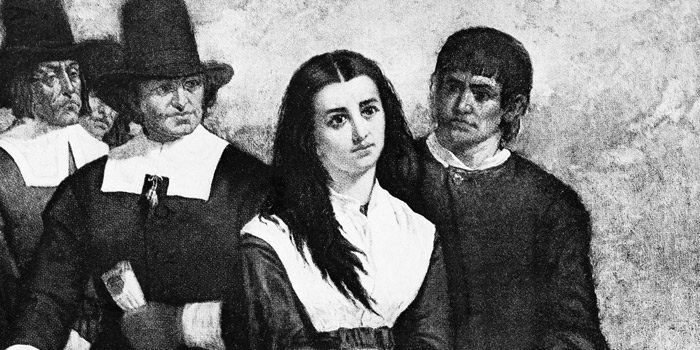
Salem Witch Trials, source: wikipedia
I’ve been doing some research on American saints and martyrs. A few of these stories seem to be ripped from a modern horror novel. For example, there are the five North American martyrs who underwent burning, flaying, and beatings. But one particular martyr caught my eye in Brian O’Neel’s book, 150 North American Martyrs You Should Know. Why? Because the martyrdom took place just before one of the most infamous events in American History: the Salem Witch hysteria. And this martyrdom is interesting for all kinds of reasons, but especially as it highlights a common criticism of Catholics from both Protestant and atheist circles. That is, the Church seems way too old school pagan for their tastes.
Ann Glover was hanged as a witch in Boston on November 16, 1688. The reason for her death is that she supposedly admitted to being in league with the devil, consorted with “unseen spirits” and practiced witchcraft; at least, according to the “minister” who investigated her, the infamous Cotton Mather. She was actually a faithful Catholic.
Puritan New England recognized no difference between Catholicism and pagan witchcraft. Sermon after sermon, book after book attacked Papists with an unrelenting fury. Praying to the saints, making the sign of the cross and other Catholic practices made one a decadent pagan as much as doing rituals in dark forests away from prying eyes. Catholics were considered deceived by the devil at best, and outright in the league with the Whore of Babylon, the Pope in Rome.
Ann’s story is a prime example of what happened to Catholics in the 1700’s. She was rounded up by the forces of Oliver Cromwell, who almost wiped out Catholicism in Ireland through genocide and selling people into slavery. Ann and her husband were sold and shipped to Barbados. He died for refusing to renounce his Catholic faith. Ann and her daughters were then shipped to Boston and sold to John Goodwin.
Apparently, Ann never stopped being a Catholic, because she refused to go to the Puritan church. She and her children endured fierce persecution in Boston. All that came to a head when the Goodwin’s daughter, Martha, and Ann’s daughter had a disagreement over a dress. When Martha threatened to tell her father, Ann responded, “You can have us whipped, but we will not go to the sermons.”
Basically, Martha was trying to blackmail the Glovers into going to listen to a three-hour sermon marathon in a Puritan church. Not long after, the Goodwin children started to act “bewitched” and the infamous Cotton Mather came to investigate.
He found Ann to be “a scandalous old Irishwoman, very poor, a Roman Catholic and obstinate in idolatry…”. She was arrested and put on trial. In a common practice, Ann was asked to say the Lord’s Prayer, which she did in Gaelic and Latin, both in the Catholic form. It was judged she couldn’t finish the prayer and therefore she was in league with the devil. Even more damning to Mather and the Puritans, she was found to be with “images” that she used in “witchcraft.” Most likely, she had crude renderings of the saints in her possession. (Many modern-day practitioners of witchcraft use Catholic images and call on the saints–they know divine power when they see it.)
When Ann was lead to the gallows, she stated that she believed the children had been bewitched, but not by her. So killing her would do no good. Further, even more moving, she kept saying she forgave her killers. Her final words were, “I die a Catholic.”
Skeptics love to point out the obvious connections between Catholicism and paganism–as if the thought never occurred to faithful Catholic. I admit those connections bothered me too, even after my confirmation. I couldn’t deny there are some striking similarities. As a former Presbyterian pastor, I found it difficult to practice some of the stranger aspects of Catholicism, like praying to the saints, praying for the dead, and even the ritualistic nature of the Mass.
Then I considered an old story, the conversion of C.S. Lewis. He relates that he had a long discussion with Tolkien and Hugo Dyson as they pressed home their belief in Christianity. Finally, Tolkien pointed out that Christianity is the true myth that fulfills all the pagan dreams and wishes. That, for Lewis, was the final tipping point to bowing the knee to Christ.
Of course, this story is well known, but the full implications of it didn’t hit me until a few months ago. Tolkien was a Catholic and he was always nettled Lewis didn’t take the full plunge. To me, it seems as if Tolkien wanted Lewis to see that Catholicism was the closest thing to the pagan myths they all loved. The saints, the prayers for the dead, the bloody sacrifice of the Mass are all the final lights of which the pagan practices foreshadowed.
That’s why when someone calls me a pagan Catholic, I accept the slur with pride. I am that, in the best possible way. Human beings are ritualistic by nature. We seek it and desire it in every aspect of our lives. Many of us feel the saints watch over us and are in our lives. We see that sacrifice was needed to restore us to God through the person of Jesus Christ. All of the best of early paganism was enfolded and embraced and realized in the Catholic Church: including the myths, the mystery, and the reverence for nature as containing the imprint of the divine.
This probably means the “Reverend” Cotton Mather may haunt me someday. That’s okay. I’ll just light a candle, pray for the repose of his soul, and ask St. Francis de Sales to show him the way.
Previous Post

October 13, 2016
Dark Devotional: Weapons of War
Next Post
October 18, 2016 When the Angel of Death Comes, Play Jazz: The Axman of New Orleans
Browse Our Archives
Select a Category Advent Approaching Mystery art Book Reviews Catholic Ghost Story Catholicism community Confession Current Events Dark Devotional Deconstruction Deconstruction Fellow Travelers I Want To Believe Interview Laudato Si Lent Mary Matthew's Letters Movie Reviews Music Reviews Our Charism Personal Essay Pilgrims Pope Francis Popular Piety Prayer Publishing Richard Beck Saints Satan Sheed and Ward Sick Pilgrim Charism Sick Pilgrim Chats Sick Pilgrim Events Sick Pilgrim Travelin' Medicine Show Sick Pilgrimage to The West Sick Pilgrims Small Joys Spiritual Autobiography Spooky Files of Ave Maria Magazine Spooky October Spooky Pilgrim Spooky Pilgrimage Strange Journey The Inklings Things Keeping Us Going Trying to Say God TV Reviews Uncategorized women in the Catholic Church Wonder Podcast Write the Vision
Select a Month February 2022 January 2022 December 2021 November 2021 October 2021 September 2021 August 2021 July 2021 June 2021 May 2021 April 2021 March 2021 February 2021 January 2021 December 2020 April 2020 March 2020 February 2020 January 2020 December 2019 October 2019 September 2019 July 2019 June 2019 May 2019 April 2019 March 2019 February 2019 January 2019 December 2018 November 2018 October 2018 September 2018 August 2018 July 2018 June 2018 May 2018 April 2018 March 2018 February 2018 January 2018 December 2017 November 2017 October 2017 September 2017 August 2017 July 2017 June 2017 May 2017 April 2017 March 2017 February 2017 January 2017 December 2016 November 2016 October 2016 September 2016 August 2016 July 2016 June 2016 May 2016 April 2016 March 2016 February 2016 January 2016 December 2015
Follow Us!
TAKE THE
Religious Wisdom Quiz
In which miracle did Jesus provide wine at a wedding?
Select your answer to see how you score.
Turning water into wine at Cana Healing a centurion's servant Walking on water Feeding 4000
Related posts from Sick Pilgrim

Dark Devotional: Why Fundamentalists Fear Empathy


Dark Devotional: After the Fire

Dark Devotional: Of False Ghosts and Real Monsters
TRENDING AT PATHEOS Catholic

Rejecting Doom: Christian Hope And Human Action
Christianity is a religion of hope. We are to have hope and...

It’s What Comes From Within Which Matters
One of the most difficult things for us to understand is why...

Why I Choose the Eucharist Over the Sermon
Choose the Eucharist, Not the Sermon What are we supposed to get...

5 Design Elements Found in Spiritually Rooted Homes
Putting Spirituality Into Home Decor Our homes are more than our living...

Credo: A Story of God Told with the...
About 10 years ago, I began to imagine a personal "Credo" that...

The Anatomy of Divine Revelation in Catholic Thought
The claim that God has made Himself known to human beings is...
view all Catholic blogs
Ad-Free & Subscriber Log-In Subscription Support
- About Us
- 2026 Calendar
- Videos
- Podcasts
- Library of World Religions
- Faith In Media Tracker
- Advertise With Us
- Write for Us
- Privacy Policy
- Terms of Service
- Do Not Sell My Data
- Contact Us
- Radiant Digital
- Manage Newsletter Subscriptions
- Unsubscribe From Notifications
- Sitemap
Copyright 2008-2026, Patheos. All rights reserved.
Subscription Support Ad-Free & Subscriber Log-In
Follow Patheos