
BuddhistCatholicContemplativeEvangelicalGeneral ChristianHinduJewishLatter-day SaintMuslimNew VisionsProgressive Christian
Beliefs
- Buddhist
- Catholic
- Contemplative
- Evangelical
- General Christian
- Hindu
- Jewish
- Latter-day Saint
- More Voices
- Muslim
- New Visions
- Pagan
- Progressive Christian
Topics
- Religion News
- Food and Religion
- Sports and Religion
- Religious Art
- Religious Music and Entertainment
- Religious Events
- History and Religion
- Style and Religion
- Politics and Religion
- Women in Religion
- Recreation Outdoors and Religion
- Business Finance and Religion
- Careers Workplace and Religion
- Education and Religion
- Family Parenting and Religion
- Health Fitness and Religion
- Home and Religion
- Relationships and Religion
- Technology and Religion
- Travel and Religion
Columnists
- Buddhist Columnists
- Business Finance and Religion Columnists
- Careers Workplace and Religion Columnists
- Catholic Columnists
- Contemplative Columnists
- Education and Religion Columnists
- Evangelists Columnists
- Family Parenting and Religion Columnists
- General Christian Columnists
- Health Fitness and Religion Columnists
- Hindu Columnists
- History and Religion Columnists
- Home and Religion Columnists
- Jewish Columnists
- More Voices Columnists
- Latter Day Columnists
- Muslim Columnists
- New Visions Columnists
- Nonreligious Columnists
- Pagan Columnists
- Politics and Religion Columnists
- Progressive Columnists
- Recreation Outdoors and Religion Columnists
- Relationships and Religion Columnists
- Religion News Columnists
- Religious Art Columnists
- Religious Events Columnists
- Religious Music and Entertainment Columnists
- Sports and Religion Columnists
- Style and Religion Columnists
- Technology and Religion Columnists
- Travel and Religion Columnists
- Women in Religion Columnists
Resource Library
- 2026 Calendar
- Library of World Religions
- The 100 Most Holy Places on Earth
- Patheos Answers
- Podcasts
- Videos
- Faith Leaders Database
- Anglican Episcopalian
- Bahai
- Baptist
- Buddhism
- Christianity
- Confucianism
- Eastern Orthodoxy
- Hinduism
- Holiness and Pentecostal
- ISKCON
- Islam
- Judaism
- Lutheran
- Methodist
- The Church of Jesus Christ of Latter-day Saints
- New Age
- Paganism
- Presbytarian and Reformed
- Protestantism
- Religion Behind the Scenes
- Roman Catholic
- Scientology
- Shia Islam
- Sikhism
- Sufism
- Sunni Islam
- Taoism
- Zen
- See all religions
Research Tools
 Ad-Free & Subscriber Log-In Subscription Support
Ad-Free & Subscriber Log-In Subscription Support
Follow Patheos 

- Trending:
- Forgiveness
- |
- Marriage
- |
- Consciousness
- |
- Death Penalty
- |
- Election
- |
- Halloween
 Sick Pilgrim
- Home
- Catholic
- Dark Devotional: Who is My Neighbor?
Dark Devotional: Who is My Neighbor?
Last updated on: July 10, 2016 at 4:03 am by Jessica Mesman Griffith
Dark Devotional: Who is My Neighbor? 2016-07-10T04:03:54-05:00 Jessica Mesman Griffith
Patheos Explore the world's faith through different perspectives on religion and spirituality! Patheos has the views of the prevalent religions and spiritualities of the world.
The Good Samaritan by Jan Wijnants, Image source: Wikipedia
There was a scholar of the law who stood up to test him and said,
“Teacher, what must I do to inherit eternal life?”
Jesus said to him, “What is written in the law?
How do you read it?”
He said in reply,
“You shall love the Lord, your God,
with all your heart,
with all your being,
with all your strength,
and with all your mind,
and your neighbor as yourself.”
He replied to him, “You have answered correctly;
do this and you will live.”But because he wished to justify himself, he said to Jesus,
“And who is my neighbor?”
Jesus replied,
“A man fell victim to robbers
as he went down from Jerusalem to Jericho.
They stripped and beat him and went off leaving him half-dead.
A priest happened to be going down that road,
but when he saw him, he passed by on the opposite side.
Likewise a Levite came to the place,
and when he saw him, he passed by on the opposite side.
But a Samaritan traveler who came upon him
was moved with compassion at the sight.
He approached the victim,
poured oil and wine over his wounds and bandaged them.
Then he lifted him up on his own animal,
took him to an inn, and cared for him.
The next day he took out two silver coins
and gave them to the innkeeper with the instruction,
‘Take care of him.
If you spend more than what I have given you,
I shall repay you on my way back.’
Which of these three, in your opinion,
was neighbor to the robbers’ victim?”
He answered, “The one who treated him with mercy.”
Jesus said to him, “Go and do likewise.”
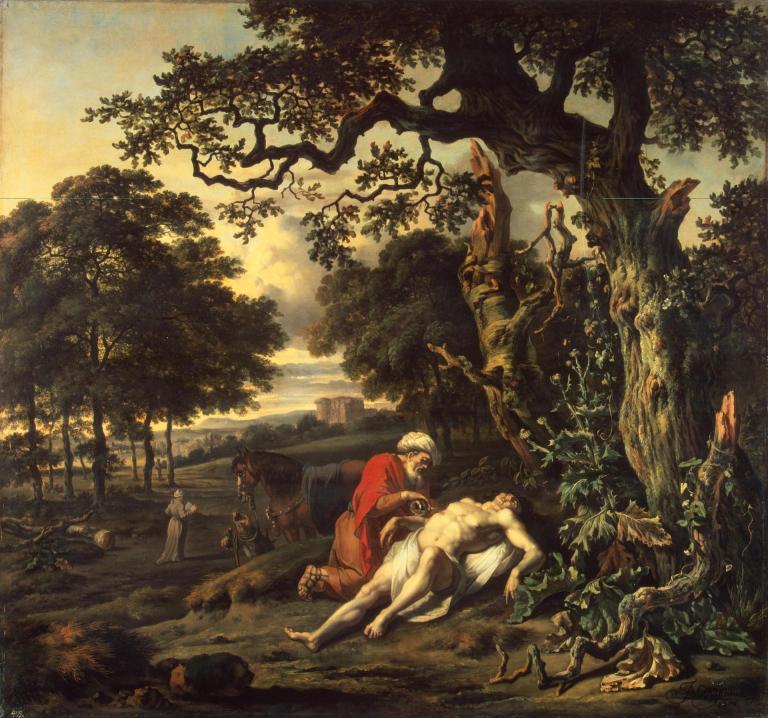
It’s Sunday morning, 2 a.m., and I can’t sleep. I’m thinking of that man on the ground, beaten and stripped, dying from his wounds, and those guys who pass him by. They pass him because they can. They pass him because it’s culturally acceptable to pass him. They pass him because they’re afraid of what will happen to them if they stop to see if they can help. They pass him because, for whatever reason they can drum up, he doesn’t merit their sympathy. And they don’t just pass him–they avoid him. They ignore him. They cross to the other side, seeking distance from the whole ugly scene.
The Good Samaritan is the unlikely hero–the one who isn’t supposed to be good, being a Samaritan and all and an enemy of Jesus’ target audience. But he’s so moved by compassion at the sight of human suffering that he ignores convention and personal safety and stops to tend to the dying. He gives his own precious resources. He even pays the guy’s bills. He doesn’t wring his hands about whether or not this person deserves his care, or whether this person has lived a noble life or was a criminal himself. He doesn’t consider that he might attract unwanted attention to himself by kneeling in the dust, mopping up blood, finding an innkeeper who will take in the half-dead. No. The Good Samaritan sees a man in pain, and he stops doing what he’s doing, and he helps him.
That’s loving your neighbor. Treating each other with mercy, despite the personal risk, the cost, the cultural taboo. Jesus says so. He turns the question, Who is my neighbor? on its head. Your neighbor is the one whose suffering you notice and care for without counting the cost.
For a long time, I have fastidiously avoided posting anything on social media that would potentially upset or unintentionally wound anyone, anywhere. I’m sure I’ve failed, because simply being Catholic will offend plenty, and it’s impossible to anticipate what triggers each of your thousands of online friends. It’s a crazy making task. But it’s what we sweet Christian ladies are subtly told we must do. We must never, ever, under any circumstances, be divisive. It’s become our first commandment: thou shalt not offend.
But I’ve seen a post from a friend who has to remind her son to take his hoodie off when he walks home. I’ve seen a post from the wife of a cop who doesn’t sleep til her husband gets home and she hears him remove his bullet proof vest. I’ve seen my little brother’s post wondering, after Pulse, if there’s anywhere he can feel safe as a gay man. I’ve seen a post that asked, earnestly, how we can expect people to play by society’s rules when that society doesn’t seem to value their lives?
I read those posts and so many more–words of pain, fear, and suffering. I see the images of dying people and grieving families, and now I lie awake and think: Dear God, in the face of all this pain and death, do not let me be like those priests crossing to the other side of the road. Let me no longer be a sweet Christian lady, self-protecting, silent, turning my head because it’s impolite to notice, to speak out, to demand that others help too. Good manners can be another form of pride.
My politeness has been a sin, and I repent.
How can love heal
the mouth shut this way?
And so the first question that the priest asked–the first question that the Levite asked was, “If I stop to help this man, what will happen to me?” But then the Good Samaritan came by. And he reversed the question: “If I do not stop to help this man, what will happen to him?” —
Previous Post

July 7, 2016
When White People Worship Death, Black People Die.
Next Post

July 10, 2016 Six Steps Toward Creating a Culture of Life
Browse Our Archives
Select a Category Advent Approaching Mystery art Book Reviews Catholic Ghost Story Catholicism community Confession Current Events Dark Devotional Deconstruction Deconstruction Fellow Travelers I Want To Believe Interview Laudato Si Lent Mary Matthew's Letters Movie Reviews Music Reviews Our Charism Personal Essay Pilgrims Pope Francis Popular Piety Prayer Publishing Richard Beck Saints Satan Sheed and Ward Sick Pilgrim Charism Sick Pilgrim Chats Sick Pilgrim Events Sick Pilgrim Travelin' Medicine Show Sick Pilgrimage to The West Sick Pilgrims Small Joys Spiritual Autobiography Spooky Files of Ave Maria Magazine Spooky October Spooky Pilgrim Spooky Pilgrimage Strange Journey The Inklings Things Keeping Us Going Trying to Say God TV Reviews Uncategorized women in the Catholic Church Wonder Podcast Write the Vision
Select a Month February 2022 January 2022 December 2021 November 2021 October 2021 September 2021 August 2021 July 2021 June 2021 May 2021 April 2021 March 2021 February 2021 January 2021 December 2020 April 2020 March 2020 February 2020 January 2020 December 2019 October 2019 September 2019 July 2019 June 2019 May 2019 April 2019 March 2019 February 2019 January 2019 December 2018 November 2018 October 2018 September 2018 August 2018 July 2018 June 2018 May 2018 April 2018 March 2018 February 2018 January 2018 December 2017 November 2017 October 2017 September 2017 August 2017 July 2017 June 2017 May 2017 April 2017 March 2017 February 2017 January 2017 December 2016 November 2016 October 2016 September 2016 August 2016 July 2016 June 2016 May 2016 April 2016 March 2016 February 2016 January 2016 December 2015
Follow Us!
TAKE THE
Religious Wisdom Quiz
Which town did Jesus grow up in?
Select your answer to see how you score.
Capernaum Bethlehem Jericho Nazareth
Related posts from Sick Pilgrim

Dark Devotional: The Firelight of Life

Dark Devotional: Let Me Smite Him

Dark Devotional: Woe to Me, for I Have...

TRENDING AT PATHEOS Catholic

Rejecting Doom: Christian Hope And Human Action
Christianity is a religion of hope. We are to have hope and...

It’s What Comes From Within Which Matters
One of the most difficult things for us to understand is why...

Why I Choose the Eucharist Over the Sermon
Choose the Eucharist, Not the Sermon What are we supposed to get...

5 Design Elements Found in Spiritually Rooted Homes
Putting Spirituality Into Home Decor Our homes are more than our living...

Credo: A Story of God Told with the...
About 10 years ago, I began to imagine a personal "Credo" that...

The Anatomy of Divine Revelation in Catholic Thought
The claim that God has made Himself known to human beings is...
view all Catholic blogs
Ad-Free & Subscriber Log-In Subscription Support
- About Us
- 2026 Calendar
- Videos
- Podcasts
- Library of World Religions
- Faith In Media Tracker
- Advertise With Us
- Write for Us
- Privacy Policy
- Terms of Service
- Do Not Sell My Data
- Contact Us
- Radiant Digital
- Manage Newsletter Subscriptions
- Unsubscribe From Notifications
- Sitemap
Copyright 2008-2026, Patheos. All rights reserved.
Subscription Support Ad-Free & Subscriber Log-In
Follow Patheos