
BuddhistCatholicContemplativeEvangelicalGeneral ChristianHinduJewishLatter-day SaintMuslimNew VisionsProgressive Christian
Beliefs
- Buddhist
- Catholic
- Contemplative
- Evangelical
- General Christian
- Hindu
- Jewish
- Latter-day Saint
- More Voices
- Muslim
- New Visions
- Pagan
- Progressive Christian
Topics
- Religion News
- Food and Religion
- Sports and Religion
- Religious Art
- Religious Music and Entertainment
- Religious Events
- History and Religion
- Style and Religion
- Politics and Religion
- Women in Religion
- Recreation Outdoors and Religion
- Business Finance and Religion
- Careers Workplace and Religion
- Education and Religion
- Family Parenting and Religion
- Health Fitness and Religion
- Home and Religion
- Relationships and Religion
- Technology and Religion
- Travel and Religion
Columnists
- Buddhist Columnists
- Business Finance and Religion Columnists
- Careers Workplace and Religion Columnists
- Catholic Columnists
- Contemplative Columnists
- Education and Religion Columnists
- Evangelists Columnists
- Family Parenting and Religion Columnists
- General Christian Columnists
- Health Fitness and Religion Columnists
- Hindu Columnists
- History and Religion Columnists
- Home and Religion Columnists
- Jewish Columnists
- More Voices Columnists
- Latter Day Columnists
- Muslim Columnists
- New Visions Columnists
- Nonreligious Columnists
- Pagan Columnists
- Politics and Religion Columnists
- Progressive Columnists
- Recreation Outdoors and Religion Columnists
- Relationships and Religion Columnists
- Religion News Columnists
- Religious Art Columnists
- Religious Events Columnists
- Religious Music and Entertainment Columnists
- Sports and Religion Columnists
- Style and Religion Columnists
- Technology and Religion Columnists
- Travel and Religion Columnists
- Women in Religion Columnists
Resource Library
- 2026 Calendar
- Library of World Religions
- The 100 Most Holy Places on Earth
- Patheos Answers
- Podcasts
- Videos
- Faith Leaders Database
- Anglican Episcopalian
- Bahai
- Baptist
- Buddhism
- Christianity
- Confucianism
- Eastern Orthodoxy
- Hinduism
- Holiness and Pentecostal
- ISKCON
- Islam
- Judaism
- Lutheran
- Methodist
- The Church of Jesus Christ of Latter-day Saints
- New Age
- Paganism
- Presbytarian and Reformed
- Protestantism
- Religion Behind the Scenes
- Roman Catholic
- Scientology
- Shia Islam
- Sikhism
- Sufism
- Sunni Islam
- Taoism
- Zen
- See all religions
Research Tools
 Ad-Free & Subscriber Log-In Subscription Support
Ad-Free & Subscriber Log-In Subscription Support
Follow Patheos 

- Trending:
- Forgiveness
- |
- Marriage
- |
- Consciousness
- |
- Death Penalty
- |
- Election
- |
- Halloween
 Sick Pilgrim
- Home
- Catholic
- Friedreich’s Ataxia Awareness- Dark Devotional
Friedreich’s Ataxia Awareness- Dark Devotional
Last updated on: May 20, 2016 at 8:22 am by Matt Lafleur
Friedreich’s Ataxia Awareness- Dark Devotional 2016-05-20T08:22:42-05:00 Matt Lafleur
Patheos Explore the world's faith through different perspectives on religion and spirituality! Patheos has the views of the prevalent religions and spiritualities of the world.

Life, death, time. That about covers it.
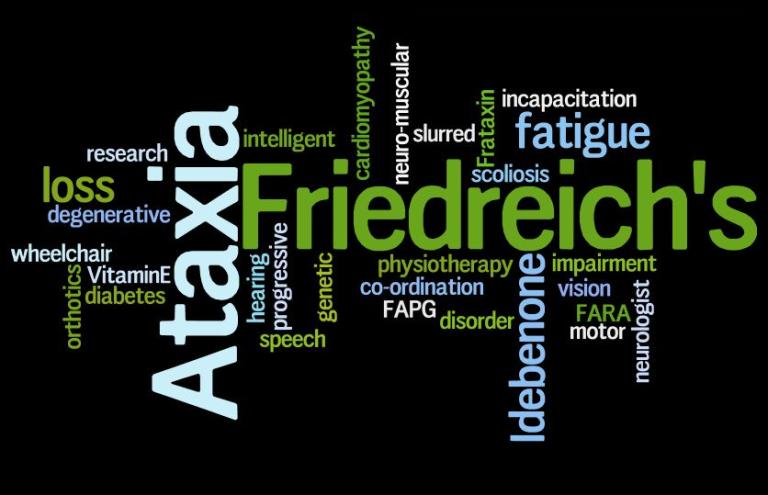
Note: May 21 is Friedreich’s Ataxia Awareness Day. Part of me is afraid that I share about my disability too much. I don’t want to be typecast as someone who only writes about his disability. However, it is the lens through which I see, every second of every day. To write personally and meaningfully, I have to mention it. FA is the elephant in my writer’s corner, and I will not pretend it isn’t there. I will stare that pitiful pachyderm down, because ignoring it is cowardly and, worse, inauthentic.
“…[W]e even boast of our afflictions,
knowing that affliction produces endurance,
and endurance, proven character,
and proven character, hope,
and hope does not disappoint…” Romans 5:3-5
I think it was windy that day. Fitting. The Louisiana sun was out, but the loud bluster kept most people indoors, uncommon for a not-too-chilly March afternoon. At fifteen, I was almost old enough to emerge victoriously from the suffocating and insecure swamp known as puberty. But not quite.
My dad reached for the handle to get out of his truck once we’d arrived at his workplace. Unbuckling the seatbelt on the passenger’s side slowly and with reservation, I blurted, probably unexpectedly, “So…I’m old enough now. Tell me what the name of the thing I have is.”
His hand stopped reaching for the door handle. He hesitated for only a second before he told me: “Friedreich’s ataxia.” After that, he opened the driver’s side door and walked into his office. The discomfort of that conversation had ended.
The “thing” I asked about was a shadowy but indelible part of me. Since I was eleven, I knew that I had something that affected my coordination and my ability to run. As a result, I stayed on the sidelines for most junior-high kids’ activities. I didn’t think that whatever the “thing” I had was obvious to others, but in fifth grade someone called me, “Cripple walk.” The teacher heard, and was furious at the name-caller. I was too confused to be upset about it. Did I really walk that differently?
Entering high school, I recognized the progression of my “thing”: running was not an option to me anymore, and neither was walking down stairs without a handrail. Rather than continue to be bounced around by an unknown and unseen force, I asked for the name of whatever it was that windy day in March.
Back then, in 2001, the Internet existed, though not as pervasively. I typed in “Friedreich’s ataxia” to my favorite search engine at the time, Ask Jeeves (RIP). After a spell-check, I found that Friedreich’s ataxia, or FA, is a recessive genetic disorder that causes the brain to produce nerve cells without frataxin, which normal nerve cells have. Frataxin moderates the amount of iron cells can carry, so without frataxin, nerve cells carry too much iron, and the excess incapacitates the entire cell.
Note 2: I am not a scientist, or someone with more than a mediocre knowledge of biology. This is as I understand it.
The last section of the article was the part I cared most about. It was called “Treatments.” There was no treatment. The article closed with: “People with FA require the full-time use of a wheelchair by the end of their teenage years.”
Reading that sentence as a 15-year-old was devastating. I expected to find out that some therapy or medication would be in store. I had even resigned myself to the fact that I may “walk funny” for the rest of my life. Learning that in a few short years I would lose all ability to independently get around was more devastating than my teenage brain could handle.
Before slaying the newly identified dragon that was my disorder, I had to lay to rest the familiar and safe cocoon of not knowing. That involved acknowledging that my childlike perception of God was not and was never strong enough. The absence of that God – who disappeared as my shadowy disorder suddenly became painfully clear – terrified me. It broke my heart.
Seeking a God who doesn’t only exist in naivety is a worthy challenge.
When I was 19, that search led me to a meeting of a Protestant group in college, visited by a faith healer. This guest speaker traveled the country and supposedly granted healings to those over whom he prayed. I was used to healing services–I’ve been to healing Masses, traiteurs and other types of faith healers, and even made a pilgrimage to Lourdes, France. My childhood was filled with anticipating miracles that never came.
But this time was different, I thought; same as I had each time. This healer was known throughout the country; my friend prepped me by reading accounts of Jesus healing people in the Bible. He ended with the Gospel of Matthew, Chapter 7, Verse 7, in which Jesus tells his followers to ask and it shall be given them, seek and they will find, knock and the door will be opened to them; my friend even said we’d go eat pizza after, because we’d have reason to celebrate.
Facing a slow but steady decline in my physical capabilities, most especially the submission to using a wheelchair full-time just a year earlier, I eagerly grasped at this hope of escaping the downward spiral and kicking my wheelchair to the curb. Like an arrogant gambler who thinks the hand he’s dealt is solid, I was all in. I was asking, knocking, and seeking. It was Jesus’ move next.
No miracle occurred that night. After the healer mumbled a few words while touching my forehead, he left. Then my friend asked me to try to stand on my own. After I tried and fell back in my seat, he asked me if I believed I was cured. Familiar with the rising disappointment of not getting a miracle, again, yet still acutely hurt, I could only reply, “I’d like to be.”
After the meeting, my friend didn’t feel like going to eat pizza in celebration anymore, so I went back to my apartment, alone and still in my wheelchair. Once again, the howling winds threatened to sink my dinghy-lifeboat. Once again, I had to redefine faith and acknowledge that I didn’t know who (or even if) God was. But battling this affliction over and over taught me that despite heartbreak and foreboding hopelessness, perhaps even in spite of myself, I would–aggravatingly–endure.
And enduring hardships may produce at first a tough callousness, but that may evolve into a kind of strength. That strength, wizened by constant batterings, may even produce a decent character. Or at least, that’s the goal. I haven’t arrived there yet, but I’m moving forward.
I’m no longer in the sheltered safety of ignorance. And I still sometimes get battered by chaotic winds. But I get up and move forward. That’s less grandiose than it sounds. Sometimes it looks like hardheadedness. Sometimes it looks like despair. Sometimes it looks like listlessness or surrender.
Or hope. Sometimes it looks like hope.
Previous Post

May 18, 2016
The Babadook and the Faith Healer
Next Post

May 22, 2016 Surprised by Dangerous Joy: Lessons from Chewbacca Woman
Browse Our Archives
Select a Category Advent Approaching Mystery art Book Reviews Catholic Ghost Story Catholicism community Confession Current Events Dark Devotional Deconstruction Deconstruction Fellow Travelers I Want To Believe Interview Laudato Si Lent Mary Matthew's Letters Movie Reviews Music Reviews Our Charism Personal Essay Pilgrims Pope Francis Popular Piety Prayer Publishing Richard Beck Saints Satan Sheed and Ward Sick Pilgrim Charism Sick Pilgrim Chats Sick Pilgrim Events Sick Pilgrim Travelin' Medicine Show Sick Pilgrimage to The West Sick Pilgrims Small Joys Spiritual Autobiography Spooky Files of Ave Maria Magazine Spooky October Spooky Pilgrim Spooky Pilgrimage Strange Journey The Inklings Things Keeping Us Going Trying to Say God TV Reviews Uncategorized women in the Catholic Church Wonder Podcast Write the Vision
Select a Month February 2022 January 2022 December 2021 November 2021 October 2021 September 2021 August 2021 July 2021 June 2021 May 2021 April 2021 March 2021 February 2021 January 2021 December 2020 April 2020 March 2020 February 2020 January 2020 December 2019 October 2019 September 2019 July 2019 June 2019 May 2019 April 2019 March 2019 February 2019 January 2019 December 2018 November 2018 October 2018 September 2018 August 2018 July 2018 June 2018 May 2018 April 2018 March 2018 February 2018 January 2018 December 2017 November 2017 October 2017 September 2017 August 2017 July 2017 June 2017 May 2017 April 2017 March 2017 February 2017 January 2017 December 2016 November 2016 October 2016 September 2016 August 2016 July 2016 June 2016 May 2016 April 2016 March 2016 February 2016 January 2016 December 2015
Follow Us!
TAKE THE
Religious Wisdom Quiz
True or False: God appeared to Moses in a burning bush on Mount Sinai.
Select your answer to see how you score.
TRUE FALSE
Related posts from Sick Pilgrim

Dark Devotional: The Firelight of Life

Dark Devotional: Let Me Smite Him

Dark Devotional: Woe to Me, for I Have...

TRENDING AT PATHEOS Catholic

Rejecting Doom: Christian Hope And Human Action
Christianity is a religion of hope. We are to have hope and...

It’s What Comes From Within Which Matters
One of the most difficult things for us to understand is why...

Why I Choose the Eucharist Over the Sermon
Choose the Eucharist, Not the Sermon What are we supposed to get...

5 Design Elements Found in Spiritually Rooted Homes
Putting Spirituality Into Home Decor Our homes are more than our living...

Credo: A Story of God Told with the...
About 10 years ago, I began to imagine a personal "Credo" that...

The Anatomy of Divine Revelation in Catholic Thought
The claim that God has made Himself known to human beings is...
view all Catholic blogs
Ad-Free & Subscriber Log-In Subscription Support
- About Us
- 2026 Calendar
- Videos
- Podcasts
- Library of World Religions
- Faith In Media Tracker
- Advertise With Us
- Write for Us
- Privacy Policy
- Terms of Service
- Do Not Sell My Data
- Contact Us
- Radiant Digital
- Manage Newsletter Subscriptions
- Unsubscribe From Notifications
- Sitemap
Copyright 2008-2026, Patheos. All rights reserved.
Subscription Support Ad-Free & Subscriber Log-In
Follow Patheos