
BuddhistCatholicContemplativeEvangelicalGeneral ChristianHinduJewishLatter-day SaintMuslimNew VisionsProgressive Christian
Beliefs
- Buddhist
- Catholic
- Contemplative
- Evangelical
- General Christian
- Hindu
- Jewish
- Latter-day Saint
- More Voices
- Muslim
- New Visions
- Pagan
- Progressive Christian
Topics
- Religion News
- Food and Religion
- Sports and Religion
- Religious Art
- Religious Music and Entertainment
- Religious Events
- History and Religion
- Style and Religion
- Politics and Religion
- Women in Religion
- Recreation Outdoors and Religion
- Business Finance and Religion
- Careers Workplace and Religion
- Education and Religion
- Family Parenting and Religion
- Health Fitness and Religion
- Home and Religion
- Relationships and Religion
- Technology and Religion
- Travel and Religion
Columnists
- Buddhist Columnists
- Business Finance and Religion Columnists
- Careers Workplace and Religion Columnists
- Catholic Columnists
- Contemplative Columnists
- Education and Religion Columnists
- Evangelists Columnists
- Family Parenting and Religion Columnists
- General Christian Columnists
- Health Fitness and Religion Columnists
- Hindu Columnists
- History and Religion Columnists
- Home and Religion Columnists
- Jewish Columnists
- More Voices Columnists
- Latter Day Columnists
- Muslim Columnists
- New Visions Columnists
- Nonreligious Columnists
- Pagan Columnists
- Politics and Religion Columnists
- Progressive Columnists
- Recreation Outdoors and Religion Columnists
- Relationships and Religion Columnists
- Religion News Columnists
- Religious Art Columnists
- Religious Events Columnists
- Religious Music and Entertainment Columnists
- Sports and Religion Columnists
- Style and Religion Columnists
- Technology and Religion Columnists
- Travel and Religion Columnists
- Women in Religion Columnists
Resource Library
- 2026 Calendar
- Library of World Religions
- The 100 Most Holy Places on Earth
- Patheos Answers
- Podcasts
- Videos
- Faith Leaders Database
- Anglican Episcopalian
- Bahai
- Baptist
- Buddhism
- Christianity
- Confucianism
- Eastern Orthodoxy
- Hinduism
- Holiness and Pentecostal
- ISKCON
- Islam
- Judaism
- Lutheran
- Methodist
- The Church of Jesus Christ of Latter-day Saints
- New Age
- Paganism
- Presbytarian and Reformed
- Protestantism
- Religion Behind the Scenes
- Roman Catholic
- Scientology
- Shia Islam
- Sikhism
- Sufism
- Sunni Islam
- Taoism
- Zen
- See all religions
Research Tools
 Ad-Free & Subscriber Log-In Subscription Support
Ad-Free & Subscriber Log-In Subscription Support
Follow Patheos 

- Trending:
- Forgiveness
- |
- Marriage
- |
- Consciousness
- |
- Death Penalty
- |
- Election
- |
- Halloween
 Sick Pilgrim
- Home
- Catholic
- The Nasty Truth of a Mother’s Heart
The Nasty Truth of a Mother’s Heart
Last updated on: April 4, 2016 at 6:45 am by Jessica Mesman Griffith
The Nasty Truth of a Mother’s Heart 2016-04-04T06:45:54-05:00 Jessica Mesman Griffith
Patheos Explore the world's faith through different perspectives on religion and spirituality! Patheos has the views of the prevalent religions and spiritualities of the world.
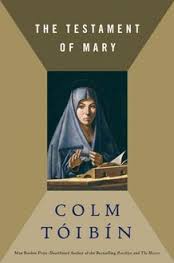 “They appear more often now, both of them, and on every visit they seem more impatient with me and with the world,” begins Colm Toibin’s novella, The Testament of Mary. “There is something hungry and rough in them, a brutality boiling in their blood, which I have seen before and can smell as an animal that is being hunted can smell.”
A friend gave me a copy of Toibin’s book a few years ago, and I read it through my fingers, afraid it would disabuse me of my tenuous Marian devotion. Mary is one of my Catholic hang-ups. I love the rosary as a soothing mantra in times of distress, and I have a Mary statue in my yard because it reminds me of home. But I feel no genuine closeness to the virgin, and pious chatter about the Blessed Mother makes my blood run cold. Maybe it was all those years in the Mary-fearing fundamentalist Christian churches of my dad. Maybe it was those terrifying glow-in-the-dark Marys all Catholic children in southeastern Louisiana had in our bedrooms that led me to conflate her with the Bloody Mary game we played in the mirror at slumber parties. But I’d rather politely ignore the Church’s teachings on Mary. It’s one of those prickly issues that might confirm I’m actually a protestant.
Despite what might have been his attempt to undo the traditional Christian narrative about Christ’s mother, I found Toibin’s imagining of Mary irresistible. In the quote above, she’s describing the apostles, who hound her as she hides from a vengeful world. They want her to confirm their Easter stories. But she could also be speaking of the angels—angels are always terrifying in my imagination, towering figures with ragged, animal wings, not obese babies. Angels brought Mary the news of her destiny carrying nails and a crown of thorns. It is this image of Mary the hunted that Toibin pursues from the Annunciation to her death.

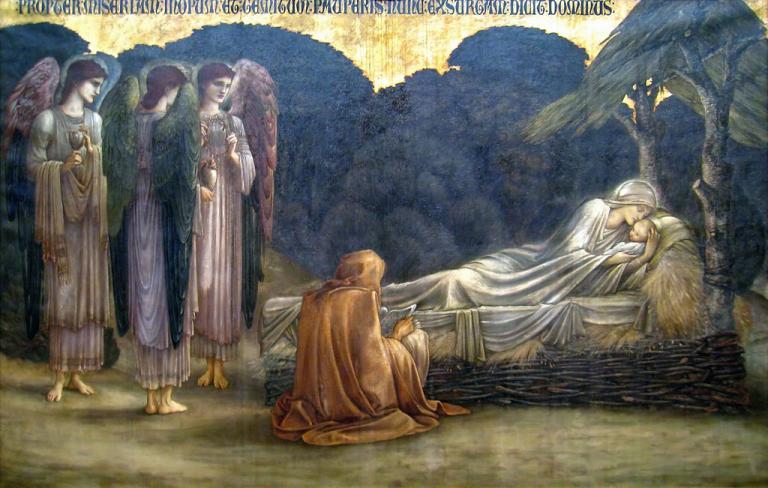
Edward Burne-Jones, Nativity (source: Wikipedia)
I’ve never been a fan of Mary the mute, pious doll on the pedestal in my childhood churches. It’s neither sinful nor shocking to imagine that the one who was so highly favored might have counted the cost of such honor, or wondered at her own fiat. She was a human mother, and though we know little of her, we know she was a thinker.
The Bible tells us almost nothing about Mary, but among the few details it gives us flat out is that she pondered things in her heart, that she wondered about what was happening to her and her son. It’s controversial to say so in the Catholic Church, but I can’t understand why. Mary’s incomplete understanding of her own life story and the meaning of the cross–the engine that drives Toibin’s Testament–is right there in the Gospels.
Toibin’s Mary runs from the foot of the cross. Afterwards, she is so lost in her own despair, her sense of having lost everything and failed her child, that she dismisses the memories of her conception and pregnancy as merely strange and special, something every human mother, lost in the mysteries of her own body, feels. “It does not seem ordinary,” she says. Every pregnant woman has felt that favor, that power and wonder and blessedness.
This is not the Queen of Heaven, but the poor in spirit, her suffering so great she is bereft even of the memory of faith. I recognized her at once.
Caryll Houselander, in her Marian book The Reed of God, also imagined the mother of Christ as a human mother, not the Madonna of the Christmas card. Her Mary is both beautifully human and thoroughly Christian. Her greatest achievement is bringing Christ into the world, which Houselander manages to render—inspirationally—as perfectly ordinary. In this way, she argues, Mary is the only model of sainthood most of us can ever hope to emulate.
Every day, each of us has the same chance to bring Christ to the world through our simplest actions, through saying yes, through our care for our family, through our love for others.
But Houselander’s Mary, however relatable, is not really like us. Or at least, not like me. Her trust in God never wavers.
Toibin imagines Mary without Christianity, a mother who never understands why her son had to suffer. After she watches his torture, she doesn’t care to save her own soul, much less humanity’s. She’d throw away all eternal life for one more golden Sabbath day with her family, for a shy smile from her young son.
This Mary’s love for God and man is dangerously roped to her love of her own family. She is far from the apex of Christianity, or any kind of model for sainthood. She is me.
“It is simple,” she says. “If water can be changed into wine and the dead can be brought back, then I want time pushed back. I want to live again before my son’s death happened, or before he left home…I want to be able to imagine that what happened to him will not come, it will see us and decide—not now, not them. And we will be left in peace to grow old.”
These are the words of an afflicted soul. And yet they are still a prayer. They cry out for redemption. Give me back my life, Lord. How often have I whispered those words to the dark?
Toibin’s Testament is perversely beautiful, so aware of the nasty truths of the human mother’s heart. Yes, he makes the apostles look like a bunch of thugs. Yes, his miracle-working Jesus is vain and power-drunk (This Mary is embarrassed by her son’s behavior with his friends—what mother isn’t?). Yes, his Mary is bitter and hungry for someone else’s catastrophe to eclipse her own suffering, comforted only by the fertility idol she keeps hidden in a trunk.
And you know what? I could imagine, faced with the horrible death of those I love, feeling and doing all of these things. Even without such a tragedy, there are dark days and nights when I am, like Toibin’s Mary, without Christianity.
But what if Houselander is right, and Mary’s greatest gift was not her own spiritual perfection, but the bearing of Christ into the world?
In the end, Mary is hunted not by the apostles but by her own guilt. She dreams of holding her son’s broken body, as the apostles say she did. She longs for death. And yet there is hope. We leave her walking toward her own dream of heaven, a time when all this might not have happened, a place where redemption means that her family was spared.
Previous Post

April 3, 2016
Is this Heaven? An Ode to the Sacramental Beauty of Baseball
Next Post
April 6, 2016 Sick Pilgrim Now Has Two Things in Common with the Pope
Browse Our Archives
Select a Category Advent Approaching Mystery art Book Reviews Catholic Ghost Story Catholicism community Confession Current Events Dark Devotional Deconstruction Deconstruction Fellow Travelers I Want To Believe Interview Laudato Si Lent Mary Matthew's Letters Movie Reviews Music Reviews Our Charism Personal Essay Pilgrims Pope Francis Popular Piety Prayer Publishing Richard Beck Saints Satan Sheed and Ward Sick Pilgrim Charism Sick Pilgrim Chats Sick Pilgrim Events Sick Pilgrim Travelin' Medicine Show Sick Pilgrimage to The West Sick Pilgrims Small Joys Spiritual Autobiography Spooky Files of Ave Maria Magazine Spooky October Spooky Pilgrim Spooky Pilgrimage Strange Journey The Inklings Things Keeping Us Going Trying to Say God TV Reviews Uncategorized women in the Catholic Church Wonder Podcast Write the Vision
Select a Month February 2022 January 2022 December 2021 November 2021 October 2021 September 2021 August 2021 July 2021 June 2021 May 2021 April 2021 March 2021 February 2021 January 2021 December 2020 April 2020 March 2020 February 2020 January 2020 December 2019 October 2019 September 2019 July 2019 June 2019 May 2019 April 2019 March 2019 February 2019 January 2019 December 2018 November 2018 October 2018 September 2018 August 2018 July 2018 June 2018 May 2018 April 2018 March 2018 February 2018 January 2018 December 2017 November 2017 October 2017 September 2017 August 2017 July 2017 June 2017 May 2017 April 2017 March 2017 February 2017 January 2017 December 2016 November 2016 October 2016 September 2016 August 2016 July 2016 June 2016 May 2016 April 2016 March 2016 February 2016 January 2016 December 2015
Follow Us!
TAKE THE
Religious Wisdom Quiz
Who was Aquila's wife?
Select your answer to see how you score.
Mary Lydia Ruth Priscilla
Related posts from Sick Pilgrim


Things Keeping Us Going: Winter Weather Edition

TRENDING AT PATHEOS Catholic

Creation, Preservation, and Teleology in Catholic Theology
As I write this, it is very early Monday morning. Like millions...

The Parable Of The Sower And The Word...
One of Christ’s most famous parables is that of the sower who...

Rejecting Doom: Christian Hope And Human Action
Christianity is a religion of hope. We are to have hope and...

Why I Choose the Eucharist Over the Sermon
Choose the Eucharist, Not the Sermon What are we supposed to get...

5 Design Elements Found in Spiritually Rooted Homes
Putting Spirituality Into Home Decor Our homes are more than our living...

Credo: A Story of God Told with the...
About 10 years ago, I began to imagine a personal "Credo" that...
view all Catholic blogs
Ad-Free & Subscriber Log-In Subscription Support
- About Us
- 2026 Calendar
- Videos
- Podcasts
- Library of World Religions
- Faith In Media Tracker
- Advertise With Us
- Write for Us
- Privacy Policy
- Terms of Service
- Do Not Sell My Data
- Contact Us
- Radiant Digital
- Manage Newsletter Subscriptions
- Unsubscribe From Notifications
- Sitemap
Copyright 2008-2026, Patheos. All rights reserved.
Subscription Support Ad-Free & Subscriber Log-In
Follow Patheos