
BuddhistCatholicContemplativeEvangelicalGeneral ChristianHinduJewishLatter-day SaintMuslimNew VisionsProgressive Christian
Beliefs
- Buddhist
- Catholic
- Contemplative
- Evangelical
- General Christian
- Hindu
- Jewish
- Latter-day Saint
- More Voices
- Muslim
- New Visions
- Pagan
- Progressive Christian
Topics
- Religion News
- Food and Religion
- Sports and Religion
- Religious Art
- Religious Music and Entertainment
- Religious Events
- History and Religion
- Style and Religion
- Politics and Religion
- Women in Religion
- Recreation Outdoors and Religion
- Business Finance and Religion
- Careers Workplace and Religion
- Education and Religion
- Family Parenting and Religion
- Health Fitness and Religion
- Home and Religion
- Relationships and Religion
- Technology and Religion
- Travel and Religion
Columnists
- Buddhist Columnists
- Business Finance and Religion Columnists
- Careers Workplace and Religion Columnists
- Catholic Columnists
- Contemplative Columnists
- Education and Religion Columnists
- Evangelists Columnists
- Family Parenting and Religion Columnists
- General Christian Columnists
- Health Fitness and Religion Columnists
- Hindu Columnists
- History and Religion Columnists
- Home and Religion Columnists
- Jewish Columnists
- More Voices Columnists
- Latter Day Columnists
- Muslim Columnists
- New Visions Columnists
- Nonreligious Columnists
- Pagan Columnists
- Politics and Religion Columnists
- Progressive Columnists
- Recreation Outdoors and Religion Columnists
- Relationships and Religion Columnists
- Religion News Columnists
- Religious Art Columnists
- Religious Events Columnists
- Religious Music and Entertainment Columnists
- Sports and Religion Columnists
- Style and Religion Columnists
- Technology and Religion Columnists
- Travel and Religion Columnists
- Women in Religion Columnists
Resource Library
- 2026 Calendar
- Library of World Religions
- The 100 Most Holy Places on Earth
- Patheos Answers
- Podcasts
- Videos
- Faith Leaders Database
- Anglican Episcopalian
- Bahai
- Baptist
- Buddhism
- Christianity
- Confucianism
- Eastern Orthodoxy
- Hinduism
- Holiness and Pentecostal
- ISKCON
- Islam
- Judaism
- Lutheran
- Methodist
- The Church of Jesus Christ of Latter-day Saints
- New Age
- Paganism
- Presbytarian and Reformed
- Protestantism
- Religion Behind the Scenes
- Roman Catholic
- Scientology
- Shia Islam
- Sikhism
- Sufism
- Sunni Islam
- Taoism
- Zen
- See all religions
Research Tools
 Ad-Free & Subscriber Log-In Subscription Support
Ad-Free & Subscriber Log-In Subscription Support
Follow Patheos 

- Trending:
- Forgiveness
- |
- Marriage
- |
- Consciousness
- |
- Death Penalty
- |
- Election
- |
- Halloween
 Sick Pilgrim
- Home
- Catholic
- Bringing Catholic Magic Back
Bringing Catholic Magic Back
Last updated on: April 7, 2016 at 6:44 am by Jonathan Ryan
Bringing Catholic Magic Back 2016-04-07T06:44:13-05:00 Jonathan Ryan
Patheos Explore the world's faith through different perspectives on religion and spirituality! Patheos has the views of the prevalent religions and spiritualities of the world.
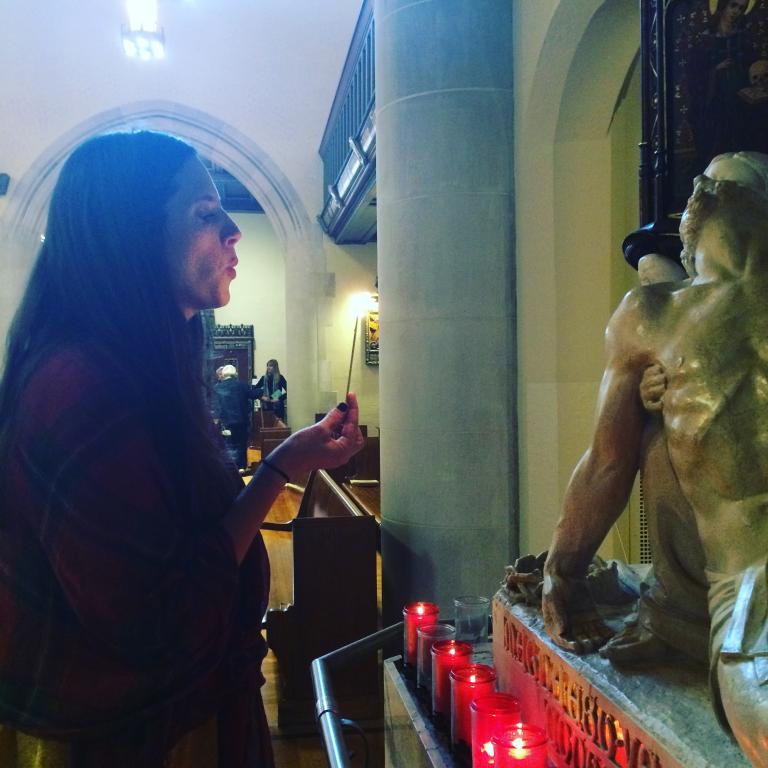
Jess prays at the Shrine of the Mother of Sorrows at St Gregory the Great in Chicago.
An article in The Atlantic grabbed our attention last week–about young Jews embracing the more traditional practices their parents had rejected. We completely identified. The return to traditional faith practices–what the Catholic Church refers to as “popular piety”– played a significant role in both of our returns to Catholicism, the religion our parents had abandoned.
Our families had been Catholic for generations. Jess’s parents were old school cultural Catholics from New Orleans–they went to Mass and prayed the rosary but they also threw salt over their shoulders and crossed themselves when they saw a black cat. Jonathan’s parents got caught up in the Catholic Charismatic movement in the 70s. He remembers going to masses where nuns and priests spoke in tongues, danced in the aisles and prophesied. Quite a sight.
Much of that charismatic fervor was fueled by the Baby Boomer, Vatican II generation. They threw many of the old school Catholic practices–the stuff Jess was raised with–out with the bath water in the name of “modernization.” They were trying to be “relevant,” that word we despise so much today. Left and right, the movement to dispose of the obviously foreign, the un-American, the embarrassingly Catholic ways swept both sides of the church. We all became kinda protestant.
It’s understandable. Catholicism before Vatican II needed a serious overhaul. But whether out of embarrassment or outright derision, we lost our Popular Piety–the practices that distinguished us as Catholics, the stuff that made us look weird. When Jess moved away from New Orleans and Pittsburgh–both old-world, ethnic Catholic cultures that clung to the old ways–she no longer recognized her church. The Catholic churches were indistinguishable from the Protestant mega-churches. She found herself wondering why on earth she’d continue to wrestle with this archaic, Problematic with a capital P faith if there was no more smells, bells, and magic? She needed those things to imagine herself in divine love.
That kind of Catholic distinctiveness is attracting Millennials, and Jonathan, as a former Presbyterian minister, thinks it’s because millennials don’t really want that mega-church style. They’re looking for something more, something that marks them as different, something they can’t find in secular culture. They’re rebelling against the changes our grandparents rebelled to make. As The Atlantic pointed out about Millennial Jews, “They want connection, boundaries and authenticity.” Or as the American Conservative noted of Millennial Anglican converts, they “ache for sacramentality.” They’ve had the luxury of forgetting (or never knowing) the very real oppression and misogyny and corruption and on and on, and now they want some of that good old fashioned Catholic magic.
Working at Notre Dame, Jonathan tries to attend mass at the Basilica of the Sacred Heart at least once a week. He noticed how many of the younger women have started to use prayer shawls to cover their heads–mantillas. Another Catholic practice that went out with Vatican II. While he marveled at this with one of his Baby Boomer/Gen-X friends, she was appalled: “Don’t they know that’s a sign of oppressing women?” But when Jonathan asked one of the women after the service, she only looked puzzled. “Uh, is it really? I just know it focuses my attention on God and helps me to pray.”
The official Vatican Directory on Popular Piety defines these practices as “diverse cultic expressions of a private or community nature which, in the context of the Christian faith, are inspired predominantly not by the Sacred Liturgy but by forms deriving from a particular nation or people or from their culture.” It’s the Catholicism of your neighborhood, your hometown, your ethnicity. It’s what marked American Catholics as immigrants and outsiders. The Vatican document goes on to call it “a treasure of the people of God” that “generates interior attitudes otherwise rarely seen to the same degree: patience, an awareness of the Cross in every-day life, detachment, openness to others and devotion.”
Wearing a mantilla is an expression of piety, and it’s one of those distinctively Catholic things that attracts people and/or repels people from the Church. So is praying to Saint Anthony to find something you lost. So is making a Saint Joseph’s Altar on his feast day. Or making soul cakes on All Hallow’s Eve. Walking in a corpus Christi procession or a Santa Lucia parade. Eating Paczkis or king cakes on Fat Tuesday. The list is endless (see the Vatican document for dozens of examples), and we each have our favorites. Are they necessary for our salvation? Hell no. But these are the things we, Jonathan and Jess, miss when we try to worship somewhere else. These–along with the sacred liturgy–are the things that draw us back to a quest for holiness, to a longing for Jesus.
For the next few weeks, we want to explore the physicality and the magic of traditional Catholicism here at Sick Pilgrim, because we suspect it’s what many of us are after. We want to hear and tell stories that reveal the power and beauty of ancient Catholic practices in real life—as clumsy and imperfectly realized as they may be. We hope these stories will encourage delight and comfort in the distinctive (and peculiar) ways Catholics have lived their faith in many disparate traditions and locations. We want to hear and talk about what’s not so beautiful too–what is ugly, creepy, sexist, offensive, or just silly. There are plenty of ancient pious practices that we aren’t itching to revive.
We at Sick Pilgrim are magical Catholics. Jonathan makes Icons based on New Mexican folk art and once had a vision of the Sacred Heart (lucky!). Jess never met a ritual she didn’t love, and she’s superstitious as hell and once made her daughter dip a voodoo doll key chain (a present from her less jumpy aunt) in a font of holy water. We love the physicality of the sacraments and sacramentals, we light candles at roadside shrines, and we’re always looking for a hidden house of the holy.
But for this new series, and we hope, for the benefit of our souls, we’re going to up the ante.
We’re starting small: We’re going to pray a novena to the Immaculate Heart of Mary. Novenas are not uncommon in today’s Catholic world, though they are decidedly old-fashioned. But since we both have hangups about Marian devotion, this will be a challenge for us. Jess has also challenged Jonathan to make a hair shirt and wear it to work, and she’s thinking of walking barefoot to confession as a sign of public penance like Kristin Lavransdatter. Matt’s going to write about a traiteur–an old school Cajun Catholic faith healer.
We don’t just want these to be stunts, or some kind of gimmicky project. We are hungry for real-life experiences of the sacraments, sacramentals, and the often obscure, sometimes embarrassing, and all-together forgotten Catholic customs that formed and sustained the faith of so many before us. We’re setting out to raid the church for treasures. Maybe we’ll bring some Catholic magic back.
Onward, pilgrims!
Jonathan & Jess
Previous Post
April 6, 2016
Sick Pilgrim Now Has Two Things in Common with the Pope
Next Post

April 7, 2016 Dark Devotional: Broken and Multiplied
Browse Our Archives
Select a Category Advent Approaching Mystery art Book Reviews Catholic Ghost Story Catholicism community Confession Current Events Dark Devotional Deconstruction Deconstruction Fellow Travelers I Want To Believe Interview Laudato Si Lent Mary Matthew's Letters Movie Reviews Music Reviews Our Charism Personal Essay Pilgrims Pope Francis Popular Piety Prayer Publishing Richard Beck Saints Satan Sheed and Ward Sick Pilgrim Charism Sick Pilgrim Chats Sick Pilgrim Events Sick Pilgrim Travelin' Medicine Show Sick Pilgrimage to The West Sick Pilgrims Small Joys Spiritual Autobiography Spooky Files of Ave Maria Magazine Spooky October Spooky Pilgrim Spooky Pilgrimage Strange Journey The Inklings Things Keeping Us Going Trying to Say God TV Reviews Uncategorized women in the Catholic Church Wonder Podcast Write the Vision
Select a Month February 2022 January 2022 December 2021 November 2021 October 2021 September 2021 August 2021 July 2021 June 2021 May 2021 April 2021 March 2021 February 2021 January 2021 December 2020 April 2020 March 2020 February 2020 January 2020 December 2019 October 2019 September 2019 July 2019 June 2019 May 2019 April 2019 March 2019 February 2019 January 2019 December 2018 November 2018 October 2018 September 2018 August 2018 July 2018 June 2018 May 2018 April 2018 March 2018 February 2018 January 2018 December 2017 November 2017 October 2017 September 2017 August 2017 July 2017 June 2017 May 2017 April 2017 March 2017 February 2017 January 2017 December 2016 November 2016 October 2016 September 2016 August 2016 July 2016 June 2016 May 2016 April 2016 March 2016 February 2016 January 2016 December 2015
Follow Us!
TAKE THE
Religious Wisdom Quiz
True or False: David committed adultery with Bathsheba and arranged for her husband Uriah to be killed.
Select your answer to see how you score.
TRUE FALSE
Related posts from Sick Pilgrim


TRENDING AT PATHEOS Catholic

Rejecting Doom: Christian Hope And Human Action
Christianity is a religion of hope. We are to have hope and...

It’s What Comes From Within Which Matters
One of the most difficult things for us to understand is why...

Why I Choose the Eucharist Over the Sermon
Choose the Eucharist, Not the Sermon What are we supposed to get...

5 Design Elements Found in Spiritually Rooted Homes
Putting Spirituality Into Home Decor Our homes are more than our living...

Credo: A Story of God Told with the...
About 10 years ago, I began to imagine a personal "Credo" that...

The Anatomy of Divine Revelation in Catholic Thought
The claim that God has made Himself known to human beings is...
view all Catholic blogs
Ad-Free & Subscriber Log-In Subscription Support
- About Us
- 2026 Calendar
- Videos
- Podcasts
- Library of World Religions
- Faith In Media Tracker
- Advertise With Us
- Write for Us
- Privacy Policy
- Terms of Service
- Do Not Sell My Data
- Contact Us
- Radiant Digital
- Manage Newsletter Subscriptions
- Unsubscribe From Notifications
- Sitemap
Copyright 2008-2026, Patheos. All rights reserved.
Subscription Support Ad-Free & Subscriber Log-In
Follow Patheos