
BuddhistCatholicContemplativeEvangelicalGeneral ChristianHinduJewishLatter-day SaintMuslimNew VisionsProgressive Christian
Beliefs
- Buddhist
- Catholic
- Contemplative
- Evangelical
- General Christian
- Hindu
- Jewish
- Latter-day Saint
- More Voices
- Muslim
- New Visions
- Pagan
- Progressive Christian
Topics
- Religion News
- Food and Religion
- Sports and Religion
- Religious Art
- Religious Music and Entertainment
- Religious Events
- History and Religion
- Style and Religion
- Politics and Religion
- Women in Religion
- Recreation Outdoors and Religion
- Business Finance and Religion
- Careers Workplace and Religion
- Education and Religion
- Family Parenting and Religion
- Health Fitness and Religion
- Home and Religion
- Relationships and Religion
- Technology and Religion
- Travel and Religion
Columnists
- Buddhist Columnists
- Business Finance and Religion Columnists
- Careers Workplace and Religion Columnists
- Catholic Columnists
- Contemplative Columnists
- Education and Religion Columnists
- Evangelists Columnists
- Family Parenting and Religion Columnists
- General Christian Columnists
- Health Fitness and Religion Columnists
- Hindu Columnists
- History and Religion Columnists
- Home and Religion Columnists
- Jewish Columnists
- More Voices Columnists
- Latter Day Columnists
- Muslim Columnists
- New Visions Columnists
- Nonreligious Columnists
- Pagan Columnists
- Politics and Religion Columnists
- Progressive Columnists
- Recreation Outdoors and Religion Columnists
- Relationships and Religion Columnists
- Religion News Columnists
- Religious Art Columnists
- Religious Events Columnists
- Religious Music and Entertainment Columnists
- Sports and Religion Columnists
- Style and Religion Columnists
- Technology and Religion Columnists
- Travel and Religion Columnists
- Women in Religion Columnists
Resource Library
- 2026 Calendar
- Library of World Religions
- The 100 Most Holy Places on Earth
- Patheos Answers
- Podcasts
- Videos
- Faith Leaders Database
- Anglican Episcopalian
- Bahai
- Baptist
- Buddhism
- Christianity
- Confucianism
- Eastern Orthodoxy
- Hinduism
- Holiness and Pentecostal
- ISKCON
- Islam
- Judaism
- Lutheran
- Methodist
- The Church of Jesus Christ of Latter-day Saints
- New Age
- Paganism
- Presbytarian and Reformed
- Protestantism
- Religion Behind the Scenes
- Roman Catholic
- Scientology
- Shia Islam
- Sikhism
- Sufism
- Sunni Islam
- Taoism
- Zen
- See all religions
Research Tools
 Ad-Free & Subscriber Log-In Subscription Support
Ad-Free & Subscriber Log-In Subscription Support
Follow Patheos 

- Trending:
- Forgiveness
- |
- Marriage
- |
- Consciousness
- |
- Death Penalty
- |
- Election
- |
- Halloween
 Sick Pilgrim
- Home
- Catholic
- When a Doubter Writes a Devotional Book
When a Doubter Writes a Devotional Book
Last updated on: January 14, 2016 at 10:32 am by Jessica Mesman Griffith
When a Doubter Writes a Devotional Book 2016-01-14T10:32:56-05:00 Jessica Mesman Griffith
Patheos Explore the world's faith through different perspectives on religion and spirituality! Patheos has the views of the prevalent religions and spiritualities of the world.
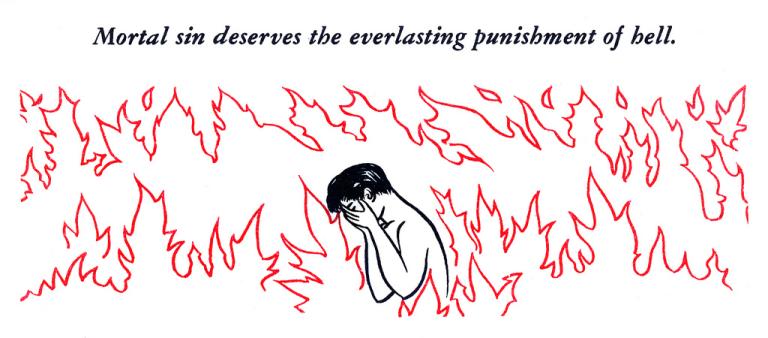
“We have foolishly conceived you to be a tyrant over human life.” –St Augustine
I’ve had a lot of trouble finding a priest who believes in the devil. They usually dismiss my fears of the man with the pitchfork and speak instead of an amorphous evil or darkness at work in the world, if they’ll acknowledge evil at all. Evil is out of style. We’re the Church of Mercy.
But a Catholicism that’s obsessed with hell had a stranglehold on the American south in the last century. Growing up even as late as the 1980s, my girlfriends and I all feared demon possession as much as we did the eternal hell fire shown in the graphic cartoons in our children’s catechism. Or maybe we all just saw The Exorcist one too many times. So many of my friends left the church as teens and adults who’d worn themselves out feeling guilty and afraid.
But I didn’t dare.
Even Flannery O’Connor, fellow southerner and the great patron saint of Catholic writers, felt as I did—she worried in her prayer journal that her fear of hell was the only thing keeping her faith.
To be fair, it wasn’t just southern Catholics who were obsessed with the devil. My dad left the Catholic Church after my mother’s death when I was 14, and he became a proof-texting, Bible wielding, Chick Tract distributing Pentecostal. But we still talked about demons more than we talked about Jesus, and about condemnation more than love.
At Thanksgiving one year, he attempted to perform an exorcism on my aunt’s dog. 
By the time I returned to the church I was afraid of the Bible. I was sure it told the terrifying story of a fallen humanity, ruled by our passions, fierce and stubborn enough to kill our own God, who rightly punishes us and rewards only those who embrace their suffering. For all my liberal-arts Catholicism, I was, deep down, an old-school pagan, convinced that God demanded blood. So I left the Bible to the Mass and buried myself instead in theology, philosophy, art and literature.
Then my life fell apart. It keeps doing that.
During a particularly dark night of the soul, I foolishly agreed to write a book of daily devotions based on the Catholic lectionary—about 400 meditations on scripture.
I’m a career spiritual writer, but I don’t read devotional books. Unfounded or not, I imagine them to be a genre of soft-focus covers, churchy, pious language and stock Christian platitudes. So even though I’ve written books and essays that might be shelved as “inspirational,” my stubborn belief in God has mostly been inspired by secular art.
But when I signed the contract for the devotional book, I was completely disenchanted with faith, and Tolkien and Terrence Malick were no longer carrying the day. When the press approached me, I thought, well, why not? It’s time I figured out for myself what that big book says. I was tired of being afraid of God, tired of believing in a deity who demanded suffering. I wanted to search the scriptures for the God of love I’ve heard so much about but couldn’t seem to find in my own life. I wanted a reason to keep believing—a better reason than fear.
As O’Connor wrote, “I don’t want to fear to be out. I want to love to be in.”
In the early stages of writing the book, I had a phone date with a friend who was raised Catholic and now goes to a Unitarian Church. She told me she still believes in God–most of the time–but she’s haunted by questions: “What if we’re wrong? What if we die and there’s nothing there?” She’s worried about lying to her children about God, spinning fictions.
“Yes, what if we’re wrong?” I said. “But what if instead of nothing, we die and we find God shaking his head in sorrow, because we spent our whole lives in terror of the one who truly loves us?”
My answer surprised me. It wasn’t something I’ve ever said or even thought.
My questions guided me as I started writing the book, searching each day’s scripture readings for the God of grace. Very quickly, I discovered how easy a task it was. I began to suspect that I’d been wrong, that the Bible was not a terrifying book of condemnations and prohibitions, but the ongoing saga of God and creation, a tale of repeated attempts to cultivate relationship with us, culminating in an act of unfathomable divine love, the incarnation and all it implies–the willingness to suffer and die like we do.
As I read the scriptures and wrote, I still wallowed at rock bottom. I’d just left behind another home I loved, which I was sure was more than I could bear after losing so many throughout my life. My young family was wounded and limping along. I felt I deserved the pain I was experiencing, and my parish priest, at one point, pretty much agreed with me. So much for the Church of Mercy.
I took my children and flew to my childhood hometown—which still bears the scars of destruction by Hurricane Katrina ten years ago—thinking it would help me to recover from a fresh round of trauma. Boy, was I wrong. All the painful memories flooded in, and I broke down.
As I cried on my dad’s sofa, my stepmother, trying to comfort me, told me to “hold onto Jesus’ cloak.” This is exactly the sort of Christian platitude—however scriptural it may be—that makes me recoil. There were too many times when I was a little girl grieving my mother that I felt as if my dad dismissed my pain with a Bible verse when he should have just held me and told me he loved me. But this time, the phrase hold onto his cloak haunted me for weeks. Why do people say stuff like this? What does it mean? How is it possible? Why does it comfort anyone at all? Why didn’t it comfort me?
I returned to the Gospel story about the woman who reaches out for Jesus’ cloak in a crowd. He doesn’t see her, but he feels power leave him and calls out, ”Who touched me?”
How afraid she must have been. And how brave. What did that woman believe in? Was she so desperate for healing that she would have tried anything, reached out to caress any old idol or image, including this man who seemed to have magical powers? Would she have just as soon sought out a witch in a hut? Why was her superstitious faith rewarded?
What Andrew Sullivan had to say about this in his book about Jesus and women really moved me. Maybe, he says, this woman’s faith was in nothing more than the possibility of grace in this world. Maybe all we have to do is yearn for its source.
So I wrote my daily devotions, full of doubt, shame, anger and sadness. As I wrote, I prayed only for the gift of that anonymous woman: I prayed to remain open to the possibility of grace, to reach out, to hold on.
Sick Pilgrim’s Dark Devotional, which we’ll launch this Friday, will be that kind of prayer. The kind that struggles to understand, often gets it wrong, but reaches out anyway for the source of all grace, and holds on.
Previous Post

January 12, 2016
It Takes All Kinds
Browse Our Archives
Select a Category Advent Approaching Mystery art Book Reviews Catholic Ghost Story Catholicism community Confession Current Events Dark Devotional Deconstruction Deconstruction Fellow Travelers I Want To Believe Interview Laudato Si Lent Mary Matthew's Letters Movie Reviews Music Reviews Our Charism Personal Essay Pilgrims Pope Francis Popular Piety Prayer Publishing Richard Beck Saints Satan Sheed and Ward Sick Pilgrim Charism Sick Pilgrim Chats Sick Pilgrim Events Sick Pilgrim Travelin' Medicine Show Sick Pilgrimage to The West Sick Pilgrims Small Joys Spiritual Autobiography Spooky Files of Ave Maria Magazine Spooky October Spooky Pilgrim Spooky Pilgrimage Strange Journey The Inklings Things Keeping Us Going Trying to Say God TV Reviews Uncategorized women in the Catholic Church Wonder Podcast Write the Vision
Select a Month February 2022 January 2022 December 2021 November 2021 October 2021 September 2021 August 2021 July 2021 June 2021 May 2021 April 2021 March 2021 February 2021 January 2021 December 2020 April 2020 March 2020 February 2020 January 2020 December 2019 October 2019 September 2019 July 2019 June 2019 May 2019 April 2019 March 2019 February 2019 January 2019 December 2018 November 2018 October 2018 September 2018 August 2018 July 2018 June 2018 May 2018 April 2018 March 2018 February 2018 January 2018 December 2017 November 2017 October 2017 September 2017 August 2017 July 2017 June 2017 May 2017 April 2017 March 2017 February 2017 January 2017 December 2016 November 2016 October 2016 September 2016 August 2016 July 2016 June 2016 May 2016 April 2016 March 2016 February 2016 January 2016 December 2015
Follow Us!
TAKE THE
Religious Wisdom Quiz
Which sea did God part for the Israelites to escape Egypt?
Select your answer to see how you score.
Sea of Galilee Jordan River Red Sea Dead Sea
Related posts from Sick Pilgrim

Dark Devotional: The Firelight of Life

Dark Devotional: Let Me Smite Him

Dark Devotional: Woe to Me, for I Have...

TRENDING AT PATHEOS Catholic

Rejecting Doom: Christian Hope And Human Action
Christianity is a religion of hope. We are to have hope and...

It’s What Comes From Within Which Matters
One of the most difficult things for us to understand is why...

Why I Choose the Eucharist Over the Sermon
Choose the Eucharist, Not the Sermon What are we supposed to get...

5 Design Elements Found in Spiritually Rooted Homes
Putting Spirituality Into Home Decor Our homes are more than our living...

Credo: A Story of God Told with the...
About 10 years ago, I began to imagine a personal "Credo" that...

The Anatomy of Divine Revelation in Catholic Thought
The claim that God has made Himself known to human beings is...
view all Catholic blogs
Ad-Free & Subscriber Log-In Subscription Support
- About Us
- 2026 Calendar
- Videos
- Podcasts
- Library of World Religions
- Faith In Media Tracker
- Advertise With Us
- Write for Us
- Privacy Policy
- Terms of Service
- Do Not Sell My Data
- Contact Us
- Radiant Digital
- Manage Newsletter Subscriptions
- Unsubscribe From Notifications
- Sitemap
Copyright 2008-2026, Patheos. All rights reserved.
Subscription Support Ad-Free & Subscriber Log-In
Follow Patheos