
BuddhistCatholicContemplativeEvangelicalGeneral ChristianHinduJewishLatter-day SaintMuslimNew VisionsProgressive Christian
Beliefs
- Buddhist
- Catholic
- Contemplative
- Evangelical
- General Christian
- Hindu
- Jewish
- Latter-day Saint
- More Voices
- Muslim
- New Visions
- Pagan
- Progressive Christian
Topics
- Religion News
- Food and Religion
- Sports and Religion
- Religious Art
- Religious Music and Entertainment
- Religious Events
- History and Religion
- Style and Religion
- Politics and Religion
- Women in Religion
- Recreation Outdoors and Religion
- Business Finance and Religion
- Careers Workplace and Religion
- Education and Religion
- Family Parenting and Religion
- Health Fitness and Religion
- Home and Religion
- Relationships and Religion
- Technology and Religion
- Travel and Religion
Columnists
- Buddhist Columnists
- Business Finance and Religion Columnists
- Careers Workplace and Religion Columnists
- Catholic Columnists
- Contemplative Columnists
- Education and Religion Columnists
- Evangelists Columnists
- Family Parenting and Religion Columnists
- General Christian Columnists
- Health Fitness and Religion Columnists
- Hindu Columnists
- History and Religion Columnists
- Home and Religion Columnists
- Jewish Columnists
- More Voices Columnists
- Latter Day Columnists
- Muslim Columnists
- New Visions Columnists
- Nonreligious Columnists
- Pagan Columnists
- Politics and Religion Columnists
- Progressive Columnists
- Recreation Outdoors and Religion Columnists
- Relationships and Religion Columnists
- Religion News Columnists
- Religious Art Columnists
- Religious Events Columnists
- Religious Music and Entertainment Columnists
- Sports and Religion Columnists
- Style and Religion Columnists
- Technology and Religion Columnists
- Travel and Religion Columnists
- Women in Religion Columnists
Resource Library
- 2026 Calendar
- Library of World Religions
- The 100 Most Holy Places on Earth
- Patheos Answers
- Podcasts
- Videos
- Faith Leaders Database
- Anglican Episcopalian
- Bahai
- Baptist
- Buddhism
- Christianity
- Confucianism
- Eastern Orthodoxy
- Hinduism
- Holiness and Pentecostal
- ISKCON
- Islam
- Judaism
- Lutheran
- Methodist
- The Church of Jesus Christ of Latter-day Saints
- New Age
- Paganism
- Presbytarian and Reformed
- Protestantism
- Religion Behind the Scenes
- Roman Catholic
- Scientology
- Shia Islam
- Sikhism
- Sufism
- Sunni Islam
- Taoism
- Zen
- See all religions
Research Tools
 Ad-Free & Subscriber Log-In Subscription Support
Ad-Free & Subscriber Log-In Subscription Support
Follow Patheos 

- Trending:
- Forgiveness
- |
- Marriage
- |
- Consciousness
- |
- Death Penalty
- |
- Election
- |
- Halloween
 Sick Pilgrim
- Home
- Catholic
- Keeping Christianity Weird: Nadia Bolz-Weber and Heather King
Keeping Christianity Weird: Nadia Bolz-Weber and Heather King
Last updated on: January 21, 2016 at 4:53 pm by Jessica Mesman Griffith
Keeping Christianity Weird: Nadia Bolz-Weber and Heather King 2016-01-21T16:53:08-05:00 Jessica Mesman Griffith
Patheos Explore the world's faith through different perspectives on religion and spirituality! Patheos has the views of the prevalent religions and spiritualities of the world.
The Washington Post described Lutheran Pastor Nadia Bolz-Weber as a “superhero from Planet Alternative Christian:”
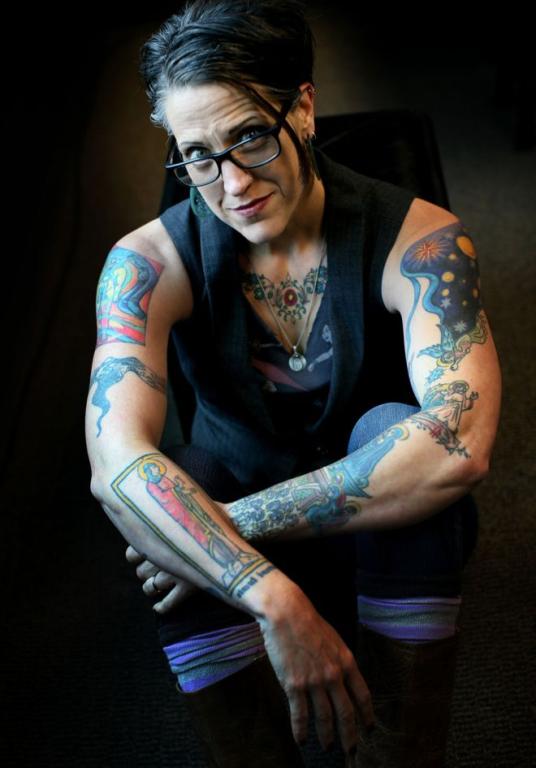
Pastor Nadia Bolz-Weber is tired of talking about her tattoos.
In her body and her theology, Bolz-Weber represents a new, muscular form of liberal Christianity, one that merges the passion and life-changing fervor of evangelicalism with the commitment to inclusiveness and social justice of mainline Protestantism. She’s a tatted-up, foul-mouthed champion to people sick of being belittled as not Christian enough for the right or too Jesus-y for the left.
Not Christian enough for the right, too Christian for the left . . . it’s the story of my life in what I like to call the radical middle. Still I was surprised to love Bolz-Weber and her books. Every time I thought she was going to annoy me with that Cool Pastor schtick she beat me to my own ridicule. She’s all too aware of how her supposed coolness has become a cliche. She’s the first to say nobody who is actually cool thinks she’s cool at all. She also knows that her desire to be cool is spiritually dangerous. When she started attracting “normal” people to her House for All Sinners and Saints in Denver, she hated them all a little bit for “fucking up her weird.” She prefers t0 minister to outcasts and freaks and junkies—to the exceptional, rather than the average. Average is not in Nadia Bolz-Weber’s comfort zone.
And yet, admitting that she pouted about regular old bourgeois white Christians fucking up her weird is exactly the sort of charming, self-deprecating, image-maintaining crack at which Bolz-Weber excels. Despite (or because of) her repeated attempts to assure us that she’s a terrible, cowardly person who hides from God and would rather be doing pretty much anything else than being his superhero, she’s damn likeable.
I like people who run from God and end up doing right in the end despite themselves, because I fear that’s the best I can do. I suspect that’s the way with most people, and it’s why Bolz-Weber’s books, including the recent Accidental Saints, are New York Times Bestsellers. Despite her petulant insistence on the exceptional, she speaks to the average and the mainstream remarkably well.
Also, she made me cry like a baby. Bolz-Weber delivered a moving performance on Fresh Air, and she received the NPR stamp of approval:
“You don’t have to be religious to get something out of this book . . . . This is a quick read that will leave you feeling better about yourself and others—for all our flawed, messy goodness.”
As chirpy and superficial and irritating as I find those two previous sentences, I don’t find Bolz-Weber to be any of those things. She’s sincere and passionate and she loves Jesus and she’s not afraid to say it, as uncool as it sounds even on her lips. And the truth is—sometimes I do just need to “feel better” about myself and this ancient faith I’m practicing, and there’s no harm in that. Bolz-Weber makes Christianity look good, feel good—and I love her for it.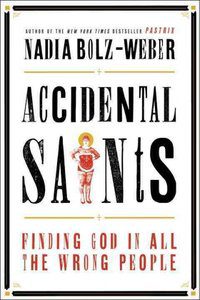
But.
There’s this persistent little voice in my head that prompts me to wonder if maybe this whole sainthood by accident thing is just a bit too easy. That voice belongs to the very Catholic Heather King, warning that love without pain and/or sacrifice is not love at all. It’s “faux love” and King finds it insulting, because it says:
” . . . you’re too delicate to face the highest truth and live it out. I don’t think you’re strong enough, or mature enough, to take in the whole picture, to hold the full tension of the suffering of the world before you; I don’t trust you to recognize that to aim for anything lower than the highest is to contribute to that suffering and, as much to the point, to deprive yourself of the highest joy. So if a kid you conceive might be ‘unwanted,’ abort him or her. If an old person strikes you as no longer serving any ‘useful purpose,’ help him or her to commit suicide . . . ’exterminate or annihilate people who are suffering or you might stand to suffer.’ Which in the end is going to be everybody . . . You can’t annihilate suffering; you can only share in it. You can only refrain from contributing to it.”
Like Bolz-Weber, King is a recovering addict with a long list of repented sins, but you’d probably walk right by her on the streets of Koreatown in L.A. She doesn’t have shirtsleeve tattoos or visible piercings—more commonplace now among Christians than a nun’s habit or clerical collar. Nothing about King’s physical appearance screams that she’s living in high contrast to her world as a kind of urban monastic. Unlike Bolz-Weber, she’d disappear in a crowd. And unlike Bolz-Weber—who in spite of her “edgy” appearance, is never truly offensive on paper-—King holds all sorts of unpopular opinions. She’s celibate (after divorce and her share of romantic heartbreak), pro-life (she confessed her abortions as sins but compares people who wear “their giant aborted fetus buttons” to “Pharisees who prayed loudly on the street corners”), critical of feminism and the ideology of the left (that “faux love” that will take any “shortcut to avoid suffering”). She won’t even wear the pink ribbon that tells the world she survived breast cancer (“to survive was no real victory, because someone else wasn’t going to”).
Pastor Nadia runs from God. When someone asked her how she draws closer to God, she responded, “why the hell would I want to do that?” Heather King scales mountains and fasts in the desert trying to meet him. Bolz-Weber fears God might require something of her she doesn’t want to give. King gives it all without being asked. Sometimes she’s too strident, but more often I find her humble and tough-minded, bracing even when I disagree. She reminds me of Dorothea Brooke in George Eliot’s Middlemarch, who longed for sainthood but was born in the wrong milieu. King’s spiritual grandeur seems somehow mismatched with her time. She’s not content to be broken and loved all the same. She wants to be holy. Which isn’t cool. But it’s fascinating.
“’Where are the courageous ones?'” King asks in her latest book, Stripped: At the Intersection of Cancer, Culture, and Christ. ‘Where are the saints, the heroes, the martyrs? Where is the real follower of Christ?’ From my bed on the couch, I gazed out over the rooftops of Koreatown. I was just beginning to realize: Oh. I’m supposed to try to be that person myself.”
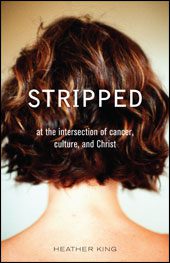
Heather King’s Stripped: It’s not just a cancer book.
Bolz-Weber is a preacher, and it shows on the page. The chapters of Accidental Saints are magnificent sermons, honed in the pulpit and on the stage, not a word out of place. King, on the other hand, is a writer and a consummate essayist-—discovering what she thinks on the page. Her ideas may not go down as smooth as Pastor Nadia’s, but her prose and her storytelling are always impeccable, and Stripped is a literary memoir of the highest quality. It’s not a cancer book, really, though the story of being diagnosed with breast cancer, challenging the wisdom of the medical establishment, and surviving her illness offers a kind of scaffolding for King to test her ideas about suffering and love. She writes with an impressive command of the secular literature of suffering. She loves Kafka and Antonin Artaud and Whitman and Simone Weil but dispenses with intellectual giant Susan Sontag, hilariously, as a “big, humorless crab,” all while turning over and over “the bizarre way that the world is so often redeemed not through health and wholeness but through sickness and violence and insanity.”
But to be content with one’s brokenness isn’t King’s way. She asks elsewhere, “who can parse out which part of our wound is killing us and which part of our wound is keeping us alive?”
King’s illness takes her to a spiritual peak, if only because she has little else to do: “Like one of the wise virgins in the parable of the wise and foolish virgins (Matthew 25:1-13), my lamp was more or less in oil.” She entered a contemplative state in which she “‘saw Christ all the time: in myself, in the poor and rich, in my friends.” Describing the strange ecstasy of her state of affliction, she writes she’d “never felt so alone,” and yet she’d “never felt so close to the beating heart of the rest of the world.” It comes to her, “with a pang,” that this is joy. King writes in this grand language of Catholic mysticism right alongside her jokes about her past promiscuity and binge drinking. And in the end, she winds her very different path to the same Gospel truths as Pastor Nadia, expressed in a new version of the beatitudes:
“Blessed are the poor in spirit; the out-of-step, the unhappy in marriage, the mistake makers, the frightened, the sick, the uncertain, the lonely, the yearning, the oppressed. Because only the poor in spirit know the incalculable value, the infinite preciousness, of a fellow human hand.”
But it’s King’s suffering and asceticism that give her the eyes to see Christ exactly where she thought he couldn’t be—”the boring homily, the screaming kids, the sexual obsession, the doubt, the fear; that’s where he most was.” Seeing him there, she desires holiness not for her own pious satisfaction, but for the protection of those she is learning to love.
Next Post

January 26, 2016 Sick Pilgrims: Jack Kerouac
Browse Our Archives
Select a Category Advent Approaching Mystery art Book Reviews Catholic Ghost Story Catholicism community Confession Current Events Dark Devotional Deconstruction Deconstruction Fellow Travelers I Want To Believe Interview Laudato Si Lent Mary Matthew's Letters Movie Reviews Music Reviews Our Charism Personal Essay Pilgrims Pope Francis Popular Piety Prayer Publishing Richard Beck Saints Satan Sheed and Ward Sick Pilgrim Charism Sick Pilgrim Chats Sick Pilgrim Events Sick Pilgrim Travelin' Medicine Show Sick Pilgrimage to The West Sick Pilgrims Small Joys Spiritual Autobiography Spooky Files of Ave Maria Magazine Spooky October Spooky Pilgrim Spooky Pilgrimage Strange Journey The Inklings Things Keeping Us Going Trying to Say God TV Reviews Uncategorized women in the Catholic Church Wonder Podcast Write the Vision
Select a Month February 2022 January 2022 December 2021 November 2021 October 2021 September 2021 August 2021 July 2021 June 2021 May 2021 April 2021 March 2021 February 2021 January 2021 December 2020 April 2020 March 2020 February 2020 January 2020 December 2019 October 2019 September 2019 July 2019 June 2019 May 2019 April 2019 March 2019 February 2019 January 2019 December 2018 November 2018 October 2018 September 2018 August 2018 July 2018 June 2018 May 2018 April 2018 March 2018 February 2018 January 2018 December 2017 November 2017 October 2017 September 2017 August 2017 July 2017 June 2017 May 2017 April 2017 March 2017 February 2017 January 2017 December 2016 November 2016 October 2016 September 2016 August 2016 July 2016 June 2016 May 2016 April 2016 March 2016 February 2016 January 2016 December 2015
Follow Us!
TAKE THE
Religious Wisdom Quiz
Who baptized Jesus?
Select your answer to see how you score.
Elijah Paul Peter John the Baptist
Related posts from Sick Pilgrim
Things Keeping Us Going: All Saints Edition

Dark Devotional: Mind Your Own Distractions
Dark Devotional: He Who Comes to Me Will...

TRENDING AT PATHEOS Catholic

Rejecting Doom: Christian Hope And Human Action
Christianity is a religion of hope. We are to have hope and...

It’s What Comes From Within Which Matters
One of the most difficult things for us to understand is why...

Why I Choose the Eucharist Over the Sermon
Choose the Eucharist, Not the Sermon What are we supposed to get...

5 Design Elements Found in Spiritually Rooted Homes
Putting Spirituality Into Home Decor Our homes are more than our living...

Credo: A Story of God Told with the...
About 10 years ago, I began to imagine a personal "Credo" that...

The Anatomy of Divine Revelation in Catholic Thought
The claim that God has made Himself known to human beings is...
view all Catholic blogs
Ad-Free & Subscriber Log-In Subscription Support
- About Us
- 2026 Calendar
- Videos
- Podcasts
- Library of World Religions
- Faith In Media Tracker
- Advertise With Us
- Write for Us
- Privacy Policy
- Terms of Service
- Do Not Sell My Data
- Contact Us
- Radiant Digital
- Manage Newsletter Subscriptions
- Unsubscribe From Notifications
- Sitemap
Copyright 2008-2026, Patheos. All rights reserved.
Subscription Support Ad-Free & Subscriber Log-In
Follow Patheos