
BuddhistCatholicContemplativeEvangelicalGeneral ChristianHinduJewishLatter-day SaintMuslimNew VisionsProgressive Christian
Beliefs
- Buddhist
- Catholic
- Contemplative
- Evangelical
- General Christian
- Hindu
- Jewish
- Latter-day Saint
- More Voices
- Muslim
- New Visions
- Pagan
- Progressive Christian
Topics
- Religion News
- Food and Religion
- Sports and Religion
- Religious Art
- Religious Music and Entertainment
- Religious Events
- History and Religion
- Style and Religion
- Politics and Religion
- Women in Religion
- Recreation Outdoors and Religion
- Business Finance and Religion
- Careers Workplace and Religion
- Education and Religion
- Family Parenting and Religion
- Health Fitness and Religion
- Home and Religion
- Relationships and Religion
- Technology and Religion
- Travel and Religion
Columnists
- Buddhist Columnists
- Business Finance and Religion Columnists
- Careers Workplace and Religion Columnists
- Catholic Columnists
- Contemplative Columnists
- Education and Religion Columnists
- Evangelists Columnists
- Family Parenting and Religion Columnists
- General Christian Columnists
- Health Fitness and Religion Columnists
- Hindu Columnists
- History and Religion Columnists
- Home and Religion Columnists
- Jewish Columnists
- More Voices Columnists
- Latter Day Columnists
- Muslim Columnists
- New Visions Columnists
- Nonreligious Columnists
- Pagan Columnists
- Politics and Religion Columnists
- Progressive Columnists
- Recreation Outdoors and Religion Columnists
- Relationships and Religion Columnists
- Religion News Columnists
- Religious Art Columnists
- Religious Events Columnists
- Religious Music and Entertainment Columnists
- Sports and Religion Columnists
- Style and Religion Columnists
- Technology and Religion Columnists
- Travel and Religion Columnists
- Women in Religion Columnists
Resource Library
- 2026 Calendar
- Library of World Religions
- The 100 Most Holy Places on Earth
- Patheos Answers
- Podcasts
- Videos
- Faith Leaders Database
- Anglican Episcopalian
- Bahai
- Baptist
- Buddhism
- Christianity
- Confucianism
- Eastern Orthodoxy
- Hinduism
- Holiness and Pentecostal
- ISKCON
- Islam
- Judaism
- Lutheran
- Methodist
- The Church of Jesus Christ of Latter-day Saints
- New Age
- Paganism
- Presbytarian and Reformed
- Protestantism
- Religion Behind the Scenes
- Roman Catholic
- Scientology
- Shia Islam
- Sikhism
- Sufism
- Sunni Islam
- Taoism
- Zen
- See all religions
Research Tools
 Ad-Free & Subscriber Log-In Subscription Support
Ad-Free & Subscriber Log-In Subscription Support
Follow Patheos 

- Trending:
- Forgiveness
- |
- Marriage
- |
- Consciousness
- |
- Death Penalty
- |
- Election
- |
- Halloween
 Shekhinah Calling
-
Archive Index
- Home
- Pagan
- A Witch in Iceland (Part 2: Earth)
A Witch in Iceland (Part 2: Earth)
Last updated on: June 11, 2016 at 8:35 pm by Asa West
A Witch in Iceland (Part 2: Earth) 2016-06-11T20:35:12-08:00 Asa West
Patheos Explore the world's faith through different perspectives on religion and spirituality! Patheos has the views of the prevalent religions and spiritualities of the world.
Last week, I attended a conference in Reykjavik for my job, and my husband and I were able to see some of the country. I’m not a travel writer, but this series is an effort at sorting through the thoughts I have about the wonderful things I saw (and not-so-wonderful things that happened during the trip). Click here for part 1: Water.
Part 2: Earth
Before I left, I prepared by reading up on Icelandic lore. I read Snorri Sturluson’s Prose Edda (I’d read the Poetic Edda a few years before) and a book of Icelandic folktales called Hildur, Queen of the Elves by J.M. Bedell. On our second day in the country, when my husband and I rented a car to see the Golden Circle, I told him some of the stories I’d read in the book. One of my favorites, “Búkolla,” is about a she-troll who steals a family’s cow. When the son of the family steals the cow back, the troll chases them and the cow tells the son to put a hair from her tail on the ground. It grows into a river, but the troll has her bull drink it up. The boy sets down another hair, which grows into an inferno, but the bull puts it out with all the pee he’s stored up from drinking the river. Finally, the boy puts down a hair that grows into a mountain, and the troll tries to drill through it, but she gets stuck halfway in the hole. When the sun rises, she turns to stone. During our travels in the countryside, I saw a mountain with a humanoid rock formation sticking out of it.
One of the best ways, I think, to understand a culture’s mythology is to engage with its landscapes. Of all the characters that inhabit Icelandic folklore, the Huldufólk (Hidden People) are the most prominent, living within the hills. In multiple stories, voices can be heard if one puts their ear to the ground.
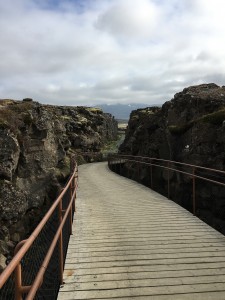
The tectonic plates. Photo by Asa West, CC Attribution ShareAlike.
Our first stop on the Golden Circle was Þingvellir, where Icelandic chieftains held their annual parliament and the North American and Eurasian tectonic plates meet. Walking between the continental plates is a heady experience in itself, but what really took my breath away was when I happened to thump my hand on the ground. The thump was resonant. The ground sounded hollow. And just like that, the stories of the Huldufólk made perfect sense.
Of course, it was hard to feel their presence when I was surrounded by other tourists, as I talked about in my last post. But the next day we went to Þórsmörk.
Þórsmörk, or “Thor’s Forest,” is a remote nature preserve accessible only by 4-wheel-drive busses that can ford rivers. It’s surrounded by a gravelly plain threaded with rivulets, and fording them was terrifying; each time the bus went through a rivulet, it rocked from side to side and I thought that it would tip over and crush me. Within the preserve, though, there’s a peaceful low birch wood surrounding Valahnúkur mountain. There are still tourists there, of course, but few enough that the trails aren’t too crowded.
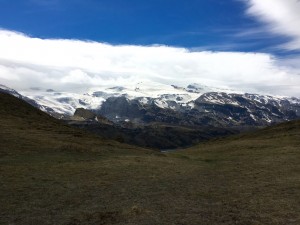
The hollow hill. Photo by Asa West, CC Attribution ShareAlike.
When we were about halfway up Valahnúkur, we came upon a broad hilltop covered in short grass, with the glacier Eyjafjallajökull beyond. The landscape was silent except for the occasional birdcall, and I sat down on the hill to find that it, like the trail between the plates, sounded hollow. I lay down on the earth and sent respect and good wishes to the Huldufólk inside. It felt viscerally good to lie on the earth and listen to the silence. I didn’t want to leave. When we got a little higher, I looked back down at the hill and saw that it was indeed hollow on the north side, carved out by erosion patterns that looked like windows and doors. At the bottom of the mountain we saw the Alfakirkja, or Elf Church: a hollow rock formation with what looked like spires at the top.
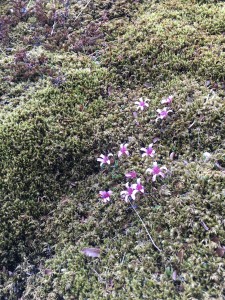
Flowers on Valahnúkur. Photo by Asa West, CC Attribution ShareAlike.
It was a 7-hour round trip from Reykjavik to Þórsmörk, which meant that we spent twice as much time traveling as we did at the site. But I’d do it again in a heartbeat, even with the terror of fording those rivers. I felt like a humble guest in Thor’s forest, a sanctuary he’d set aside for himself and protected with rivers.
***
As a knitter, I arrived in Reykjavik ready to do some serious yarn shopping.
As luck would have it, we arrived right within the few weeks during which southern Iceland is crawling with sheep and baby lambs, so we saw hundreds of lambs around the countryside. (We also saw lamb stew for sale in every restaurant, but I’m trying not to dwell too much on that.) Because of its healthy supply of wool, yarn is the one thing in Iceland that doesn’t cost a bajillion dollars. In fact, it’s about 5 times cheaper than comparable wool in the US. In Reykjavik, I went to the Handknitting Association yarn shop and Storkunnin, and came home with a huge bag full and wondered if I should have bought even more. The Handknitting Association was packed with people–mostly women–from Iceland and abroad all buying Iceland’s iconic Lopi yarn, and it was pleasant to find myself among kindred spirits when I was so far from home. Before leaving home, I’d printed out the specs for my next lace project, and I bought some lovely blue einband yarn for it, along with other varieties of Lopi for smaller projects: a scarf for my daughter and a couple of hats or pairs of mitts for myself.

Lopi yarn at Storkunnin. Photo by Asa West, CC Attribution ShareAlike.
This knitting blog has excellent descriptions of Icelandic wool and knitting traditions, so I won’t attempt to replicate it here. Instead, I’ll say that nothing makes me feel connected to my ancestors quite like knitting does. I feel that connection when my fingers are moving swiftly and comfortably, adding row upon row to a project; I feel it when I watch the YouTube tutorials that women have created for tricky or obscure techniques. I feel it when I do Fair Isle colorwork or Estonian lace. I feel it when a project is finished, lying stretched and blocked on the floor. When I knit with natural fibers, I feel a connection to the grass that fed the sheep that was shorn, the people who cleaned and carded and spun and dyed the wool, the designer who created the pattern I’m using. I feel a connection with the descendants who will inherit the lace shawls that I’ve made. When I knit, or lie on hills, or walk between the plates that are the skin of the earth, I feel something much deeper and more ancient than the gods we’ve named–even as I feel the presence of those gods.
Next in this series: Fire, with sulfur, volcanoes, and news of a shooting at my campus back home.
Click here to follow Asa West on Facebook, and click here to book a tarot reading!
Previous Post
June 8, 2016
A Witch in Iceland (Part 1: Water)
Browse Our Archives
Select a Category Anu Aphrodite Book reviews Books Buddhism Daily practice Deity Depression Divination Feminism Goddess Holidays Judaism Justice Magic Mental Health Morrigan Morrigan Hymns Nature Politics Pop culture Priestessing Race Reclaiming Tradition Sabbats Shekhinah Tikkun Olam Travel Uncategorized Witchcraft
Select a Month June 2016 May 2016 April 2016 March 2016 February 2016 January 2016 December 2015 November 2015 October 2015 September 2015 August 2015 July 2015 June 2015 May 2015 March 2015 February 2015 January 2015 December 2014 November 2014 October 2014 September 2014 August 2014 July 2014 June 2014 May 2014 April 2014 March 2014 February 2014 January 2014
Follow Us!
TAKE THE
Religious Wisdom Quiz
What does "Zion" (as in Mount Zion) mean?
Select your answer to see how you score.
River Fortress Light Spirit
Related posts from Shekhinah Calling
A Witch in Iceland (Part 1: Water)
A New Queer Jewitch Tarot Deck: The Hidden...
"Just Let Me Label You So We Can...
Together We Form the Bodies of the Gods
TRENDING AT PATHEOS Pagan

I was recently chatting with someone on Instagram. She asked me what...

While there are many people who share their results, the end of...

On July 23, I saw Christopher Nolan's The Odyssey which is Homer’s...

As I write this two big events have just finished up. One...

Restoring the Watershed of Divine Love
Perhaps cooperation is not something we manufacture through legislation, ideology, or moral...

Many UUs don’t pray because of bad experiences in a previous religion,...
view all Pagan blogs
Ad-Free & Subscriber Log-In Subscription Support
- About Us
- 2026 Calendar
- Videos
- Podcasts
- Library of World Religions
- Faith In Media Tracker
- Advertise With Us
- Write for Us
- Privacy Policy
- Terms of Service
- Do Not Sell My Data
- Contact Us
- Radiant Digital
- Manage Newsletter Subscriptions
- Unsubscribe From Notifications
- Sitemap
Copyright 2008-2026, Patheos. All rights reserved.
Subscription Support Ad-Free & Subscriber Log-In
Follow Patheos